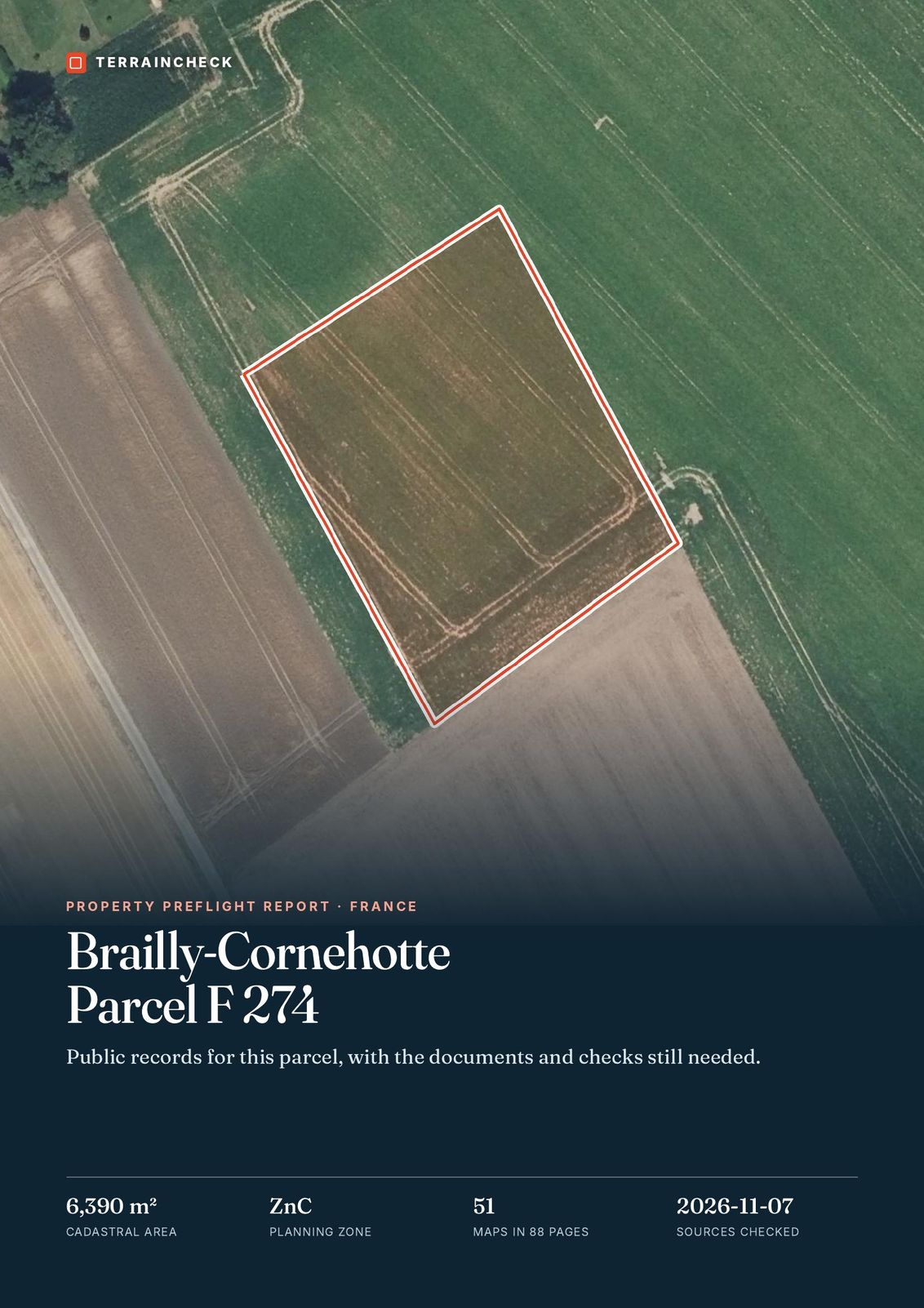
Pillar: Buying building land in France
Notary fees when buying land in France: 2026 rates by département, the fee scale and worked examples
On a plot bought for €40,000 with no VAT on the sale, expect about €3,364 where the département (French county) charges 5.00% (first homes aside) and about €3,160 at 4.50%: transfer duties, a land-registry contribution and the regulated fee of the notaire, the public legal officer who draws up the deed, with formalities and disbursements on top (our calculation, mainland France outside Alsace-Moselle). First question for the seller: is the sale subject to VAT?
In brief
- Transfer duties: a departmental tax (5.00% in 89 of the 101 départements on 1 June 2026, 4.50% in 11, 3.80% in Indre), a 1.20% tax for the commune (the municipality) and a collection charge of 2.37% of the departmental tax.
- Contribution de sécurité immobilière, a land-registry charge: 0.10% of the price, minimum €15 (in Alsace-Moselle the deed goes to a separate register, the Livre foncier). Notaire’s fee: a national scale from 3.870% down to 0.799% by price band, plus 20% VAT. Formalities and disbursements: depend on the file.
- Building land sold by a seller acting as a taxable person for VAT (assujetti), with VAT (TVA) on the full price: departmental tax of 0.70%, no communal tax. VAT on the seller’s margin, or a seller not acting as a taxable person: the ordinary rate.
- The 5.00% rate covers deeds signed from 1 April 2025 to 31 March 2028. The law rules it out where the property is a first home intended as the buyer’s main residence; for bare land bought to build on, the official tax guidance does not say whether that exception applies: ask the notaire which rate will be used.
On this page
What the notaire’s bill is made of
In mainland France outside Alsace-Moselle, the costs of buying land fall under four headings: transfer duties, the contribution de sécurité immobilière, the notaire’s fee, and formalities and disbursements. The buyer pays them (Civil Code, article 1593).
| Item | Rate or scale |
|---|---|
| Departmental tax (taxe de publicité foncière or droit d’enregistrement) | 3.80%, which each département may set between 1.20% and 4.50%; up to 5% for deeds signed from 1 April 2025 to 31 March 2028 |
| Communal surtax | 1.20%, for the commune (more than 5,000 inhabitants, or a classified tourist resort) or, elsewhere, for a departmental equalisation fund |
| Collection charge for the State (frais d’assiette et de recouvrement) | 2.37% of the departmental tax (2.14% when that tax is charged at 0.70%) |
| Contribution de sécurité immobilière, for the State | 0.10% of the price, minimum €15 per deed |
| Notaire’s fee (émoluments) | Scale by price band, plus 20% VAT |
| Formalities and disbursements (débours) | Depend on the file |
Texts in force on 12 November 2026. Sources: Tax Code (CGI), art. 1594 D; Finance Act for 2025, art. 116; CGI, art. 1584; CGI, art. 1595 bis; CGI, art. 1647; CGI, art. 881 K; CGI, art. 881 M; Commercial Code, art. A444-91. Accessed 12 November 2026.
Alsace-Moselle and overseas. In Bas-Rhin, Haut-Rhin and Moselle, duties are charged at the voted rates, but deeds go to the Livre foncier, a separate register run under the Ministry of Justice, instead of the land registration office (service de la publicité foncière): ask the notaire for the statement that applies there. In the overseas départements the notaire’s fee carries a surcharge (from 20% in French Guiana to 36% in La Réunion and Mayotte); our examples do not apply there.
Sources: Civil Code, art. 1593; BOFiP: sales of property, ordinary regime; Commercial Code, art. A444-53. Accessed 12 November 2026.
Which duty regime applies to your plot
For VAT, building land (terrain à bâtir) is land on which construction may be authorised under the planning documents, such as the local plan (PLU); what the buyer intends to do with it does not count. To find out which category your plot is in, see how to check whether land is buildable. VAT applies when the seller sells as a taxable person acting as such (assujetti agissant en tant que tel): ask whether this particular sale is subject to VAT, and on what basis.
| Sale | Departmental tax | Communal tax |
|---|---|---|
| Land that is not building land for tax purposes | Ordinary rate | 1.20% |
| Building land, seller not acting as a taxable person for VAT | Ordinary rate | 1.20% |
| Building land, seller acting as a taxable person, VAT on the margin | Ordinary rate | 1.20% |
| Building land, seller acting as a taxable person, VAT on the full price | 0.70% (about 0.715% of the price with the 2.14% collection charge) | Not charged |
The reduced rate requires the VAT to be paid, or proof that it has been accounted for. Rural property: see below. Sources: BOFiP: building land, reduced rate; CGI, art. 1594 F quinquies; CGI, art. 1647. Accessed 12 November 2026.
Under the official tax guidance (BOFiP), VAT is charged on the margin only if it is established that the seller’s own purchase gave no right to deduct VAT and the land is resold under the same classification. If the deed states separately the VAT due by the seller, duties are calculated on the price net of VAT; if not, on the price including VAT.
Some rural property also qualifies for 0.70%, under conditions (D and E of article 1594 F quinquies of the Tax Code) that the notaire checks. See also farmland prices per hectare.
Sources: BOFiP: definition of building land; BOFiP: VAT on the margin; BOFiP: amount on which duties are charged; CGI, art. 1594-0 G. Accessed 12 November 2026.
Rates by département on 1 June 2026
The latest table of rates voted by the départements, published by the tax administration (DGFiP) and online on 12 November 2026, is dated 1 June 2026. Where a département has raised its rate, the table shows both the rate “hors primo-accédant”, which applies to everyone except qualifying first-home buyers, and the rate voted under article 1594 D of the Tax Code.
With the communal tax and the collection charge, the levy comes to about 6.32% of the price at 5.00%, 5.81% at 4.50% and 5.09% at 3.80% (our calculation).
The table can change: decisions notified between 16 April and 30 November 2026 apply to deeds signed from 1 January 2027. If the preliminary contract (compromis) is signed before a change of rate, the date that counts is that of the final deed (acte authentique). From 1 April 2028 the rate goes back to that of 31 January 2025.
First home: the exception and bare land
The increase above 4.50% does not apply where the property is a first home for the buyer (première propriété) and is intended as their main residence: the rate voted under article 1594 D then applies, which is 4.50% in the départements that moved to 5.00%. This covers a person who has not owned their main residence during the two years before the purchase (article L. 31-10-3 of the Construction and Housing Code), with no income test.
The guidance covers joint purchases and the waivers (disability, disaster), and defines a main residence as the dwelling where the buyer habitually and actually lives. It does not deal with bare land bought in order to build a main residence: ask the notaire to state in writing which rate will be used. In Savoie the table shows a reduced rate of 4.00% for first homes, with an undertaking to use the property as a main residence for at least five years (article 1594 F septies of the Tax Code).
Sources: BOFiP: sales of property, ordinary regime; Finance Act for 2025, art. 116; CGI, art. 1594 F septies. Accessed 12 November 2026.
The notaire’s fee: the official scale
Article A444-91 of the Commercial Code sets the notaire’s fee for a sale, band by band on the price; the amount is the same whichever notaire you choose.
| Price band | Rate | Plot at €40,000 | Plot at €120,000 |
|---|---|---|---|
| €0 to €6,500 | 3.870% | €251.55 | €251.55 |
| €6,500 to €17,000 | 1.596% | €167.58 | €167.58 |
| €17,000 to €60,000 | 1.064% | €244.72 | €457.52 |
| Over €60,000 | 0.799% | not reached | €479.40 |
| Fee before VAT | €663.85 | €1,356.05 | |
| VAT on the fee | 20% | €132.77 | €271.21 |
| Fee including VAT | €796.62 | €1,627.26 |
Scale in force on 12 November 2026, applied to two prices (our calculation). Mainland France. Sources: Commercial Code, art. A444-91; Service-Public: notaire’s fees. Accessed 12 November 2026.
For a cheap plot, the notaire’s fees for the transfer (deed and formalities) are capped at 10% of the plot’s value, though the cap is never below €90. It applies before VAT: for a €1,500 plot, at most €150, i.e. €180 with VAT; for €600, €90, i.e. €108 with VAT. Duties and the contribution de sécurité immobilière come on top.
A discount is allowed, at a fixed rate that is the same for every client, up to 20% of the part of the fee calculated on the bands of the price at or above €100,000.
Sources: Commercial Code, art. A444-175; Commercial Code, art. A444-174; Commercial Code, art. L444-2. Accessed 12 November 2026.
Worked examples: €40,000 and €120,000
Take a plot bought without VAT, with no first-home exception, in the Somme (5.00%) and then in the Oise (4.50%). Each tax is rounded to the nearest euro (article 1724 of the Tax Code).
| Cost item | €40,000, Somme (5.00%) | €40,000, Oise (4.50%) | €120,000, Somme (5.00%) | €120,000, Oise (4.50%) |
|---|---|---|---|---|
| Departmental tax | €2,000 | €1,800 | €6,000 | €5,400 |
| Communal tax (1.20%) | €480 | €480 | €1,440 | €1,440 |
| Collection charge (2.37% of the departmental tax) | €47 | €43 | €142 | €128 |
| Contribution de sécurité immobilière (0.10%) | €40 | €40 | €120 | €120 |
| Notaire’s fee incl. VAT (previous table) | €796.62 | €796.62 | €1,627.26 | €1,627.26 |
| Total | about €3,364 | about €3,160 | about €9,329 | about €8,715 |
Cost breakdown, item by item (our calculation), before formalities and disbursements. Sources: DGFiP: rates on 1 June 2026 (PDF); CGI, art. 1584; CGI, art. 1647; CGI, art. 1724; CGI, art. 881 K; Commercial Code, art. A444-91. Accessed 12 November 2026.
With VAT on the full price, for building land at €100,000 net of VAT and the VAT stated separately in the deed: 100,000 × 0.70% = €700, plus 700 × 2.14% = €15 of collection charge, so €715 of duties, against 5,000 + 1,200 + 119 = €6,319 at the ordinary 5.00% rate. The contribution de sécurité immobilière and the notaire’s fee are added in both cases.
Getting the exact figure: three steps
- Get the VAT regime in writing. Where: the seller or the estate agent. Ask whether the sale is subject to VAT, on the full price or on the margin, and whether VAT will be stated separately in the deed. Cost: none. When: before the preliminary contract.
- Look up the rate and estimate. Where: on impots.gouv.fr, page Droits d’enregistrement (in French), latest table (PDF). Then redo the calculation above, or use the simulator on Service-Public’s Frais de notaire page. Cost: none. Time: a few minutes.
- Ask the notaire for a detailed written quote (devis) or a forecast statement of costs: the notaire is the one who puts a figure on formalities and disbursements. How long: depends on the office.
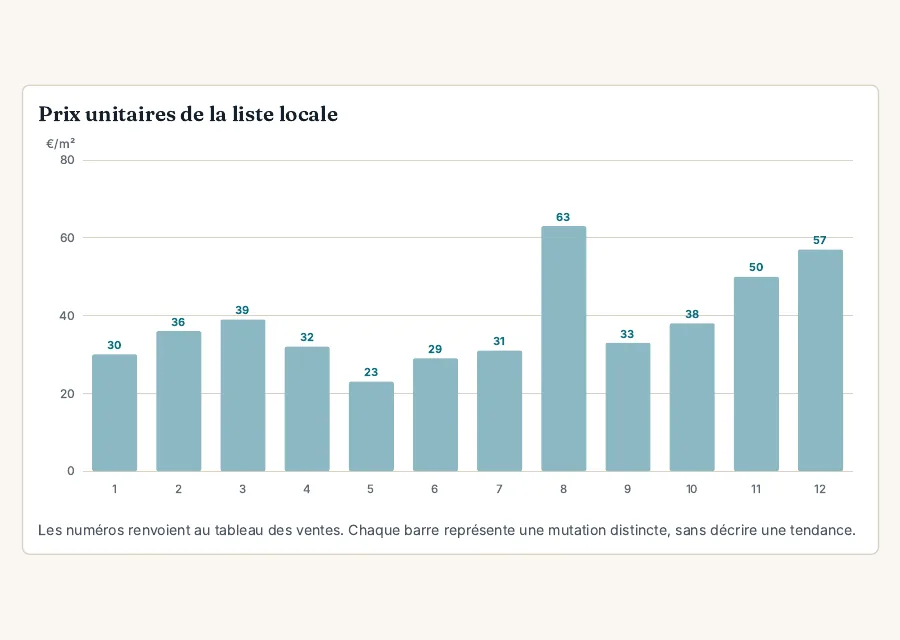
In the report: recorded land sales around the parcel
Before you sign the preliminary contract
- VAT regime written into the contract: no VAT, VAT on the margin or VAT on the full price.
- Rate of the département read in the latest DGFiP table, for the planned date of the final deed.
- First home and main residence: rate confirmed in writing by the notaire.
- The notaire’s detailed quote: duties, contribution de sécurité immobilière, fee, formalities, disbursements.
Common questions
Are notaire’s fees the same for building land, farmland and non-buildable land in France?
The fee scale and the contribution de sécurité immobilière are the same. Transfer duties follow the ordinary rate of the département, except for building land sold by a taxable person for VAT acting as such, with VAT on the full price (0.70%, no communal tax) and, subject to conditions, for some rural property (article 1594 F quinquies of the Tax Code).
Does the 5% rate apply to a first-time buyer?
For bare land, the texts we consulted do not settle it. The law rules out the increase for a first home (no main residence owned in the past two years) intended as a main residence; the official guidance defines a main residence as a dwelling and does not deal with land bought to build on. Ask the notaire for the rate in writing.
Can the notaire’s fee be negotiated?
The scale is regulated, but a discount is allowed up to 20% of the part of the fee calculated on the bands of the price at or above €100,000, at a fixed rate that is the same for every client.
Keep reading
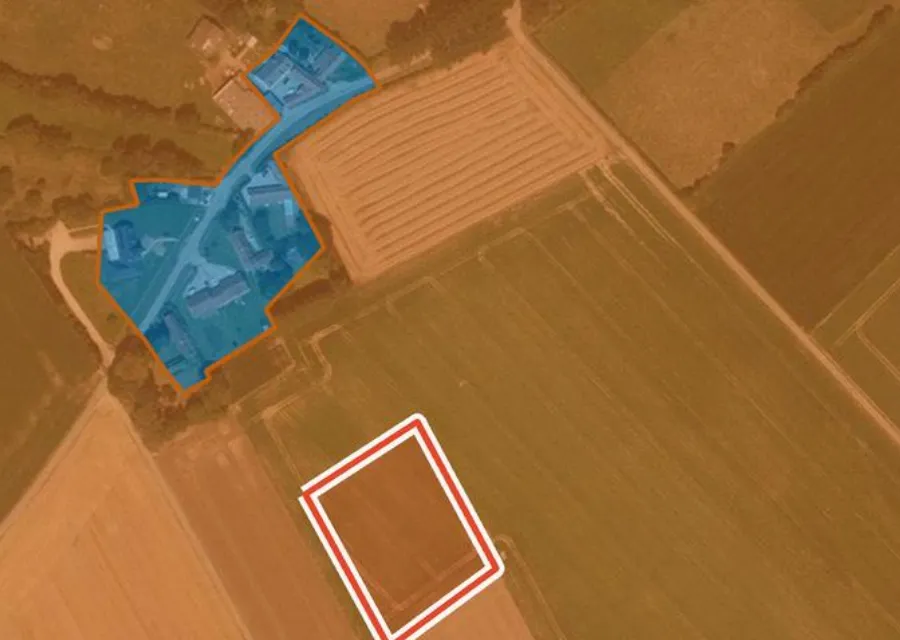
Before you set your budget, check the plot itself
Pick the parcel on the map. The report brings together its planning zone, natural hazards, dimensions and the land sales recorded around it, each with its source and date, explained in English. It does not calculate the notaire’s fees. Free preview, PDF report for €29 (€39 in French and English).