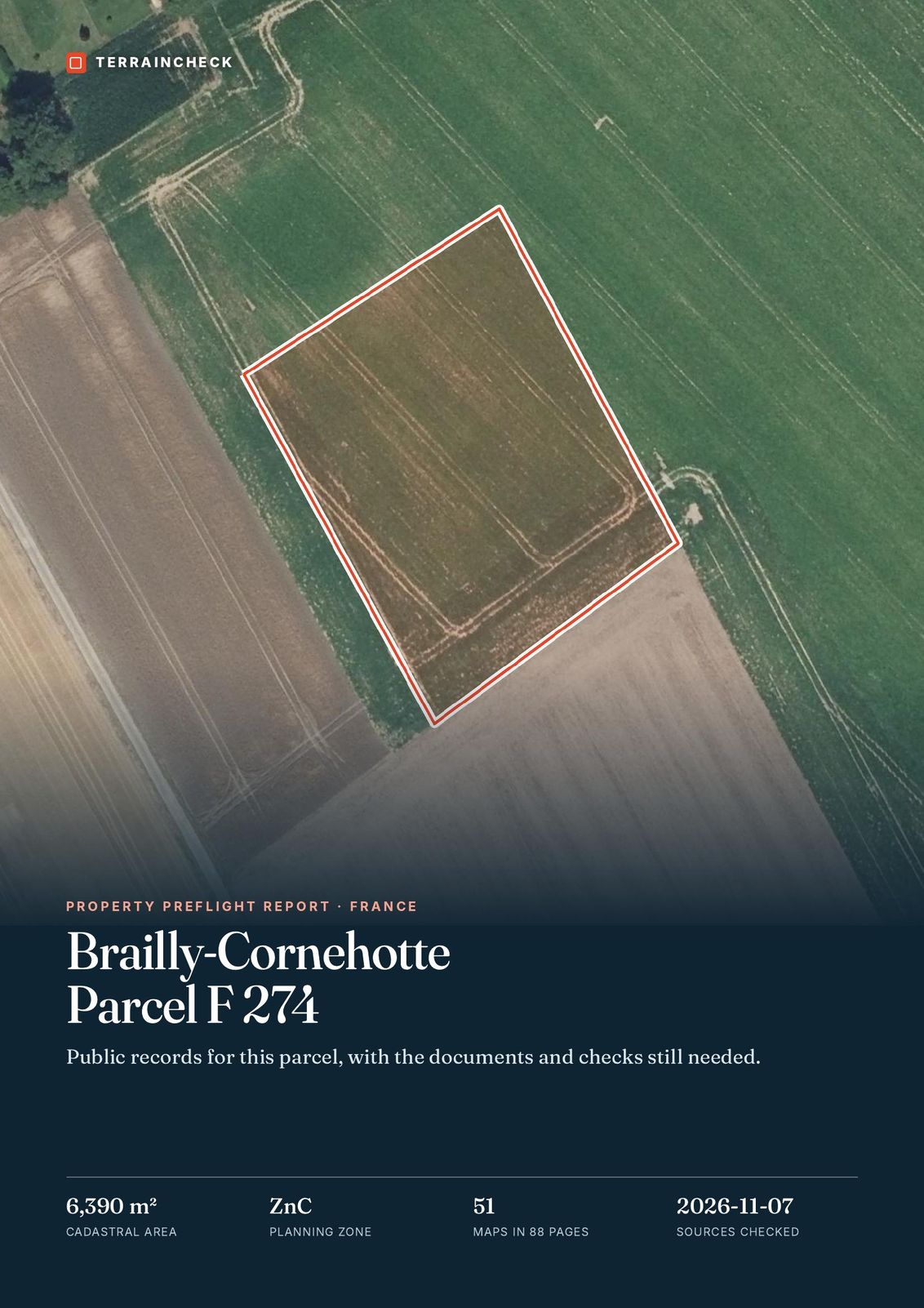
Pillar: Buying building land in France
Is a plot buildable in France? How to check the zone, utilities, easements and the official answer
A French plot is buildable for your project if three things hold together: the planning document allows it (a zone of the PLU, the local plan; a sector of a carte communale, a simpler local map; or, with no plan, a built-up part of the commune), utilities and access can serve it, and no easement or hazard rules it out. The written answer is the operational planning certificate: free, 2 months from the mairie (town hall), valid 18 months.
In brief
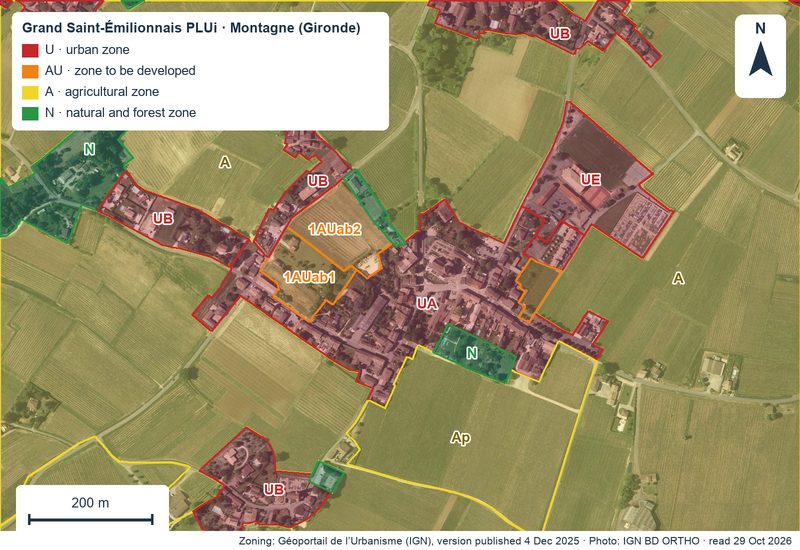
- First check, ten minutes: on the Géoportail de l’urbanisme (national planning portal, in French), type the address and click the parcel to see which plan applies and its zone: a PLU (plan local d’urbanisme, the local plan with zones and written rules) or a carte communale (a simpler map that only separates the sectors where building is allowed from the rest). The portal is for information only: the documents held at the mairie (town hall), the intercommunal body or the prefecture are what count.
- The zone is not enough. For an AU zone (“to be urbanised”), article R151-20 sets out two cases, detailed below: building is allowed, on conditions, where the roads and utilities at the zone’s immediate edge have enough capacity; where that capacity is lacking, opening the zone depends on a modification or revision of the PLU.
- Where a commune (municipality) has neither a PLU nor a carte communale, the national rules (RNU) allow building as a rule only in its built-up parts (art. L111-3), with the exceptions of article L111-4, each with its own conditions.
- The written answer is the operational planning certificate (certificat d’urbanisme opérationnel): free, and anyone with an interest, a prospective buyer included, may apply at the mairie. Answer within 2 months. If the permit is applied for within 18 months, the planning rules and taxes as they stood on the certificate date cannot be called into question, except provisions that protect public safety or public health (art. L410-1). The certificate is not a permit.
On this page
Buildable: three conditions that must all hold
A plot is buildable for a given project if the planning document allows it there, if utilities and access can serve it, and if no easement or hazard rules it out. The cadastral map answers none of these questions: it identifies the parcel and nothing more.
An advert that calls the land a “building plot” does not commit the commune. Whether an isolated plot can be built on depends on where it sits in the commune, and the operational planning certificate is the written answer on whether your particular project can go ahead on it.
Steps 1 and 2: the document and the zone
There are three regimes, and their exceptions must not be mixed up: a PLU’s exceptions are written in its own rules, those of the carte communale and of the national rules in the Planning Code. The Géoportail shows the document in force; if a commune has none online, that does not mean it has no plan.
| Document | Where to read it | Rule for a new house | Exceptions: examples only, the article decides |
|---|---|---|---|
| PLU or PLUi (local or intercommunal plan) | Géoportail de l’urbanisme, mairie or intercommunal body | By zone: U, the zone rules; AU, depending on which of the two cases of article R151-20 applies (see below the table); an A (farming) zone is not buildable as a rule; in A and N (natural) zones, only what the zone rules allow. | Those the zone rules provide for. In an A or N zone the rules may also, as an exception, mark out a STECAL (small sector of limited size and capacity) where buildings are allowed (L151-13). |
| Carte communale (simpler local plan) | Géoportail de l’urbanisme, mairie | Building allowed in the sectors set aside for it; not admitted elsewhere, save exceptions (L161-4). | Outside building sectors, article L161-4 allows exceptions only. Examples: adapting, changing the use of, restoring or extending existing buildings, and putting up annexes close to an existing building (1°); buildings and installations needed for public facilities or for farming or forestry (2°), provided among other things that they are not incompatible with farming, grazing or forestry on the land and do not harm natural areas or landscapes. Full list and conditions: the text of the article (in French). |
| No plan: national rules (RNU) | Mairie | Building allowed only in the built-up parts of the commune (L111-3). | Outside built-up parts, article L111-4 lists exceptions, each with its own conditions. Examples: adapting, changing the use of, restoring and extending existing buildings, or new dwellings inside the perimeter that groups the buildings of a former farm, in keeping with local building traditions (1°); buildings and installations needed for farming (2°); those that are incompatible with being close to inhabited areas, and the limited extension of what exists (3°); other buildings by a reasoned decision of the municipal council, on the conditions of 4°. Full list and conditions: the text of the article (in French). |
Each regime has its own exceptions, all with conditions. The table gives examples, not the full list: read the article that applies in your commune. An exception does not make the plot buildable for any house you like. Sources: Géoportail de l’urbanisme: FAQ; Planning Code, art. R151-20 (AU zones); Service-Public: building in a farming zone; Planning Code, art. L151-13 (STECAL sectors in A and N zones); Planning Code, art. L161-4 (carte communale); Planning Code, art. L111-3 (national rules, built-up areas); Planning Code, art. L111-4 (exceptions outside built-up areas). Accessed 12 November 2026.
To read the zone and its rules article by article, see reading the PLU.
Steps 3 and 4: what the zone does not tell you
A well-zoned plot can still be impossible to build on. Three things are checked outside the zoning map.
- Utilities. If works on the public water, sewer or electricity networks are needed to serve the project, the permit cannot be granted until the authority can say when, and by which public body or network operator, they will be done (L111-11).
- Access. A plot with no direct access to a public road needs a right of way, set up before the building permit application. See where to find easements.
- Hazards and public-interest easements. The planning document marks the areas exposed to natural or industrial hazards, and public-interest easements come on top. If the plot is exposed, the listing must point to Géorisques and you receive the état des risques (risk statement) at the first viewing. For flooding, see this guide.
The PLU itself can change. Since 26 May 2026 it is revised when the authority changes the aims of its development strategy (PADD), except where the law places the change under the lighter modification procedure; other changes go through modification (L153-31, L153-36). A procedure that has been announced is not a new zoning: only the approved document counts.
The proof: the operational planning certificate
- Prepare the application. Where: the official certificate application form, or the mairie’s online service. Attach a location plan and a short description of the project (a house, its rough position). On paper, at least 4 copies (more in protected areas). Cost: free.
- File it at the mairie. Online, by registered post or by hand against a receipt. The owner is not told when a prospective buyer applies.
- Wait for the answer. Time: 2 months. The certificate says whether the land can take the project and describes the roads and networks, existing or planned. If it is negative, it gives the reasons. With no answer in time, the tacit certificate covers only the planning rules, the administrative limits and the taxes: it says nothing on feasibility.
- Use the 18 months. If the permit application or prior declaration is filed within 18 months of the certificate being issued, the planning rules, the planning taxes and contributions and the administrative limits on property rights as they stood on the certificate date cannot be called into question, except provisions that protect public safety or public health (art. L410-1). A one-year extension must be requested at least 2 months before expiry; it may be granted if the planning rules, public-interest easements and taxes have not changed.
The two certificates, information and operational, and how to describe the project are covered in the planning certificate guide. For a purchase, ask the notaire (the public notary who handles French property sales) to make the sale conditional on a positive operational certificate or on the permit itself.
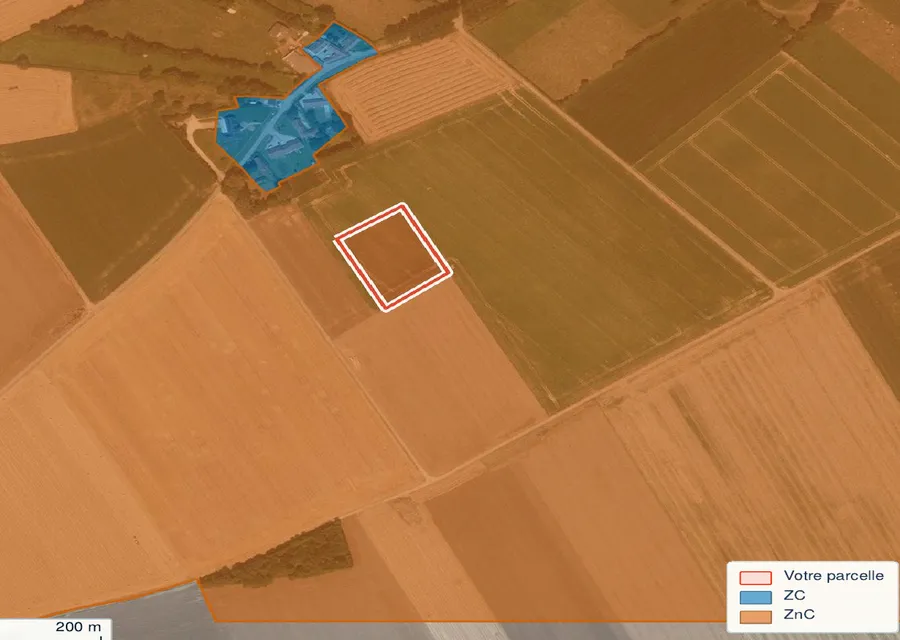
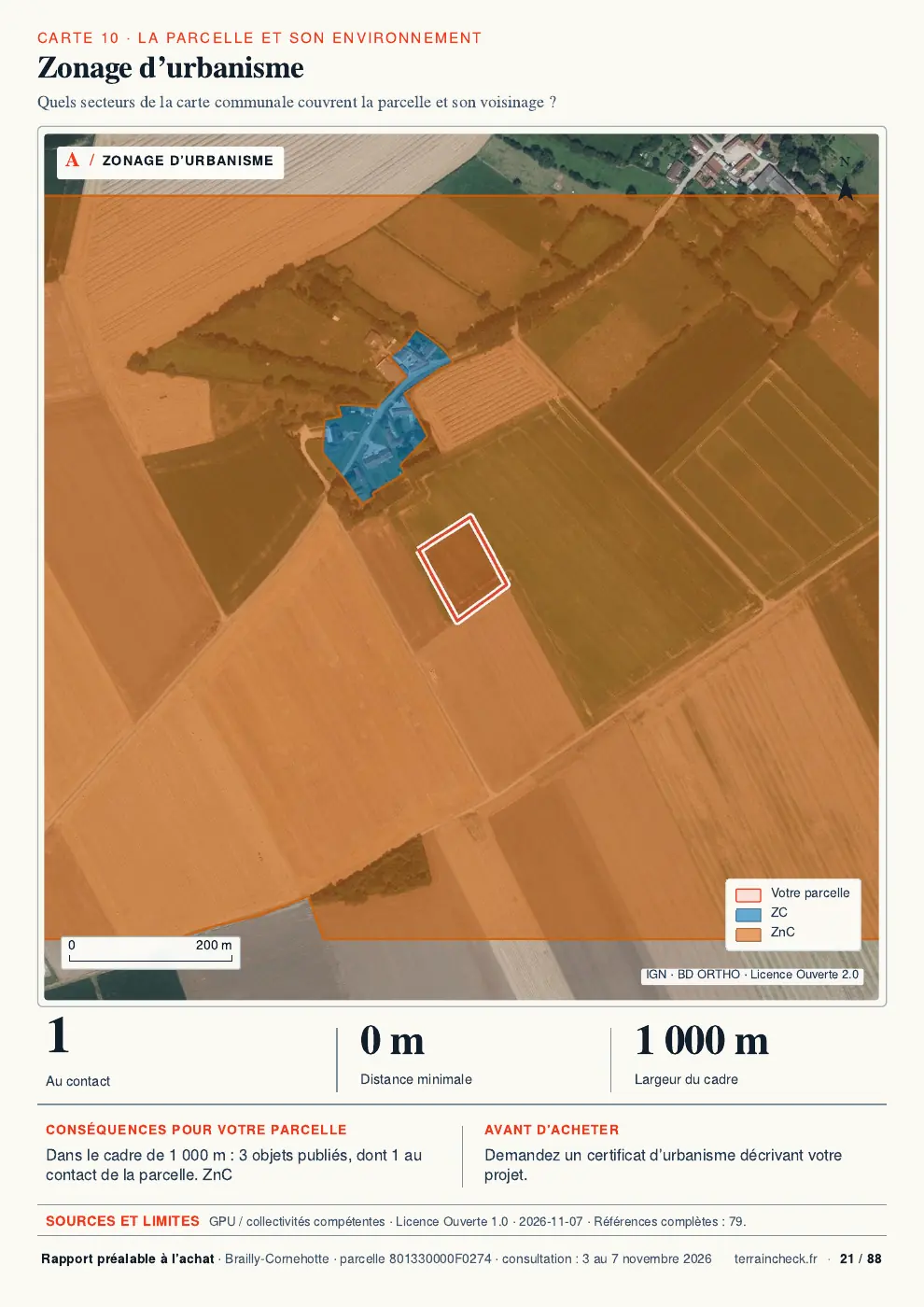
In the report: the zone that covers the parcel
Before making an offer: the ten-minute checklist
- Plan in force and zone noted from the Géoportail de l’urbanisme, with their dates.
- AU zone: capacity of the roads and utilities at its edge and development conditions (OAP) confirmed in writing by the mairie.
- Commune under the national rules: plot inside a built-up part, confirmed by the mairie.
- Public networks in front of the plot, or the date and the body doing the works known.
- Direct access to a public road, or a written right of way.
- Risk statement and public-interest easements read.
- Operational planning certificate applied for, and a matching condition in the preliminary contract.
Read next: the checks before the compromis (preliminary sale contract) and surveying the boundaries.
Keep reading
Wetlands on a plot in France: thresholds, declaration and penalties before you buy
Building in a French commune with no local plan: the national planning rules (RNU)
French planning certificates: information or operational CU before buying land
Reading the PLU before you buy: zone, rules, easements and pending changes
Easements (servitudes) on French land: where to find them before you buy
Read the zone of your parcel before you make an offer
Pick the parcel on the map. The report gives the planning document and zone that cover it, the published easements, the hazards and the distance to roads, and names the source and date of each record. It does not replace the planning certificate. Free check, PDF report for €29 (€39 in French and English).