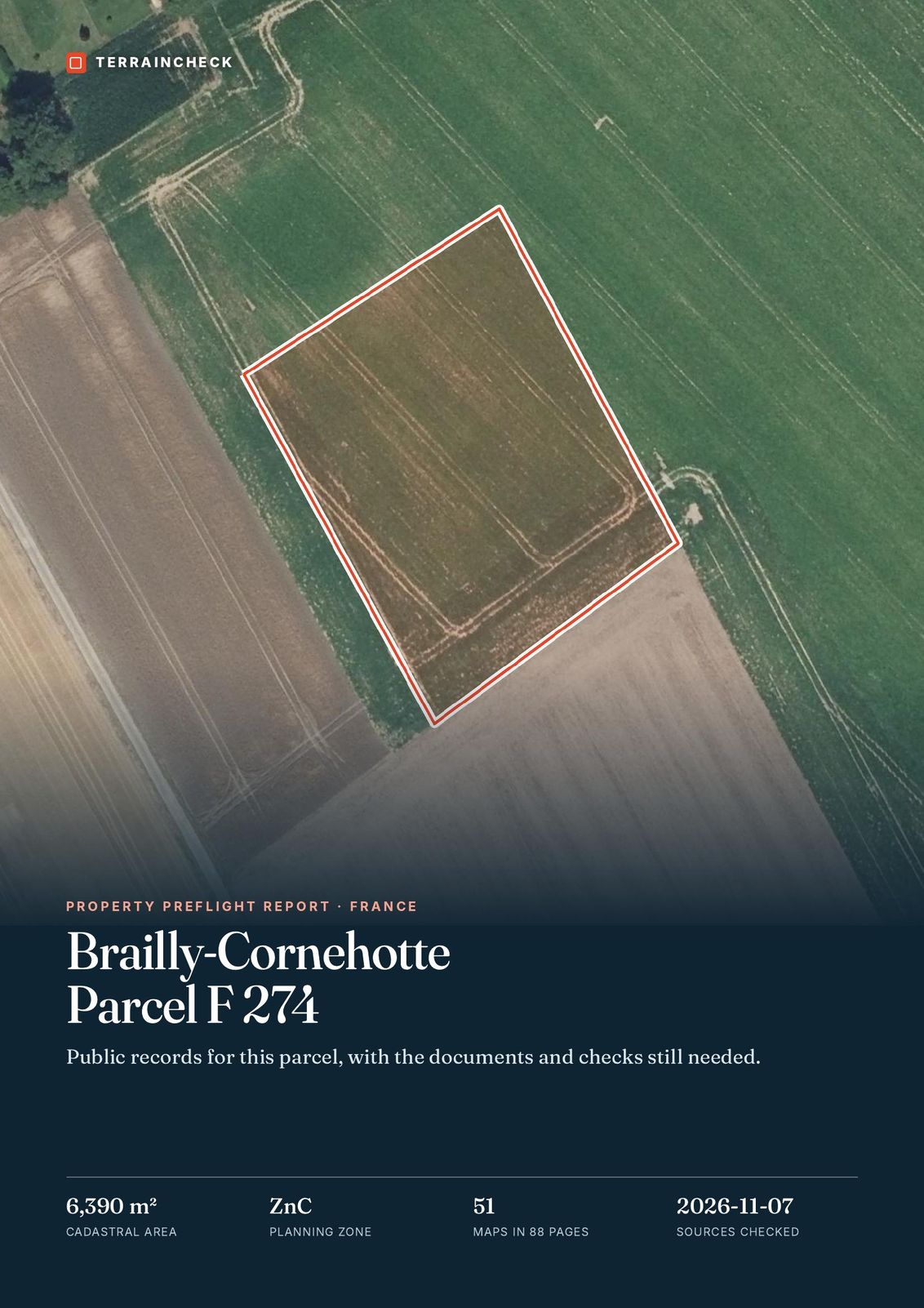
Pillar: Buying building land in France
Land boundary survey (bornage) in France: when it is required, how the price is set and who pays
French law sets no price for a bornage (boundary survey): it is paid on the quote of a géomètre-expert (chartered land surveyor), and the cost is in principle shared between neighbours (Civil Code, art. 646). First step: ask the seller whether a signed survey report already exists, then get several quotes from géomètres-experts.
In brief
- There is no official price. A bornage (formal boundary survey) costs what the géomètre-expert (chartered land surveyor) quotes. The profession’s governing body states that fees are freely agreed with the client; there is no official scale, and they are usually based on an hourly rate.
- Who pays: in an agreed survey, the cost is usually shared equitably between the neighbours (Civil Code, art. 646: “at shared cost”), unless they agree otherwise. In court, the judge may split it or charge it all to the neighbour who refused.
- Is it compulsory? Not automatically. It becomes compulsory when one of the owners concerned asks for it: the neighbour cannot refuse. A prospective buyer may also request a survey, but the right to force the neighbour into one belongs to the owner (art. 646). On a sale, it depends on the land. For a plot in a lotissement (planned subdivision), a plot divided off inside a ZAC (zone d’aménagement concerté, a designated development zone) by the body in charge of developing it, or a plot that comes out of a land reallocation (remembrement) by an AFU (association foncière urbaine, an urban land association), the preliminary contract or the sale contract must carry the plot description resulting from the survey when the buyer intends to build a home or a mixed-use building (Planning Code, art. L115-4). For other land, Service-Public, the official government information site, says a survey is not compulsory on sale.
- If the neighbour refuses: a settlement attempt (a free court conciliator, a mediator or a lawyer-led procedure) must come before the tribunal judiciaire (civil court), save the exemptions in article 750-1 of the Code of Civil Procedure. After judgment, official sources give different time limits for an appeal (15 days or one month): go by the one stated in the notice served with the judgment, and see a lawyer the day you receive it.
On this page
When is a boundary survey required?
A bornage fixes the exact line between two private plots and marks it on the ground with boundary markers. It is not a fence and not the cadastral map, which gives the shape of a plot without guaranteeing where its edges run. French law does not require one for every sale; it depends on the case.
| Situation | What the rule says | What it means for a buyer |
|---|---|---|
| Building plot outside a lotissement, a ZAC and an AFU land reallocation | No survey is compulsory on sale, according to Service-Public. If the buyer intends to build a home or a mixed residential and business building, the preliminary contract and the sale contract state whether the plot description comes from a survey (L115-4). | Ask the seller whether a survey exists; if not, agree who orders one before completion. If the statement is missing, see the action to annul below the table. |
| Plot in a lotissement, plot divided off inside a ZAC by the body developing it, or plot that comes out of an AFU land reallocation | If the buyer intends to build a home or a mixed building, the plot description resulting from the survey is written into the preliminary contract or the sale contract (L115-4). For a plot in a lotissement, Service-Public adds that it must be marked out by a survey. | Check that the contract carries that description. If the statement is missing, see the action to annul below the table. |
| An owner asks for it | The survey becomes compulsory and the neighbour cannot object. | As a prospective buyer you may request a survey; to make it binding on the neighbour, have the seller, who still owns the plot, ask for it. |
| Line already surveyed for good | No new survey is possible. | Ask for the existing report and plan. |
| Line with a public road or public land | No bornage: a separate procedure applies, such as the alignement individuel (official road line). | Ask the mairie (town hall) which procedure applies. |
When a survey is required and when it is your choice. Sources: Service-Public: boundary surveys (bornage); Planning Code, art. L115-4 (survey statement in the sale); Planning Code, art. L115-5 (action to annul, one month); Service-Public: precautions before buying a building plot outside a lotissement; Service-Public: seller’s duties for a plot in a lotissement. Accessed 12 November 2026.
Where the statement required by article L115-4 is missing, article L115-5 gives an action to annul to the beneficiary of a promise to sell, to the party who gave a promise to buy, or to the buyer. It must be brought within one month of the notarial deed recording the sale. If that deed contains the statement, signing it forfeits the right to challenge the earlier promise or contract on that ground.
How a boundary survey works
You must start with an agreed survey. Tell the neighbour, ideally by registered letter with proof of receipt. No set form is required, but in practice the line is drawn by a géomètre-expert. Under an act of 7 May 1946, only géomètres-experts registered with their professional body may fix property boundaries, public services working for themselves apart. An ordinary surveyor or a builder cannot.
- Choose a géomètre-expert and get a quote. Where: the professional body’s directory or a local firm. Cost: quotes are free or charged, depending on the firm and the job. Time: as stated in the quote; there is no legal deadline.
- Check that no survey exists yet. Where: the Géofoncier portal, which publishes the land records drawn up by géomètres-experts, surveys included. Cost: as shown on the portal. If a final survey exists, it stands and no new one is possible.
- Invite the neighbours. The géomètre-expert visits the site, reads each owner’s title deeds and proposes the line. Time: depends on the surveyor’s and the neighbours’ diaries; there is no legal deadline.
- Sign the report, or not. Each party signs only if they agree. Once signed, the procès-verbal de bornage fixes the line for good and cannot be challenged, even in court. The markers are then set and a survey plan is drawn.
- Register the report (optional). Where: the service de publicité foncière (land registry), through a notaire (the public notary who handles French property sales). Effect: the survey binds everyone, later buyers and heirs included. Cost: ask the notaire.
If the neighbour refuses or disputes the line, a court claim must be preceded by a settlement attempt: a court conciliator (free), a mediator, or a negotiated procedure through lawyers (both charged). Without it, the judge may declare the claim inadmissible. Article 750-1 of the Code of Civil Procedure lists five exemptions, among them a legitimate reason such as manifest urgency, or conciliators being so unavailable that the first meeting would be more than three months after the request; the full list is in the article (in French). The civil court where the land lies can then be asked at any time: there is no time limit on a boundary action.
The court appoints a géomètre-expert, then gives a judgment that can be appealed. Official sources differ on the time limit. The Service-Public bornage page gives 15 days from notification. Article 538 of the Code of Civil Procedure gives one month in contested matters and 15 days in uncontested ones. The Service-Public page on civil appeals repeats those limits and adds one month for a party living in a French overseas territory when the decision was given in mainland France (and the other way round), two months for a party living abroad. We do not choose between them: the routes of appeal and the steps to take are set out in the document by which the judgment is served or notified. Read it the same day and see a lawyer straight away; representation by a lawyer is compulsory on appeal, apart from the procedures Service-Public lists.
The price of a boundary survey: no official rate, and who pays
No rule sets the price of a bornage, so there is no official figure to quote. The Order of géomètres-experts says fees are agreed freely with the client, with no scale, that prices can vary from one firm to another and that they are usually worked out on an hourly rate, which may differ with the complexity of the job. A quote therefore depends on the time planned and on how difficult the file is. To find the figure, the Order tells clients to consult several géomètres-experts and compare their quotes. Expect the quotes and the report in French.
| Case | Who pays | What to put in writing |
|---|---|---|
| Agreed survey between neighbours | Usually shared equitably between the neighbours, who may agree another split. | The split, in the agreement or the signed quote. |
| Survey ordered for a sale | To be agreed between seller and buyer; between neighbours, the rule is still a split. | Who orders it, who pays and by when, in the preliminary contract. |
| Settlement attempt before court | The conciliator is free; mediators and lawyers charge. | The conciliation or non-agreement record. |
| Court-ordered survey | Split as the judge decides, or all of it charged to the neighbour who refused. | The court decision, to be kept. |
| Registration at the land registry | The Service-Public bornage page does not say: to be agreed between neighbours. | The notaire’s quote. |
The starting rule is shared cost (Civil Code, art. 646); everything else is negotiated or decided by the court. Sources: Civil Code, art. 646 (boundary survey at shared cost); Service-Public: boundary surveys (bornage); Order of géomètres-experts: FAQ (fees, Géofoncier). Accessed 12 November 2026.
Our advice: have each quote describe the same work, meaning the boundaries to be surveyed, the neighbouring owners to be invited, the setting of markers, and the report and plan handed to each party. A “bornage” quote covering one side out of five cannot be set against one for the whole perimeter.
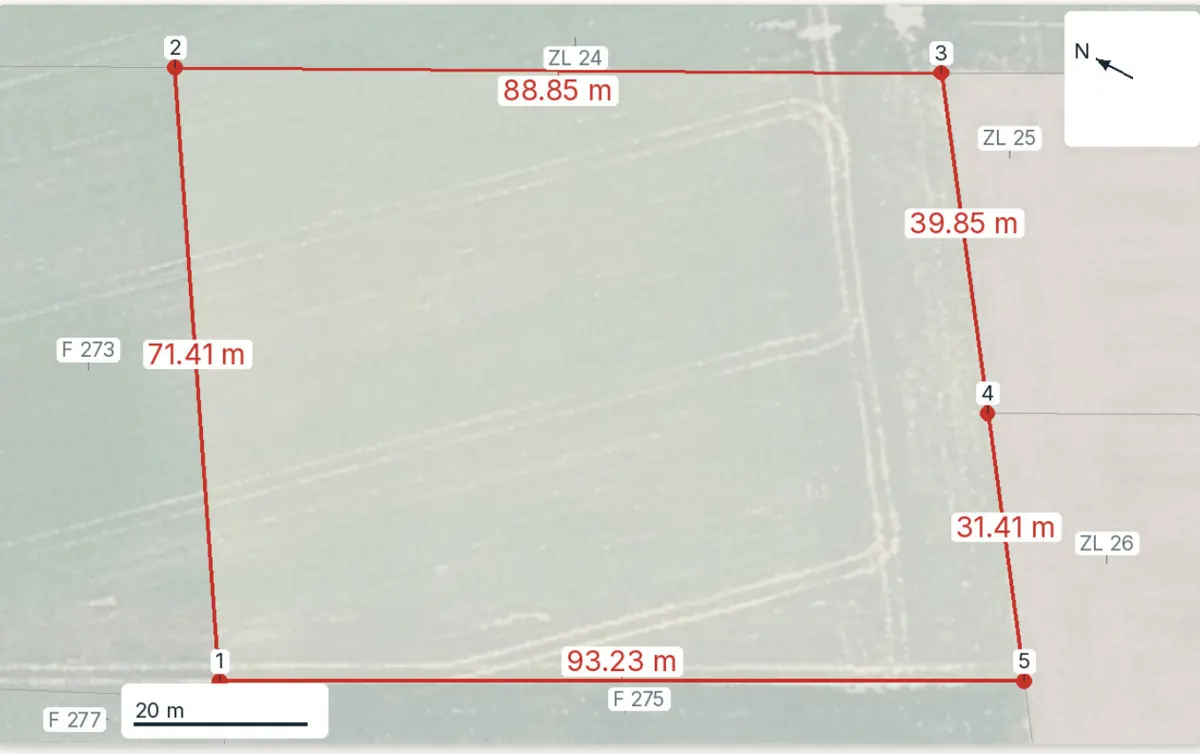
In the report: the parcels that touch yours
Before you sign: the boundary checklist
- Ask the seller for any survey report and plan, and check on Géofoncier whether a survey is recorded.
- Plot in a lotissement, plot divided off in a ZAC by the body developing it, or plot from an AFU land reallocation: check that the contract carries the description resulting from the survey.
- Other land: have the contract say whether the description comes from a survey, and who orders one.
- Several quotes from géomètres-experts for the same perimeter and the same boundaries.
- On the visit, compare visible markers, fences and the cadastral plan.
- Have the notaire register the report if you want it to bind everyone.
Read next: the checks before the compromis (preliminary sale contract), finding the cadastral reference for the surveyor and easements to look for before buying.
Keep reading
French cadastral reference: how to find a parcel number and read it correctly
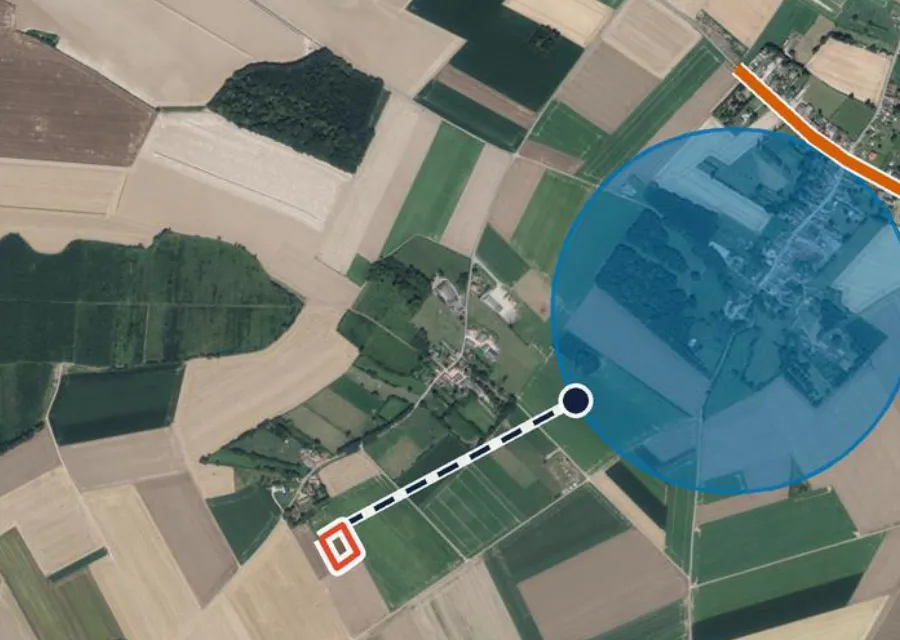
Easements (servitudes) on French land: where to find them before you buy
Buying building land in France: checks before the compromis
Buying a plot in a French subdivision (lotissement): the developer’s promise, the covenants and any duty to build
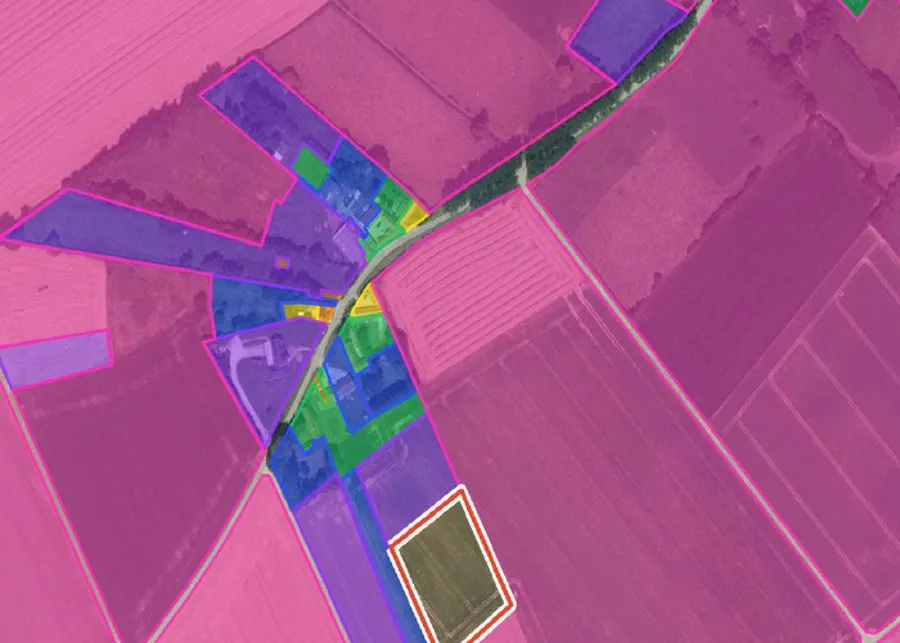
Find the neighbouring parcels before you call a surveyor
Before you ask for quotes, pick the parcel on the map. The report takes the length of each side and the area from the cadastral plan, counts the parcels that touch it and dates every record. It is not a survey. Free check, PDF report for €29 (€39 in French and English).