Pillar: Buying building land in France
Buying a plot in a French subdivision (lotissement): the developer’s promise, the covenants and any duty to build
In France, a plot in a lotissement (subdivision) that needs a development permit cannot be promised or paid for before the permit is issued. Then you have 10 days to withdraw from the developer’s promise, which may require a holding fee of up to 5% of the price. Under a prior declaration, neither the 10 days nor the cap applies.
In brief
- Development permit: 10-day cooling-off from the day after the recorded letter is first presented or after handover; holding fee of 5% of the price at most, in a blocked account. Prior declaration: no statutory cooling-off, fee set by the promise.
- Form: promise before a notaire (the public official who handles property sales), or privately signed and registered within 10 days of acceptance, otherwise void; notarised if a private-individual seller commits for over 18 months. Moselle, Bas-Rhin, Haut-Rhin: 6 months for the notarised deed, subject to conditions.
- Final deed as a rule once shared services are finished, earlier if early sale is authorised; building permit as a rule after recorded completion, earlier in cases b and c of article R442-18.
- Rules stable for 5 years from receipt of the completion declaration by the authorities (from the decision of no objection under a prior declaration), except amendments to the subdivision documents. Planning rules lapse 10 years after authorisation if a PLU (local plan) then covers it; the cahier des charges (private covenants) does not.
On this page
Development permit or prior declaration
A lotissement (subdivision) is the division of one or more adjoining land holdings to create building plots (Planning Code, article L442-1, with the exclusions of article R442-1). The lotisseur (developer) needs a development permit if the subdivision creates or lays out roads, spaces or facilities shared by several plots and specific to it, at the developer’s expense (article R421-19 a, for applications filed since 28 September 2026). Otherwise a déclaration préalable (prior declaration) is enough (article R421-23 a), and your rights differ.
For earlier applications, the version in force from 1 April 2017 also required a development permit in a site patrimonial remarquable (protected heritage area), near a listed historic monument, or in a site classé (protected landscape) or one being classified, even without shared facilities. Check which decision was actually issued.
Sources: Planning Code, art. L442-1; Planning Code, art. R*442-1; Planning Code, art. R*421-19; Planning Code, art. R*421-19, version of 1 April 2017; Decree no. 2026-674 of 27 July 2026, art. 10; Planning Code, art. R*421-23; Service-Public: subdivision plots. Accessed 14 November 2026.
The developer’s promise: contents, form, 10 days, 5%
Once the permit is issued, the developer may grant you a unilateral promise to sell: it is bound to sell, you remain free not to buy. It states what the plot consists of, its boundaries, its price and its delivery date (article L442-8). The permit and any cahier des charges must be given to you before you sign (article L442-7).
It becomes final only after ten days in which you may withdraw. For a non-professional buyer they run from the day after the recorded letter serving it is first presented (Construction and Housing Code, or CCH, article L271-1) or, according to Service-Public, after it is handed to you. A last day falling on a Saturday, Sunday, public holiday or non-working day moves to the next working day.
You withdraw by recorded-delivery letter with acknowledgement of receipt; money paid is refunded within 21 days, counting from the day after you withdraw.
The developer may ask for a holding fee (indemnité d’immobilisation) of up to 5% of the price (article R442-12): €4,000 for an example plot at €80,000. Held in a blocked account, it becomes a down payment if you take up the option. Otherwise it is returned within three months, unless the sale fails because of you although every condition of the promise has been met (article L442-8).
Form. Signed privately, it must be registered with the tax registration office within ten days of your acceptance, otherwise it is void (Civil Code, article 1589-2). Service-Public counts the ten days from signature and puts the cost at €125.
Over 18 months. Given by a private individual for more than 18 months, extensions included, a promise must be notarised, otherwise it is void (CCH, article L290-1), and provide for a holding fee of at least 5% of the price, paid to or guaranteed with the notaire (article L290-2). With a development permit, that minimum meets the 5% cap: have the notaire confirm the amount.
Moselle, Bas-Rhin, Haut-Rhin. There, a privately signed deed transferring ownership of real property must be followed within six months of being entered into by a notarised deed or, if one party refuses, by court proceedings, or it lapses (Act of 1 June 1924, article 42). Service-Public applies this 6-month limit to the unilateral promise.
| Point | Plot with a development permit | Plot under a prior declaration |
|---|---|---|
| Promise before authorisation | Forbidden, like any down payment | Possible, even before the decision of no objection |
| Cooling-off | 10 days from the day after the letter is first presented or handed over | No statutory right, for seller or buyer |
| Holding fee | 5% of the price at most, blocked account | Set by the promise; at least 5%, with the notaire, if the seller is a private individual and the promise exceeds 18 months |
| Rules stable for 5 years | From receipt of the completion declaration | From the decision of no objection |
The two kinds of subdivision in France. Sources: Planning Code, art. L442-4; Planning Code, art. L442-8; Planning Code, art. R*442-12; CCH, art. L290-2; Planning Code, art. L442-14; Service-Public: promise for a subdivision plot. Accessed 14 November 2026.
Under a prior declaration, make the decision of no objection a condition precedent. For land outside a subdivision, see unilateral promise or compromis.
Sources: Civil Code, art. 1589-2; CCH, art. L290-1; Act of 1 June 1924, art. 42. Accessed 14 November 2026.
When to sign the deed and apply for a building permit
As a rule, the final deed is signed once the shared services are finished: roads, water, electricity, gas. The development permit, or a later order, may allow sales before that in two cases (article R442-13):
- Deferred finishing works (final road surface, pavements, kerbs, planting): the developer undertakes to finish them within the order’s deadlines and, unless a public body, deposits their cost in a blocked account or provides a completion guarantee.
- Completion guarantee from a bank, a financial institution or a mutual guarantee company (article R442-14): either a credit facility that future buyers can require to be honoured, or a surety bound to them jointly and severally with the developer. Sales may also be authorised phase by phase, each guaranteed (article R442-13-1).
The building permit can be granted (article R442-18): a) in the usual case, from completion of the works recorded under articles R462-1 to R462-10 (developer’s completion declaration to the mayor); b) from the authorisation to sell early, if the services reaching the plot are finished, developer’s certificate attached to the application; c) from the development permit, to be used only once those services are finished.
Case c is not open to a single-family house within the meaning of article L231-1 of the CCH (see the CCMI contract).
From reserved plot to building site: the steps
- Check the authorisation at the mairie (town hall), by appointment if needed: what it is and when the application was filed, then get the documents from the developer; no deadline in the texts cited.
- Sign the promise, notarised or registered within 10 days; with a development permit, 10-day cooling-off after that.
- Final deed before the notaire: on the date set in the promise; in Moselle, Bas-Rhin and Haut-Rhin, see above.
- Building permit at the mairie, when article R442-18 allows (see above); processing: building permit processing time.
Règlement, cahier des charges, owners’ association
The règlement (subdivision rules) exists only where the developer adds to the rules of the PLU; the cahier des charges, if one was drawn up, sets the plot owners’ (colotis) rights and duties towards each other (Service-Public).
The planning rules in the subdivision documents lapse ten years after the subdivision was authorised if a PLU or equivalent document covers it then, without affecting relations between owners set by the cahier des charges (article L442-9).
The cahier des charges, whatever its date, is a contract binding the owners to each other for all its clauses, including those on land use (Cour de cassation, France’s highest civil court, 21 January 2016, no. 15-10.566). Likewise, a “one family house per plot” clause is contractual, and a second house breaches it even after the parcel is split in two (29 January 2008, no. 07-10.938).
If half the owners holding at least half the area ask for it or agree, the competent authority can amend the règlement, an approved cahier des charges or the regulatory clauses of an unapproved one, in line with the planning rules. For five years from completion of the subdivision, a developer still owning a buildable plot must also not object (article L442-10).
If a PLU is approved after the subdivision was authorised, the competent authority can also bring these documents into line with it, after a public inquiry and a municipal council vote (article L442-11).
For five years, a building permit cannot be refused or given special conditions on the basis of planning rules adopted after the development permit (article L442-14). The text counts from recorded completion; the Conseil d’État, the top administrative court, from receipt of the completion declaration by the authorities (19 July 2017, no. 396775). Amendments to the subdivision documents still apply; under a prior declaration, the five years run from the decision of no objection.
The developer normally undertakes to set up a buyers’ association that owns and maintains the shared land and facilities (article R442-7), unless they go to the buyers or are all transferred to the commune or group of communes (article R442-8). Read its articles and latest budget.
Sources: Service-Public: subdivision rules; Cour de cassation, 21 January 2016, no. 15-10.566; Cour de cassation, 29 January 2008, no. 07-10.938; Planning Code, art. L442-10; Planning Code, art. L442-11; Conseil d’État, 19 July 2017, no. 396775; Planning Code, art. R*442-8. Accessed 14 November 2026.
Do you have to build within a set time?
The texts cited here set no deadline to build. Check the cahier des charges, promise and draft deed for a clause; ask the notaire when it starts and what a breach leads to.
Plot in a subdivision or plot outside one
SDES, the environment ministry’s statistics office, calls land not created by a land division, so outside any subdivision, “secteur diffus”. For a subdivision plot, the promise must give the description from the boundary survey (article L115-4). According to Service-Public, the plot must be buildable, serviced and surveyed; if not, the buyer can ask a court, through a lawyer, to cancel the sale.
See the boundary survey and serviced or unserviced plot.
The official land price survey (EPTB) covers only land bought by private individuals for a single-family house outside subdivisions. In 2024, in France: €95,000 on average, €102 per m², 932 m².
In the report: the plot and its neighbours
Before you sign with the developer
- Development permit or decision of no objection: decision date and filing date known, file seen at the mairie.
- Development permit: nothing signed or paid before it was issued.
- Received before signing: permit, règlement and cahier des charges where they exist, ASL articles.
- Promise: area, floor area, survey-based boundaries, price, delivery date.
- Development permit: holding fee of 5% at most in a blocked account; end of the 10 days noted.
- Prior declaration: refund terms for the holding fee read in the promise.
- Private promise registered within 10 days; over 18 months, seller a private individual: notaire.
- Services to the plot finished, or early-sale authorisation and guarantee copied.
- Time limit to build looked for in the cahier des charges, the promise and the draft deed.
Common questions
Can I reserve a plot before the development permit?
With a development permit, no: no promise or down payment before it is issued (article L442-4). Under a prior declaration, yes, even before the decision of no objection, according to Service-Public.
Does the 10-day cooling-off apply to every plot?
No. According to Service-Public, this statutory right applies only with a development permit; under a prior declaration, neither seller nor buyer has it. Read the exit terms in the promise.
Keep reading
VAT on building land in France: total price, margin scheme or transfer duties
Dividing a plot in France: prior declaration, development permit or nothing, depending on the case
Unilateral promise to sell or compromis: what changes for the buyer of a plot in France
Land boundary survey (bornage) in France: when it is required, how the price is set and who pays
Serviced or unserviced plot in France: what “viabilisé” promises and how to check it
Before you reserve a plot, look at the parcel and its surroundings
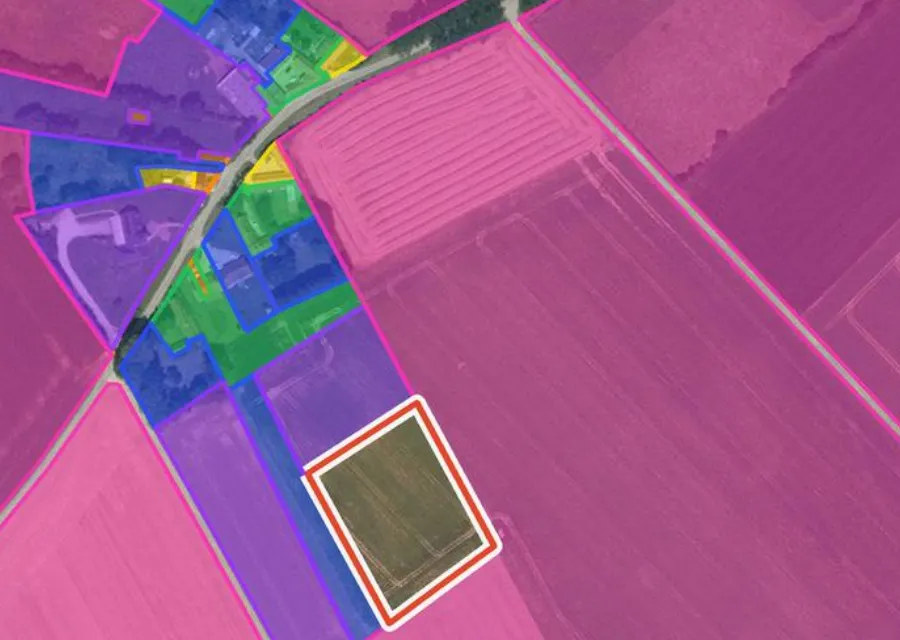
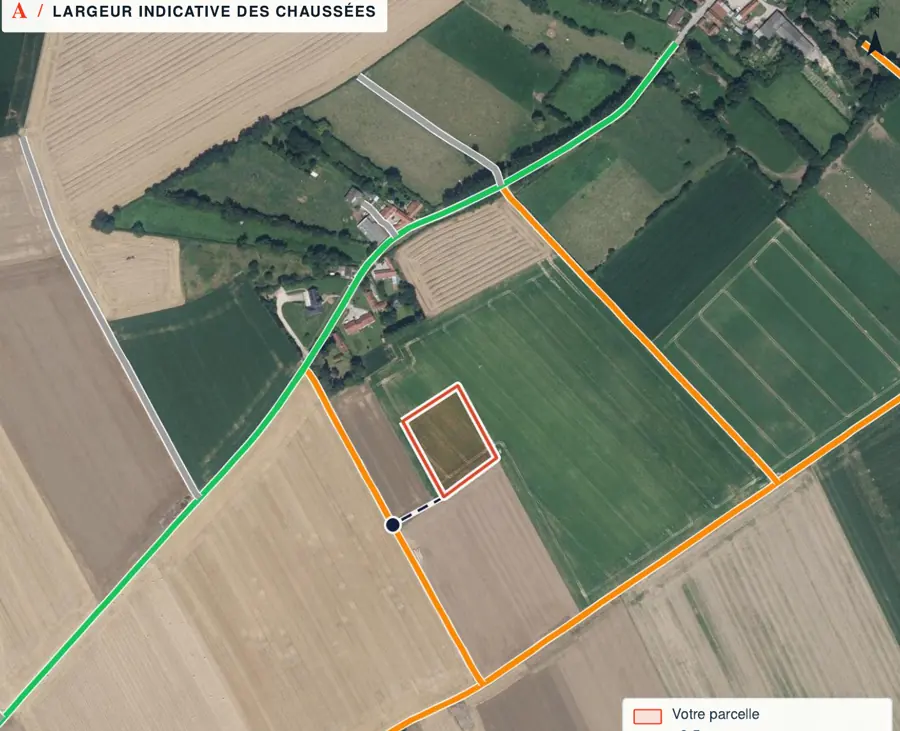
The report brings together the public records on the parcel: cadastral outline, zone in the local plan (PLU) or carte communale, natural hazards, clay soils and nearby sales, each with its source and date, explained in English. It does not replace the notaire or the cahier des charges and does not name the owner. Free check, PDF report for €29 (€39 in French and English).