Pillar: Buying building land in France
Serviced or unserviced plot in France: what “viabilisé” promises and how to check it
A terrain viabilisé (a “serviced” plot) is, in the words of Service-Public, the French government’s information site, land that can be connected to roads and to the water, drainage, electricity and telephone networks: able to be connected, not connected, and the word says neither where the networks stop nor who pays. Before signing, check two things: the certificat d’urbanisme opérationnel, a free planning certificate from the mairie (town hall), processed within 2 months, and a written answer from each network operator on the connection point and the works you would pay for.
In brief
- Outside a lotissement (land divided into building plots), only an express certificat d’urbanisme opérationnel, a planning certificate for a described project, states the existing or planned public infrastructure (Planning Code, art. L410-1); a tacit certificate, which arises if the authority stays silent for 2 months, says nothing about it.
- In a lotissement that needs a permis d’aménager (development permit), ask for the programme of works filed with the permit application: it shows the position of the networks (art. R442-5).
- Who pays. The authority requires the permit holder, “as far as needed”, to build and pay for the project’s own infrastructure, including the connection to the public infrastructure existing in front of the land (art. L332-15). Detail by type of works.
- Public network to extend. If serving the project requires works on the public water, drainage or electricity networks, the permit cannot be granted if the authority is unable to say by when and by whom they will be carried out (art. L111-11).
- In the preliminary contract, have each network written down: what exists and who pays for the rest. Any obscure or ambiguous clause is read against the seller (Civil Code, art. 1602).
On this page
Four listing phrases, no document behind them
French listings call a plot viabilisé (“serviced”), desservi (“served”), en bordure de réseaux (“networks at the boundary”) or à viabiliser (“to be serviced”). None of the legal texts quoted here defines these words: the Planning Code speaks of the works needed to service and equip a building (art. L332-15). Service-Public’s definition says raccordable: the networks can be brought to the house, not that they already have been. The other phrases say even less.
Four questions remain for each network. Does it exist in front of the plot, at its boundary? With what capacity? What works are still to be done? Who pays for them?
What the certificat d’urbanisme opérationnel says about utilities
You apply at the mairie of the commune (municipality) for a described project: its nature, and the use and approximate position of the buildings. The owner or anyone else with an interest in the land may apply, free of charge.
During the two months it has to answer, the authority asks the bodies that run the public water, drainage and electricity networks for their opinion. An opinion not given within one month is deemed favourable (art. R410-10), so a positive certificate does not prove that every operator has studied the project. Ask the mairie for the opinions received.
An express certificate stating that the project can be carried out covers, among other points, how the land is served by existing or planned public infrastructure (art. R410-13). If it says the opposite, or sets requirements, it must give reasons (art. R410-14).
Sources: Planning Code, art. L410-1; Planning Code, art. R410-1 to R410-21; Service-Public: planning certificate. Accessed 12 November 2026.
Checking the real position, network by network
- Mairie, planning office: the certificat opérationnel. Application form, location plan and a short description of the project (procedure on Service-Public, in French). Cost: free. Time: 2 months.
- Mairie: the drainage zoning. The commune or its intercommunal body marks out the areas of mains drainage (assainissement collectif) and of non-mains drainage (art. L2224-10 of the Local Authorities Code). The zoning can be consulted at the mairie and appears, where applicable, in the annexes to the local plan (plan local d’urbanisme, PLU) (art. R151-53). Time: one visit. It shows the regime for the area, not whether a sewer runs in front of the plot.
- Water and drainage services. Ask the mairie who runs them. According to Sispea, the national observatory of public water and sanitation services kept by the French Biodiversity Office, drinking water services run by a single commune, 54% of the total, cover only 9% of the population (chart below). Write to the operator with the cadastral reference: main in front of the plot, connection point, works and charges that would fall to you. Cost and time: set by each service.
- Electricity: the operator of the public distribution network. Enedis states that it runs this network across 95% of French territory, with local distribution companies doing so elsewhere. Ask whether the connection involves an extension of the network (see who pays). Cost and time: those in the operator’s offer.
- Buried networks: reseaux-et-canalisations.ineris.fr. This online service identifies, free of charge, the operators whose networks are affected by works at a given place. Time: one online search.
Access, sewer, private system
If the land is not directly served by a road open to public traffic, the site plan in the building permit file shows the right of way that gives access to it (art. R431-9). With non-mains drainage, the permit file includes the document certifying that the planned installation complies (art. R431-16, d), issued according to Service-Public by the Spanc, the public service for non-mains drainage. For the duty to connect to the sewer, its exemptions and the sums payable, including the PFAC contribution to mains drainage where a local decision has introduced it, see the Service-Public page (in French) and the drainage service’s written answer.
Sources: Local Authorities Code, art. L2224-10; Planning Code, art. R151-53; Enedis: the electricity market; Ineris: the “réseaux-et-canalisations” online service; Planning Code, art. R431-9; Planning Code, art. R431-16. Accessed 12 November 2026.
Who pays for what under the legal texts
The texts name the holder of the planning permission: for a house, whoever obtains the building permit, in practice the buyer.
| Works | What the text provides | Text |
|---|---|---|
| The project’s own infrastructure (roadway, water, gas, electronic communications, wastewater, among others) and its connection to the public infrastructure existing in front of the land, including across private roads or by using easements | The authority requires the permit holder, “as far as needed”, to build and pay for it. | Planning Code, art. L332-15, paras 1 and 2 |
| Connection to the water network along public roads or public land | The permit may make the holder pay for it, on the terms set by the authority in charge of the water service, if the connection is no longer than 100 m and the pipe, sized only for the needs of the project, is not meant to serve other buildings. | Art. L332-15, para. 3 |
| Extension of the public electricity network needed for a project covered by a permit or a prior declaration | The contribution is paid by the holder of the permit or of the decision not to oppose the declaration, if the project lies outside a zone d’aménagement concerté (public development zone) and does not give rise to the contributions the text names (exceptional public infrastructure, roads and networks). | Energy Code, art. L342-21, 1° |
| Works on the public water, drainage or electricity networks needed to serve the project | Carried out by a public body or a public-service concession holder. If the authority is unable to say which one and by when, the permit cannot be granted; it must oppose a prior declaration. | Planning Code, art. L111-11 |
The split set by the texts. None of these articles sets a price. Sources: Planning Code, art. L332-15 (version in force since 28 May 2026); Energy Code, art. L342-21; Planning Code, art. L111-11. Accessed 12 November 2026.
The certificat d’urbanisme also lists the planning taxes and contributions that apply to the land (art. L410-1). The amounts come from the operators’ quotes and from local council decisions.
In a lotissement: what the developer must be able to show
Service-Public writes that a plot sold in a lotissement must be buildable, serviced and delimited (constructible, viabilisé, délimité), and that the buyer may otherwise ask the civil court to annul the sale. A lotissement that provides for roads, spaces or infrastructure shared by several plots requires a permis d’aménager (art. R421-19). The permit file includes the programme and plans of the works, with the route of the roads, the position of the networks and how they will connect to the future buildings (art. R442-5). The permit must be shown to you before the preliminary contract, then handed over when you sign it (art. L442-7).
For a single house (maison individuelle), the building permit may be granted once the estate works are finished or, if the developer (lotisseur) has been authorised to sell plots before the works are carried out, provided the infrastructure serving the plot is finished: the developer then gives you a certificate stating this, under its own responsibility, to attach to the permit application (art. R442-18). Other lotissements need only a prior declaration (déclaration préalable): check the utilities there as for a stand-alone plot.
Sources: Service-Public: plot in a lotissement, the seller’s duties; Planning Code, art. R421-19; Planning Code, art. R442-5; Planning Code, art. L442-7; Planning Code, art. R442-12 to R442-18. Accessed 12 November 2026.
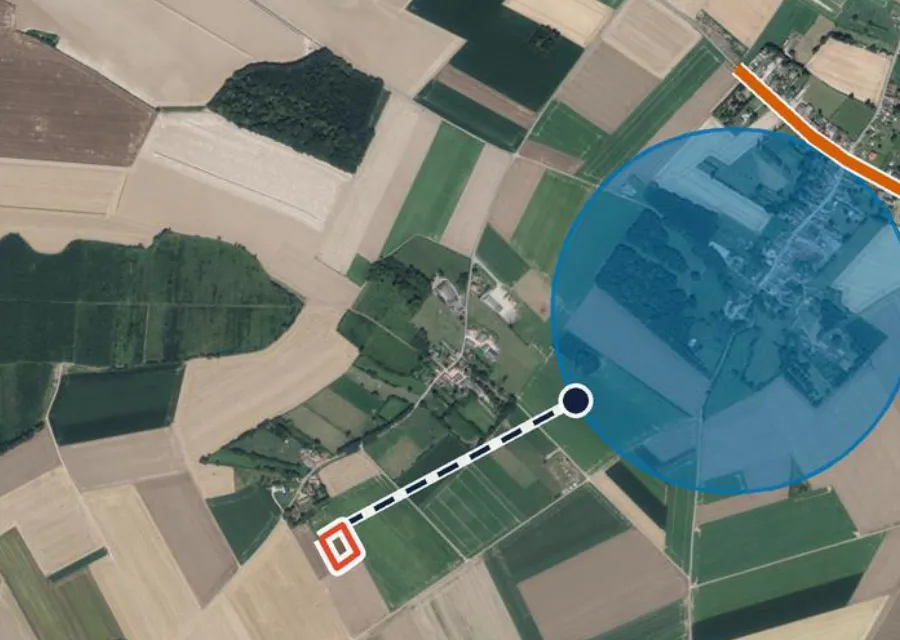
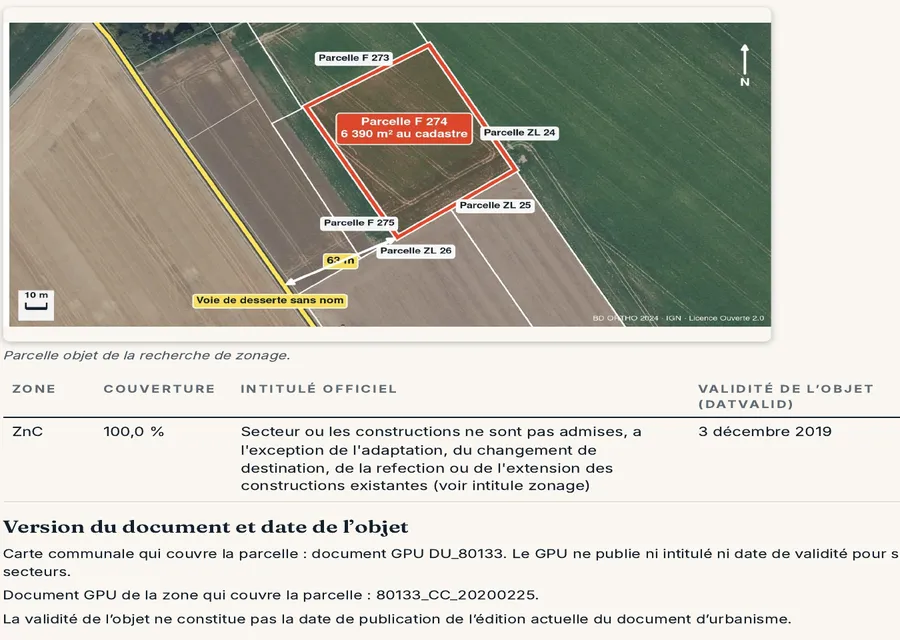
In the report: the nearest road to parcel F 274
Writing it into the preliminary contract
The sale is first fixed by a preliminary contract (promesse or compromis de vente) drawn up by the notaire, the public officer who handles the sale. The seller must explain clearly what he or she undertakes, and any obscure or ambiguous clause is read against the seller (Civil Code, art. 1602). According to Service-Public, a seller who knows information decisive for the buyer’s consent must disclose it in the compromis.
- Network by network: what exists, where it is in relation to the boundary, and the attached document that proves it.
- The works still to be done, who pays for them and, if it is the seller, a date.
- The certificat d’urbanisme opérationnel, attached, and a condition precedent (condition suspensive) that the building permit is obtained, which Service-Public lists among the contents of the contract.
- In a lotissement: the permis d’aménager, the programme of works and, where applicable, the developer’s certificate on the infrastructure serving the plot.
Send these documents to the notaire before the signing. For the other clauses, see the compromis de vente for land.
Sources: Civil Code, art. 1602; Service-Public: preliminary contract for a building plot outside a lotissement; Planning Code, art. L442-7. Accessed 12 November 2026.
Before you sign: utilities in six points
- An express certificat d’urbanisme opérationnel, read network by network.
- Drainage zoning consulted; a sewer in front of the plot confirmed or ruled out.
- Written answers from the water and drainage services and the electricity network operator.
- Network extension: needed or not, by whom, by when.
- Access by a road open to public traffic, or a right of way in place.
- Preliminary contract: each network described with its proof, cost of works allocated, condition precedent.
Next: how to check that the land is buildable, then the order of checks before the compromis.
Common questions
Is a “terrain viabilisé” already connected to utilities?
Not necessarily. Service-Public defines it as land that can be connected (raccordable) to roads and networks. Connecting the house is among the works the authority requires, as far as needed, from the permit holder (Planning Code, art. L332-15).
Does a certificat d’urbanisme guarantee the connection?
No. The certificat opérationnel states the existing or planned public infrastructure (art. L410-1); Service-Public points out that it is not a planning permission. A tacit certificate says nothing about infrastructure.
Keep reading
French planning certificates: information or operational CU before buying land
Is a plot buildable in France? How to check the zone, utilities, easements and the official answer
Easements (servitudes) on French land: where to find them before you buy
Buying land from a French municipality: council vote, State valuation and time limits
Septic tank, micro-station or sand filter in France: choosing by soil, and what drives the price
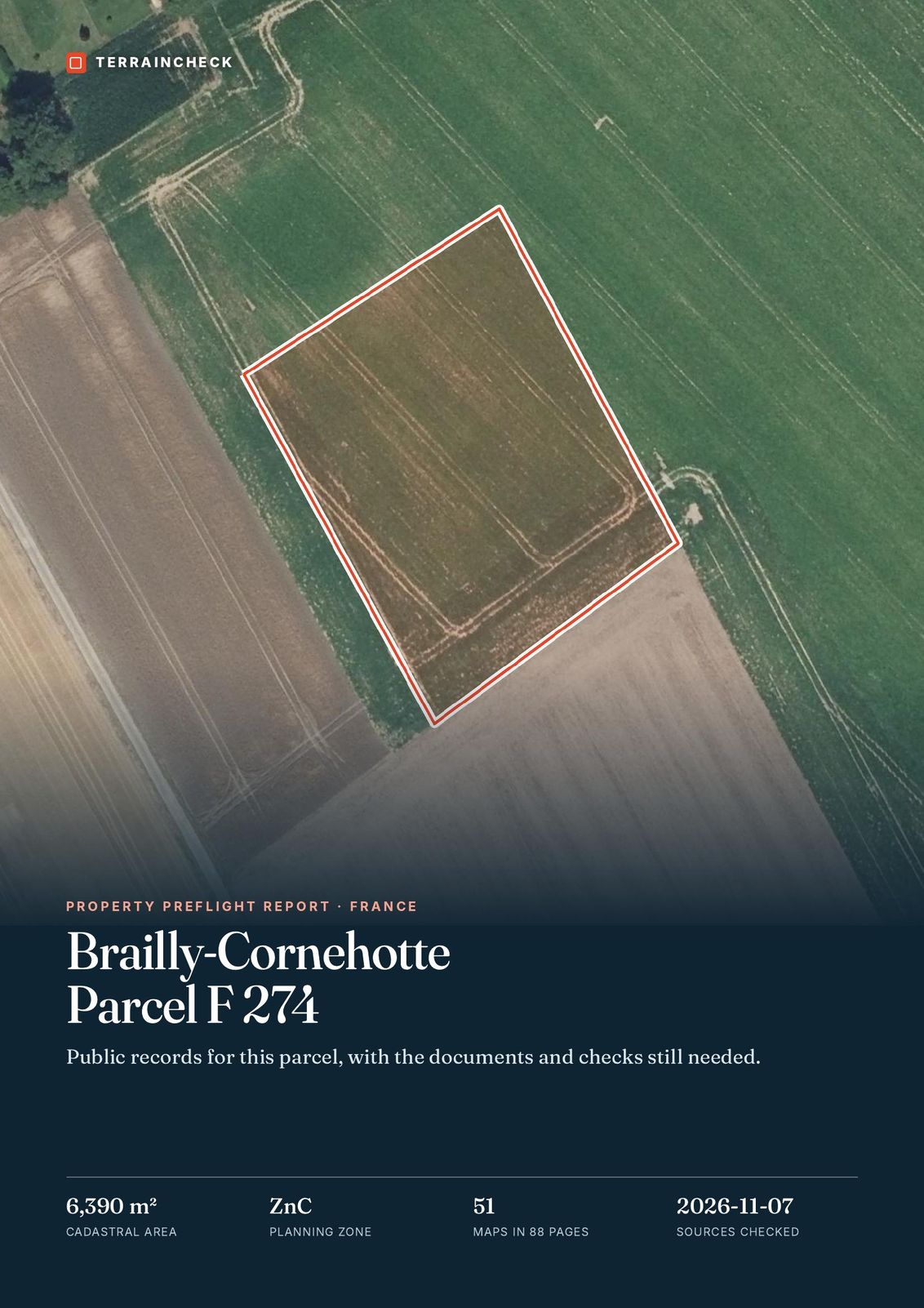
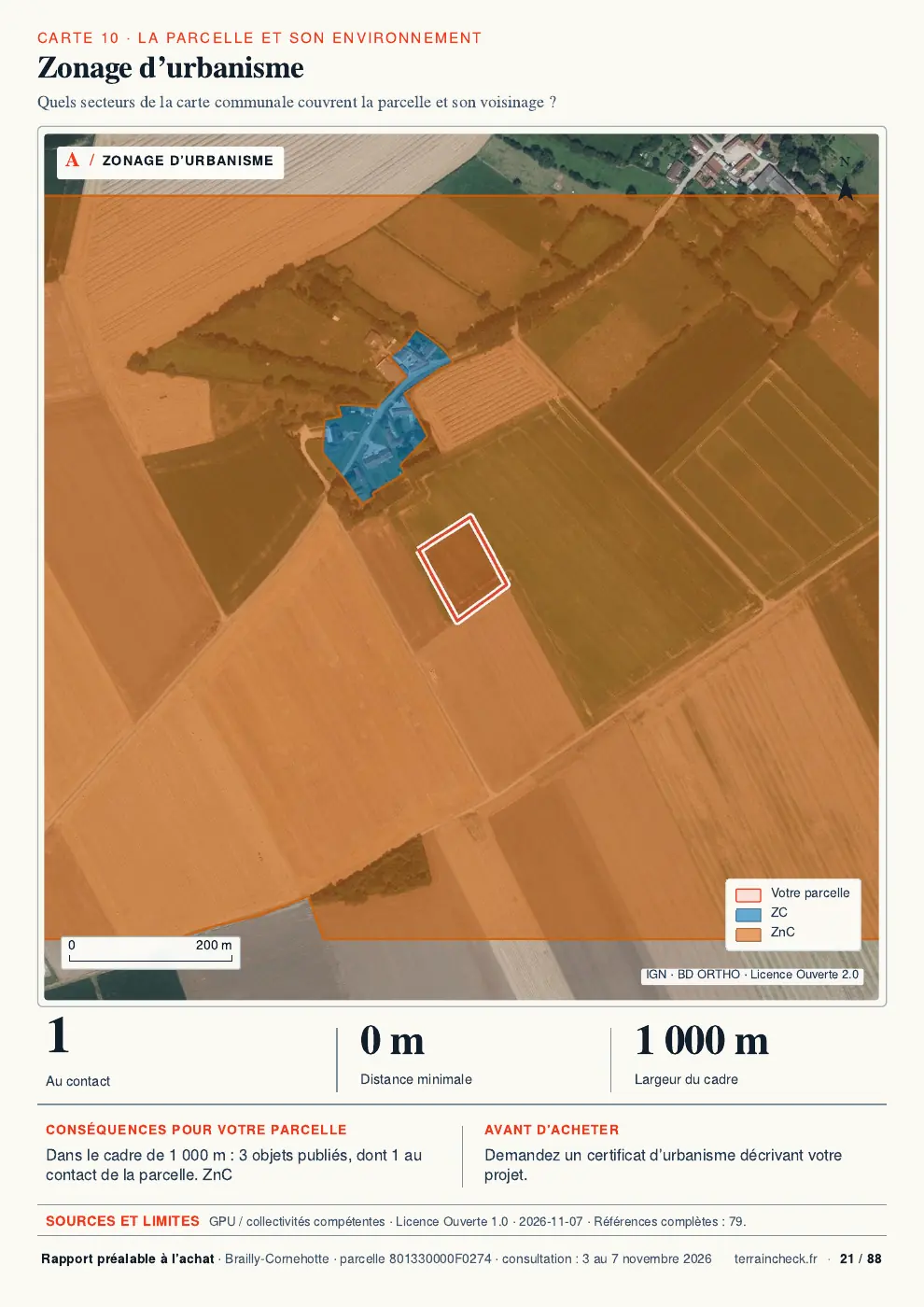
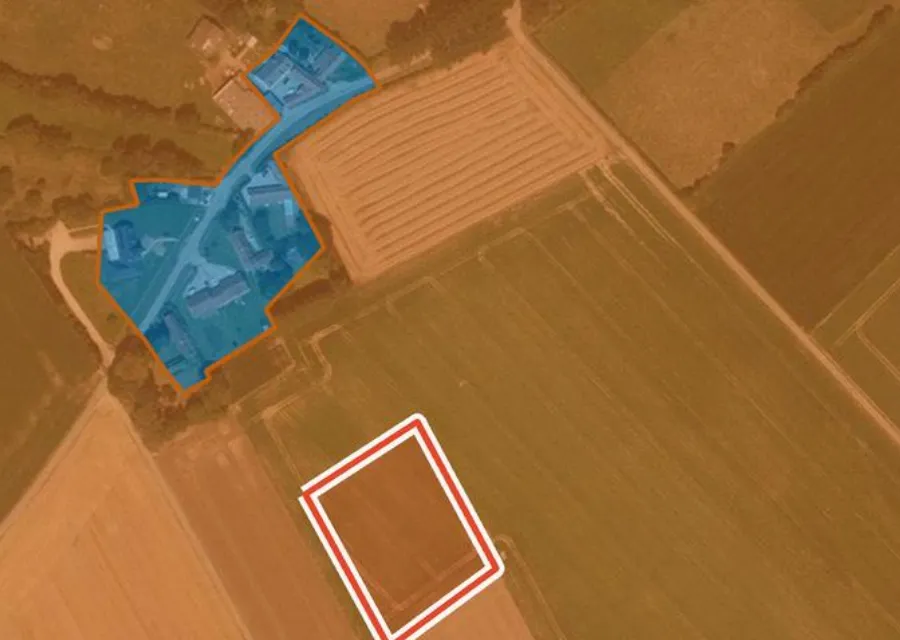
See the road and the surroundings of the parcel before you write to the operators
Pick the parcel on the map. The report locates the nearest road in the IGN data and its indicative width, nearby high-voltage lines and railways, the planning zone and natural hazards, each with its source and date, explained in English. It does not draw water, sewer or electricity networks. Free preview, PDF report for €29 (€39 in French and English).