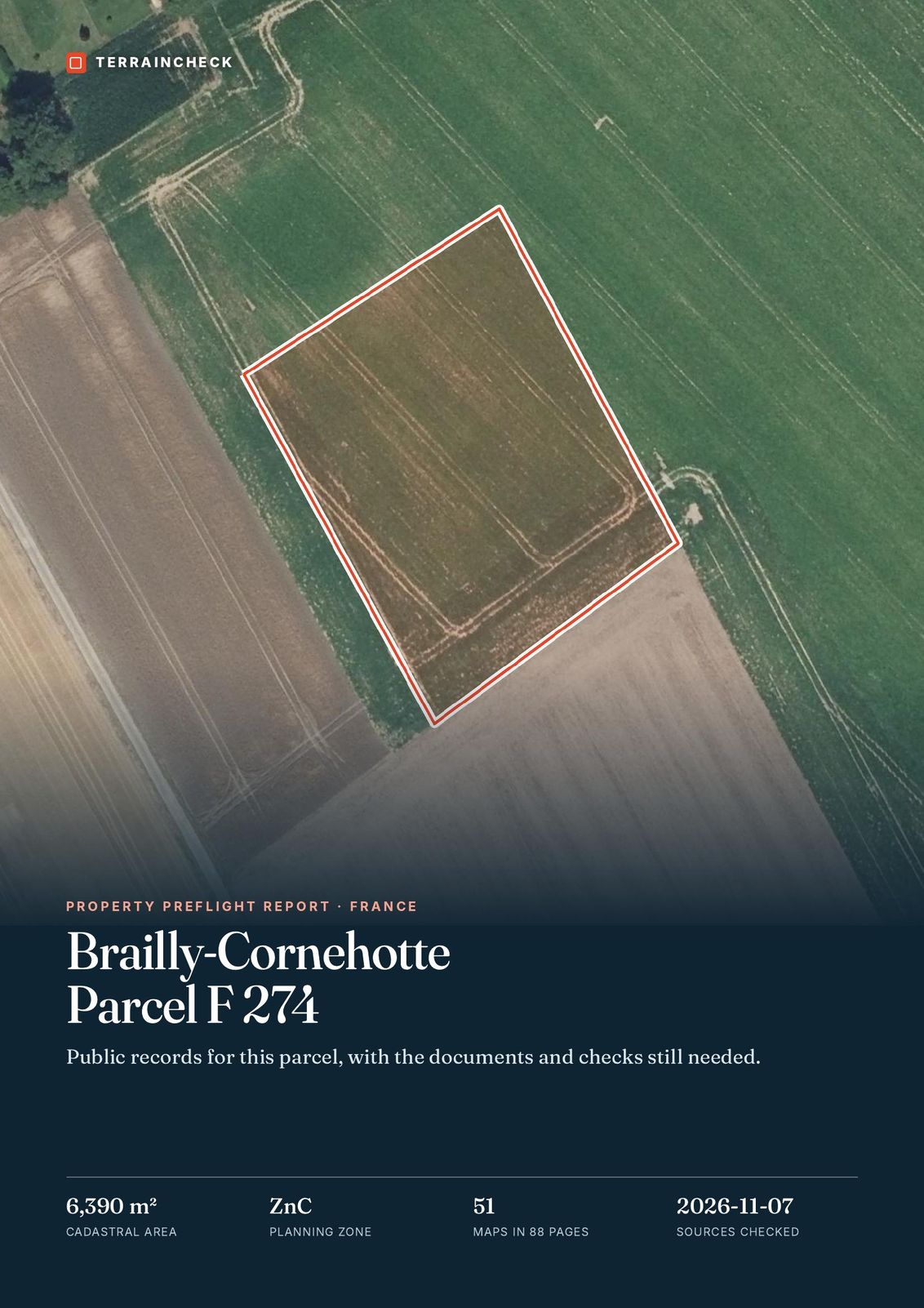
Pillar: Buying building land in France
Easements (servitudes) on French land: where to find them before you buy
Look for easements in three places before you sign: the seller’s title deed, the land registry (service de publicité foncière, form 3233-SD, €12 per property, answer within 10 days; in Moselle, Bas-Rhin and Haut-Rhin a separate register, the Livre foncier, with its own procedure) and, for public-interest easements, the annexes of the local plan (PLU) or the Géoportail de l’urbanisme. The cadastral map does not show rights of way.
In brief
- Private easements: read the seller’s title deed, then ask the service de publicité foncière (land registry) for the area (form 3233-SD, €12 per property, written answer within 10 days). That form, fee and deadline do not apply in Moselle, Bas-Rhin and Haut-Rhin (Alsace-Moselle): those three départements have a separate register, the Livre foncier, with its own offices and procedure; apply to the office for the area.
- Public-interest easements (historic monument, power line, hazard plan): the annexes of the PLU (the local plan) at the mairie (town hall) and the Géoportail de l’urbanisme; the free planning certificate lists them too.
- On site: access to a public road, slope and water run-off. A plot with no direct road access needs a right of way, to be checked before any building permit application.
- An easement that cannot be seen, that the seller did not declare and that is serious enough to presume you would not have bought had you known of it lets you ask for the sale to be cancelled or, if you prefer, for compensation: all three conditions apply to either remedy (Civil Code, art. 1638). Better to find it before the compromis (the preliminary sale contract).
On this page
Four kinds of easement, four places to look
In French law a servitude is a burden on one piece of land for the benefit of a neighbouring one (Civil Code, art. 637). It arises from the lie of the land, from statute or from an agreement between owners (art. 639). On top come public-interest easements (servitudes d’utilité publique, SUP), imposed for public bodies and network operators.
| Kind | Example | What to know |
|---|---|---|
| Natural | The lower plot must take the water that runs down from the plot above. | Only rain, spring or snow-melt water flowing naturally, not wastewater. You may not build anything that blocks that natural flow. The burden ends if the neighbour makes it worse, for example with a drain directed at your plot. |
| Statutory | A right of way across a neighbour’s land for a landlocked plot. | The plot must have no outlet to a public road, or one too narrow for its use, building included. The neighbour is compensated. A plot that is merely awkward to reach has no such right: the neighbour must agree in writing. |
| Agreed | Access, a pipe or a view granted by a former owner. | Discontinuous easements (such as a right of way) and those that cannot be seen can only be established by titre (art. 691). That title is not always a separate deed creating the easement: between two plots that were once a single property, a visible arrangement left by the former owner can stand as title (destination du père de famille, art. 692 to 694, explained below). A right of way passes with the land on a sale. |
| Public interest | Setting of a monument (AC1), power line (I4), road line (EL7). | Annexed to the PLU and published on the Géoportail de l’urbanisme. They burden the land by law, and no private person can set them aside on their own. |
AC1, I4 and EL7 are codes from the national list of public-interest easements. Sources: Service-Public: water running off a neighbour’s land; Civil Code, art. 640 (natural run-off); Service-Public: right of way; Civil Code, art. 682 (right of way for landlocked land); Civil Code, art. 691 (easements created by deed); Civil Code, art. 690 to 696 (how easements are established; destination du père de famille, art. 692 to 694); Géoportail de l’urbanisme: public-interest easements (Planning Code, art. L152-7); Géoportail de l’urbanisme: list of public easement codes, updated 21/03/2025. Accessed 12 November 2026.
Private easements: the deed and the land registry
The cadastral map says nothing about a right of way or a pipe. Easements agreed between owners are written into deeds, and those that were registered are held by the land registry. Its records are public: anyone may ask about a property, not only the owner. Moselle, Bas-Rhin and Haut-Rhin work differently: land registration there goes through a separate register, the Livre foncier, a system specific to local law and run by its own offices (bureaux fonciers). Form 3233-SD, its fee and its deadline, described below, do not automatically carry over; ask the office for the area where the land lies for its own procedure.
- The seller’s title deed. Where: ask the seller or their notaire before you make an offer. Read the section on easements and on previous owners. Cost: nothing to ask. Time: as agreed with the notaire.
- A search at the land registry. Where: the service for the area where the land lies, on form 3233-SD (records published since 1 January 1956). Cost: €12 per property, paid in advance; the answer comes free by email, or €2 more by post. Time: a written answer within 10 days; the office gives no information by phone or in person. The answer lists the registered deeds. To read the deed that creates an easement, order a copy on form 3236-SD: €15 per deed copied (registration schedules and co-ownership rules are charged differently), plus €2 by post. Forms and answers are in French.
- The site visit. Look for a track crossing the land, manholes, poles, network markers, ditches, and how you actually reach the public road. Cost: none. What is visible matters twice over: the protection of article 1638 covers only easements that cannot be seen and were not declared, and between plots that were once one property a visible arrangement can stand as title (see below).
- Written questions to the seller. By email, before the preliminary contract. Ask for every easement they know of, benefiting or burdening the land, with copies of any agreements. A party who knows information decisive to the other’s consent must disclose it, provided the other is legitimately unaware of it or relies on them (Civil Code, art. 1112-1).
A deed that says nothing does not settle the matter. Where two plots come from the division of one property, and it was the former common owner who laid things out in the way that gives rise to the easement, the destination du père de famille stands as title for continuous and apparent easements (Civil Code, art. 692 and 693). Article 694 adds that where the owner of two plots with a visible sign of an easement between them disposes of one and the contract contains no agreement about that easement, it continues to exist. The Cour de cassation applies that rule to discontinuous easements where visible signs existed when the property was divided and the deed of division contains no stipulation against keeping them (3rd civil chamber, 23 March 2022). So a missing clause in the seller’s deed is not enough to rule out a visible track or pipe: ask the notaire for the deed of division and for their reading of it.
Sources: Civil Code, art. 691 (easements created by deed); Civil Code, art. 690 to 696 (how easements are established; destination du père de famille, art. 692 to 694); Cour de cassation, 3rd civil chamber, 23 March 2022, no. 21-11.986 (destination du père de famille and discontinuous easements). Accessed 12 November 2026.
Public-interest easements: the PLU, the Géoportail and the planning certificate
The PLU carries in its annexes the public-interest easements that affect land use (Planning Code, art. L151-43). One year after the PLU is approved, or after a new easement is created, only those annexed to the plan or published on the Géoportail de l’urbanisme can be raised against a permit application (L152-7). Where the plan or the easement predates the decree listing easements, the one-year period runs from that decree’s publication.
- Géoportail de l’urbanisme. Open the map tab, type the address, click the parcel: the documents that apply can be downloaded, easements included. Cost: none. Time: immediate. The site is in French.
- Mairie or intercommunality. The portal is for information only; the documents held at the mairie, the intercommunal body or the prefecture are the ones that count. Some easements (airport clearance T5, pipelines I1) are hidden beyond 1:25,000: ask for the easement plan.
- Information planning certificate. Where: the mairie, by form or online. Cost: free. Time: 1 month. It lists the public-interest easements on the plot and is valid for 18 months. A prospective buyer may apply. See the certificate guide.
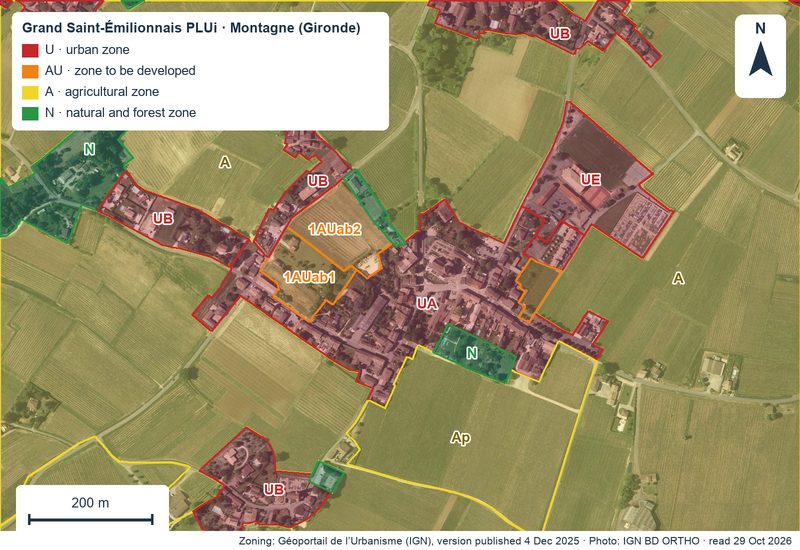
A blank map proves nothing about private easements: the report says so itself, and the PLU annexes deal with public-interest easements. For the zone rules that sit alongside the easements, see reading the PLU.
Finding an easement after signing
If the land carries easements that cannot be seen, that the seller did not declare, and that are serious enough to suggest you would not have bought had you known, you may ask for the sale to be cancelled or accept compensation instead (Civil Code, art. 1638). An easement you could see on the visit, such as a worn track, does not give you that remedy.
Most of this is easier to settle before you sign: have the preliminary contract list the known easements, attach the written agreements, and make the sale conditional on the building permit if your project depends on access. In a dispute, turn to the notaire and a lawyer.
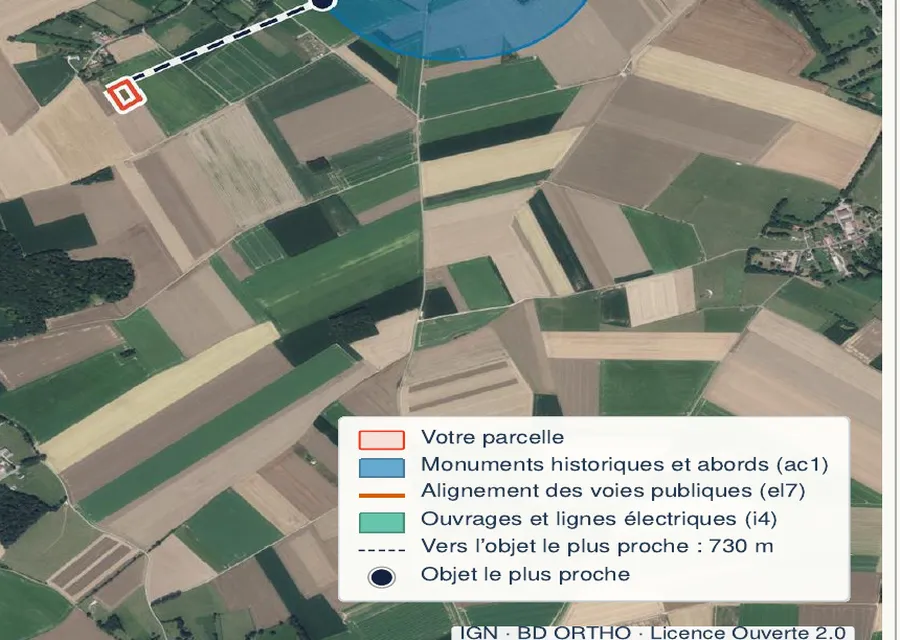
In the report: public easements around the parcel
Before the compromis: the easements checklist
- Copy of the seller’s title deed, easements section read; deed of division requested if the plot was carved out of a larger property.
- Form 3233-SD sent to the land registry (€12 per property, answer within 10 days); in Moselle, Bas-Rhin and Haut-Rhin, a request to the Livre foncier office under its own procedure.
- Public-interest easements noted on the Géoportail de l’urbanisme, then confirmed at the mairie.
- Information planning certificate requested (free, 1 month).
- Access to a public road checked; a written right of way if the plot does not reach one.
- Known easements listed, and written agreements attached, in the preliminary contract.
Read next: boundary surveys and their cost, access and utilities and the checks before the compromis.
Keep reading
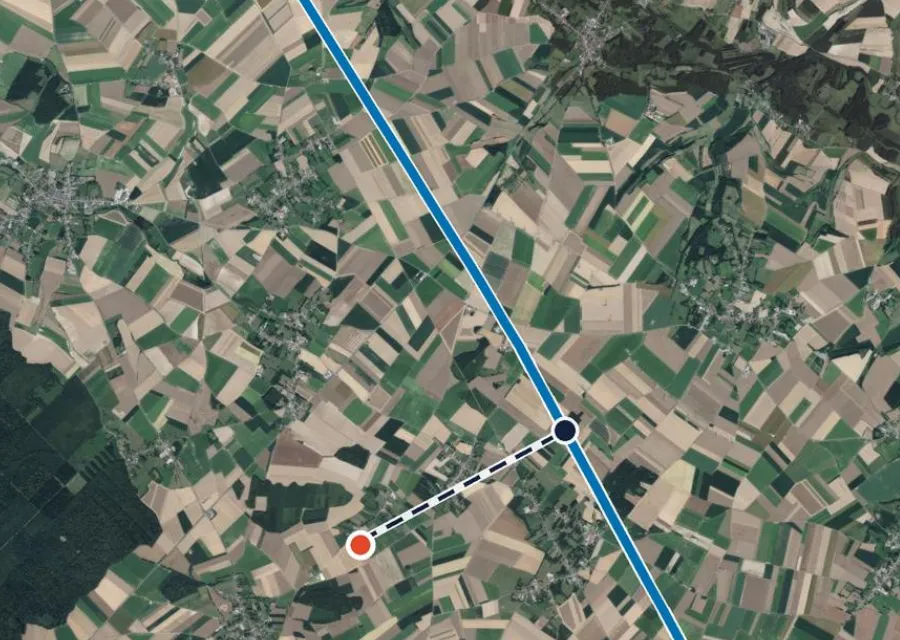
Land near a high-voltage line or transformer in France: easements, distances, fields
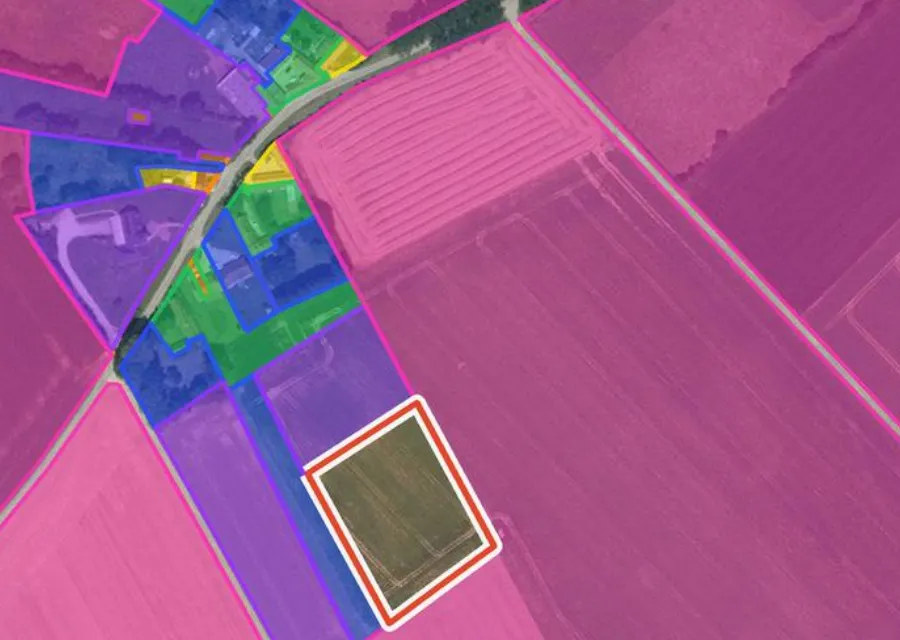
Land boundary survey (bornage) in France: when it is required, how the price is set and who pays
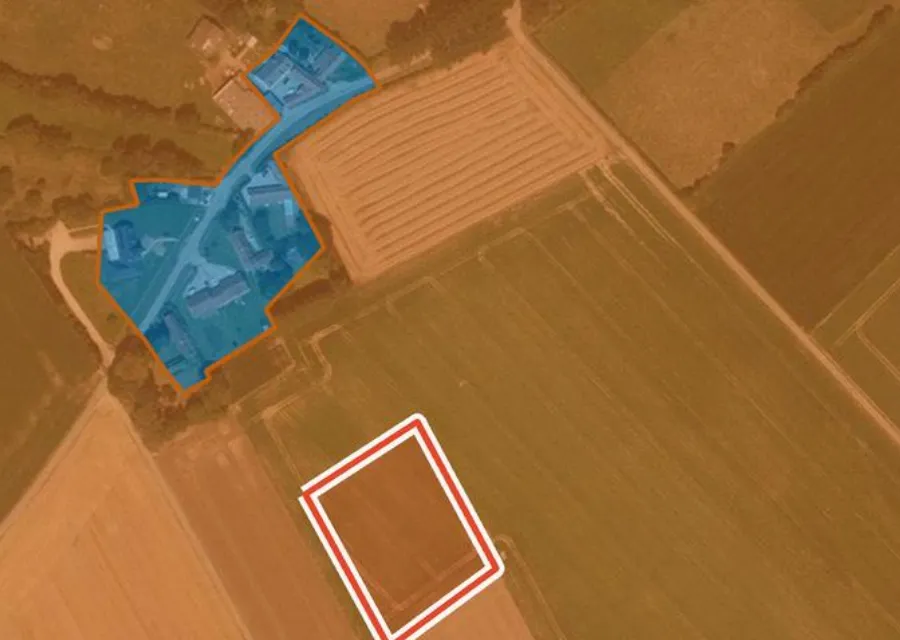
Is a plot buildable in France? How to check the zone, utilities, easements and the official answer
Reading the PLU before you buy: zone, rules, easements and pending changes
Pipe and utility easements on land in France: what they forbid and how to find them
See the public easements around your parcel
For the parcel you pick on the map, the report lists the public-interest easements published nearby and how far away they are, then the planning zone and the hazards, each with its source. Private easements are a matter for the notaire. Free check, PDF report for €29 (€39 in French and English).