Pillar: Buying building land in France
Connecting land to utilities in France: costs, steps and timescales
In France, you pay each utility separately to connect a plot. Where Enedis runs the grid, connecting a house (up to 36 kVA, plot with direct access to a public road) costs €490 incl. VAT on average if the meter box is already on the boundary and €1,910 if one has to be fitted, with a minimum wait estimated by Enedis at 2 months (3 with a meter box, 6 with a network extension). First step: an operational planning certificate from the town hall, then a written quote from each operator.
In brief
- The order: an operational planning certificate from the mairie (town hall), free, with 2 months for the reply; written answers from each utility before you sign the compromis (the binding preliminary contract); connection requests once you hold the building permit; switch-on when the works are finished.
- Who quotes: every network has its own operator and its own quote. Enedis runs the electricity distribution network across 95% of France, a local distribution company elsewhere; water and wastewater are run by the commune (municipality) or a group of communes.
- Electricity: for a house up to 36 kVA on a plot with direct access to a public road, extending the network adds a length-based part to the Enedis fixed part (€1,910 incl. VAT on average), and the stated minimum wait rises to 6 months. Plots without direct access or with special features need a specific Enedis study.
- Wastewater: where the local authority has adopted it, the PFAC sewer charge is capped at 80% of what supplying and installing the private system you avoid would cost, less any reimbursement the owner owes the local authority for the public part of the connection; the connection works are paid on top. With no public sewer, budget for a private system, inspected by the SPANC (the local service inspecting off-mains systems).
- Budget: one line per item, each backed by the quote or council decision that prices it. A line with no document is an unknown amount, not a zero.
On this page
The steps in order, and how long each takes
Plan the utility connections for a stand-alone plot before you sign; the works come once you have planning permission. The sequence for a house, with each source’s time limit where one exists:
- Before the preliminary contract: the operational planning certificate. Apply at the mairie; it is free, the mairie has 2 months to deal with it and the certificate is valid for 18 months from issue. It states the public roads and networks, existing or planned. How to apply.
- Ask each utility in writing. Ask Enedis (or the local distribution company), the water service and the wastewater service where the nearest connection point is and what they will charge. Enedis offers an online simulation before planning consent. Reply time: none is set by the texts cited here.
- The compromis or unilateral promise. Have the notaire (the public official who draws up the sale) record what is already there (a meter box on the boundary, a sewer inspection chamber) and what remains to be done, and make the purchase subject to the building permit through a condition precedent. Time: whatever the contract sets for each condition.
- The building permit. If there is a public sewer, the site plan shows the connection to it; if not, it shows the private system, and the file includes the certificate of compliance of the project issued by the SPANC. Processing: 2 months for a single-family house from the filing of a complete application; the cases where this changes are in our guide to permit processing times.
- Connection requests. Enedis takes them online, with a copy of the planning consent, the site plan and the power you need; it estimates 2 to 6 weeks to draw up the quote depending on the case, the quote is valid for 3 months and a deposit is paid when you sign it. For water and wastewater, the documents, payments and times are those in each service’s rules: no national time limit is set by the texts cited here.
- Works and switch-on. Enedis estimates 4 to 18 weeks of works depending on the case, then 1 to 2 weeks to switch on. Where a public sewer already runs past, the connection is made during the building works. Power for the building site is a separate temporary connection (branchement provisoire), requested on its own.
Serviced or just “served”: where the network stops
In a lotissement (a planned subdivision), the plot sold must be buildable, serviced and surveyed, meaning connectable to roads and networks (drinking water, wastewater, electricity, telephone). Outside one, “viabilisé” or “desservi” in a listing does not tell you where the connection point is: our guide to these listing phrases shows how to check them document by document.
For the budget, what matters is the distance between the network and your boundary. For a house up to 36 kVA on a plot with direct access to a public road, Enedis describes three situations, each setting the average price and the wait.
Who prices each network, and where to find the detail
Each network has its own operator, rules and quote. The table shows whom to ask, what is published, and which guide covers each network. Quotes will be in French; ask for them by email.
| Network | Operator | What is published | In detail |
|---|---|---|---|
| Electricity | Enedis across 95% of France, elsewhere the local distribution company | Enedis averages, house up to 36 kVA with direct access to a public road: €490 incl. VAT (box on the boundary), €1,910 incl. VAT (box to fit); with an extension, a fixed part plus a length-based part. Not binding. | Enedis connection |
| Drinking water | The water service of the commune or group of communes | Each service sets its own charges and rules. | Water connection |
| Wastewater, public sewer | Commune or group of communes | PFAC, if a council decision adopts it: at most 80% of the cost of supplying and installing the private system you avoid, less any reimbursement the owner owes for the public part of the connection; due on connection. It is not the price of the works. | Sewer and PFAC |
| Wastewater, no sewer | An installer you choose, inspected by the SPANC | Inspection is compulsory and charged; soil studies required by the commune are paid by the owner. | Septic tank or micro-station |
What each operator publishes, and the guide that covers its network. Sources: Enedis: indicative connection prices and times; Enedis: the electricity market (who runs the distribution network); Public Health Code, art. L1331-7 (PFAC); Service-Public: domestic wastewater. Accessed 14 November 2026.
The Enedis averages are a benchmark before the quote. The exact price list and how an extension is charged are explained in our guide to an Enedis connection.
The public part of the sewer connection, the part under the public road up to and including the inspection chamber nearest the edge of the public land, has its own rules.
For a house built after the sewer came into service, the commune may take on that part at the owner’s request; the other cases and the owner’s reimbursement to the local authority are set by Article L1331-2 of the Public Health Code. Ask the wastewater service who builds it and for how much. The pipework that takes wastewater from the house to that public part is paid for by the owner alone.
The PFAC can be charged even where the connected building was subject to the taxe d’aménagement (a one-off development tax) at a rate above 5% (Conseil d’État opinion of 18 July 2025), so budget for both. How the tax is worked out is in our guide to the development tax.
A servicing budget you fill in yourself
Copy each amount from the quote or council decision you obtain; with no document, mark the line “unknown”. The “benchmark” column repeats what a source publishes. Lines 5 to 7 apply if there is a public sewer, line 8 if there is not.
| Item | Who prices it | Document to get | Published benchmark | Your amount |
|---|---|---|---|---|
| 1. Electricity connection | Enedis or the local company | A quote on the actual technical solution | €490 or €1,910 incl. VAT on average with Enedis (up to 36 kVA, direct access to a public road) | ……… € |
| 2. Network extension, if needed | The same operator | The same quote, with the variable part itemised | Length-based, on the operator’s price list | ……… € |
| 3. Work on your land not covered by the operator | Your builder or groundworks firm | A written list of what the operator’s quote leaves out, then a quote | No national benchmark cited here | ……… € |
| 4. Drinking-water connection | Water service | Quote and service rules | The service’s charges | ……… € |
| 5. PFAC | Commune or group of communes | The PFAC council decision | At most 80% of the cost of the private system avoided, less any reimbursement owed for the public part of the connection (Art. L1331-2) | ……… € |
| 6. Public part of the sewer connection | Wastewater service | Quote, or the council decision on the owner’s reimbursement | Conditions: Art. L1331-2 of the Public Health Code | ……… € |
| 7. Private pipework up to the public part | Your contractor | Quote | Paid by the owner alone | ……… € |
| 8. No sewer: soil study and private system | Engineering firm, installer, SPANC | Study, quote, certificate of compliance of the project | SPANC inspection compulsory and charged | ……… € |
| Total | Sum of the priced lines, plus the lines still without a document | ……… € |
A budget template to fill in from the quotes and council decisions in the third column. Sources: Enedis: indicative connection prices and times; Public Health Code, art. L1331-7 (PFAC); Public Health Code, art. L1331-2 (owner’s reimbursement for the public part of the connection); Public Health Code, art. L1331-4 (private pipework); Service-Public: domestic wastewater. Accessed 14 November 2026.
The full cost of the purchase, including notary fees and the development tax, is in our guide to the total cost of a plot.
Electricity often sets the timetable
Enedis publishes minimum times for a house, quote included, on condition that your own steps and works are done in time. They run from the request, which requires planning consent.
So plan backwards. If an extension is needed and building should start in spring, the request goes in as soon as the permit arrives. The meter is only switched on once the works invoice is paid, a contract is signed with an electricity supplier and the Consuel certificate of conformity for the indoor wiring has been obtained.
In the report: the distance that drives the quote
Before you sign: the utilities checklist
- Operational planning certificate applied for, with roads and networks mentioned.
- Electricity box, water meter and sewer chamber: on the boundary or not (photos).
- Written answers from Enedis, the water service and the wastewater service on the connection point.
- The PFAC council decision, or the off-mains sanitation zoning and a soil study.
- Budget template filled in, with lines still lacking a document marked.
- Timetable: permit, connection requests, for electricity at least 2 months, 3 with a meter box, 6 with a network extension (Enedis estimate, house up to 36 kVA with direct access to a public road).
Read next: the total cost of a plot and the cadastral reference to give the operators.
Common questions
Does the seller have to deliver a serviced plot?
In a lotissement, yes: the plot must be buildable, serviced and surveyed. Outside one, check the position network by network with each operator and have the compromis record what is there and what remains to be done.
Can I apply for the electricity connection before the permit?
Enedis takes a house connection request with a copy of the planning consent (building permit or prior declaration). Before that, Enedis offers an online simulation to estimate the technical solution.
Is the PFAC charged everywhere?
No. It applies only where the commune or group of communes has adopted it by council decision, and it is paid by owners of buildings that must connect to the public sewer. Ask the mairie for the decision.
Keep reading
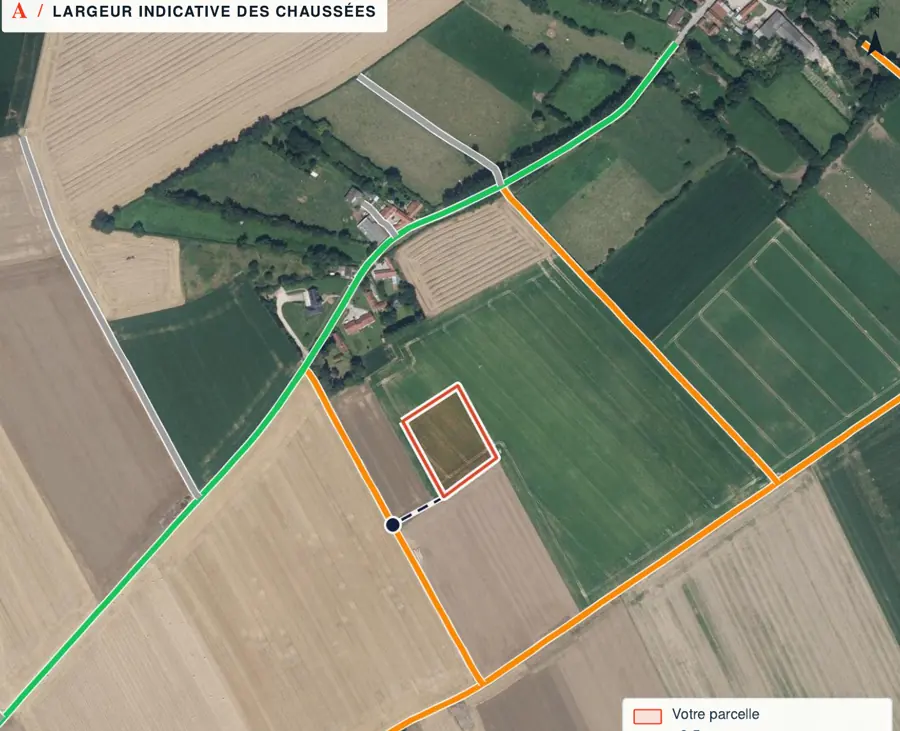
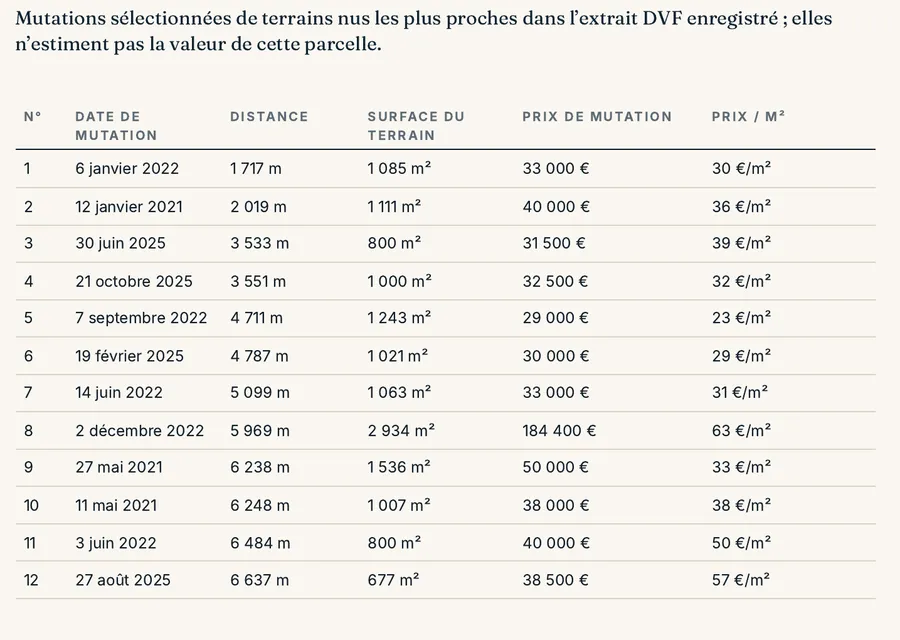
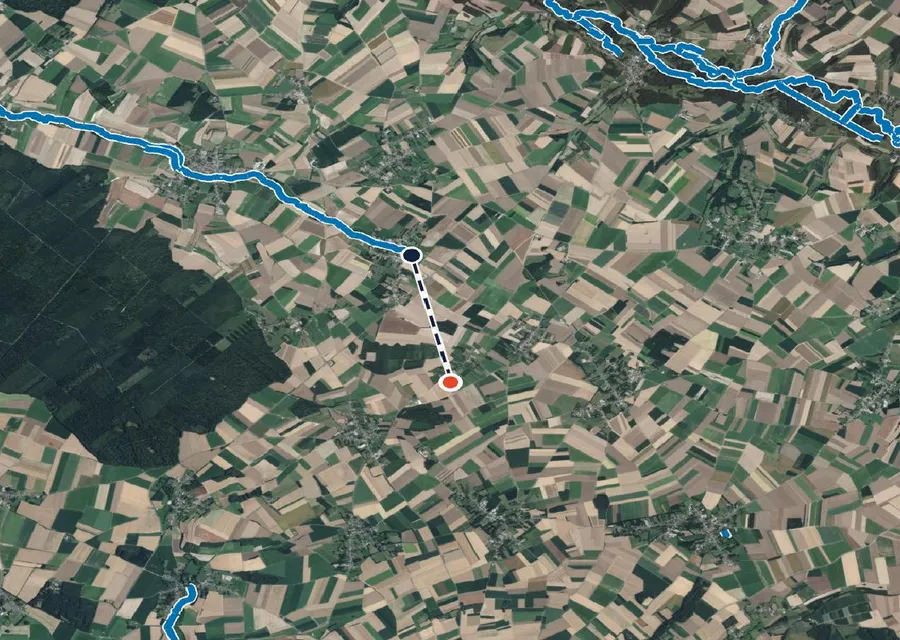
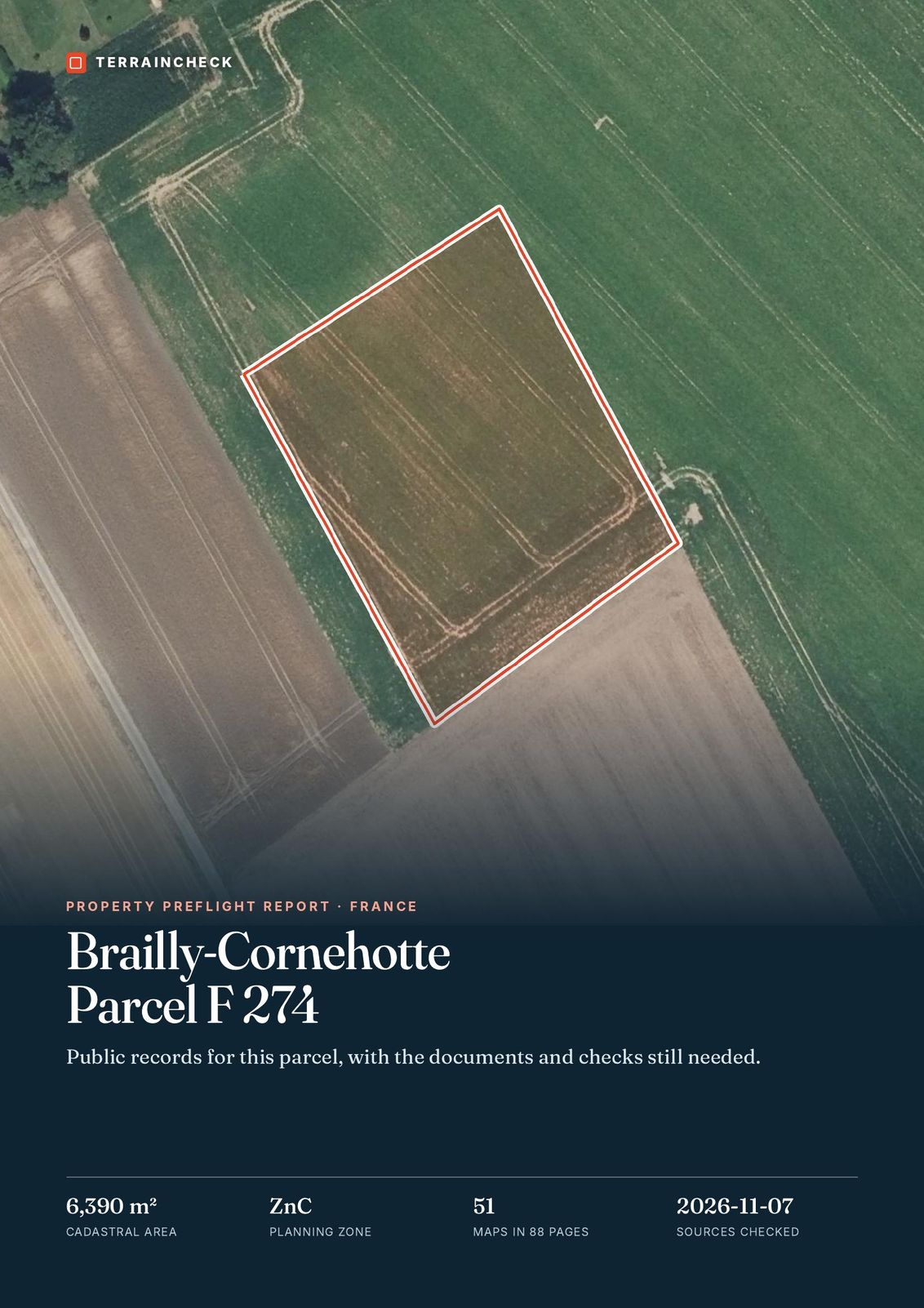
Measure the distance to the roads for your parcel
Pick the parcel on the map. The report measures how far away the nearest roads are and how wide, marks overhead power lines and gives the zone in the PLU (the local zoning plan), each with its source and date, explained in English. It does not map pipes or buried cables. Free check, PDF report for €29 (€39 in French and English).