Pillar: Buying building land in France
Building permit in France: processing times, missing documents and tacit approval
In France, if no document is requested and no extension notified within a month of filing, the town hall (mairie) has, as a rule, two months to decide on a building permit for a single house; after that, its silence amounts, with some exceptions, to a tacit permit (Planning Code, art. R423-23 and R424-1). First step: keep the filing receipt, which gives the date of that tacit permit.
In brief
- 1, 2 or 3 months. Prior declaration: 1 month; building permit for a single house: 2 months; other building permits and development permits: 3 months, from a complete file. Within a month of filing, the mairie (town hall) may ask for documents or extend the period, for example by one month near a listed historic monument; with no letter in that month, no extension applies, apart from exceptional ones (art. R423-34 to R423-37-3).
- Missing documents: three months. If not every document has reached the town hall three months after you received the letter, the application is tacitly refused. Otherwise the period runs from their receipt.
- Silence means yes, with exceptions. A building on the historic monuments register, a classified site, a public inquiry, an environmental assessment, an unfavourable or conditional opinion from the ABF heritage architect: in these cases and the others listed below, silence means refusal.
- After approval. Third-party appeals: two months from the first day of two months of continuous display on the land. Withdrawal of an unlawful permit: three months after the decision. Validity: three years as a general rule, extendable twice by a year under conditions; a transitional regime applies to permits from 2021 to May 2024.
On this page
Standard periods and when they start
The standard period is one month for a déclaration préalable (prior declaration, the lighter procedure for small works), two months for a permis de construire (building permit) for a single house or its outbuildings and for a demolition permit, and three months for other building permits and development permits (art. R423-23). It runs from the day the town hall receives a complete file (art. R423-19), and the file counts as complete if no list of missing documents has been notified within a month of filing (art. R423-22).
You file at the town hall of the commune where the land is, by hand or by recorded delivery. Communes of more than 3,500 inhabitants have an online procedure for applications filed since 1 January 2022 (art. L423-3); elsewhere it depends on the commune. Service-Public’s assistant (in French) lists the documents to attach. Cost: recorded delivery, and the drawings on a quote. The receipt (récépissé) gives the file number and the date on which the permit becomes tacit (art. R423-4): keep it.
| Application | Standard period | Silence at the end |
|---|---|---|
| Prior declaration | 1 month (R423-23 a) | Tacit non-opposition (R424-1 a), except R424-2 II and R424-2-1 |
| Building permit, single house or outbuildings | 2 months (R423-23 b) | Tacit permit (R424-1 b), except R424-2, R424-2-1 and R424-3 |
| Other building permits, development permits | 3 months (R423-23 c) | Tacit permit, same exceptions |
Standard periods, before any extension. Sources: Planning Code, art. R423-19 to R423-37-3 (processing periods); Planning Code, art. R424-1 to R424-4 (tacit decisions). Accessed 12 November 2026.
When the period gets longer
The period is extended in the cases the Code lists. The town hall must tell you within a month of filing the new period, its starting point and the reasons (art. R423-42); an extension not notified in this way does not apply (art. R423-43).
| Situation | Effect | Article |
|---|---|---|
| Another body of law applies; exemption (1° and 3° of art. L152-4 and L152-6); protected heritage area or surroundings of historic monuments; opinion of the CDPENAF farmland commission; public participation (Environment Code art. L123-19-2, or R423-58-1); building subject to demolition (art. L121-22-5, I) | +1 month, prior declarations included | R423-24 |
| Permits: departmental or regional commission; agriculture minister (Rural Code L643-4); exemption under Rural Code L111-3 or Construction Code L111-4-1; retail licence; online public participation (also for a declaration). Not added to the +1 month | +2 months | R423-25 |
| Declaration referred to the regional heritage and architecture commission | +2 months | R423-25-1 |
| Core of a national park; national commission; Corsican Assembly; national nature reserve (declaration: 2 months); building on the monuments register; public-access building or high-rise | 5 months | R423-26 to R423-28 |
| Prior woodland clearance; defence or civil aviation; special consent under the protected-sites law | 3 to 10 months depending on the case | R423-29 to R423-31 |
| Public inquiry (other than woodland clearance); bringing a planning document into line | 2 months or 1 month after the report or decision | R423-20, R423-21, R423-32, R423-32-1 |
| Exceptional extensions, notified before the initial period ends (R423-44): woodland clearance, dispute with the ABF taken to the prefect, call-in by a minister, cinema, retail; suspensions (European Commission, consultation, impact study) | +2 to 5 months, 8 months, or suspension | R423-34 to R423-37-3 |
The extensions of R423-24 and R423-25 are not added to the periods of R423-26 to R423-32-1 (art. R423-33). Sources: Planning Code, art. R423-19 to R423-37-3 (processing periods). Accessed 12 November 2026.
Missing documents: what happens exactly
If the file lacks documents the Code requires, the town hall sends you, within a month of filing, a recorded-delivery letter listing them “exhaustively” (art. R423-38). It counts as received when first presented (art. R423-47), even if collected from the post office later. If you live abroad, give an address where someone can sign for it.
The letter states (art. R423-39) that the documents must reach the town hall within three months of its receipt, that if not all of them are supplied the application is tacitly refused (tacitly opposed for a declaration), and that processing starts when they arrive. A second request made within the month replaces the first and restarts the three months (art. R423-40). A request sent after the first month, or for a document the Code does not require, does not change the periods (art. R423-41).
Example: house application filed on 2 March, letter presented on 25 March, last documents received on 20 April. The two-month period runs from 20 April to 20 June.
Tacit permit: when silence means yes, and when it means no
If no express decision is notified within the period, silence counts as non-opposition to a prior declaration, or as a tacit permit (art. R424-1). A tacit permit takes effect as soon as it arises (art. L424-8), and the town hall issues a certificate of it on request (art. R424-13), which the bank and the notaire (the notary handling the sale) will want.
Silence means refusal for a permit (art. R424-2, I) for: works needing consent from the defence minister, or consent under the law on classified sites (or sites being classified) or nature reserves; a call-in by the minister for sites or nature reserves; a building on the historic monuments register; a public inquiry (Environment Code art. R123-7 to R123-23) or online public participation; referral to the Corsican Assembly; the core or future core of a national park; a cinema refused by the departmental commission; an unfavourable opinion of the retail planning commission; a demolition in a registered site; a refused exemption under Construction Code art. L111-4-1.
For permits and declarations alike, silence also means refusal if the building is subject to the demolition obligation of art. L121-22-5 (R424-2, II) or the project needs an environmental assessment (R424-2-1). Nor is there a tacit permit where the ABF (architecte des Bâtiments de France, the state heritage architect), whose agreement is required, has notified in time an unfavourable opinion or one with conditions (R424-3). In the R424-2 and R424-2-1 cases, the first-month letter must warn you that silence will mean refusal (art. R423-42).
Display, appeals, withdrawal and validity
From notification of the decision, or from the day the tacit permit arises, the holder displays the permit on the land, visible from outside, for the whole of the works (art. R424-15).
| Period | Length | Starts from | Article |
|---|---|---|---|
| Third-party court appeal | 2 months | 1st day of two months of continuous display on the land | R600-2 |
| Serving the appeal on the holder and the authority | 15 clear days | filing of the appeal | R600-1 |
| Administrative appeal (recours gracieux) | 1 month, without extending the court deadline | not set by the article: see the appeal notice | L600-12-2 |
| Withdrawal of an unlawful permit | 3 months | date of the decision, tacit or written | L424-5 |
| Validity | 3 years as a general rule; also lapses if, after that period, works stop for more than a year | notification or date of the tacit permit | R424-17 |
| Extension | twice 1 year, if rules and easements have not changed against the project | apply at least 2 months before expiry; granted if no answer within 2 months | R424-21 to R424-23 |
A court appeal suspends validity until a final decision (art. R424-19). Sources: Planning Code, art. R600-2; Service-Public: displaying a planning permission on site; Planning Code, art. R600-1; Planning Code, art. L600-12-2; Planning Code, art. L424-5; Planning Code, art. R424-17 to R424-20 (lapse); Planning Code, art. R424-21 to R424-23 (extension). Accessed 12 November 2026.
A permit the seller already holds: Decree no. 2025-461 covers only authorisations still valid on 27 May 2025, the day it was published (art. 3). Those granted from 1 January 2021 to 27 May 2022 are extended by one year, without the conditions of articles R424-21 to R424-23 (art. 2); those granted from 28 May 2022 to 28 May 2024 are valid for five years, with no extension under the first paragraph of R424-21 (art. 1). For a tacit permit, Service-Public counts validity from filing; article R424-17, which we follow, uses the date of the tacit decision.
What these periods mean for the compromis
In the compromis de vente (the binding preliminary contract), set the date of a permit condition from the period actually notified, not the standard one, with three months’ margin if documents may be requested. If the deed requires a “purged” permit, use the later of two dates: the end of the third-party appeal period (two months of display, plus fifteen clear days to serve an appeal) and the end of the withdrawal period (three months after the decision). The clause itself is covered in our guide to the compromis; before applying, an operational planning certificate states whether the land can be used for the project.
A historic-monument easement (AC1), which can add a month to the period, appears in the annexes of the PLU (the local plan).
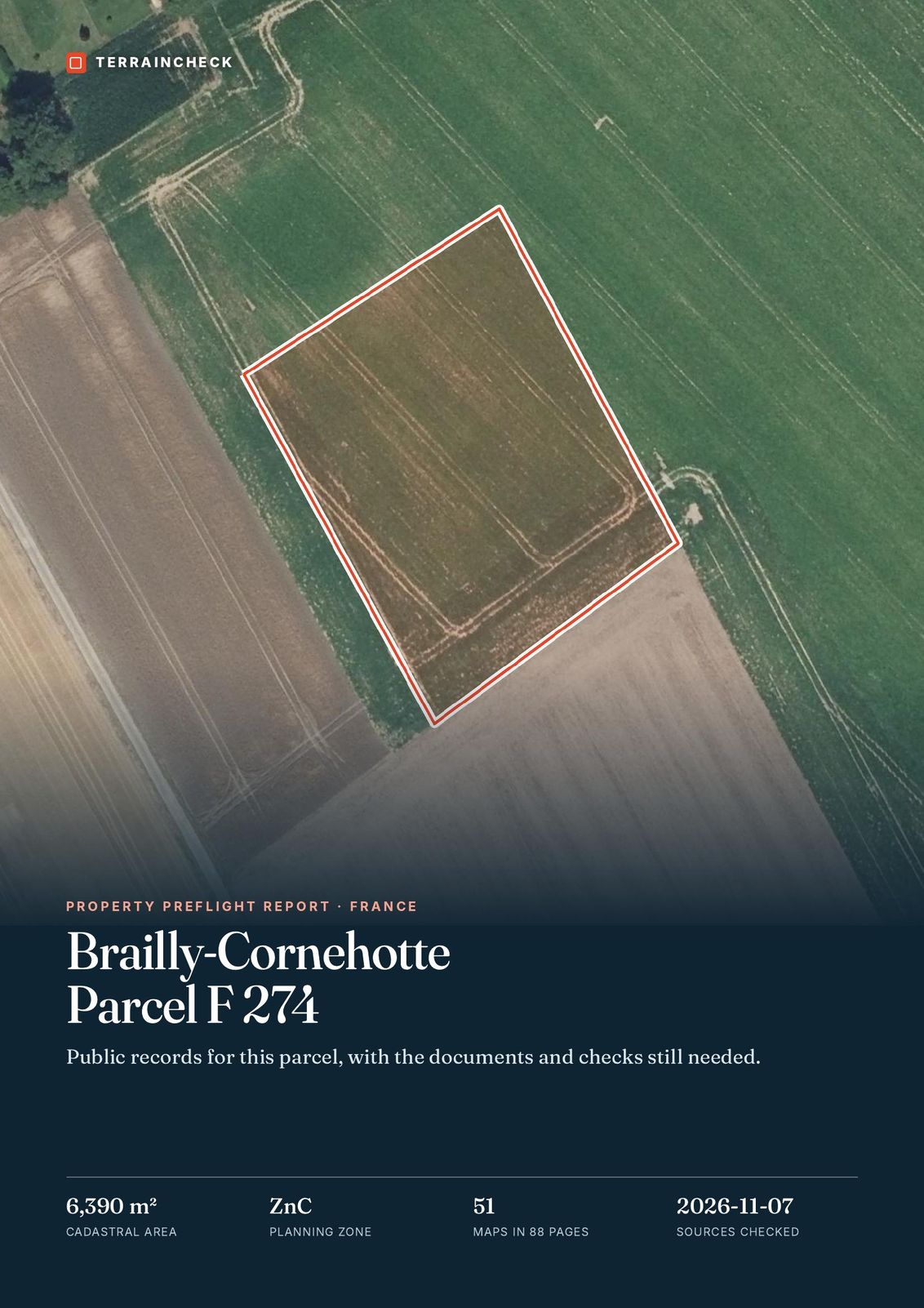
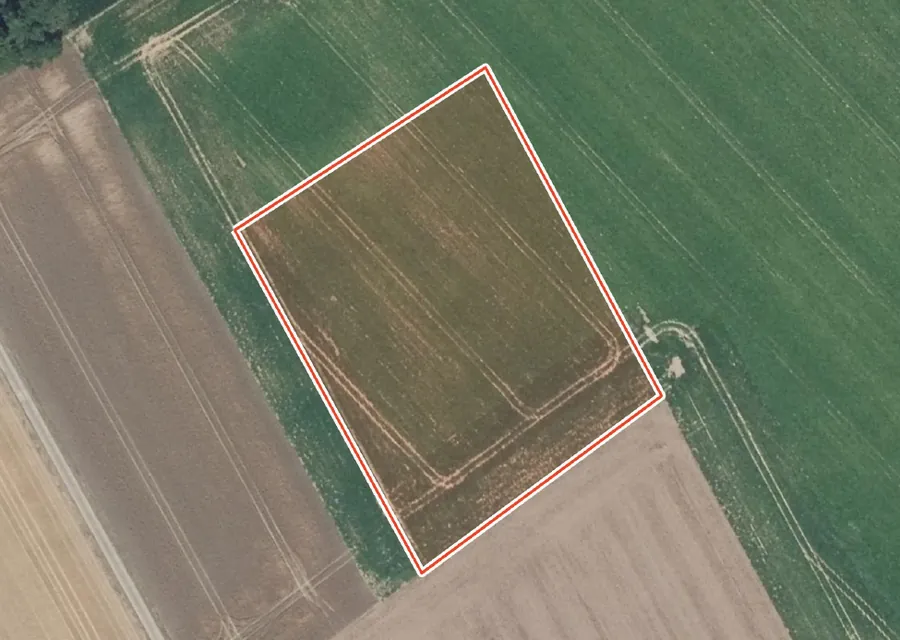
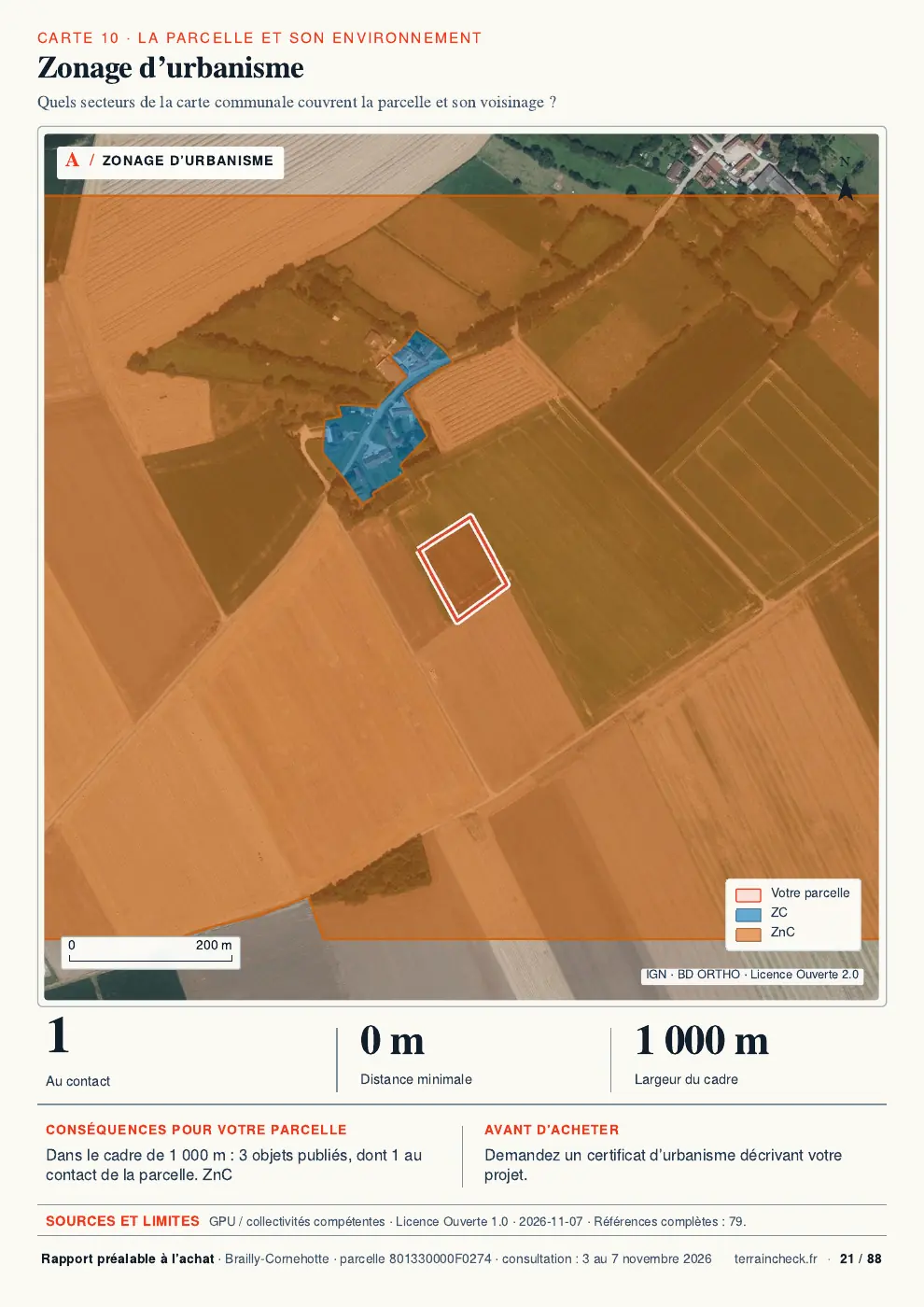
In the report: public easements around F 274
Checklist
- Filing receipt kept, with the tacit-permit date.
- Letter or not in the first month: documents, longer period, warning that silence will mean refusal.
- All documents sent together, by recorded delivery, before the three months run out.
- AC1 easement, classified or registered site, national park: checked before filing.
- Tacit permit: certificate requested; site notice put up and photographed the same day.
- Expiry date (general rule or Decree no. 2025-461) and last date to apply for an extension noted.
Common questions
Does the processing period start on the day I file?
It starts when the town hall receives a complete file (art. R423-19). If no document is requested within a month of filing, the file counts as complete and the period runs from filing; if documents are requested, it runs from their receipt (art. R423-22 and R423-39).
What if the town hall has not answered after two months?
Check that your case is not one where silence means refusal (art. R424-2, R424-2-1, R424-3) and that no extension letter was presented in the first month. Otherwise the permit is tacit: ask the town hall for a certificate (art. R424-13) and display it on the land.
How long is a French building permit valid?
Three years from notification or from the date of the tacit permit, and it lapses if works stop for more than a year after that (art. R424-17). It can be extended twice by one year, on an application made at least two months before expiry (art. R424-21 and R424-22). That is the general rule: a permit granted from 1 January 2021 to 28 May 2024 and still valid on 27 May 2025 falls under Decree no. 2025-461.
Keep reading
Compromis de vente for land in France: the clauses to check before you sign
France’s development tax (taxe d’aménagement): how it is calculated, when it is due and who is exempt
French planning certificates: information or operational CU before buying land
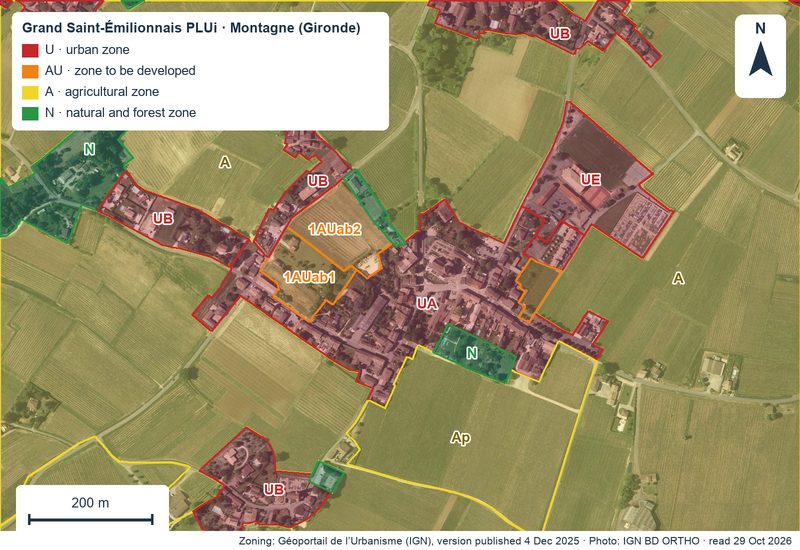
Reading the PLU before you buy: zone, rules, easements and pending changes
Before you apply, see the easements around the land
Pick the parcel on the map: the report locates published public easements (historic monuments, protected sites, networks), the PLU zone and natural hazards, each with its source and date, explained in English. It does not replace the town hall’s decision. Free preview, PDF report for €29 (€39 in French and English).