Pillar: Buying building land in France
France’s development tax (taxe d’aménagement): how it is calculated, when it is due and who is exempt
For a 120 m² main home outside Île-de-France (the Paris region), the 2026 development tax (taxe d’aménagement) is worked out on a value of €62,440; at example rates of 3% for the commune (municipality) and 2.5% for the département (county), the calculation gives €3,434.20, or €3,434 once rounded to the euro, billed in two halves of €1,717 after the work is completed. First step: look up the local rates in the tax administration’s online simulator.
In brief
- 2026 value: €892 per m² outside Île-de-France (the Paris region), €1,011 inside it; €446 and €505 for the first 100 m² of a main home and its outbuildings.
- Rates: the commune (municipality) 1% to 5% (up to 20% in some sectors, no share if it has not introduced the tax), the département (county) 2.5% at most, the Île-de-France region 1% at most.
- Return: within 90 days of completion, on impots.gouv.fr (“Gérer mes biens immobiliers”, manage my property), even if you are exempt, for a permit applied for since 1 September 2022.
- Payment: one bill up to €1,500, otherwise two halves; the first issued from 90 days after completion, the second six months later (projects under 3,000 m²).
On this page
How the development tax is worked out
The taxe d’aménagement is a one-off local tax on work authorised by a building permit (permis de construire), a development permit or a prior declaration (déclaration préalable), or done without one. Since 1 September 2022 the tax administration (DGFiP) assesses and collects it for the commune, the département and, in Île-de-France, the region. The formula: taxable floor area × flat value per m² × the rate of each share.
Taxable floor area
It is the total floor area of every enclosed and roofed level, measured inside the external walls. Deducted are the wall thickness around outside doors and windows, stairwells and lift shafts, and any area with a ceiling height of 1.80 m or less. A pergola or an open terrace is not taxed because it is not enclosed and roofed; an enclosed garden shed or conservatory is.
2026 values, the allowance and the rates
| Item | Outside Île-de-France | Île-de-France |
|---|---|---|
| Flat value per m², 2026 | €892 | €1,011 |
| First 100 m² of a main home and its outbuildings (50% allowance) | €446 | €505 (rounded down to the euro) |
| Communal or inter-communal share | 1% to 5%, up to 20% in some sectors | Same |
| Departmental share | 2.5% at most | Same |
| Regional share | None | 1% at most |
| Archaeology tax (taxe d’archéologie préventive, work that affects the subsoil) | 0.40% of the same value | Same |
Values for permits granted in 2026. Swimming pools (€251 per m²) and outdoor parking spaces (€2,928 to €5,857 per space) have values of their own. Sources: CGI, art. 1635 quater H; CGI, art. 1635 quater I; CGI, art. 1635 quater M; Service-Public: the 2026 amounts (7 January 2026); CGI, art. 235 ter ZG (archaeology tax). Accessed 12 November 2026.
The values follow the construction cost index of INSEE, the national statistics office, every 1 January. The 50% allowance applies only to a main home: a holiday or second home counts at €892 or €1,011 from the very first square metre.
Values, rates, exemptions and allowances are those in force on the day the permit is granted, deemed granted by silence, or the prior declaration is cleared. The floor area, on the other hand, is measured as built.
Sources: Service-Public: taxe d’aménagement (TA); CGI, art. 1635 quater C; CGI, art. 1635 quater F; CGI, Annex II, art. 318 J. Accessed 12 November 2026.
Worked example: a 120 m² house
Assumptions: a new house with 120 m² of taxable floor area, used as the main home, no pool or outdoor parking, permit granted in 2026. The 3% and 2.5% rates are example rates, taken from the examples of Service-Public, the official information site: replace them with yours.
| Step | Outside Île-de-France, example rates | Île-de-France, example rates | Brailly-Cornehotte (Somme), 2026 rates |
|---|---|---|---|
| First 100 m² (value cut by 50%) | 100 × €446 = €44,600 | 100 × €505 = €50,500 | 100 × €446 = €44,600 |
| Next 20 m² | 20 × €892 = €17,840 | 20 × €1,011 = €20,220 | 20 × €892 = €17,840 |
| Taxable value | €62,440 | €70,720 | €62,440 |
| Communal share | 3%: €1,873.20 | 3%: €2,121.60 | 0%: €0 |
| Departmental share | 2.5%: €1,561 | 2.5%: €1,768 | 2.5%: €1,561 |
| Regional share | none | 1%: €707.20 | none |
| Calculated total | €3,434.20 | €4,596.80 | €1,561 |
| Development tax due, rounded to the euro | €3,434 | €4,597 | €1,561 |
| Tax bills | two halves | two halves | two halves |
| Archaeology tax, 0.40%, if the work affects the subsoil: one bill | €249.76, rounded to €250 | €282.88, rounded to €283 | €249.76, rounded to €250 |
Our calculation: shares to the cent, then each tax rounded to the nearest euro (CGI, art. 1724). Example rates in the first two columns; actual rates on 1 January 2026 in the third (DGFiP DELTA file). Sources: CGI, art. 1635 quater H; CGI, art. 1635 quater I; CGI, art. 1724 (rounding to the euro); CGI, art. 1679 octies; CGI, art. 235 ter ZG (archaeology tax); DGFiP: development tax rates voted by local authorities (DELTA), data.gouv.fr. Accessed 12 November 2026.
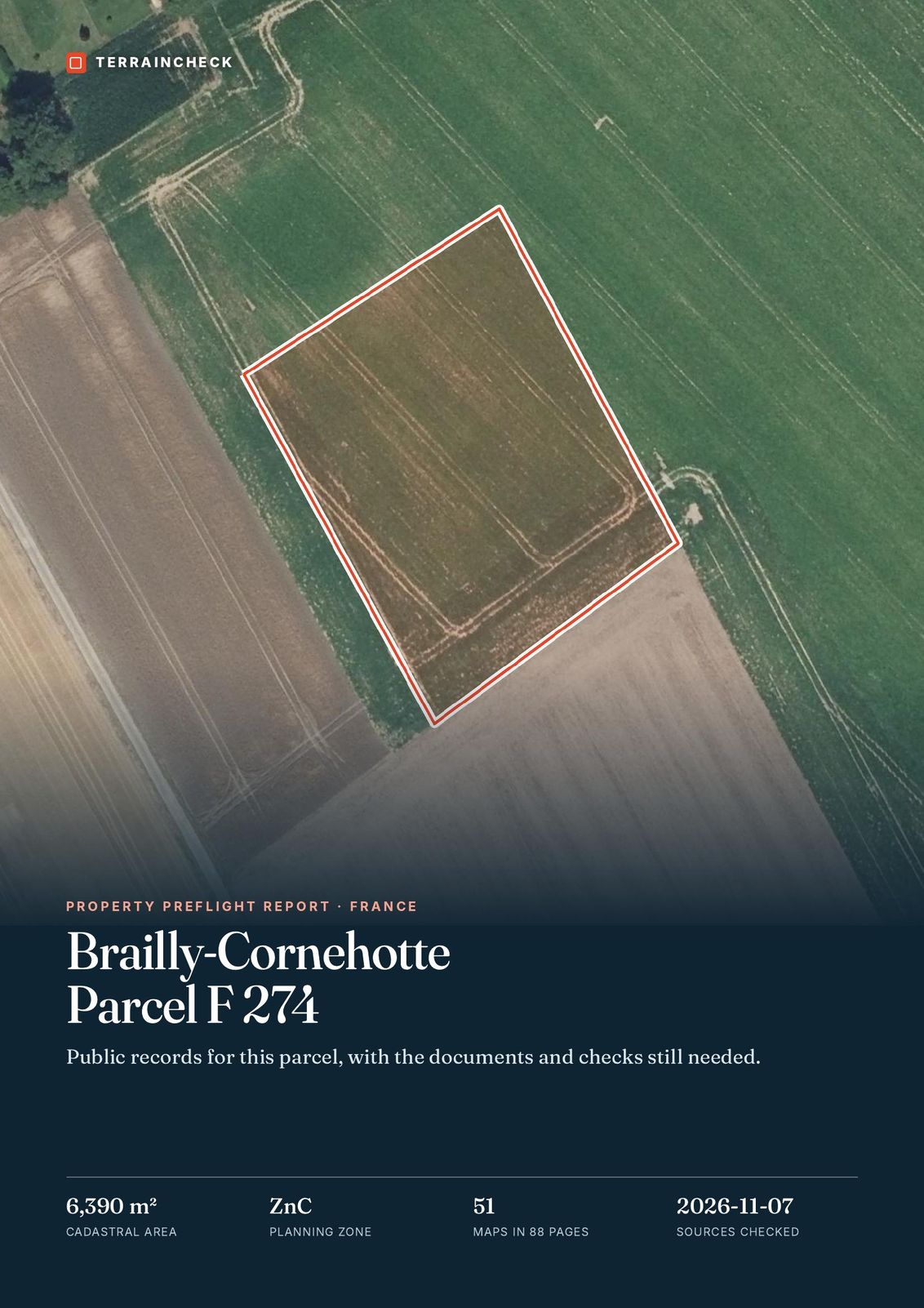
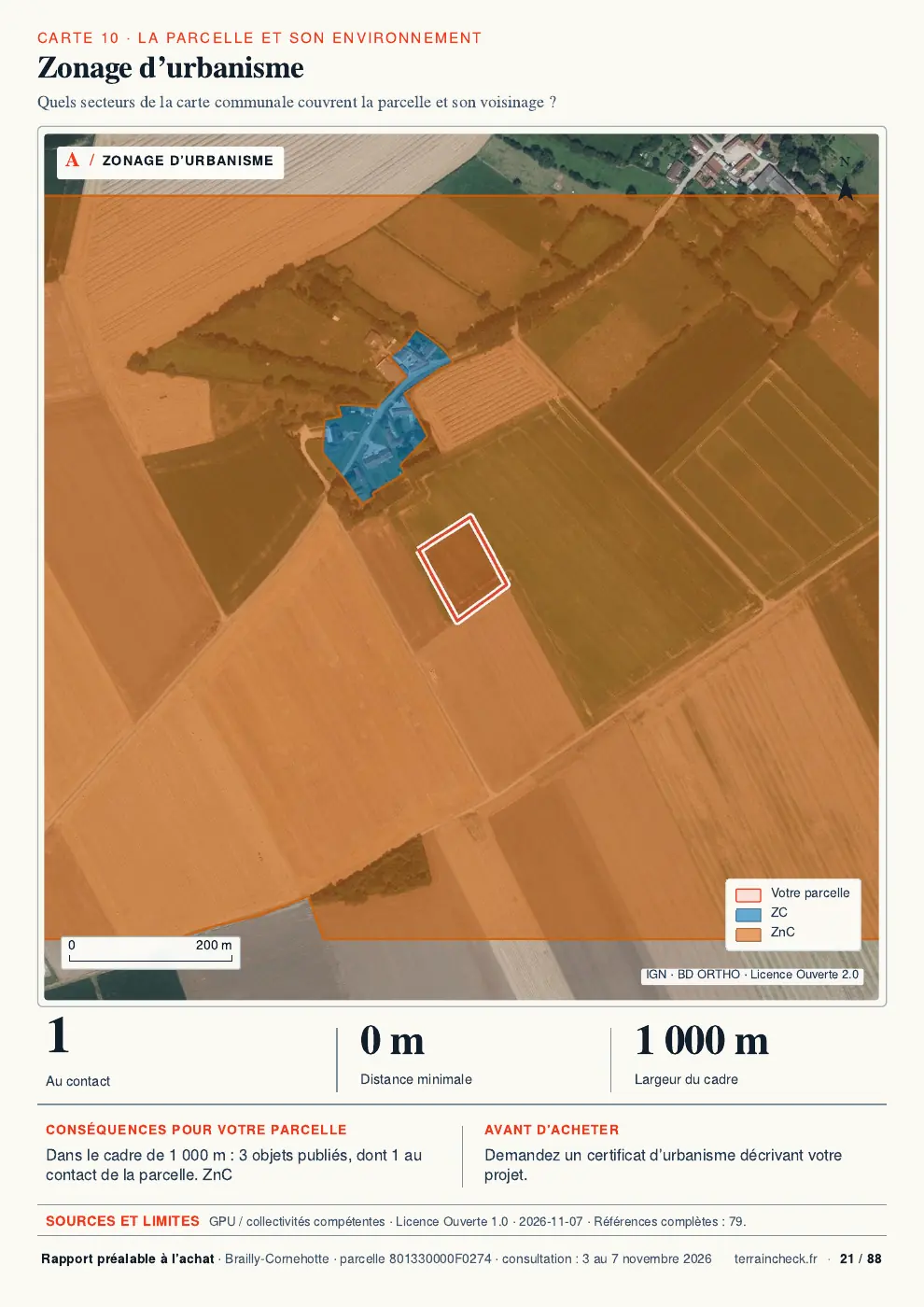
The third column uses the commune of our sample report, Brailly-Cornehotte in the Somme: a communal rate of 0% since 2022 and a departmental rate of 2.5% since 1 January 2026 according to the DELTA file, so €1,561. The archaeology tax is declared on the same return but collected through a single bill.
Sources: DGFiP: filing after building work, user notice (PDF); CGI, art. 1724 (rounding to the euro); CGI, art. 235 ter ZG (archaeology tax). Accessed 12 November 2026.
Finding the rate for your commune
Communes, groups of communes and départements notify their rates to the DGFiP through an application called DELTA, published on data.gouv.fr. These are the communal rates in force on 1 January 2026.
The most common rate is 5%, followed by 1%, 3% and 2%. In the 3,243 communes split into sectors, the rate depends on the plot’s sector. Among the départements, 57 of 101 charge the 2.5% maximum, the lowest 0.8%. The Île-de-France region charges 1% in all eight of its départements.
A commune with a local plan (plan local d’urbanisme, PLU) or an older land-use plan collects the communal share unless it has decided otherwise, at 1% if it has not voted a rate. Other communes, such as those with only a carte communale (a simple zoning map), collect it only if they have introduced it by a council decision.
- Planning-tax simulator on impots.gouv.fr (in French): postcode and cadastral references; it uses the latest rates in force. Cost: none. Result on screen.
- Planning department of the mairie (town hall): does the commune have development-tax sectors, and which one is the plot in? Cost: none. Time: depends on the mairie.
Sources: impots.gouv.fr: planning-tax simulator; Tax Code (CGI), art. 1635 quater A; CGI, art. 1635 quater L. Accessed 12 November 2026.
Filing and paying: it all happens after completion
For a house whose permit was applied for on or after 1 September 2022, nothing is paid when the permit is granted: everything runs from completion.
- Completion. The tax falls due on the date the work is finally completed within the meaning of article 1406 of the Tax Code. On the planning side, the declaration of completion and compliance (DAACT) is filed at the mairie: that is a separate step.
- Return, within 90 days. Where: your secure account on impots.gouv.fr, “Gérer mes biens immobiliers”, in the same online path as the property-tax return (déclaration foncière); compulsory even if you are exempt. Or a paper form sent to the land tax office (centre des impôts fonciers). Cost: none.
- First tax bill (titre de perception), issued from 90 days after completion: a single bill if the tax is €1,500 or less, otherwise half.
- Second bill, issued six months after the first, for the other half.
The Tax Code sets when the bills are issued, not the deadline for paying them: do not work it out from the completion date, pay as stated on the bill. The archaeology tax comes on a single bill.
Sources: CGI, art. 1635 quater G; CGI, art. 1406; CGI, art. 1635 quater P; CGI, art. 1679 octies; CGI, art. 1679 nonies; CGI, art. 235 ter ZG (archaeology tax); impots.gouv.fr: “Gérer mes biens immobiliers”; DGFiP: filing after building work, user notice (PDF); Service-Public: taxe d’aménagement (TA); Service-Public: the 2026 amounts (7 January 2026). Accessed 12 November 2026.
Exemptions and allowances that matter for a house
| Case | Effect | Conditions |
|---|---|---|
| Building of 5 m² or less | Exempt by law | Floor area of 5 m² or less |
| First 100 m² of a main home and its outbuildings | Value cut by 50% | Main home only; cannot be combined with the social-housing allowance |
| Main home financed with a zero-interest loan (PTZ) | Optional exemption, full or partial | Only if voted by the authority, for its own share; at most 50% of the area not covered by the allowance |
| Garden shed or greenhouse for non-business use, 20 m² or less | Optional exemption, full or partial | Only if voted by the authority, for its own share |
| Building in a ZAC (planned development zone), a PUP (developer agreement area) or a national-interest project | Communal share only is waived | Public works charged to builders or developers (ZAC, national-interest project); area and term of the agreement (PUP) |
Cases for a new house. Other exemptions by law (rebuilding, public services, farming, social housing, risk-prevention plans): see article 1635 quater D. Sources: CGI, art. 1635 quater D; CGI, art. 1635 quater E; CGI, art. 1635 quater I. Accessed 12 November 2026.
An optional exemption exists only where the authority has voted it, and only for its own share; it appears in its decision published with the rates (DELTA file).
Buying a plot with a permit or a planning certificate
If the seller’s permit is transferred to you, you pay: the tax is owed by whoever holds the permit on the date it falls due, which is completion. The values, rates and exemptions stay those of the date the original permit was granted. Cost the tax before you sign the preliminary sale agreement.
A planning certificate (certificat d’urbanisme) lists the taxes that apply to the plot. If the permit is applied for within 18 months of the certificate, the tax regime it states (value, rates, exemptions) applies where it is more favourable. See the two types of planning certificate.
Sources: CGI, art. 1635 quater C; CGI, art. 1635 quater F; Planning Code, art. L410-1. Accessed 12 November 2026.
In the report: who issues the planning certificate
Before you apply for the permit
- Communal rate, any sector, and departmental rate noted for the year the permit should be granted.
- Taxable floor area estimated from the plans, enclosed and roofed outbuildings included.
- Main home or second home: 50% allowance on the first 100 m², or not.
- Optional exemptions (PTZ loan, garden shed) checked in the commune’s and département’s decisions.
- Money set aside for after completion: one or two development-tax bills, plus one bill for the 0.40% archaeology tax if the subsoil is affected.
Common questions
When is the development tax paid in France?
For a permit applied for since 1 September 2022, after the work is completed: one bill if the tax is €1,500 or less, otherwise two halves. The first bill is issued from 90 days after completion, the second six months later (projects under 3,000 m²).
Does a second home get the 50% allowance?
No. The allowance on the first 100 m² applies only to a main home and its outbuildings, so a holiday home is taxed on the full value per m².
Who pays if the seller’s permit is transferred to me?
Whoever holds the permit when the tax falls due, at completion: after a transfer, the buyer. The rates stay those of the date the original permit was granted.
Keep reading
Notary fees when buying land in France: 2026 rates by département, the fee scale and worked examples
Building permit in France: processing times, missing documents and tacit approval
Serviced or unserviced plot in France: what “viabilisé” promises and how to check it
French planning certificates: information or operational CU before buying land
Before you cost the build, look at the land
Pick the parcel on the map. The report brings together its planning zone, natural hazards, dimensions and the local offices to contact, each with its source and date, explained in English. It does not calculate the development tax. Free preview, PDF report for €29 (€39 in French and English).