Pillar: Buying building land in France
Total cost of a building plot in France: price, notary fees, taxes and connections
In mainland France, a plot bought for €60,000 from a private seller costs €4,903.08 more at signing in a département (county) charging 5.00%, plus disbursements; development tax follows once the house is built, and utility connections are quoted separately. First step: look up the département’s rate in the tax authority’s table and ask the notaire for a written estimate of costs.
In brief
- At the final deed, on a €60,000 plot bought from a private seller in the Somme: transfer duties €3,791.10, the notaire’s (the public notary’s) fee €1,051.98 including VAT, land registry contribution €60. That makes €4,903.08, plus disbursements.
- The département (county) rate of transfer duty depends on the département and on the buyer’s situation: on 1 June 2026 the tax authority’s table gives 5.00% in most départements, 4.50% in others and 3.80% in the Indre, plus reduced rates in a few specific cases. A plot sold with VAT by a developer follows other rules.
- On quotation: surveyor and utility connections (power, water, sewer). Estate agent’s fees: the agent’s published scale, paid by whichever party the listing names.
- Once the house is finished: development tax and archaeology tax. For a 100 m² main home at the example rates: €2,631.40.
On this page
What goes into the budget, and how each item is worked out
| Item | How it is calculated | When | Example |
|---|---|---|---|
| Price of the plot | Agreed with the seller; agent’s fees included when the listing puts them on the buyer | Deed | €60,000 (assumed) |
| Transfer duties | Département rate from the DGFiP table (5.00% in the Somme; 4.50% or 3.80% elsewhere) + 1.20% for the commune + 2.37% of the département share | Deed | €3,791.10 |
| Notaire’s fee | Sliding scale of article A444-91, plus 20% VAT | Deed | €1,051.98 |
| Land registry contribution | 0.10% of the price, at least €15 | Deed | €60 |
| Disbursements, formalities | Sums the notaire pays out on your behalf | Deed | Notaire’s estimate |
| Boundary survey | Fees of the géomètre-expert (chartered surveyor) | Before or after the deed | Quotation |
| Utility connections | Network operators’ quotes; PFAC (sewer charge), where introduced, worked out by local decision within the cap of article L1331-7 | Building work | Quotation |
| Development and archaeology taxes | Taxable area × €892 outside Île-de-France (50% off the first 100 m²) × rates; 0.40% | After completion | €2,631.40 |
| Taxe foncière (property tax) | Owed by whoever owns the land on 1 January | Every year | Local rates |
Rules in force on 13 November 2026, mainland France. Example: €60,000 plot bought from a private seller in the Somme (département rate 5.00%), 100 m² taxable area, main home, development tax rates of 3% and 2.5%. Sources: DGFiP: registration duty rates in force on 1 June 2026 (PDF); impots.gouv.fr: buying property, what is paid at the notaire’s?; Commercial Code, article A444-91 (notary’s sale fee); Service-Public: what notary fees are made of; Service-Public: boundary surveys; Public Health Code, article L1331-7 (PFAC); Public Health Code, article L1331-2 (repaying connection works); Service-Public: development tax (taxe d’aménagement); Tax Code, article 235 ter ZG (preventive archaeology tax); impots.gouv.fr: who pays property tax in the year of a sale?. Accessed 13 November 2026.
What you pay at the notaire’s
In France the sale is signed before a notaire, a public officer who collects the taxes. Transfer duty (droits de mutation) is charged on the price. Each département votes its rate: the 2025 Finance Act lets it go above 4.50%, up to 5%, for deeds signed from 1 April 2025 to 31 March 2028. The tax authority’s table at 1 June 2026 shows 5.00% for the Somme. Not every département has voted the increase: the same table gives 4.50% in several of them and 3.80% in the Indre. On top come 1.20% for the commune (the municipality) and a collection charge of 2.37% of the département share.
The increase does not apply when the property is the buyer’s first home ownership within the meaning of article L31-10-3 of the Construction Code and is to be the buyer’s main residence; the ordinary rate then applies. The tax authority’s guidance speaks of “the property acquired”; for bare land, ask the notaire which rate will be used.
The notaire’s fee follows a scale set by the state, the same with every notaire, plus 20% VAT. The percentages, disbursements and possible discounts are in our guide to notary fees on land. If the seller is a developer or another business selling with VAT, the duties change: see VAT on building land.
What comes from a quotation
Estate agents set their fees freely. They must publish their maximum prices including VAT and say who pays; when the buyer pays, the listing shows the price with and without fees and the fee percentage. A boundary survey costs what the géomètre-expert (chartered surveyor) charges, usually split with the neighbour: see boundary surveys, cost and who pays.
For a buildable bare plot in a clay zone set by ministerial order, the seller supplies the preliminary soil study, attached to the promise or compromis of sale, or failing that to the deed, unless local planning rules there do not allow single-family houses. Studies for the house itself are covered in our soil study guide.
Connections have no single tariff: electricity (Enedis connection), mains water, sewer. For the sewer, the commune or the intercommunal body in charge may ask owners of buildings that are required to connect to pay a PFAC (sewerage connection charge), worked out under a local council decision. It is at most 80% of the cost of supplying and installing a compliant private sewage system, less, where relevant, the cost of connection works that the same owner must repay to the commune (article L1331-2). In a ZAC (a planned development zone), where the developer has paid for all or part of the sewer network, the PFAC is reduced in proportion. It falls due from the date of connection (article L1331-7 of the Public Health Code; full method: PFAC). What a “serviced” plot should already have is in serviced or unserviced plot.
The worked example, step by step
Assumption: a plot bought for €60,000 from a private seller in the Somme, mainland France. Duties: 60,000 × 5.00% = €3,000 for the département, 60,000 × 1.20% = €720 for the commune, 3,000 × 2.37% = €71.10 collection charge. Total €3,791.10, or 6.32% of the price. At the 4.50% rate the total would be €3,483.99.
Notaire’s fee: 6,500 × 3.870% = €251.55; 10,500 × 1.596% = €167.58; 43,000 × 1.064% = €457.52. Total €876.65 before VAT, €1,051.98 with it. Land registry contribution: 60,000 × 0.10% = €60. Due at signing, before disbursements and formalities: €4,903.08, or 8.17% of the price.
Development tax (taxe d’aménagement) on a house with 100 m² of taxable area used as a main home: 100 × €892 = €89,200, halved by the 50% allowance on the first 100 m², so €44,600. With a commune rate of 3% and a département rate of 2.5% (the rates used in Service-Public’s own example): €1,338 + €1,115 = €2,453. The preventive archaeology tax, 0.40% of the same value, adds €178.40 if the work affects the subsoil. Full method and your commune’s real rates: development tax.
Sources: Service-Public: what notary fees are made of; BOFiP: transfer duty rates (BOI-ENR-DMTOI-10-20). Accessed 13 November 2026.
When the money goes out
- Compromis (the binding sale agreement signed before the deed). The deposit is whatever the compromis states. Check that the soil study, where required, and the agent’s fees are written into it. Time to the deed: the period set in the compromis, as a rule 3 or 4 months according to Service-Public; in Moselle, Bas-Rhin and Haut-Rhin the deed must follow within 6 months and the parties cannot agree on a longer period.
- Final deed at the notaire’s. You pay the price and the costs: €4,903.08 in the example, plus disbursements. Ask before signing for a written quote or a detailed estimate; after the deed the notaire gives you a detailed statement.
- Building permit, at the mairie (town hall). For a single-family house, processing takes 2 months from the filing of a complete application; that period is extended in the cases listed in articles R423-24 onwards of the Planning Code. More in building permit processing time.
- Connections. Ask the network operators for quotes once the permit is granted; the PFAC is payable from connection to the sewer. Timing: none set by the texts cited.
- After completion. Declare the new building within 90 days on impots.gouv.fr (“Biens immobiliers”) or on form 6650-H1: meeting that deadline is a condition of the temporary property tax exemption. Development tax above €1,500 is paid in two equal parts, the first from 90 days after completion, the second 6 months later (permit applications filed since 1 September 2022).
Throughout, the taxe foncière (annual property tax) runs: it is due for the whole year by whoever owns the land on 1 January. In the year of purchase the seller alone owes it; the deed may share it pro rata, but that is a private arrangement. More in property tax on undeveloped land.
The price of the plot in official statistics
For a benchmark on the first line of the budget, the building-land price survey (EPTB) run by the ministry’s statistics service (SDES) gives a national figure: in 2024 the average plot bought to build a single-family house cost €95,000. These prices include all taxes but exclude notary and agency fees.
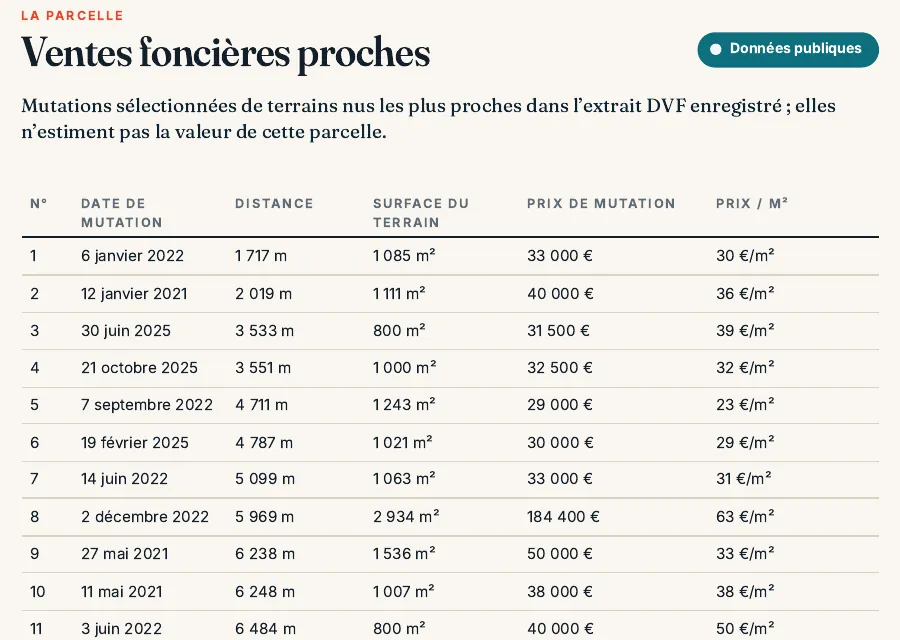
The plot accounts for 30% of an average total of €313,700 for land and house in 2024. The average hides large regional gaps; for your area, look at actual sales: estimating a price with DVF and price per m² by region.
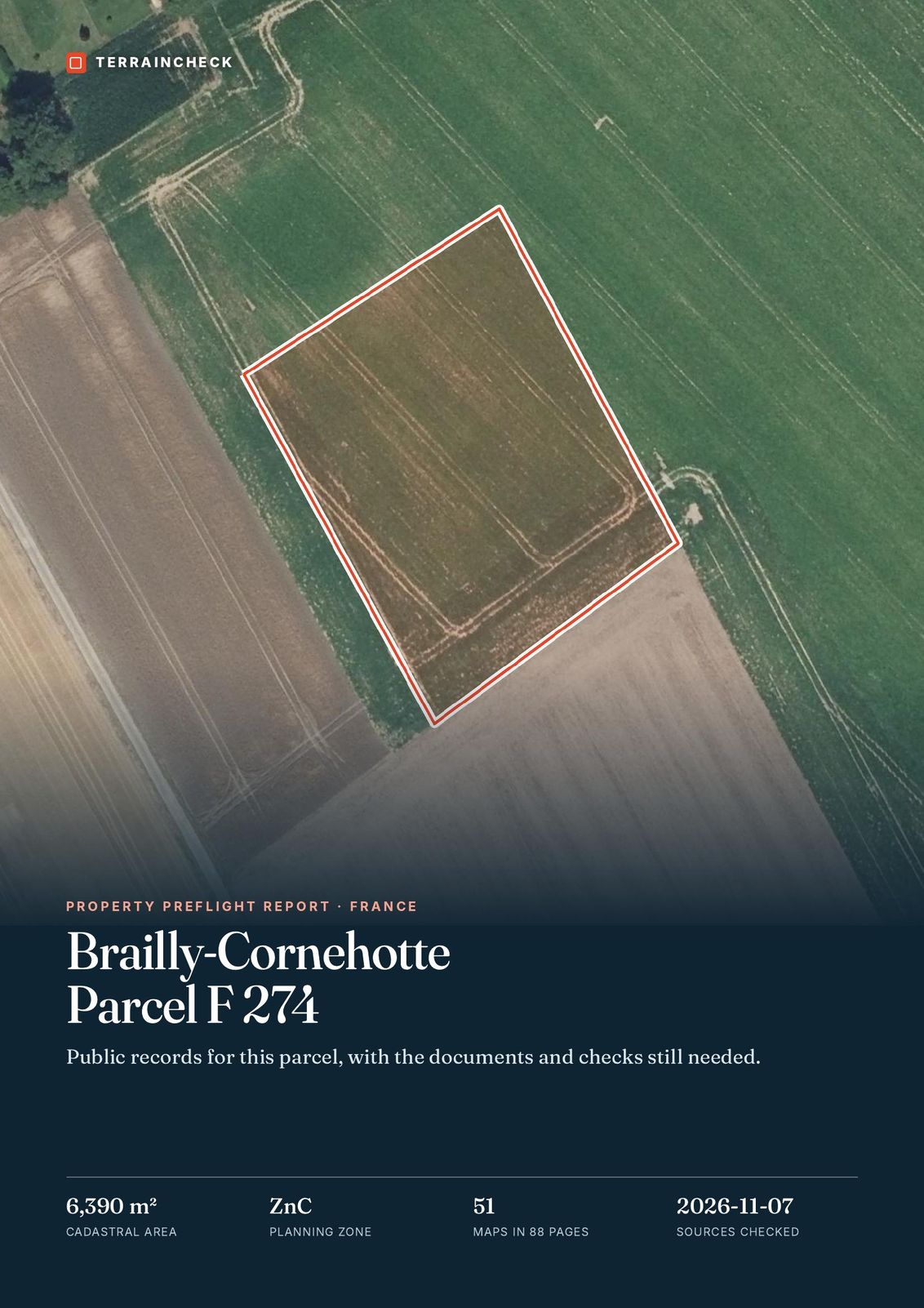
In the report: sale prices around F 274
Before the compromis: six budget checks
- Département rate looked up in the tax authority’s table; notaire asked if you are a first-time owner.
- Private seller or business selling with VAT: the duty regime depends on it.
- Agent’s fees: who pays, amount including VAT and percentage, in writing.
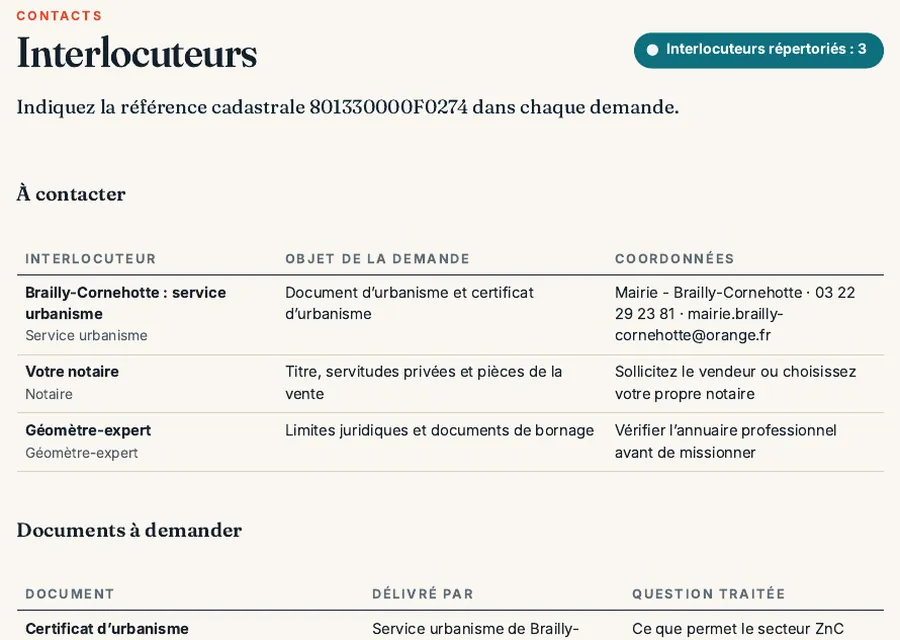
- Notaire’s estimate of all costs requested, disbursements included.
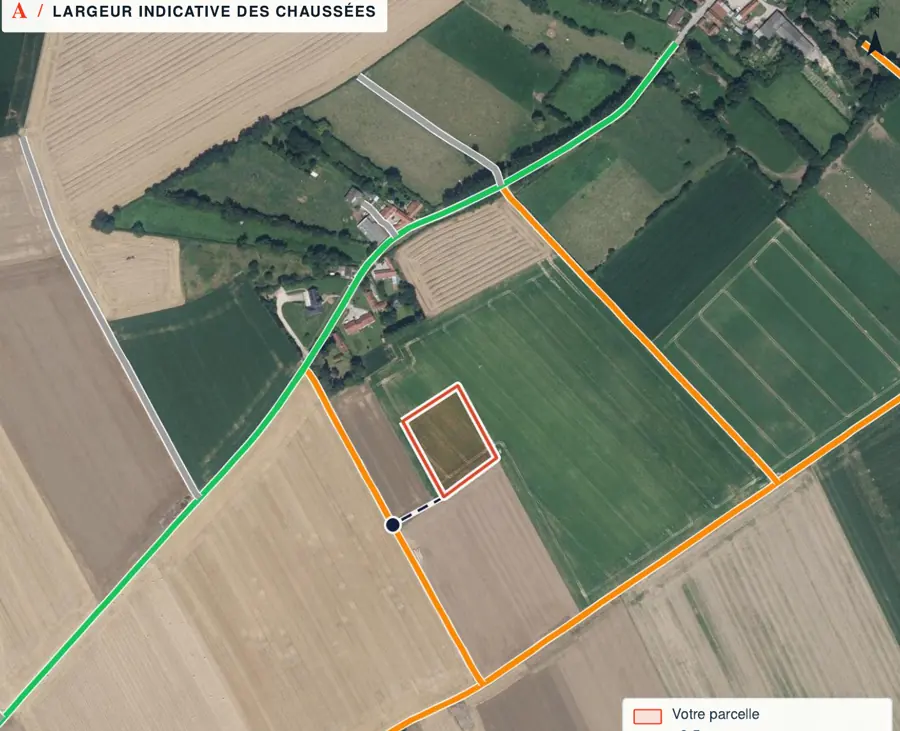
- Quotes for electricity and water connections; the PFAC figure from the local authority, with its calculation and any deductions.
- Commune and département development tax rates noted for the commune.
Next: the clauses of the compromis, then the order of checks before buying.
Common questions
Is development tax paid when the plot is bought?
No. It arises from the building permit. For an application filed since 1 September 2022 for a house, you declare the building within 90 days of completion; above €1,500 the tax is paid in two parts, from 90 days after completion and 6 months later.
Who pays property tax in the year of purchase?
Whoever owned the land on 1 January, so the seller, for the whole year. The deed may provide for the buyer to refund a pro rata share; that is a private arrangement and does not bind the tax office.
Are the agent’s fees included in the advertised price?
When the buyer pays them, the listing must show the price including fees, the price without fees and the fee percentage. When the seller pays, it shows the price without fees.
Does the notaire’s fee vary between notaires?
No: the regulated scale gives the same amount with every notaire. A discount is possible in some cases above €150,000. Disbursements and formalities appear on the notaire’s estimate.
Keep reading
Notary fees when buying land in France: 2026 rates by département, the fee scale and worked examples
France’s development tax (taxe d’aménagement): how it is calculated, when it is due and who is exempt
Serviced or unserviced plot in France: what “viabilisé” promises and how to check it
Before you set the budget, check what the parcel allows
Pick the parcel on the map. The report sets out the zone in the PLU (local plan), natural hazards, clay soils, Natura 2000 and recent land sales around it, each with its source and date and explained in English. It does not replace the notaire’s cost estimate. Free check, PDF report for €29 (€39 in French and English).