Pillar: Buying building land in France
Connecting a plot to mains water in France: process, meter and cost
In France you apply to the local water service to connect a plot to mains water; it may be the commune, an intercommunal body or a syndicate, run in-house or by a contractor, and the price of the connection depends on its charges. Before buying, ask the town hall for an operational planning certificate: it is free, processed within two months and states the existing or planned utilities.
In brief
- Who: supplying drinking water is the job of the commune (the French municipality) or of the grouping it has handed this task to. France had 9,623 public drinking-water services in 2024; of those whose management mode is known, 69% are run in-house (régie), the rest by a contractor (délégataire).
- Cost: each service sets its own charges. In Rodez for 2026: €545.31 excluding VAT for a basic connection with 1 m of pipe, €2.91 per extra metre, €135.88 to fit the meter, digging not included.
- Main too far away: the building permit can make you pay for a connection of up to 100 m along public roads if it serves your project alone. If work on the public network is needed, the permit can only be granted if the authority says who will do it and when.
- Well or borehole: for domestic use, notify the mayor at least one month before work starts and complete the notice within a month of finishing. For groundwater, a 2026 Act moves this notice into the Mining Code on a date set by decree, by 31 December 2027 at the latest.
On this page
Who supplies water in the commune
Communes are responsible for distributing drinking water and adopt a distribution plan (schéma de distribution) setting the areas the network serves. Many have passed the task to an intercommunal body or a syndicate.
The service is run in-house (en régie) or by a private company under contract (délégataire). Its service rules (règlement de service) set out the duties of the operator, customers and owners; with the yearly decision on charges, they answer questions on price and timing.
Communes run more than half the services but serve about 6 million people. For a given plot, ask the mairie (town hall) for the name of the service and a copy of its rules.
Before you buy: what the planning certificate tells you
An operational planning certificate (certificat d’urbanisme opérationnel) says, for the project described in the application, whether the land can be used for it and the state of existing or planned public utilities. Applying is free; the town hall has two months from receipt to reply.
The authority consults the network operators; an opinion not given within a month is deemed favourable, so the certificate may say little about the main. A tacit certificate, arising from the town hall’s silence, does not answer the utilities question (what a tacit certificate is worth).
The local plan (PLU) can also set conditions for connecting plots to the public water network: read the utilities article for the plot’s zone.
Sources: Service-Public, planning certificate; Planning Code, Art. R*410-10; Planning Code, Art. R*410-12; Planning Code, Art. R151-49. Accessed 13 November 2026.
Service connection or network extension: who pays
A service connection (branchement) links your plot to a public main that already runs past it. In the Eau de Rodez rules, used here as an example, it runs from the tapping on the main to the meter and its box, which go on the property boundary, as close as possible to the public road while staying on the private side where possible.
A network extension means lengthening the public main when it does not reach the plot. The permit can require its holder to pay for a connection to the water network along public roads on two conditions: it is no longer than 100 metres, and the pipe, sized for this project alone, is not meant to serve other buildings.
Beyond that, the Planning Code gives a closed list of what a permit holder can be made to pay, including the development tax and the project’s own on-site utilities. Where work on the public network is needed, the permit cannot be granted unless the authority can say when, and by which public body or concession holder, the work will be done.
| Situation | Who does the work | Who pays | Rule |
|---|---|---|---|
| Main in front of the plot | Water service, digging separate (Rodez) | The applicant, on a quote | Rules |
| Main up to 100 m away, for this project only | As the water authority decides | Can be the permit holder | L332-15 |
| Larger network work | Public body or concession holder | Only through the L332-6 list | L111-11, L332-6 |
| After the meter | The owner’s plumber | The owner | Rules |
Three situations and the private side. The first and last rows quote the Eau de Rodez rules: check those of your own service. Sources: Planning Code, Art. L332-15; Planning Code, Art. L332-6; Planning Code, Art. L111-11; Eau de Rodez, service rules. Accessed 13 November 2026.
What a connection costs: the Eau de Rodez example
Each local authority votes its own charges; here are those of Eau de Rodez for 2026, worked out for a single-family house with a 20 mm tapping and 15 m of pipe between the main and the meter:
| Item | Working | Excl. VAT |
|---|---|---|
| New connection (1 m of pipe included) | flat rate | €545.31 |
| Extra pipe | 14 m × €2.91 | €40.74 |
| Fitting the meter | flat rate | €135.88 |
| Standard meter box | flat rate | €238.14 |
| Opening the supply contract | flat rate | €12.71 |
| Total excluding digging | 545.31 + 40.74 + 135.88 + 238.14 + 12.71 | €972.78 |
2026 charges of Eau de Rodez (Aveyron), valid in its area only. Extra metres are added up to 100 m. Digging, backfilling and making good the road are not included; VAT is added. Sources: Eau de Rodez, 2026 charges; Eau de Rodez, service rules. Accessed 13 November 2026.
Digging is ordered from a contractor on a quote, once a road-works permit (permission de voirie) is granted. Its price depends on the trench length and the ground; on a sloping plot, see also the extra costs of a sloping plot.
Then come the bills: the average price of drinking water was €2.50 per m³ including VAT for a reference use of 120 m³ a year, or €25 a month per customer, based on prices on 1 January 2025. Sewerage is billed on top and the sewer connection has its own rules (sewer connection and the PFAC fee).
Sources: OFB, Sispea national report, 2024 data. Accessed 13 November 2026.
Steps and timescales
- Find the service. At the mairie: the name of the water service, its rules and the decision on charges. Cost: nothing. Time: no deadline set in the texts cited.
- Apply for an operational planning certificate. At the mairie of the plot’s commune. Cost: free. Time: two months from receipt of the application.
- Get the planning authorisation required. A building or installation that needs a permit or prior declaration cannot be permanently connected to the water network unless it was authorised (L111-12). Connecting the plot itself follows the water service’s rules. Timescales: building permit processing.
- Apply for the connection. To the water service, which issues a quote and sets the completion date (Rodez). No deadline set in the texts cited: ask for one in writing.
- Have the trench dug. By a contractor, on a quote, with a road-works permit if the trench affects the public road.
- Sign the supply contract. Water is turned on once the quote is accepted and the contract signed. In Rodez, an existing compliant connection is opened within eight working days of signing.
Sources: Planning Code, Art. L111-12; Eau de Rodez, service rules. Accessed 13 November 2026.
Wells and boreholes: notifying the town hall
Any abstraction point, well or borehole for domestic use must be notified to the mayor of the commune at least one month before work starts, by its owner or user. The notice is completed within a month of finishing: completion date, any changes and, if the water is for drinking, an analysis by an approved laboratory.
Domestic use covers the needs of the people living in the home: drinking and cooking, washing, cleaning, and growing food or keeping animals for the family’s own table. Any abstraction of up to 1,000 m³ a year counts as domestic. The drilling firm also notifies the mayor for its client within three months; a firm without the required certification faces an administrative fine of up to €15,000 per borehole.
Use form Cerfa 13837*03, at the town hall or online on the DUPLOS website (in French). For a well already on land you are buying, regularising it falls to the owner of the well: ask the seller for proof that it was declared.
If the house is also on mains water, the water service can inspect the well and indoor plumbing at the customer’s cost; where the mains supply is at risk of contamination and the required protective measures are not taken, it can shut off the connection. Whether well water is safe to drink is governed by other rules, outside this guide.
Sources: CGCT, Art. R2224-22; CGCT, Art. R2224-22-1; Environment Code, Art. R214-5; CGCT, Art. L2224-9; Act 2026-403 of 26 May 2026, Art. 44. Accessed 13 November 2026.
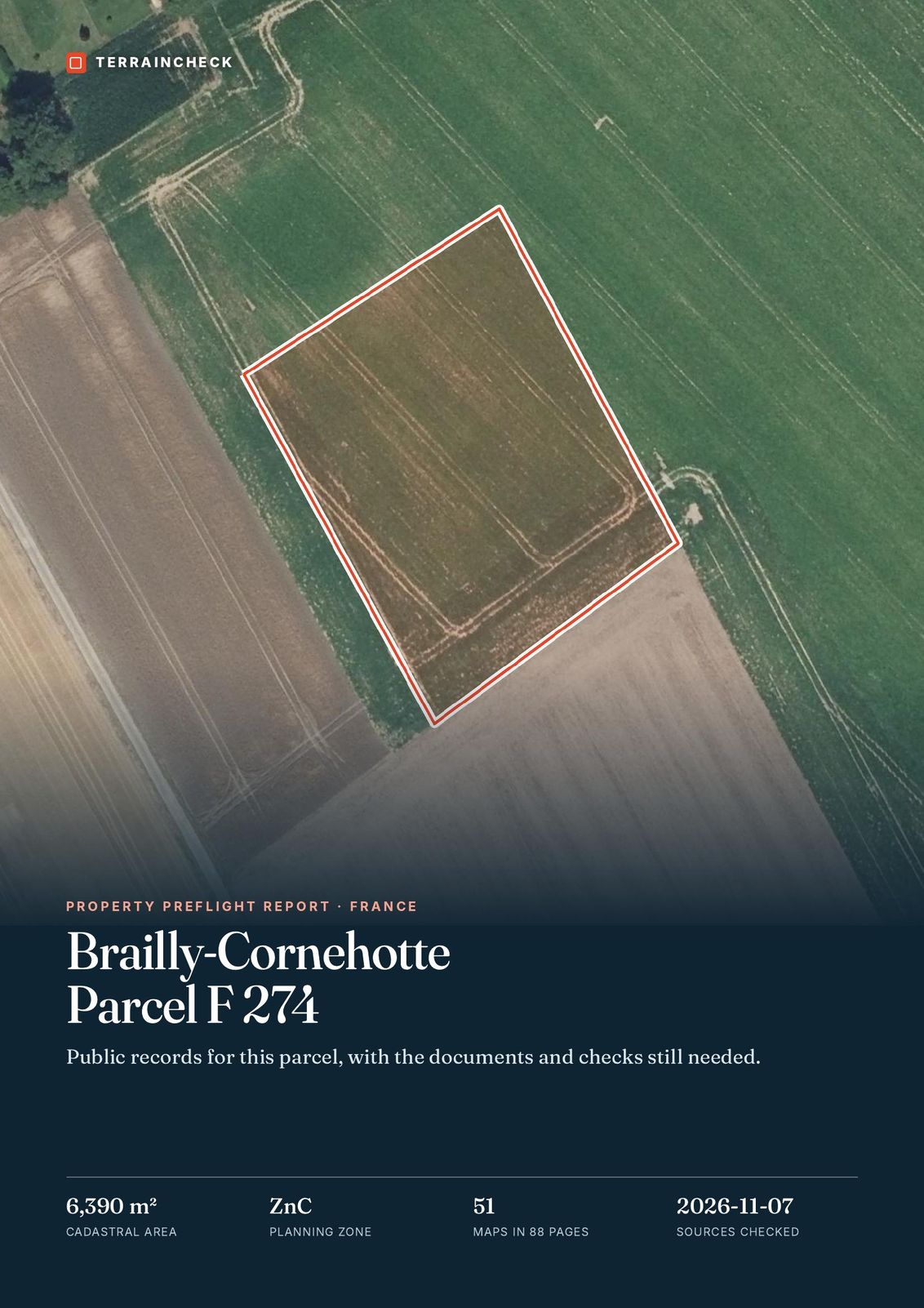
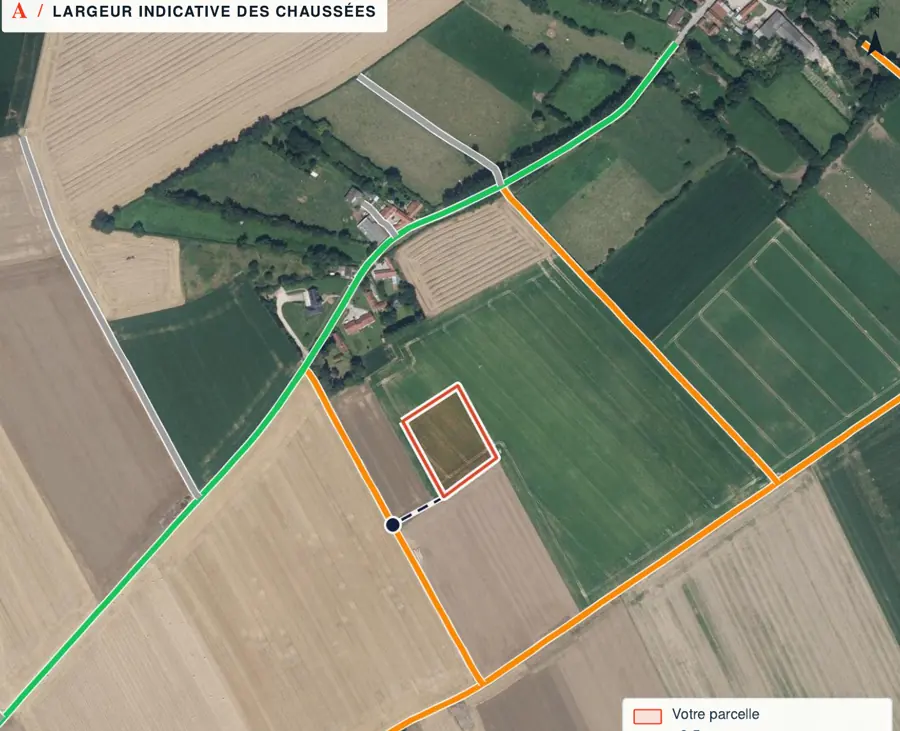
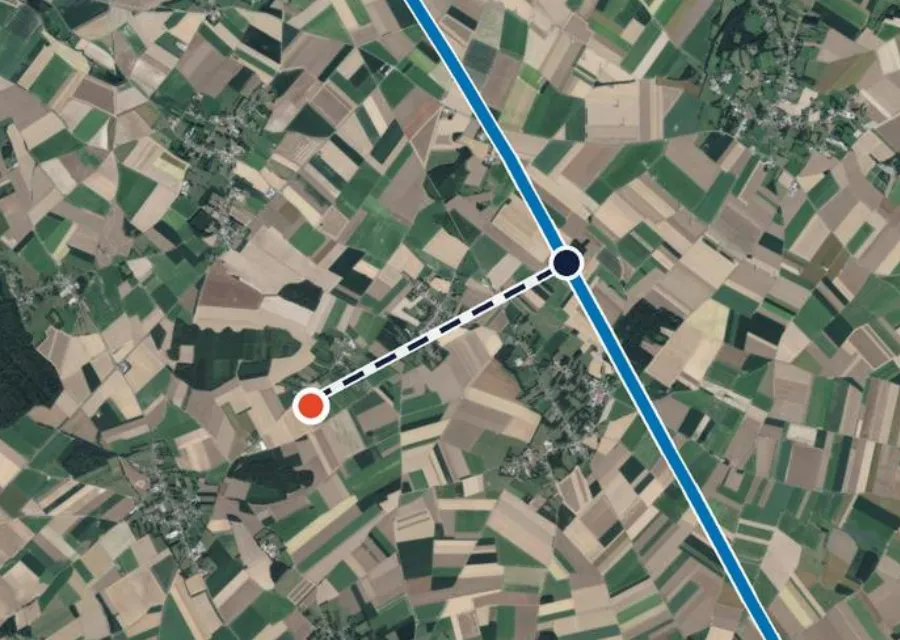
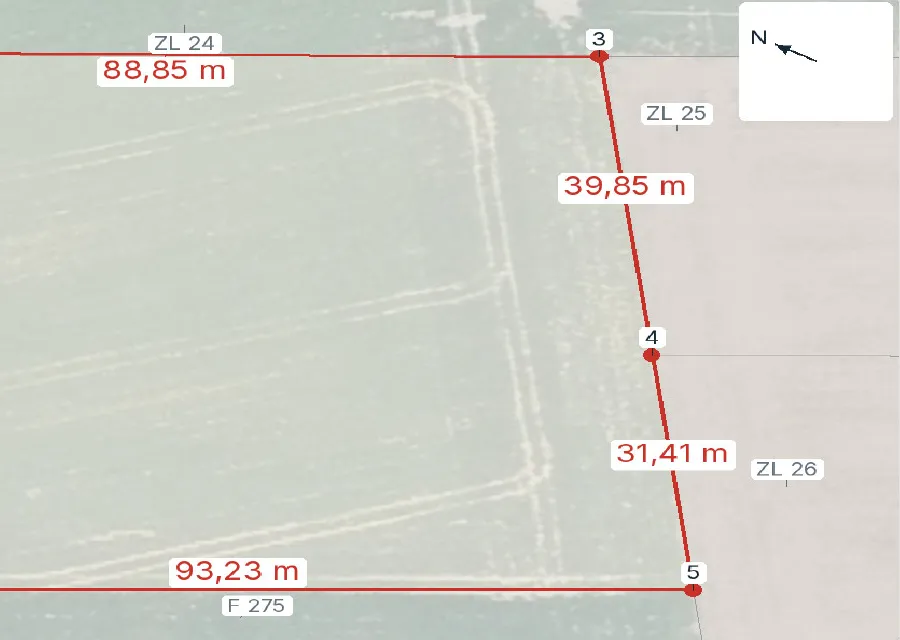
In the report: water around parcel F 274
Before the compromis: six checks on water
- Name of the water service, its rules and this year’s charges obtained.
- Operational planning certificate applied for, with the state of utilities.
- PLU article on utility connections read.
- Distance from the public main to the future meter known; a quote from the service if possible.
- If the main does not reach the plot: written answer on who builds the extension, who pays and when.
- Existing well or borehole: proof it was declared at the town hall.
For the other utilities: serviced or unserviced plot and electricity connection with Enedis.
Common questions
The main is 300 m away: who pays for the extension?
The permit can charge you for a connection of up to 100 m along public roads, sized for your project alone. If the main must be extended further, the permit is granted only if the authority says who will do the work and when; what you can be charged is limited to the list in Article L332-6 of the Planning Code.
Can a borehole replace mains water for a house?
A domestic borehole must be notified to the mayor at least one month before work starts; the notice is completed after the work, with a water analysis by an approved laboratory if the water is for drinking. The local plan (PLU) can set conditions for connection to the public network: ask the town hall before you buy.
The plot already has a meter: what do I do when buying?
Sign a supply contract in your own name. In Rodez, an existing compliant connection is opened within eight working days of signing. The previous customer’s contract ends no later than fifteen days after they ask to cancel it.
Keep reading
Serviced or unserviced plot in France: what “viabilisé” promises and how to check it
Electricity connection for a bare plot in France: Enedis steps, timings and cost
Sewer connection and the PFAC fee in France: duty, time limits and cost
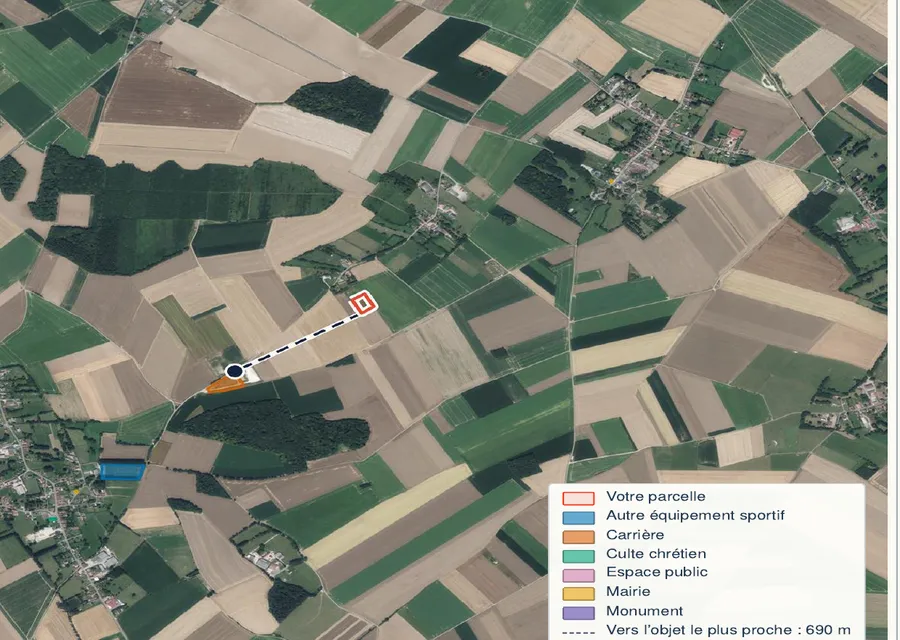
Fire hydrant distance for a building plot in France: a departmental rule
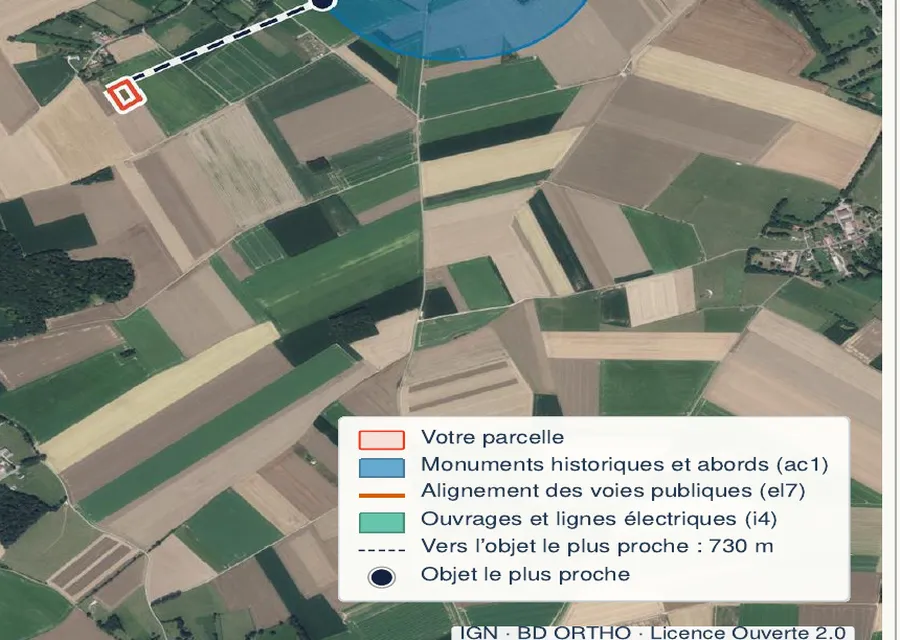
Pipe and utility easements on land in France: what they forbid and how to find them
Before pricing the utilities, take a close look at the plot
Pick the parcel on the map. The report sets out its PLU zone, natural hazards, mapped streams nearby and recent sales around it, each with its source and date and explained in English. It does not replace a quote from the water service. Free check, PDF report for €29 (€39 in French and English).