Pillar: Buying building land in France
Tacit planning certificate (CU) in France: what the town hall’s silence means
In mainland France, if the town hall (mairie) has served no planning certificate one month after receiving your application (two months for an operational CU), you hold a tacit CU: the planning rules, administrative limits and taxes of that date are frozen for 18 months for a permit or prior declaration filed within that time, except public safety or health rules. It does not tell you whether your project can be built. First step: gather proof of the date of receipt and ask the town hall for an attestation.
In brief
- The clock starts when the application is received at the mairie (town hall), not when you post it (art. R*410-9 and R*410-10). Keep the recorded-delivery receipt, the filing receipt or the online acknowledgement with its registration number.
- A tacit CU has only one effect, freezing the rules, even if you asked for an operational CU (art. R*410-12). It gives no answer on your project and no written list of rules.
- The 18 months run from the date of the tacit CU, even if the town hall sends a written certificate later (art. R*410-18). The freeze only helps a building permit or prior declaration filed within that time.
- Free to apply for, according to Service-Public (the French government’s public information site), on form cerfa no. 13410. It can be extended one year at a time, on a request made at least two months before expiry, if rules, easements and taxes have not changed (art. R*410-17).
On this page
One month or two, counted from receipt at the town hall
French planning law has two certificates. The information CU (article L410-1, a) states the planning rules, the administrative limits on property rights such as public easements, and the list of planning taxes and charges for the plot. The operational CU (b) also says whether the land can be used for the project described in the application, and gives the state of existing or planned public services (see information or operational CU).
The town hall has one month for an information CU (art. R*410-9) and two months for an operational CU (art. R*410-10), from receipt of the application at the mairie. For an operational CU, the services and network operators consulted have one month to give their opinion; if they say nothing, it counts as favourable. If no certificate is served within the time limit, the authority’s silence counts as the issue of a tacit CU (art. R*410-12).
Service-Public counts the month for an information CU from the acknowledgement of receipt; the code uses receipt at the town hall. The certificate articles (R*410-1 to R*410-21) provide no extension. Article R*423-38, written for permits and declarations, allows a request within one month for documents “required under this book”, Book IV, which also covers the certificate; none of the texts cited says whether such a request moves the CU deadline. If you receive one, send the document and ask in writing which date applies.
What silence gives you: frozen rules, not a green light
A tacit CU has only the effects of the fourth paragraph of article L410-1, “even if the application concerned the points mentioned in b” (art. R*410-12). If a building permit application or a prior declaration is filed within 18 months, the planning rules, the regime of planning taxes and charges and the administrative limits on property rights in force on the date of the certificate cannot be called into question. Rules whose purpose is public safety or public health are the exception.
So there is no “positive” or “negative” tacit CU for your project: silence does not tell you whether the house you described can be built. A written operational CU covers the approximate position of the buildings on the plot, their use category and the access to public services (art. R*410-13). If it is negative or comes with conditions, it must give reasons (art. R*410-14).
A written certificate must also say when a project needs the opinion or consent of a State service, and when a sursis à statuer (a deferral of the decision) could be raised against your future application, naming the ground in article L424-1 that would allow it (art. L410-1). The written certificate also states whether the land lies within a pre-emption area (art. R*410-15) or on a former industrial site or a soil information sector (art. R410-15-1). A tacit CU contains none of this.
Where the guarantee stops
- It freezes whatever applied on its date without telling you what that was: you read it in the PLU (plan local d’urbanisme, the local zoning plan) or the carte communale (a simpler municipal zoning map) and in the easements of that date (reading the PLU).
- A late written reply does not restart the 18 months, “notwithstanding any later issue of an express planning certificate” (art. R*410-18).
- It says nothing about whether the project is feasible, about State consent, a possible deferral or a pre-emption right.
Sources: Service-Public: planning certificate (F1633); Planning Code, art. L410-1; Planning Code, art. R*410-18. Accessed 12 November 2026.
Getting a tacit CU recognised in four steps
- Prove the date of receipt. The file goes to the mayor of the commune (municipality) where the land lies, who gives it a registration number; online, the electronic acknowledgement shows that number (art. R*410-3). Keep the recorded-delivery receipt, the filing receipt or the online acknowledgement. Cost: postage. Time: immediate.
- Count the period. One month for an information CU, two for an operational CU, from that date. Check that no certificate and no request for documents reached you in the meantime (post, recorded delivery, the online portal’s inbox). Time: a few minutes, TerrainCheck estimate.
- Ask the town hall for a certificate of the tacit decision. Under article L232-3 of the code governing dealings between the public and the administration, an implicit decision of acceptance is confirmed, at the request of the person concerned, by an attestation issued by the administration. Write quoting the registration number and article R*410-12. Cost: nothing beyond postage. Time: no period set by the texts cited; according to Service-Public, the town hall must issue a written reply anyway, even a late one.
- Hand the file to the notaire. The notaire is the public official who draws up and registers the sale. With the application, the proof of receipt, the attestation or a late reply, the start of the 18 months can be checked. Time: when you hand over the papers.
| Situation | What you have | What to do |
|---|---|---|
| Information CU, nothing served after 1 month | A tacit CU: rules, easements and taxes frozen for 18 months | Get the town hall’s attestation, then read the PLU and easements |
| Operational CU, nothing served after 2 months | The same tacit CU, with no answer on the project | Settle feasibility with the planning office before signing |
| Written reply arrived after the deadline | A written certificate; the 18 months still run from the tacit CU | Keep both dates and count from the first |
| Request for documents received within the month | An uncertain deadline: the certificate articles do not cover this case | Send the document, ask in writing which date applies |
| Extension requested, no decision within 2 months | A one-year extension from the end of the original validity | Keep proof that the request was received |
Five situations after a planning certificate application that went unanswered. Sources: Planning Code, art. R*410-12; Planning Code, art. R*410-17-1; Planning Code, art. R*410-18; Planning Code, art. R*423-38; Code of relations between the public and the administration, art. L232-3. Accessed 12 November 2026.
A tacit CU and the preliminary sale contract
Anyone with an interest in the land may apply for a certificate, including a future buyer or a notaire, and the authorities do not tell the owner (Service-Public). If the seller says there is a tacit CU, ask for a copy of the application, proof of the date it was received and which type was requested (a or b).
Article L410-1 refers to any permit application or declaration filed within the 18 months, without naming the certificate holder. Timing matters more: between the compromis de vente (the binding preliminary contract), the final deed and filing the permit, several months go by. If the 18 months end before you plan to file, discuss a new certificate or an extension applied for in time with the notaire.
After 18 months: a one-year extension
The certificate can be extended one year at a time, on a request made at least two months before it expires, if the planning rules, administrative easements of every kind and the regime of planning taxes and charges have not changed. You apply by letter, in two copies, enclosing the certificate to be extended (art. R*410-17).
If no express decision is served within two months of the request reaching the town hall, the extension is granted; it starts when the original validity ends (art. R*410-17-1). With a tacit CU there is no certificate to enclose: we suggest enclosing the town hall’s attestation or, failing that, the original application and its proof of receipt.
Sources: Planning Code, art. R*410-17; Planning Code, art. R*410-17-1. Accessed 12 November 2026.
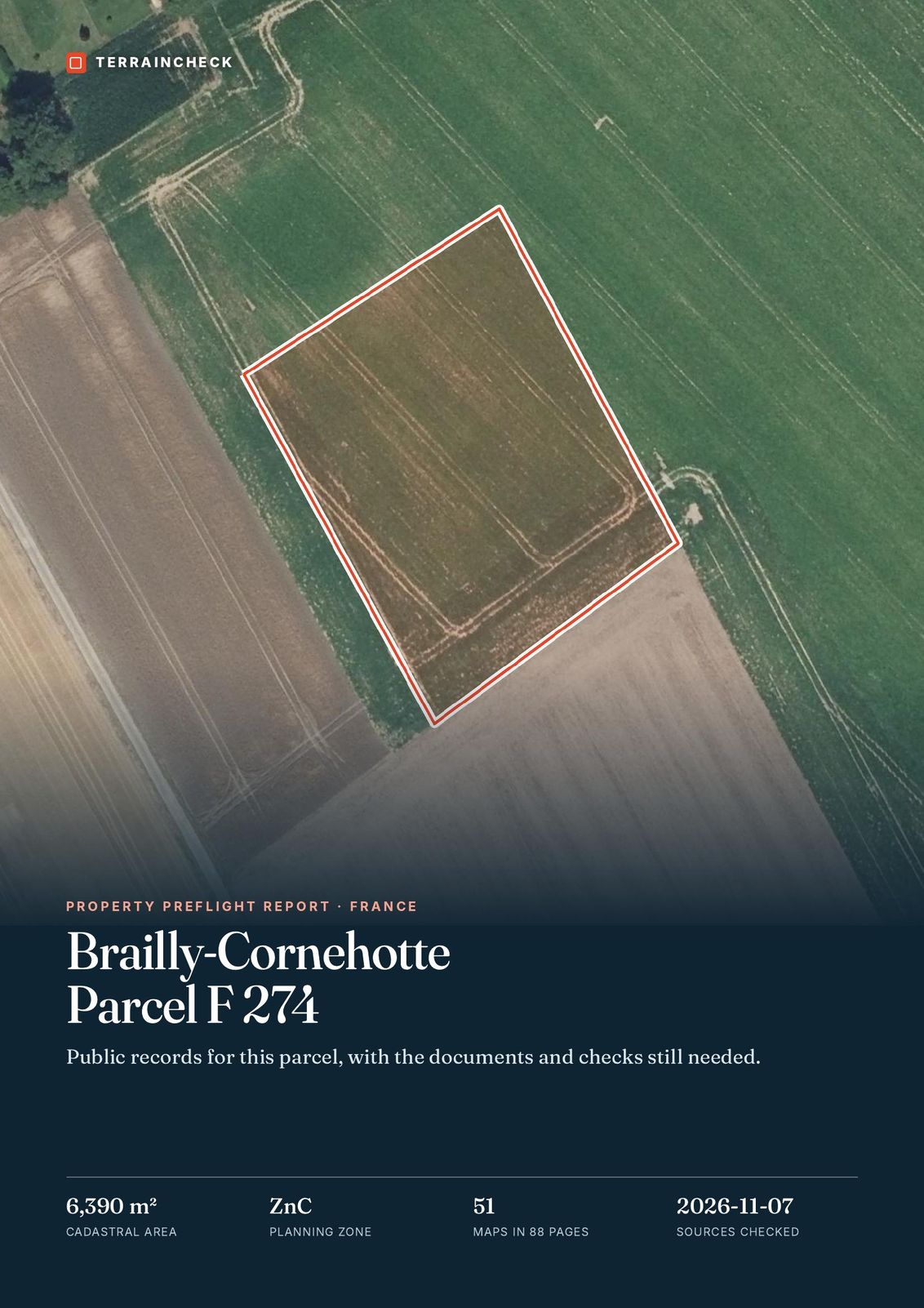
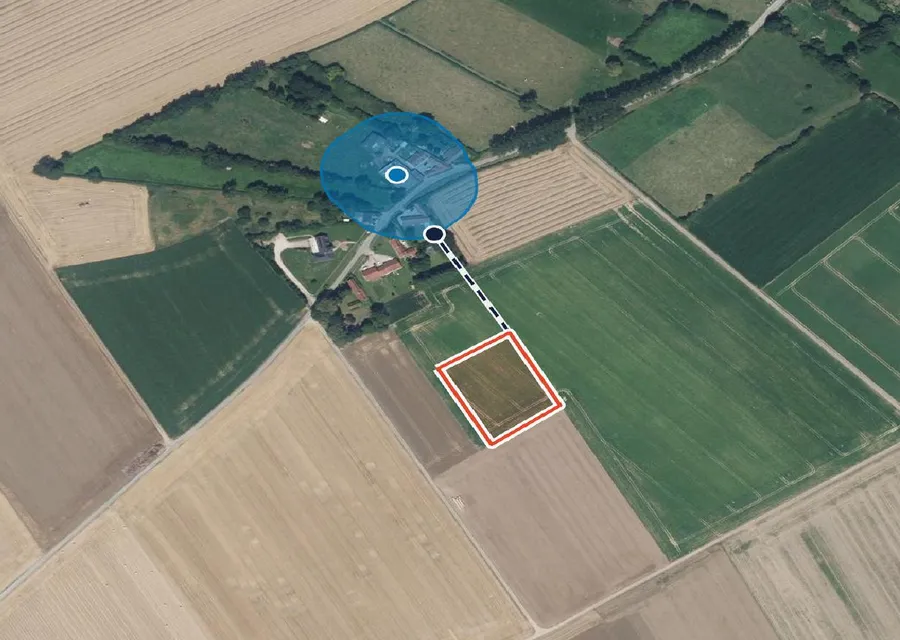
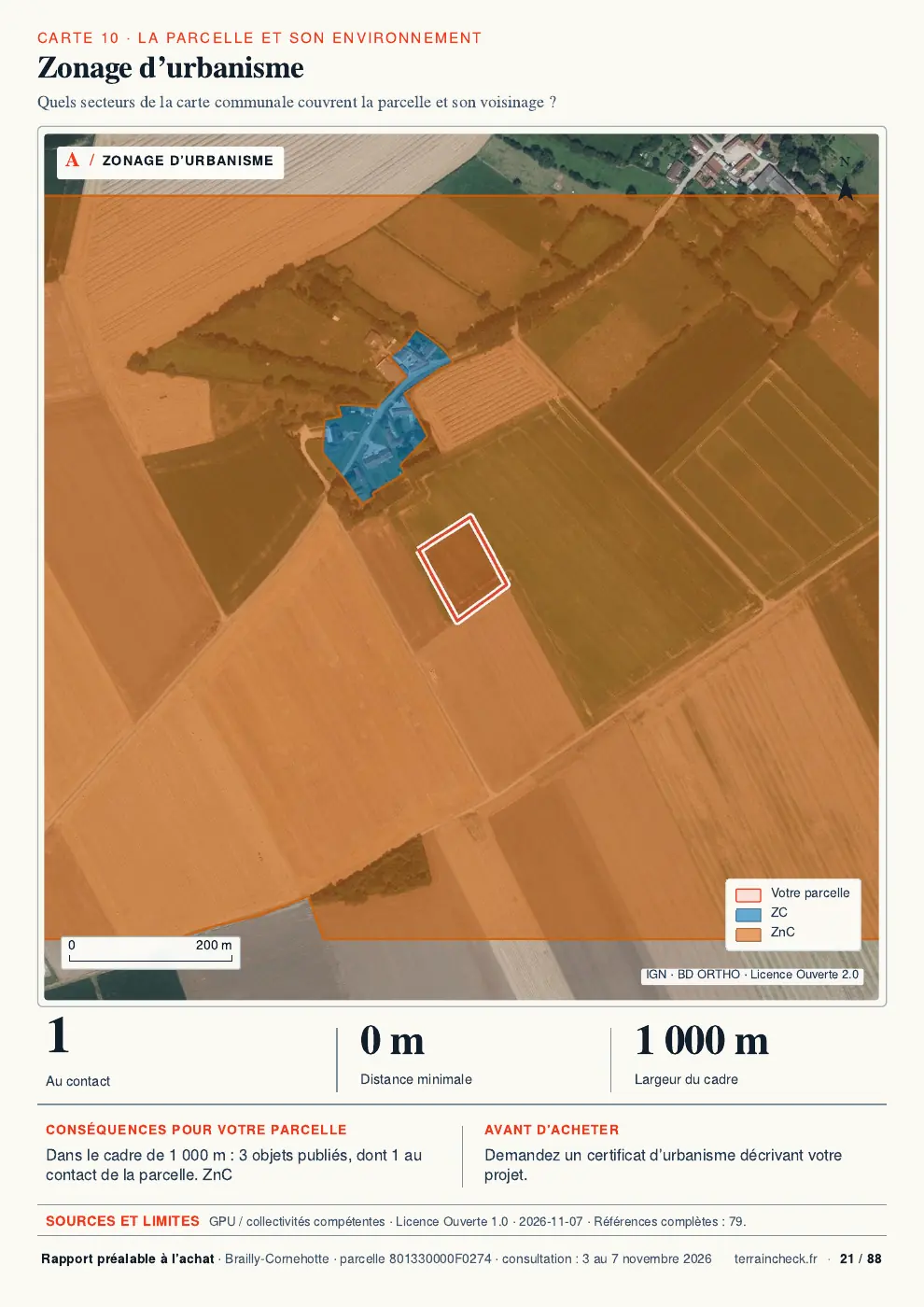
In the report: the next step for parcel F 274
Before you rely on a tacit CU
- Type of certificate requested (a or b) shown on the copy of the application.
- Proof of the date of receipt at the town hall: recorded-delivery receipt, filing receipt or online acknowledgement with its number.
- No letter from the town hall during the period: no certificate, no request for documents.
- Attestation requested from the town hall; any late reply filed with its date.
- End date of the 18 months worked out and compared with the planned permit filing date.
- PLU or carte communale and easements read in their version on the date of the tacit CU.
Common questions
Is a tacit CU the same as planning permission?
No. For 18 months it freezes the planning rules, the administrative limits on property rights and the taxes in force on its date, for a permit application or prior declaration filed within that time, except public safety or public health rules (art. L410-1 and R*410-12). You still need the permit.
Does a tacit operational CU mean my project is feasible?
No. A tacit CU only freezes the rules, even if the application described a specific project (art. R*410-12). Only a written certificate answers on feasibility.
The town hall replied late: which date starts the 18 months?
The date of the tacit CU, which is the end of the one- or two-month period after the application was received, even if a written certificate arrives later (art. R*410-18).
Keep reading
Land reclassified as non-buildable: appeals and compensation in France
French planning certificates: information or operational CU before buying land
Building permit in France: processing times, missing documents and tacit approval
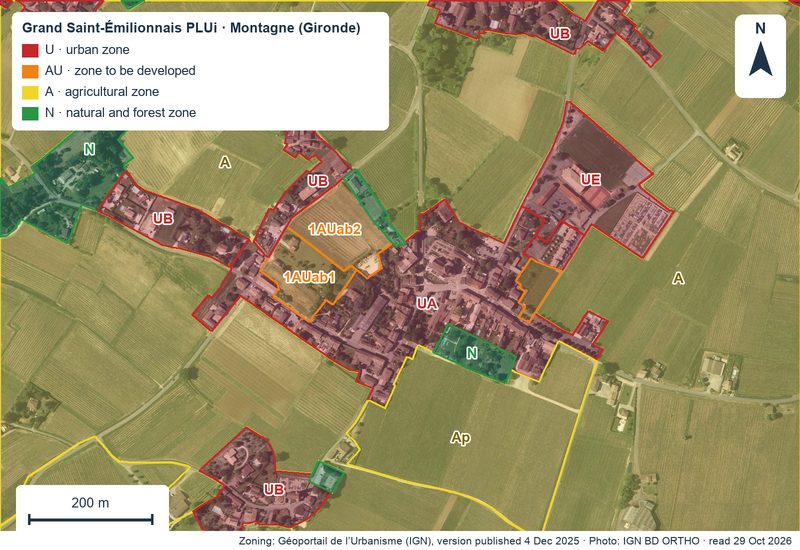
Reading the PLU before you buy: zone, rules, easements and pending changes
Before or after the certificate, see what the public records say about the plot
Pick the parcel on the map. The report sets out the PLU or carte communale zone, published easements, natural hazards and recent sales nearby, each with its source and date, explained in English, and lists the documents to ask the town hall for. It does not replace a planning certificate. Free check, PDF report for €29 (€39 in French and English).