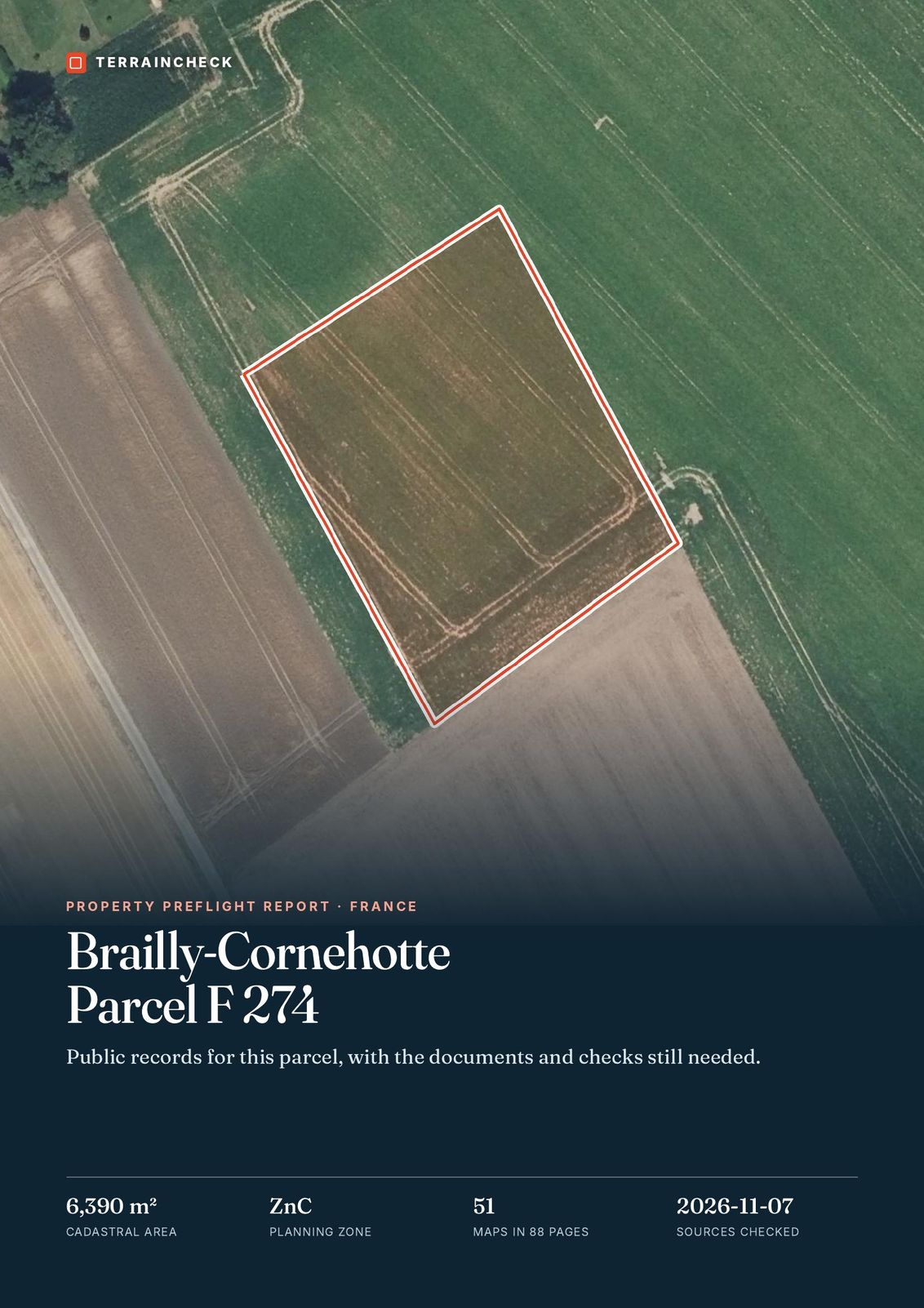
Pillar: Buying building land in France
Land reclassified as non-buildable: appeals and compensation in France
In France, moving land into an agricultural or natural zone of the PLU (local zoning plan) gives, as a rule, no right to compensation, except in the cases of article L105-1 of the planning code (acquired rights, physical state of the site altered) or, exceptionally, for a special and exorbitant burden recognised by the courts. You can influence the zoning during the public inquiry, then challenge the approval decision in court within two months of its publication. First step: check the Géoportail de l’urbanisme and ask the mairie (town hall) how far the procedure has got.
In brief
- Before the plan is approved: the notice of the enquête publique (public inquiry) appears at least 15 days before it opens. The inquiry lasts at least 30 days if the plan has an environmental assessment and can be cut to 15 days otherwise. You can always send your comments by email.
- After approval: you can go to the tribunal administratif (administrative court) within 2 months of the approval decision being published. A request to reconsider sent within that period stops the clock; two months of silence count as a refusal.
- Compensation: as a rule none; due where acquired rights are infringed or the previous physical state of the site is altered, causing direct, material and certain damage (art. L105-1) and, exceptionally, for a special and exorbitant burden (Conseil d’État case law).
- A project already under way: a certificat d’urbanisme (planning certificate) under 18 months old, a granted permit or an approved subdivision can protect you, each under conditions (table below).
On this page
How land ends up in zone A or N
The plan local d’urbanisme (PLU, the local zoning plan) puts every plot in a zone: zone A (agricultural) to protect the potential of farmland, zone N (natural and forest) notably for landscapes, forestry or flood-expansion areas. What can be authorised there: see building a house on agricultural land.
A full review (révision), required when the commune (municipality) or group of communes changes the policy aims of the plan (the PADD), follows the steps for a new plan, including a public inquiry. For a lighter amendment (modification) the draft is open to the public for one month, unless the authority opts for an inquiry or online participation; one of these two is compulsory where an environmental assessment is needed.
Rules from the law of 26 November 2025, for procedures launched since 26 May 2026 (earlier wording on Légifrance for the others). Without a PLU, other rules apply: see the carte communale and the national planning rules.
Sources: Planning Code, art. R151-22 and R151-23; Planning Code, art. R151-24 and R151-25; Planning Code, art. L153-31; Planning Code, art. L153-33; Planning Code, art. L153-41. Accessed 13 November 2026.
Spotting a review before it is approved
The decisions launching a review and adopting the draft are published on the Géoportail de l’urbanisme (GPU), the national planning portal, or, in a commune of under 3,500 inhabitants, on the mairie (town hall) notice board: ask the planning office as well.
Once the council has debated the aims of the PADD, the town hall may defer its decision (sursis à statuer) on a permit application that would compromise the future plan or make it costlier to carry out.
During the inquiry: making the case for your plot
- Find the notice, published at least 15 days before the inquiry opens, or before the online participation that replaces it: which procedure, length, where to read the file, where to write. Cost: nothing. Time: a weekly look at the commune’s website (TerrainCheck estimate).
- Read the draft for your plot: zoning map, zone rules, opinions attached to the file. With online participation, a paper copy stays available at the town hall. Time: one to two hours, more if you need a translation (TerrainCheck estimate).
- Send a written comment while the procedure is open. Inquiry: by email or by the other means set in the order opening it. Online participation: online, for at least 30 days (art. L123-19 of the Environment Code). Give the cadastral reference, the zone you ask for and checkable facts: utilities, neighbouring houses, a certificate or permit in hand. Cost: nothing.
- Read the outcome, then the approval decision. Inquiry: the inquiry officer’s report. Online participation: no officer, a summary of comments (art. L123-19). The plan is approved “possibly amended” in the light of opinions and comments: your comment does not bind the commune. Timing: no deadline in the texts cited between inquiry and approval.
Sources: Environment Code, art. L123-10 and L123-13; Planning Code, art. L153-19; Environment Code, art. L123-19; Planning Code, art. L153-21. Accessed 13 November 2026.
After approval: reconsideration and the administrative court
The PLU and the decision approving it are published on the GPU. The administrative court can be asked to quash it within two months of publication. You may first send a recours gracieux (request to reconsider) to the body that approved it: sent within the time limit, it stops the clock.
Two months without an answer count as a refusal, and a new two-month period starts. If it quashes the plan, the previous plan comes back into force, subject to articles L600-12-1 and L442-14.
Sources: Planning Code, art. L153-23; Géoportail de l’urbanisme: FAQ; CRPA (public–administration relations code), art. L411-2; CRPA (public–administration relations code), art. L231-4; Planning Code, art. L600-9; Planning Code, art. L600-12; Planning Code, art. L600-12-1; Planning Code, former art. L600-1 (repealed on 28 November 2025). Accessed 13 November 2026.
What protects a project already under way
| Situation | What works for you | Limit |
|---|---|---|
| Nothing applied for | Nothing: the new zoning governs future applications. | Compensation: the cases of article L105-1; exceptionally, a special and exorbitant burden (case law). |
| Planning certificate under 18 months old | The rules at its date cannot be called into question for an application filed within 18 months. | Except safety or public health rules; a possible deferral must be stated on it. |
| Permit application filed | A deferral is capped at two years; confirm up to two months later, decision within two months. | No second deferral on the same ground; three years at most in total if the new one rests on another statutory provision. |
| Permit granted | Can be withdrawn only if unlawful and within three months of its date, or at your request. | As a general rule, lapses without works in three years (transitional regimes below); no extension on request if the rules have become less favourable. |
| Plot in an approved subdivision | For five years a permit cannot be refused under new rules. | Starts at non-objection or completion of works; changes to the subdivision documents apply. |
Your position by project stage when the new plan applies. Sources: Planning Code, art. L105-1; Planning Code, art. L410-1; Planning Code, art. L424-1; Planning Code, art. L424-5; Planning Code, art. R*424-17 and decree 2025-461; Planning Code, art. R*424-21; Planning Code, art. L442-14. Accessed 13 November 2026.
Lapse: as a general rule, a permit lapses if works have not started within three years of its notification, or if, once that period has passed, works stop for more than a year. Decree 2025-461, published on 27 May 2025, raises this to five years for permits issued from 28 May 2022 to 28 May 2024 and extends by one year those issued from 1 January 2021 to 27 May 2022, provided they were still valid on 27 May 2025: it does not revive a permit that had already lapsed. Full table: land with a granted permit.
Compensation: the rule, its exceptions, the case law
Under article L105-1 of the planning code, planning restrictions such as bans on building in certain zones and the allocation of property between zones give no right to compensation.
Compensation is due, however, where the restriction infringes acquired rights or alters the previous physical state of the site, causing direct, material and certain damage. Without an agreement, the administrative court sets the amount, taking into account the gain in value the PLU brings to the property.
The Conseil d’État allows compensation in the exceptional case where, given the circumstances and content of the restriction, the owner bears a special and exorbitant burden out of proportion to the public-interest aim (29 June 2016, no. 375020: project ruined, only owner affected). It is not compensation for a fall in value alone. Liability for fault, if the zoning is unlawful, is a separate question.
- Send a prior written claim, with an amount, to the commune or group of communes: without it, a court claim for money is not admissible. Cost: nothing.
- Wait for the answer: a financial claim left unanswered for two months counts as refused.
- Go to the administrative court within two months of the refusal, implied or express.
Another route: if, after a deferral, permission to build or use the land is refused, the owner can formally require the authority or public body behind the project to buy the land (article L424-1). Conditions, time limits and next steps: articles L230-1 onwards; the demand goes to the town hall of the commune where the land lies.
Sources: Planning Code, art. L105-1; Conseil d’État, 29 June 2016, no. 375020; Administrative Justice Code, art. R421-1 and R421-2; CRPA (public–administration relations code), art. L231-4; Planning Code, art. L424-1. Accessed 13 November 2026.
In the report: what is published around F 274
If you are buying: operational certificate and conditions
Before the compromis de vente (binding preliminary contract), look on the GPU for a review and ask the town hall. Then apply for an operational planning certificate: it says whether the land can be used for the project you describe, and must mention any deferral that could be applied. Processing: two months from receipt at the town hall; with no answer, see what a tacit certificate is worth.
The compromis can include a condition precedent (condition suspensive), for example obtaining a permit for a defined project. Ask the notaire (the official who handles the sale) to spell out the project: see the key clauses of the compromis.
Sources: Planning Code, art. R*410-10; Civil Code, art. 1304 to 1304-7. Accessed 13 November 2026.
Land at risk of downzoning: the checks
- GPU and town hall checked: review or amendment launched, draft adopted, dates.
- Current zone and proposed zone noted for the plot, with the rules of each.
- Inquiry notice found; comment emailed while the inquiry is open, copy kept.
- Publication date of the approval decision noted; two months counted from it.
- Planning certificate or permit in hand: date and period of validity checked.
- Buyer: condition precedent written for the specific project before signing.
Next: reading the PLU for the plot and when only part of a plot is buildable.
Common questions
Can I get compensation if my land is no longer buildable?
As a rule, no: article L105-1 of the planning code rules out compensation for planning restrictions, including bans on building in certain zones. Compensation is due where acquired rights are infringed or the previous physical state of the site is altered, causing direct, material and certain damage; without an agreement, the administrative court sets it. The Conseil d’État also allows it, exceptionally, for a special and exorbitant burden.
How long do I have to challenge a PLU?
Two months from publication of the decision approving it, before the administrative court. A request to reconsider made within that period stops the clock; two months of silence count as a refusal and open a new two-month period.
Does a planning certificate protect me against a new PLU?
For a permit application or prior declaration filed within 18 months of the certificate, the rules in force at its date cannot be called into question, except those concerning safety or public health. A deferral is still possible; the certificate has to mention it.
Does the compromis fall through if the land is downzoned before completion?
It depends on the clauses. If a condition precedent, such as obtaining a permit for a defined project, fails, the obligation is deemed never to have existed. Have the condition written in before you sign.
Keep reading
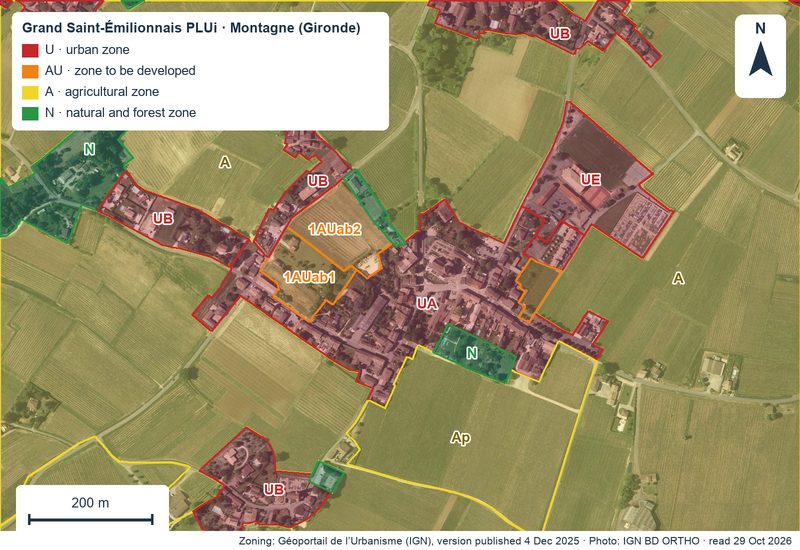
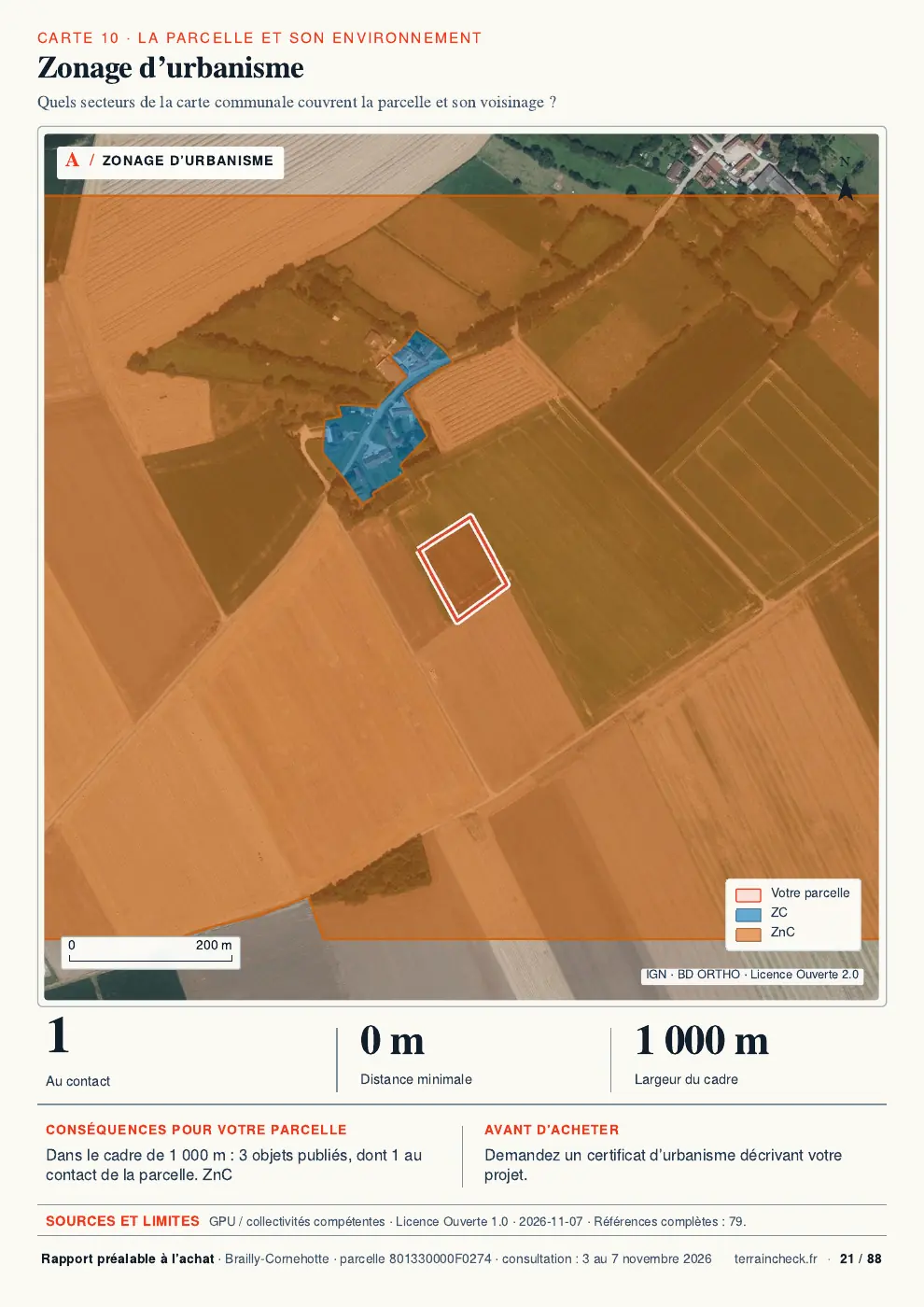
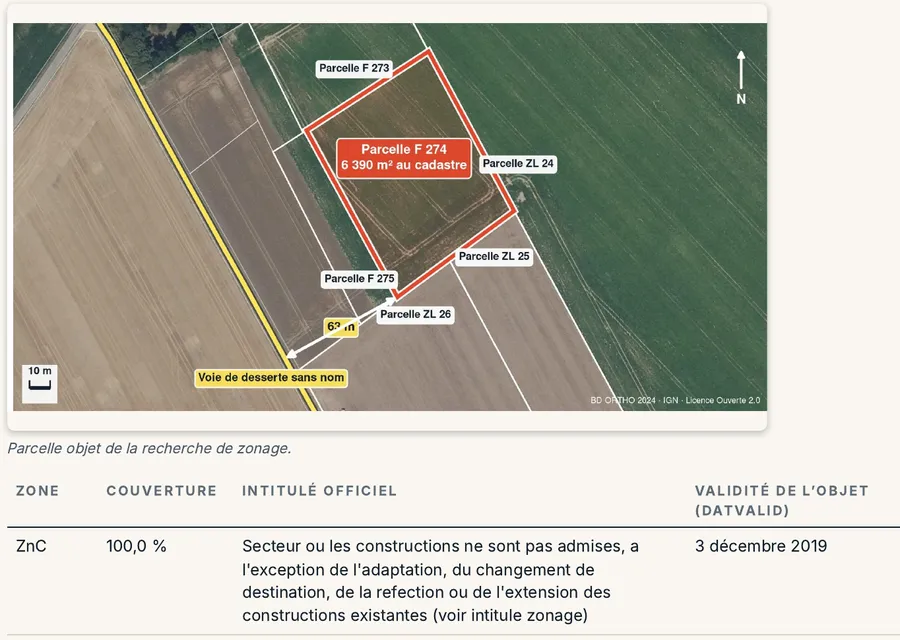
Check the published zoning of your plot
Pick the parcel on the map. The report sets out the zone of the planning document published on the GPU, the restrictions and annexed information around the plot, natural hazards and recent sales nearby, each with its source and date and explained in English. It does not read a draft plan that has not been approved and does not guarantee a permit. Free check, PDF report for €29 (€39 in French and English).