Pillar: Buying building land in France
Buying leisure land in France: what the Planning Code lets you put on it
On isolated terrain de loisirs (leisure land), a caravan may stay up to 3 months a year with no planning formality, unless the sector bans caravans; a mobile home cannot be installed there, save storage and emergency rehousing; its place is on certain campsites, residential leisure parks and holiday villages. First step: look up the parcel’s zone on the Géoportail de l’urbanisme, the national planning portal, then ask the mairie (town hall) about your project.
In brief
- Cabin, chalet or shed: outside the campsites and leisure parks named in article R111-38, it is an ordinary building (art. R111-40). The zone of the PLU, the local plan, has to allow it.
- Caravan: beyond three months a year, all periods added up, a déclaration préalable (prior declaration) at the mairie, the town hall, is required (art. R421-23). Whatever the duration, caravans are banned in the protected or wooded sectors of article R111-48 and wherever the PLU or the mayor has banned camping (art. R111-49).
- Mobile home (static caravan): outside the sites named in article R111-42, the Code provides only for storage on certain sites (art. R111-45) and for rehousing ordered by the prefect, the State’s local representative, after a disaster (art. R111-46).
- Hosting campers: a permis d’aménager (development permit) above 20 people or 6 leisure accommodation units (art. R421-19); below that, a prior declaration if the land is made available regularly (art. R421-23).
On this page
“Terrain de loisirs”: a listing label, not a zone
Terrain de loisirs means leisure land, and the Planning Code (code de l’urbanisme) has no such category. Where a commune (municipality) has a PLU (plan local d’urbanisme), the plan divides it into urban (U), to-be-urbanised (AU), farming (A) and natural and forest (N) zones. The label describes the use the seller suggests, not a right attached to the parcel.
In an A or N zone, the plan may allow only what articles R151-23 and R151-25 list, first of all buildings and installations needed for farming (and forestry in an N zone). Where the commune has a carte communale (a simpler local plan) or no plan at all, other rules apply: see how to check whether land is buildable.
| What you install | On an isolated plot | Formality |
|---|---|---|
| Tent | Camping is “freely practised” with the consent of whoever has the use of the land, outside banned sectors (art. R111-32 to R111-34). | None to camp yourself. |
| Caravan (caravane): keeps its means of mobility, may use the road (art. R111-47) | Possible outside the banned sectors (art. R111-48 and R111-49). | Up to 3 months a year: none. Beyond: prior declaration (art. R421-23). |
| Mobile home (résidence mobile de loisirs): towable, banned from the road (art. R111-41) | No, save storage (art. R111-45) and rehousing ordered by the prefect (art. R111-46). | Not applicable outside the sites of article R111-42. |
| Cabin or chalet (habitation légère de loisirs): demountable or transportable (art. R111-37) | An ordinary building (art. R111-40): the zone has to allow it. | 5 m² or less: none, except in the protected areas of art. R421-11, I (prior declaration). Up to 20 m²: prior declaration. Above: building permit. |
Planning Code in force on 12 November 2026. Sizes: footprint and floor area, for a height of 12 m at most. Sources: Code de l’urbanisme, art. R111-31 to R111-50; Code de l’urbanisme, art. R421-23 to R421-25; Code de l’urbanisme, art. R421-1 to R421-12 and R421-18; Code de l’urbanisme, art. R151-17 to R151-25. Accessed 12 November 2026.
Where tents and caravans are allowed
Camping is “freely practised” with the consent of whoever has the use of the land (art. R111-32). Unless an exemption is granted, article R111-33 bans it on seashores, in registered sites (sites inscrits), in listed sites (sites classés) or sites being listed, in heritage sites (sites patrimoniaux remarquables), around historic monuments and within 200 metres of a point where drinking water is drawn.
The PLU may also ban it in certain zones, and so may the mayor by order (art. R111-34); those two bans can be enforced only if they are posted at the mairie and signposted at the usual access points.
Outside a campsite, a residential leisure park, a holiday village classed as light accommodation or the grounds of an approved family holiday centre, keeping a caravan for more than three months a year needs a prior declaration, and every period it is parked, consecutive or not, counts (art. R421-23, d). Below that no planning formality is required (art. R421-18), but the land-use rules still apply (art. L421-8).
Whatever the duration, a caravan is banned in the sectors of article R111-33, in woods, forests and parks that a PLU has classified as woodland to be kept and in protection forests (art. R111-48), and also where the PLU or an order of the mayor has banned camping, provided the ban is posted and signposted (art. R111-49). In that last case the mayor may allow pitches for fifteen days at most.
Mobile home, cabin, shed: when the installation becomes a building
A résidence mobile de loisirs, the “mobil-home” of French listings and the static caravan of British ones, may be installed only in certain residential leisure parks (parcs résidentiels de loisirs), in holiday villages classed as light accommodation and on certain lawfully created campsites: the list and its exceptions are in article R111-42.
Elsewhere the Code provides only for storage pending the next use on the sites named in article R111-45, such as a collective caravan garage, and for temporary installation ordered by the prefect to rehouse disaster victims (art. R111-46). According to Service-Public, the government’s information site, a caravan or mobile home stripped of its means of mobility is treated as a building.
A habitation légère de loisirs (HLL), a demountable or transportable cabin or chalet, has its own sites, named in article R111-38: residential leisure parks, holiday villages classed as light accommodation and certain campsites, among others. Outside them it “is subject to the ordinary law on buildings” (art. R111-40).
That ordinary law also covers a shed: up to 12 metres high, no formality if both the footprint and the floor area are 5 m² or less (art. R421-2), a prior declaration if neither exceeds 20 m² (art. R421-9), a permis de construire (building permit) in other cases (art. R421-1). The exemption does not apply in the protected areas of article R421-11, I: a heritage site, the surroundings of a historic monument, a listed site or one being listed, a nature reserve, the core of a national park or an area set to form the core of a future one. There a prior declaration is needed from the first square metre up to 20 m² (art. R421-2 and R421-11, I). With or without a formality, the building has to comply with the rules of the zone (art. L421-8).
Sources: Service-Public: caravan or mobile home in your garden. Accessed 12 November 2026.
Hosting campers: two thresholds, and the coast
Creating or enlarging a campsite able to take more than twenty people or more than six leisure accommodation units needs a development permit (art. R421-19, c). Below that, laying out land or making it available to campers “on a regular basis” needs a prior declaration (art. R421-23, c).
In communes under the coastal rules (art. L121-1), laying out and opening campsites or caravan parking areas is banned in the coastal strip, one hundred metres from the upper limit of the shore outside built-up areas (art. L121-16 and L121-18). Elsewhere outside built-up areas, it requires sectors marked out for that purpose by the PLU (art. L121-9).
Sources: Code de l’urbanisme, art. L121-1 to L121-18. Accessed 12 November 2026.
A wooded plot: what a classification changes
A PLU may classify woods, forests and parks, and also single trees and hedgerows, as espaces boisés classés, protected woodland (art. L113-1). The classification bans any way of occupying the land that would endanger the woodland (art. L113-2). In a wood, forest or park so classified, a caravan is banned whatever the duration (art. R111-48). In any protected woodland, cutting or felling trees needs a prior declaration (art. R421-23, g), outside the cases of article R421-23-2.
Sources: Code de l’urbanisme, art. L113-1 and L113-2. Accessed 12 November 2026.
In the report: woods and hedgerows around the parcel
Checks before you sign: four steps
- Identify the parcel. Find its cadastral reference (section and number) on cadastre.gouv.fr. Cost: an A4 or A3 extract of the plan is free. Time: immediate, online. See finding a cadastral reference.
- Read the zone. On the Géoportail de l’urbanisme, the national planning portal (in French), type the address, click the parcel and download the documents that apply to it. No account is needed. Time: immediate, online. For protected woodland or an order on camping, ask the mairie in writing. See reading the PLU before buying.
- Apply to the mairie for an operational planning certificate (certificat d’urbanisme opérationnel) describing what you actually intend; a prospective buyer may apply. Cost: free. Time: 2 months (1 month for the information certificate). Validity: 18 months. See information or operational planning certificate.
- File the prior declaration or the permit application at the mairie before installing anything: form cerfa 16702*03 for a caravan according to Service-Public, cerfa 16703*03 for site works such as a campsite. Processing time: 1 month for a prior declaration, generally 2 months in a protected area (heritage site, surroundings of a historic monument, listed or registered site, nature reserve, national park core, according to Service-Public); usually 3 months for a development permit. Cost: a development tax (taxe d’aménagement) may be due depending on the project.
Sources: Service-Public: consulting the cadastre; Géoportail de l’urbanisme: FAQ; Service-Public: planning certificate; Service-Public: form cerfa 16702*03; Service-Public: form cerfa 16703*03; Service-Public: prior declaration; Service-Public: development permit; Code de l’urbanisme, art. L480-4 and L481-1. Accessed 12 November 2026.
Price: no “leisure” heading in Agreste or DVF
The farmland prices published by Agreste, the statistics service of the Ministry of Agriculture, leave out, among others, parcels sold for a non-farming use and untenanted land of under 70 ares (7,000 m²). The DVF files of recorded sales, published by the tax administration (DGFiP), sort each plot by cadastral land type (arable land, meadows, woods, amenity land, among others): no code is called “leisure”.
To place a price, look in DVF for sales of parcels of the same land type around yours. Farmland prices per hectare give the order of magnitude for agricultural land, not the price of leisure land.
Sources: Agreste: farmland values in 2025 (PDF); data.gouv.fr: recorded property sales (DVF); DGFiP: guide to the DVF files (PDF). Accessed 12 November 2026.
Before you sign
- PLU zone, carte communale sector or absence of a plan noted for the exact cadastral reference.
- For each thing already on the plot: the prior declaration or permit, with its date.
- Caravan: planned time on the plot per year, all periods added up; beyond 3 months, a prior declaration.
- Banned sectors checked at the mairie: articles R111-33, R111-48 and R111-49, protected woodland, any order of the mayor.
- Operational planning certificate applied for, describing the real project.
Common questions
Can I live all year on leisure land in France?
The caravan, the mobile leisure home and the light leisure dwelling are all defined as intended for temporary or seasonal occupation. Demountable homes occupied as a main residence for at least eight months a year come under a separate regime (art. R111-51): the land has to be in a buildable sector, or in a sector of limited size and capacity on the conditions of article L151-13, and laying it out needs a development permit or a prior declaration (art. L444-1).
Is there an official price per m² for leisure land?
Neither Agreste nor the DVF files publish one: Agreste leaves out parcels sold for non-farming use, and DVF sorts sales by cadastral land type, with no “leisure” heading.
Keep reading
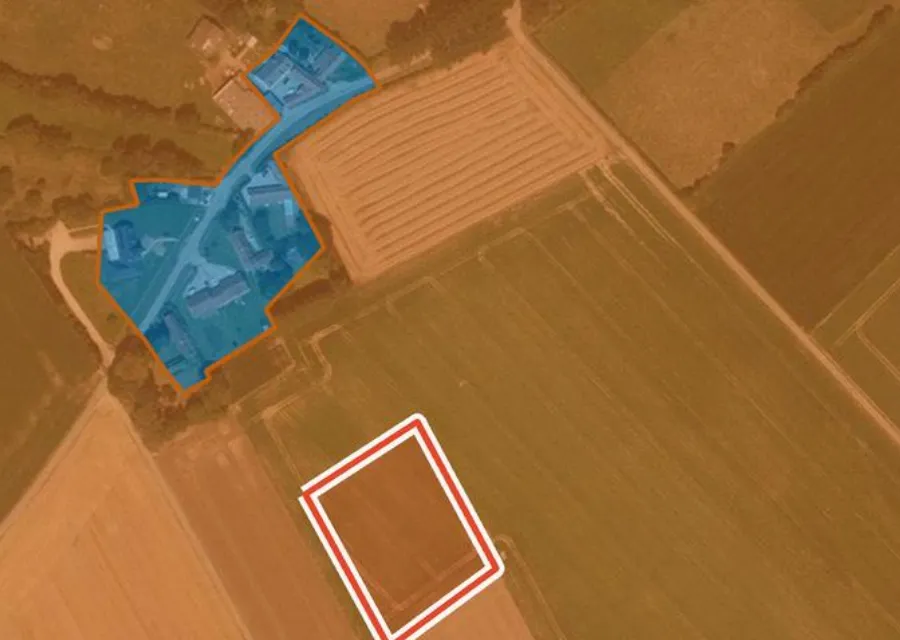
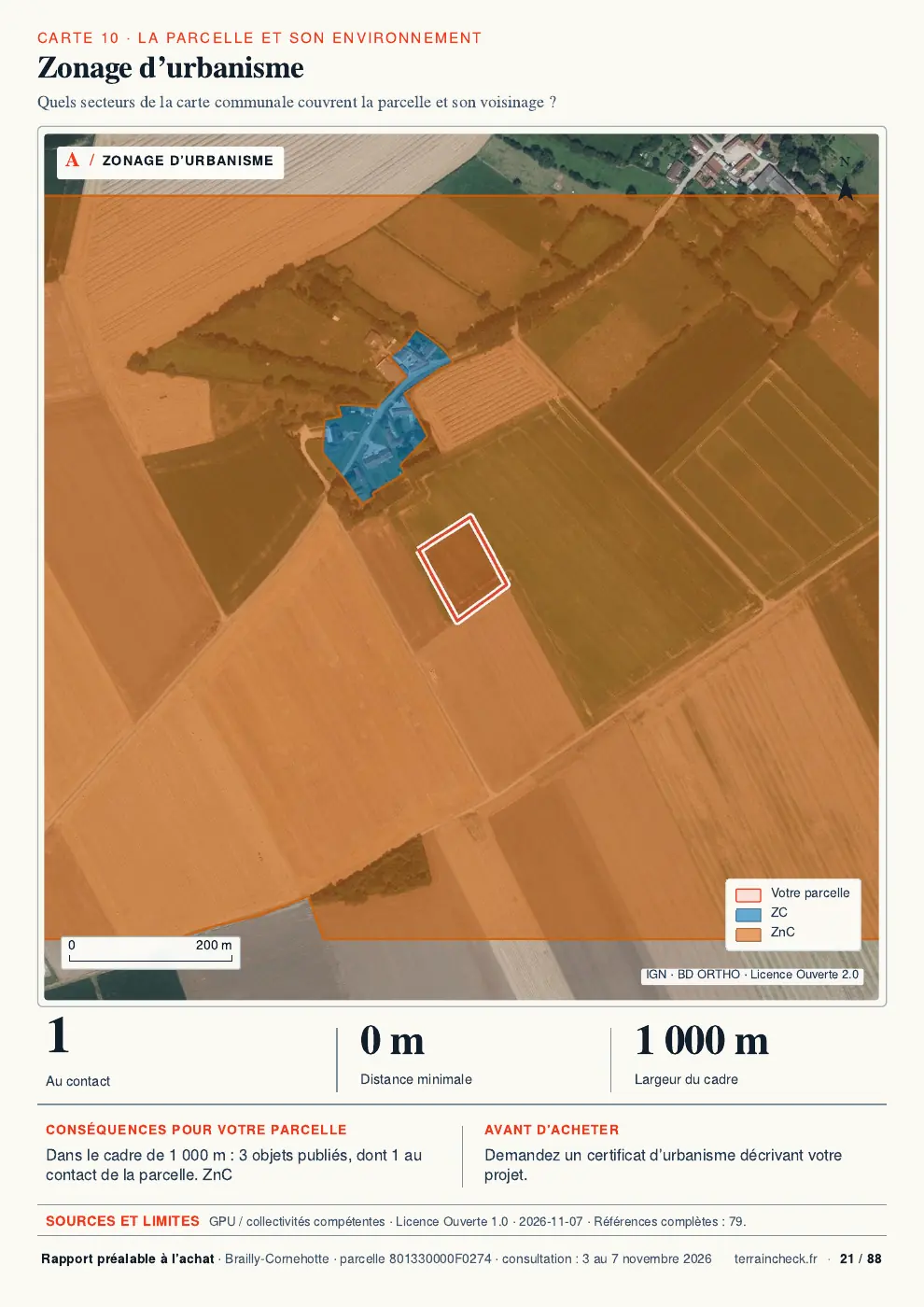
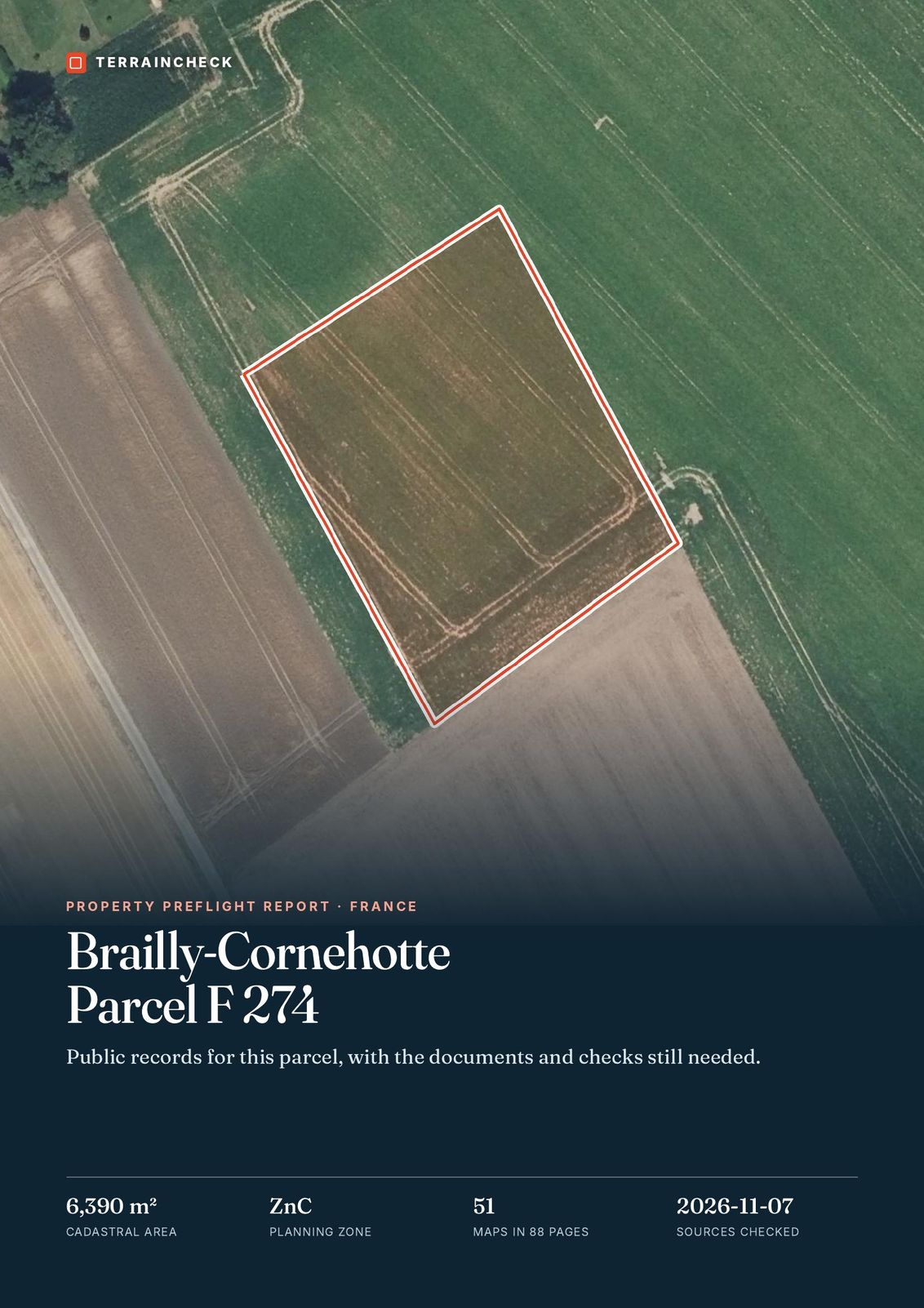
See what the public records say about the plot you have in mind
Pick the parcel on the map. The report sets out its planning zone as published, natural hazards, the woods and hedgerows around it and its dimensions, with sources and dates, explained in English. It does not say whether something already on the plot is authorised. Free preview, PDF report for €29 (€39 in French and English).