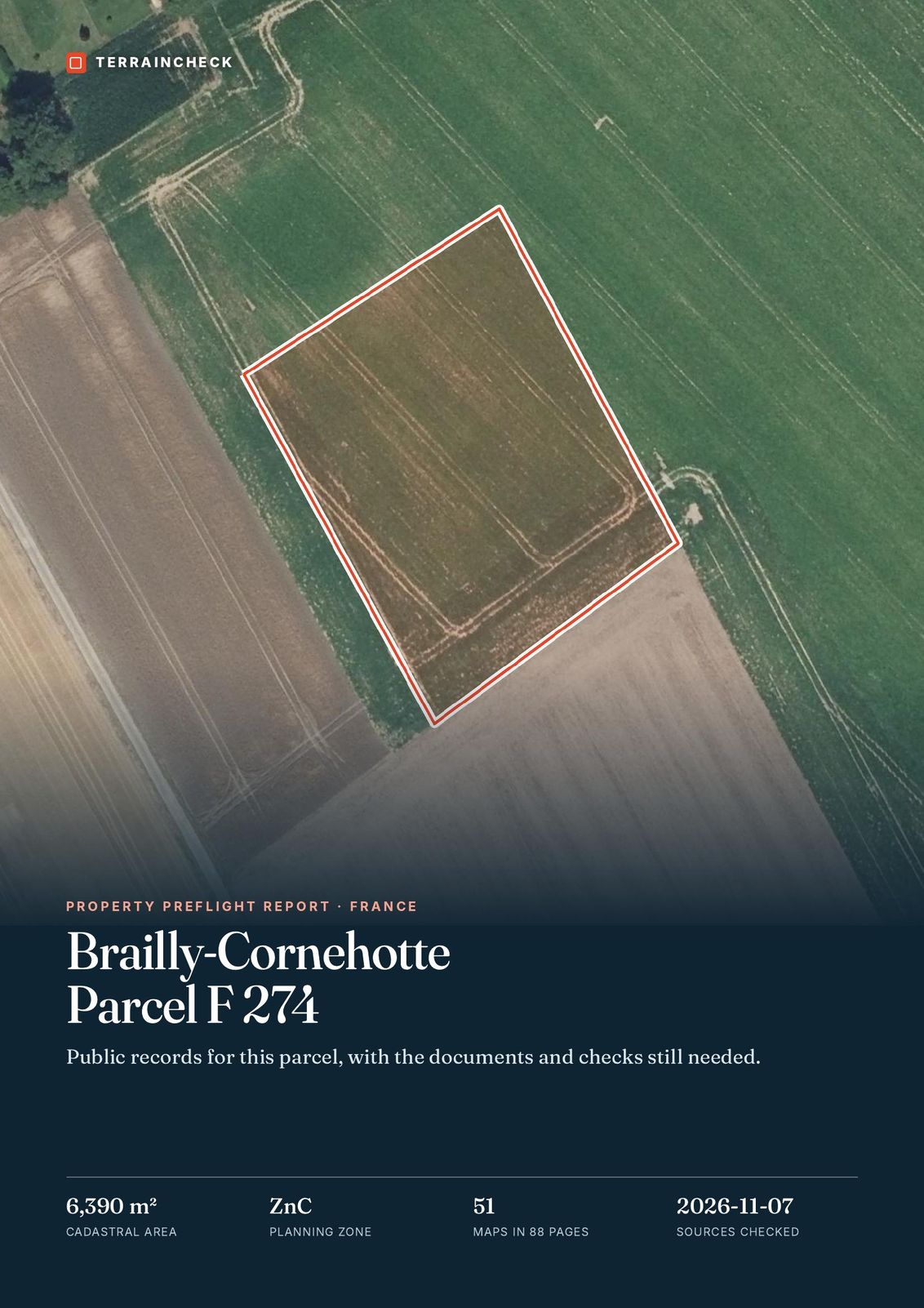
Pillar: Buying building land in France
Property tax on undeveloped land in France: who pays, how it is worked out, exemptions
In France, the tax on undeveloped land (taxe foncière sur les propriétés non bâties, TFPNB) is due for the whole year by whoever owns the plot, or holds a life interest in it, on 1 January. It is charged on 80% of the cadastral rental value, multiplied by the rates of the commune (the municipality), the intercommunal body (a grouping of communes) and some ancillary levies. Before you buy, ask the seller for their latest tax notice: it shows the base and the year’s amounts.
In brief
- 1 January decides. If you complete the purchase during the year, that year’s tax notice stays in the seller’s name. The pro rata split agreed at the notaire (the notary who handles the sale) binds only you and the seller, not the tax office.
- Farmland (arable land, meadows, pasture, orchards, vineyards, woods and heath, lakes, ponds and gardens) is 30% exempt from the commune and intercommunal shares; 100% in Corsica, 80% in the overseas départements. Building land gets no exemption and pays an additional tax on top.
- Example with the 2025 rates of Brailly-Cornehotte (Somme): for every €100 of base, about €90 a year on a plot classed as building land, about €34 on farmland.
- 2026 timetable: notices online from 27 August (unless you pay monthly), payment due by 15 October, or 20 October if you pay online. The deadline is printed on the notice.
On this page
Who pays, and for which year
France levies the taxe foncière sur les propriétés non bâties (TFPNB) every year on undeveloped property of every kind, unless the tax code expressly exempts it (art. 1393): a field, a wood, heathland or a building plot, income-producing or not.
The tax is due for the whole year based on the position on 1 January (art. 1415). It is charged to the owner, or to the usufructuary (the holder of a life interest) when the land is subject to a usufruct (art. 1400). A purchase completed on 2 January changes nothing for that year: the seller gets the notice and pays all of it.
On completion day at the notaire’s, the buyer usually refunds the seller for the rest of the year, pro rata to the last notice. That agreement only binds the two of you; the tax office ignores it. You are normally taxed in your own name from the following year, once the sale has been recorded in the cadastre.
Sources: Légifrance: tax code, article 1415 (position on 1 January); Légifrance: tax code, article 1400 (who is liable); Service-Public: property tax when a property is sold during the year; BOFiP: TFPNB, annual nature of the tax (BOI-IF-TFNB-10-10). Accessed 13 November 2026.
How the tax is worked out
The starting point is the parcel’s cadastral rental value (valeur locative cadastrale). Nobody values your plot individually: the tax office applies a scale set for each commune (the French municipality) by type of land use and, where relevant, by grade, based on rents on 1 January 1961 (another date overseas).
The value is uprated every year (coefficient 1.008 for 2026). The tax base, the revenu cadastral, is that value less 20% (art. 1396). Every line of the notice is the base times the rate of the body that receives it.
| Line on the notice | Who receives it | Which land | Brailly-Cornehotte 2025 |
|---|---|---|---|
| Commune | The commune (rate it votes) | All; 30% off for farmland | 27.70% |
| Intercommunal body | CC Ponthieu-Marquenterre (rate it votes) | All; 30% off for farmland | 7.85% |
| Additional tax | Commune or intercommunal body; fixed rate, not voted | Quarries, building land, amenity land, railways, the ground under buildings; not farmland | 43.74% |
| Chamber of agriculture | The network of chambers of agriculture | All land liable to TFPNB, without the 30% exemption | 6.35% |
| GEMAPI | Intercommunal body (water and flood defence) | All; 30% off for farmland | 1.33% |
| Special equipment tax (TSE) | Public land agency | All; 30% off for farmland | 0.224% |
Net 2025 rates in Brailly-Cornehotte (80133), plus state management fees (art. 1641). Sources: DGFiP: REI 2025 local tax file (data.gouv.fr); Légifrance: tax code, article 1519 I (additional tax). Accessed 13 November 2026.
The commune can also, by a council decision, raise the rental value of some buildable land in urban or future-urban zones (art. 1396, II). How that works is covered in holding buildable land without building; the mairie (town hall) can tell you whether it applies.
Farmland or building land: two different bills
The tax follows the parcel’s land use on 1 January, not what the buyer plans to do with it. Two rules widen the gap.
Land in agricultural use, meaning the categories “arable land, meadows, pasture, orchards, vineyards, woods and heath, lakes, ponds and gardens”, is 30% exempt (art. 1394 B bis). The exemption covers the commune and intercommunal shares, and also the GEMAPI levy and the public land agency’s tax. The chamber of agriculture tax remains payable in full. In Corsica the exemption is total; in Guadeloupe, French Guiana, Martinique, Mayotte and Réunion it is 80%.
Quarries, building land and private roads, amenity land, parks, gardens and ornamental water, railways and canals, and the ground under buildings carry an additional tax instead (art. 1519 I, not applied in Mayotte). Nobody votes its rate: it is the 2010 département and regional rates for the area added together and multiplied by 1.0485.
A worked example in Brailly-Cornehotte
Take a plot classed as building land in this commune in the Somme, with a revenu cadastral of €100, a round figure chosen for the example. Rates: 2025, from the REI file of the French tax administration (DGFiP), the latest published.
- Commune: 100 × 27.70% = €27.70. Intercommunal body: 100 × 7.85% = €7.85.
- Additional tax: 100 × 43.74% = €43.74. GEMAPI: €1.33. Public land agency: €0.22. Chamber of agriculture: €6.35.
- Total of the shares: €87.19.
- State fees (art. 1641 as it applied in 2025): 3% on the commune, intercommunal, additional tax and GEMAPI lines (€2.42), 9% on the chamber line (€0.57), under €0.03 on the land agency line. Total: about €90.
Classed as farmland, the same plot would pay about €34: the 30% exemption brings the commune share down to €19.39, the intercommunal share to €5.50, GEMAPI to €0.93 and the land agency to €0.16, and there is no additional tax; the chamber of agriculture stays at €6.35. A real notice rounds the bill to the nearest euro.
Communal rates vary widely: in 2025 the median was 41.09% and one commune in ten charged more than 83.26%. At 27.70%, Brailly-Cornehotte is on the low side, with about a quarter of communes below it.
Temporary exemptions that may apply
Some temporary exemptions apply automatically, others only if the commune has voted for them. Most require the owner to file something with the tax office.
| Situation | Length | Condition |
|---|---|---|
| Land sown, planted or replanted with trees since 1 January 2002 | 10 years (poplars), 30 years (conifers), 50 years (broadleaves and other woods) | Automatic, for planting aimed at timber production; the change must be declared within 90 days |
| Land sown, planted or replanted with trees before 1 January 2002 | 30 years from sowing, planting or replanting | Automatic; depending on the planting date, the exemption may have run out |
| Newly planted truffle trees | 50 years | Automatic |
| Land in a Natura 2000 site | 5 years, renewable | Parcel on an official list and a 5-year management commitment |
| Land in a wetland | 5 years, renewable | Scheme abolished from 21 February 2026, except commitments made before that date |
| Walnuts, orchards, vineyards | Up to 8 years | Only if the commune has voted for it |
| Organic farming | 5 years | If voted; parcel list and certificate before each 1 January |
Main temporary exemptions (page checked on 21 February 2026); full conditions in articles 1395 onwards of the tax code. Sources: Service-Public: tax on undeveloped property (TFPNB). Accessed 13 November 2026.
Olive groves can be exempt permanently if the commune has decided so (form 6707-SD before 1 January of the first year). Ask the seller which exemptions appear on their notice, and until when.
Estimating the tax before you buy
- Ask the seller for their latest avis de taxe foncière (property tax notice), or at least the base and the amounts for the plot. Cost: nothing. Timing: up to the seller; no deadline is set by the texts cited.
- Ask which land use the tax office records (arable land, meadow, wood, building land); if in doubt, ask the land tax and cadastre office (centre des impôts fonciers). Cost: nothing. No deadline set by the texts cited.
- Look up the commune’s rates with the finance ministry’s local tax rates by commune service (in French): year, region, département, then commune. Cost: nothing. Time: about a quarter of an hour (TerrainCheck estimate).
- Do the sum: base × the total of the rates, plus fees as in the example, plus any uplift. Cost: nothing. Time: a few minutes (TerrainCheck estimate).
- In the compromis (binding preliminary contract) and then the deed, have the split of the current year’s tax written in. It is usually settled at the notaire’s on completion day, pro rata to the last known notice. Cost: your share of the tax, refunded to the seller.
- After the purchase, your first notice arrives the following year. In 2026, notices were online from 27 August (19 September for monthly payers), payable by 15 October, or 20 October online.
Sources: Service-Public: local tax rates by commune; impots.gouv.fr: property tax notice and payment dates (2026). Accessed 13 November 2026.
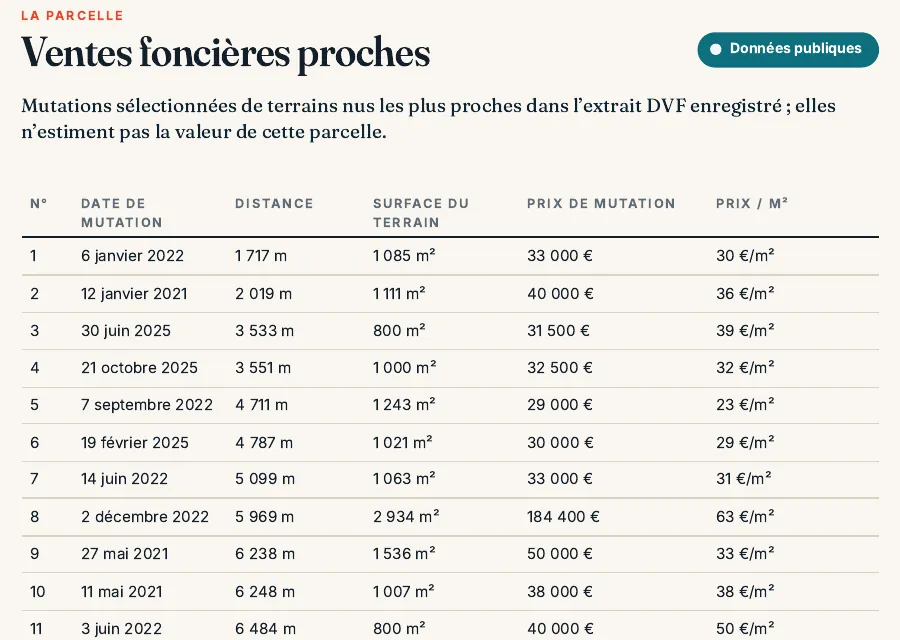
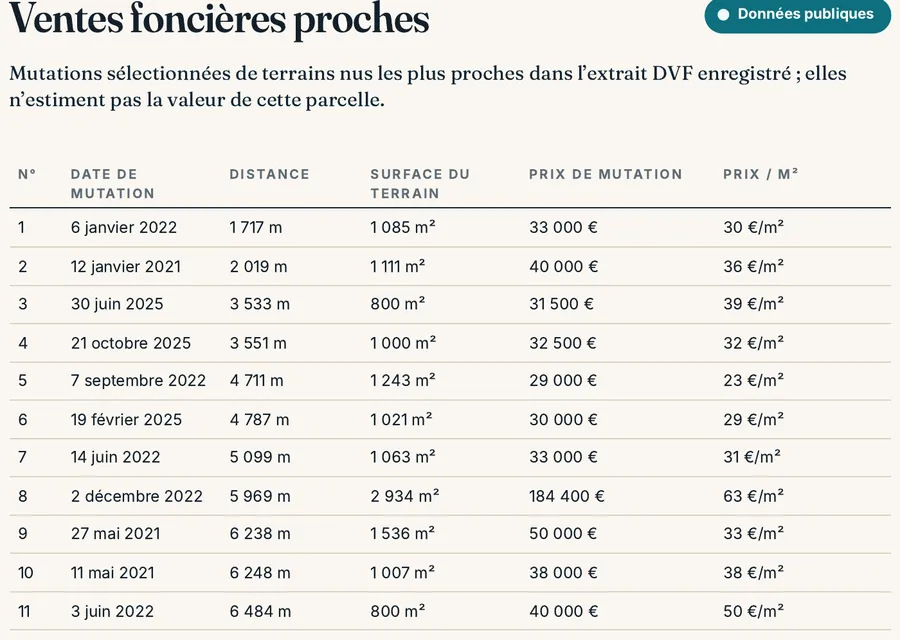
In the report: land prices in the commune
Before the compromis: six property tax checks
- Seller’s latest property tax notice in hand: base, amounts, current exemptions.
- Land use recorded for the parcel known: farmland or building land.
- Last year’s commune and intercommunal rates noted.
- Any uplift for buildable land checked at the mairie.
- Split of the current year’s tax written into the compromis.
- Any planting or change of use planned, with the 90-day declaration deadline noted.
Other costs of the project: the development tax payable with a building permit, and the notary fees on bare land.
Common questions
I am buying land in June: who pays that year’s property tax?
The seller, as owner on 1 January: that year’s notice is in their name and they pay all of it. A pro rata refund is agreed at the notaire’s and binds only buyer and seller. You are normally taxed in your own name from the following year.
Does a building plot pay more than a field?
On the same base, yes: farmland gets the 30% exemption on the commune and intercommunal shares, and building land carries the additional tax under article 1519 I. The bases themselves differ with land use and grade, so only the notice gives the exact amount.
Is woodland exempt?
Land sown, planted or replanted for timber production is automatically exempt from sowing or planting: 10, 30 or 50 years depending on the species since 1 January 2002, 30 years for older planting. The change must be declared on time. Ask when the trees were planted: for older woodland the exemption may have run out. Otherwise, land classed under “woods and heath” generally gets the 30% exemption.
Keep reading
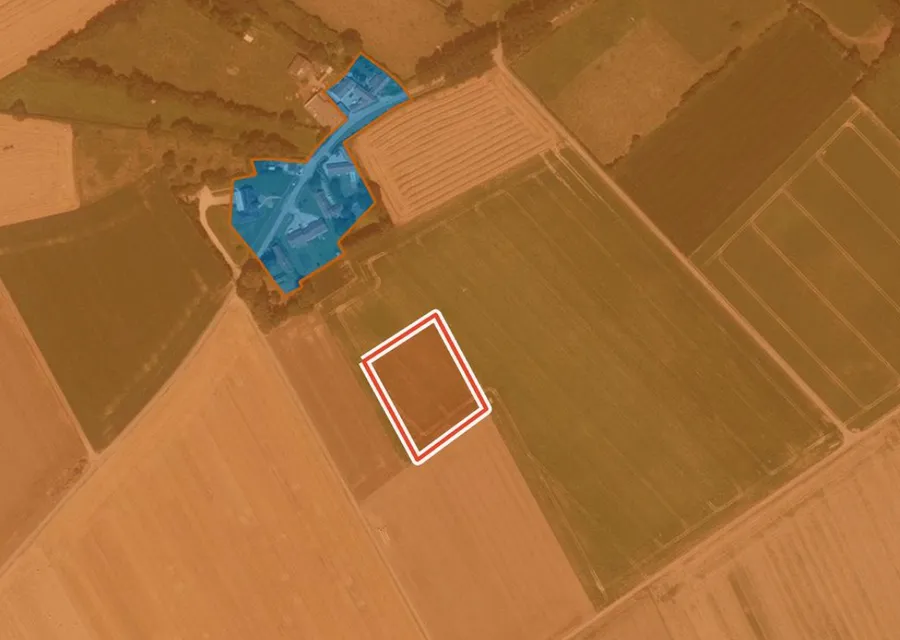
Holding buildable land without building in France: land tax, rezoning and resale
France’s development tax (taxe d’aménagement): how it is calculated, when it is due and who is exempt
Notary fees when buying land in France: 2026 rates by département, the fee scale and worked examples
Capital gains tax on selling building land in France: calculation, allowances and exemptions
Before you sign, look at the plot itself
The seller’s notice tells you the property tax. The report covers what the notice does not: the PLU zone (the local plan), natural hazards, clay soils, Natura 2000 and land sales around the parcel, each with its source and date, explained in English. Free check, PDF report for €29 (€39 in French and English).