Pillar: Buying building land in France
Capital gains tax on selling building land in France: calculation, allowances and exemptions
In France, a private owner who sells building land at a gain pays 19% income tax and, at the standard rate, 17.2% social charges on the gain, reduced by allowances from the 6th year: no income tax after 22 years of ownership, no social charges after 30 years. The notaire (the notary handling the sale) calculates and pays it all at completion in an ordinary sale, so gather your purchase deed and servicing invoices now.
In brief
- Gain = sale price, less documented selling costs, less the purchase price plus acquisition costs (actual, or a flat 7.5% if you bought the land) and road, utility and network costs. The 15% flat allowance for works does not apply to bare land.
- Income-tax allowance: 6% a year from the 6th to the 21st year, 4% for the 22nd. Social-charges allowance: 1.65% a year, then 1.60% for the 22nd year and 9% a year after that. A temporary exceptional allowance is available if you meet the conditions below.
- The surcharge on gains above €50,000 does not cover building land. On the first sale of bare land that has become buildable, two other taxes may apply if the conditions below are met.
- A plot cut from the garden of your main home and sold as building land is not exempt the way the house is. Possible exemptions: a price of €15,000 or less, pensioners or holders of the French disability card (carte mobilité inclusion), subject to income limits, compulsory purchase with reinvestment.
On this page
Working out the gain on a plot
The sale price is the one in the deed, less documented selling costs such as the compulsory surveys. The purchase price is the one in your purchase deed, increased only by the costs the law lists.
For land, two items matter most: acquisition costs (transfer duties, the notaire’s fees and any agent’s commission you paid), at their actual amount or as a flat 7.5% after a purchase, and servicing you paid for yourself, backed by invoices.
| Cost | Bare land | Proof |
|---|---|---|
| Purchase costs (duties, notaire) | Actual, or flat 7.5% of the price (purchases only) | Deed, notaire’s statement |
| Roads, utilities, networks | Actual amount, whether or not imposed by the council | Invoices |
| Drainage and works on bare land | Actual amount, if eligible | Invoices |
| Demolishing a derelict building | Allowed to sell the site as building land | Invoices |
| 15% flat allowance for works | No: built property only | n/a |
| Interest on loans for works | Not allowed | n/a |
What increases the purchase price of bare land. Proof is supplied if the tax authority asks for it. Sources: BOFiP: additions to the purchase price (BOI-RFPI-PVI-20-10-20-20); Service-Public: income tax on real-estate capital gains (checked 15 April 2026). Accessed 13 November 2026.
As a rule, a loss on one property cannot be set against a gain on another, even in the same year; the exceptions are narrow.
Holding-period allowances: 22 years and 30 years
Since 1 September 2014, building land has had the same allowances as other property. Ownership is counted in periods of twelve months up to the sale, from the purchase deed (not its registration), the date of death for inherited land, or the deed of gift.
For tax purposes the sale date depends on the preliminary contract. With no prior compromis, it is the date of the final deed. A privately signed compromis (binding on both sides) counts as a sale when it is signed; if it has a condition precedent, the sale takes place on the date of the deed recording that the condition is met. A unilateral promise to sell does not transfer ownership. Have the notaire confirm this date before you plan around an allowance.
At 22 full years of ownership income tax falls away and social charges take 12.4% of the gross gain, then fall every year (1.5% at 29) until full exemption after 30 years. If you belong to the compulsory social security scheme of another EEA country or Switzerland, and not to the French one, you are exempt from CSG and CRDS (two of the social charges); impots.gouv.fr states that UK residents still qualify for this exemption after Brexit. The 7.5% solidarity levy remains due in every one of these cases.
A temporary exceptional allowance also exists (article 150 VE of the CGI, version in force since 21 February 2026, in French). For building land, the plot must lie in a commune (municipality) that a ministerial order classes as an area of severe imbalance between housing supply and demand, Corsica excluded.
The promise to sell must be signed, with a certified date, between 1 January 2024 and 31 December 2027, and the sale completed by 31 December of the second year after that.
In the deed the buyer undertakes to build one or more blocks of flats, demolishing first if needed, finished within four years of the purchase and using at least 75% of the maximum permitted building envelope.
The rate and any further undertakings depend on the scheme and the commune: your notaire checks them against the full text of the article.
The allowance is ruled out if the buyer is your spouse, civil partner (PACS) or a partner you openly live with as a couple (concubin notoire), a direct ancestor or descendant of you or of one of those people, or a company in which you or one of them is or becomes a partner on this sale.
Inherited, gifted or divided land
For land you inherited or were given, the purchase price is the value used to calculate inheritance or gift tax, as stated in the estate return or the deed of gift. You can add the deed costs and the duties you paid yourself, at their actual amount and in proportion to the plot. The flat 7.5% does not apply: it is for purchases only.
A low value in the estate return saves inheritance tax but makes the gain larger when you sell. To get a copy of the deed, see finding a French title deed.
When you divide land, the gain is worked out on the part you sell, with its share of the price and purchase costs. The division itself is covered in selling part of your plot.
The main-home exemption and other cases
The house that is your main home on the day of sale is exempt, together with its immediate and necessary outbuildings sold at the same time. But land sold as building land (buildable under the planning documents) is not treated as an outbuilding. Still exempt in that case: garages, parking spaces, sheds and caretaker’s cottages used with the house, plus yards, paths and access ways.
- A price of €15,000 or less. The threshold is measured on the value of full ownership; for jointly owned property (indivision), on each co-owner’s share.
- Pensioners, and holders of the carte mobilité inclusion marked “invalidité” (the French disability card). You must not have been liable to IFI (the French real-estate wealth tax) in the second year before the sale, and your reference tax income for that year must be under the legal limit: for a sale in 2026, €12,793 for the first share of the household in 2024, plus €3,428 per extra half-share (different amounts in the overseas départements).
- Compulsory purchase. Land subject to a public-interest declaration, if the whole compensation is used to buy, build, rebuild or extend one or more properties within 12 months of receiving it.
- Sale to a social-housing body, or to a private developer committed to building social housing, until 31 December 2027, subject to the statutory conditions.
On the other hand, the surcharge on large gains (taxable gain above €50,000, at 2% to 6%) excludes building land as defined for VAT. A non-buildable parcel sold at a large gain can be caught by it.
Sources: French Tax Code (CGI), art. 150 U (scope and exemptions), Legifrance; BOFiP: main-home exemption and outbuildings (BOI-RFPI-PVI-10-40-10); Service-Public: income tax on real-estate capital gains (checked 15 April 2026); BOFiP: local tax on bare land made buildable (BOI-RFPI-TDC-10); BOFiP: national tax on bare land made buildable (BOI-RFPI-TDC-20); CGI, art. 1605 nonies (bare land made buildable), Legifrance; BOFiP: surcharge on large real-estate gains, scope (BOI-RFPI-TPVIE-10); CGI, art. 1609 nonies G (surcharge on large gains), Legifrance. Accessed 13 November 2026.
Who files, who pays, and when
- Gather the papers as soon as you list the plot. Purchase deed or estate return, statement of costs, invoices for servicing or demolition. Cost: nothing. Time: an hour or two if the papers are to hand (TerrainCheck estimate).
- Estimate the gain before you set the price. Redo the worked example with your own figures and check it with the notaire handling the sale. Cost: nothing. Time: half an hour (TerrainCheck estimate).
- In an ordinary sale, the notaire files and pays at completion. For building land, the notaire fills in form 2048-TAB-SD (cerfa 14968), also used for the taxes on land made buildable, and pays the tax to the land registry office (service de la publicité foncière) for the area, with the request to register the deed (in Alsace-Moselle, the return is handed in at registration). There is no scheme for deferring payment. If no tax is due, the deed simply states the exemption.
- The following spring, report the net taxable amount on your French income tax return: for a 2026 sale, the filing season opens in April 2027. Cost: none; forgetting it costs a fine of 5% of the undeclared amount, between €150 and €1,500 (€75 and €750 if you have filed correctly for the previous three years).
Exceptions to step 3: if debts ranking ahead of the Treasury’s lien prevent the full tax being paid from the price, or if the buyer is the state, a local authority or another public body listed in article 150 VG of the CGI, the return goes to the tax office for the seller’s home address within one month of the deed. You pay the tax there in the first case; the notaire pays in the second, once the public buyer has transferred the money.
Sales by court order or by administrative deed follow other rules: see the BOFiP guidance (§ 230 onwards).
If you are not resident in France, the gain is worked out the same way, but the tax is collected as a levy under its own rules (tax representative, exemptions): see impots.gouv.fr.
Sources: BOFiP: filing and payment (BOI-RFPI-PVI-30-40); Service-Public: capital gains return for sales of building land (cerfa 14968); BOFiP: chargeable event (BOI-RFPI-PVI-30-10); Service-Public: income tax on real-estate capital gains (checked 15 April 2026); impots.gouv.fr: real-estate gains of non-residents. Accessed 13 November 2026.
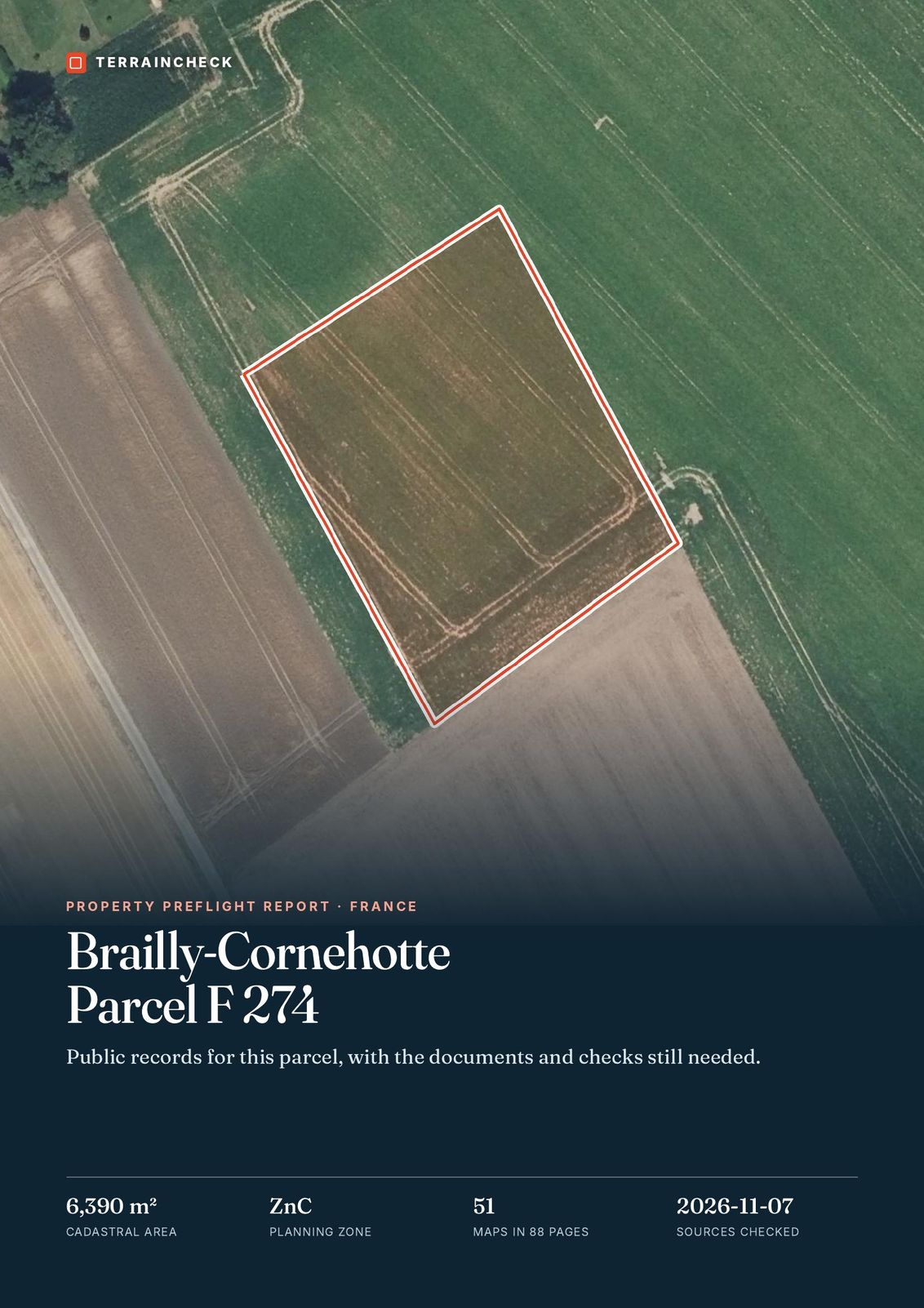
In the report: land sales around F 274
Before you list the plot: six checks on the gain
- Purchase deed, or estate return or deed of gift, found.
- Years of ownership counted in full years up to the sale date confirmed by the notaire.
- Purchase costs: actual amount or flat 7.5%, whichever is higher.
- Invoices for roads, utilities, drainage or demolition filed.
- Possible exemption checked (€15,000, pensioner, disability card, compulsory purchase).
- Notaire asked about the article 1529 and 1605 nonies taxes.
Read next: estimating land prices with DVF, notary fees on land and VAT on building land.
Common questions
Is there anything to pay after 22 years of ownership?
No income tax after 22 years, but social charges continue at a falling rate until 30 years: at the standard rate, 12.4% of the gross gain at 22 full years, then about 1.5 points less each year. The article 1605 nonies tax on bare land made buildable may still be due.
Who calculates and pays the tax?
In an ordinary sale, the notaire handling the sale, on form 2048-TAB-SD, to the land registry office when the deed is registered. Two exceptions (debts ranking ahead of the Treasury, a public buyer) are described above. You then report the net taxable amount on your income tax return.
Keep reading
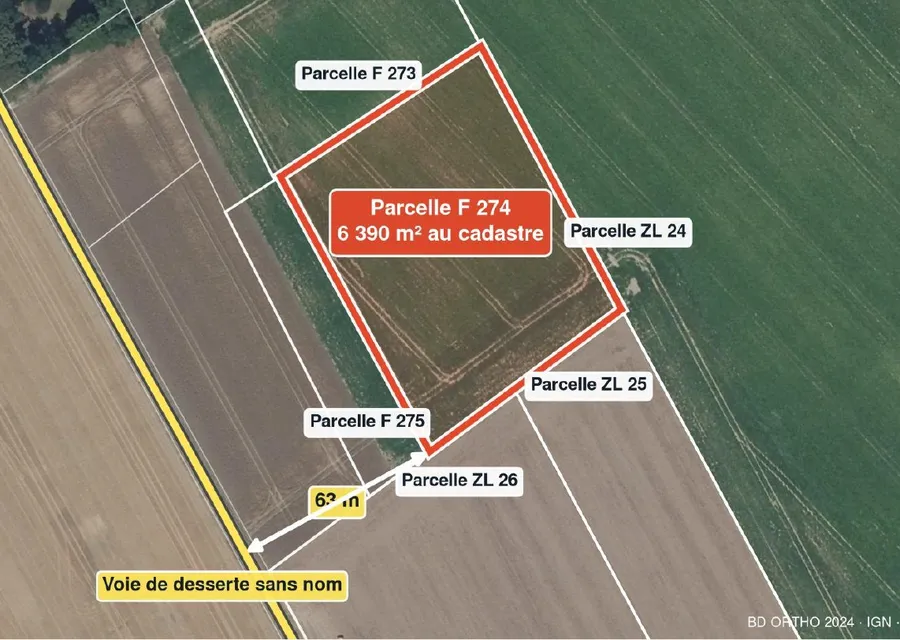
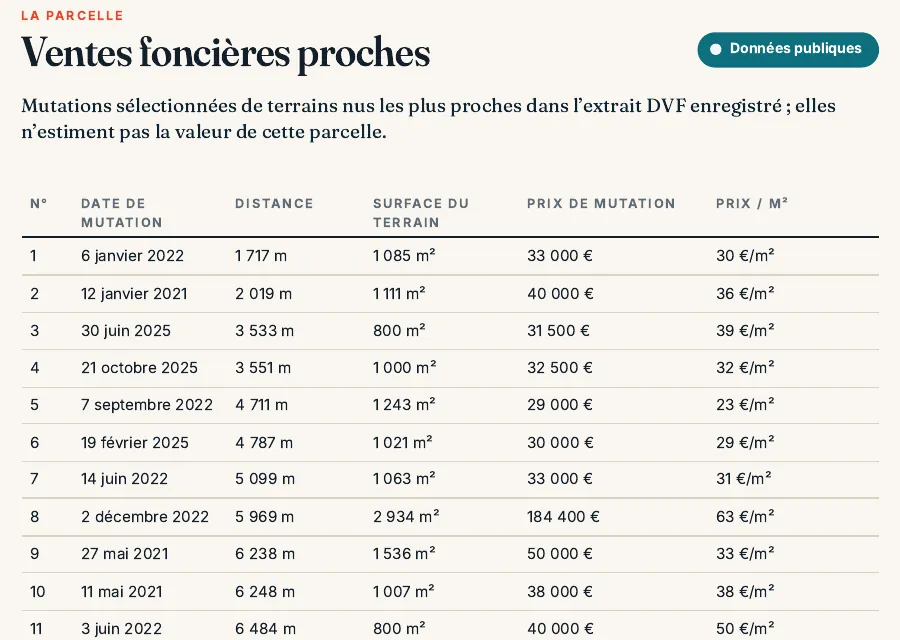
See where your asking price sits among nearby sales
Pick the parcel on the map. The report lists nearby land sales recorded by the French tax authority (not available for Alsace, Moselle or Mayotte), then the PLU zone and natural hazards, each sourced, dated and explained in English. It does not calculate your gain. Free check, PDF report for €29 (€39 in French and English).