Pillar: Buying building land in France
Property title (titre de propriété) for land in France: finding it, what it proves and what it does not
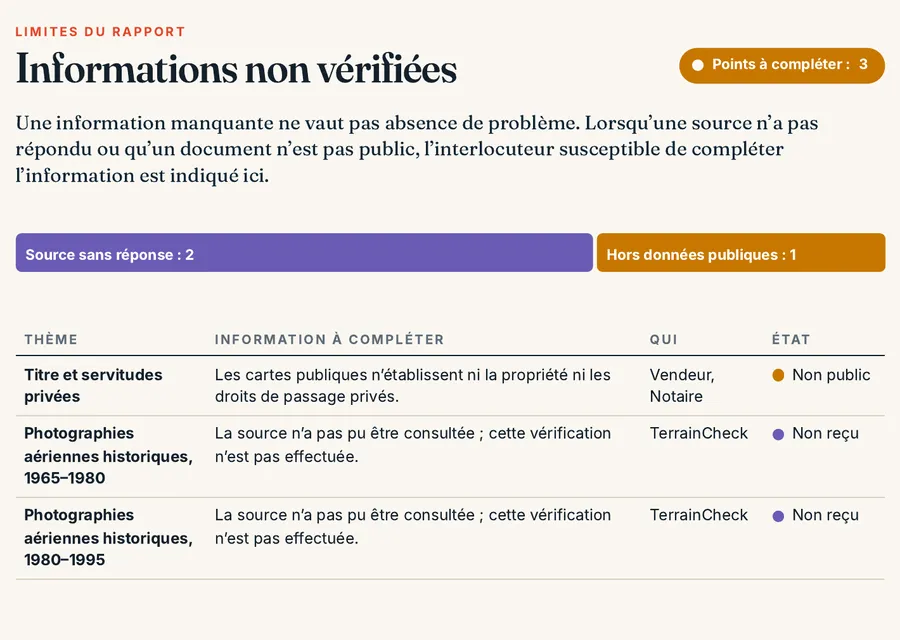
In France the title to a plot is the authentic deed registered at the land registry, the service de la publicité foncière (a sale, gift, division, certificate after a death or court ruling); the cadastre does not prove ownership. Ask the seller for a copy first; failing that, anyone can order one from the land registry office for the area on form 3236-SD, at €15 per deed if you have its registration references. In Moselle, Bas-Rhin and Haut-Rhin land is registered in a separate register, the Livre foncier.
In brief
- A notaire (the public official who draws up property deeds) gives copies of a deed, without a court’s leave, only to the people who signed it, their heirs and successors. The seller can ask their notaire; as a buyer you go through the seller or the land registry, the service de la publicité foncière (SPF).
- At the SPF, outside Alsace-Moselle: form 3236-SD if you have the date, volume and number under which the deed was registered (€15, plus €2 for a reply by post). Otherwise an information request on form 3233-SD first (€12 per property).
- The cadastral map exists for tax purposes: it does not fix boundaries and does not name the owner. Boundaries are fixed by a bornage, a survey agreed with the neighbours.
- Land can be acquired without a title by prescription: 30 years of continuous, peaceful, public and unequivocal possession as owner, or 10 years for a buyer in good faith with a juste titre (a deed of acquisition, such as a sale).
On this page
Which document is the title
In France the title (titre de propriété) is the deed through which the current owner acquired the land: a sale, a gift or a division between co-owners, a certificate drawn up by a notaire after a death, or a court decision. Any deed that has to be registered must be an authentic instrument, then registered at the land registry office for the place where the land lies.
Registration makes the deed enforceable against third parties: an unregistered sale cannot be relied on against someone who acquired competing rights over the same land from the same seller and registered them.
| Document | What it establishes | Where to get it |
|---|---|---|
| Deed of sale, gift or division | Ownership passing to the buyer; once registered, it can be relied on against third parties. | Seller; their notaire; SPF (anyone). |
| Notaire’s certificate after a death | The land passing to heirs or legatees, and whether they accepted. | Heirs; notaire; SPF. |
| Cadastral map | The parcel for tax purposes, without boundaries or the owner’s name. | cadastre.gouv.fr; the mairie (town hall). |
| Bornage report | It definitively establishes the boundaries between the surveyed plots. | Seller; the géomètre-expert (chartered land surveyor) who drew it up. |
| Acte de notoriété (prescription) | Witness statements on possession; a judge weighs them. | Seller; the notaire who drew it up. |
The deed records the transfer and registration makes it enforceable against third parties; in a dispute the judge weighs all the evidence, possession included. The cadastre and the bornage answer other questions. Sources: Légifrance: decree 55-22 of 4 January 1955 (land registration); Service-Public: consulting the cadastre; Service-Public: boundary surveys; Cass. 3rd civ., 10 October 2024, no. 23-17.458. Accessed 13 November 2026.
What the deed contains: the headings to read
For a sale other than a court-ordered one, the copy filed with the land registry opens with a standard part, in an order set by the 1955 decree on land registration (art. 34 and 34-1). A gift, a certificate after a death or a court ruling may follow a different layout. The diagram shows the headings of a deed of sale that matter to a buyer.
The description must give, for each property, its nature, location, area and cadastral designation: section, plan number and lieu-dit (the named locality), or street and number in the built-up part of an urban commune (municipality). Check it against the listing and the cadastral reference of the plot you visited.
The origin of title gives the references of the previous deed. Read the charges and conditions in full too, looking for any mention of an easement. To look for easements beyond the deed, see where to find easements before buying.
Getting a copy: seller, notaire, land registry
- Ask the seller for a copy in writing before the compromis (the binding preliminary contract); if it is lost, they can ask their notaire for another. Cost to you: nothing. Time: no deadline is set by the texts cited.
- The notaire who drew up the deed keeps the original, called the minute. Copies go to the signatories, their heirs and successors; anyone else needs leave from the president of the tribunal judiciaire (the local civil court), applied for through a lawyer. Cost: retrieval and copying charges that vary from office to office, so ask for a quote. Time: no deadline is set by the texts cited.
- The land registry office for the place where the land lies gives anyone a copy of a deed registered since 1 January 1956: form 3236-SD, quoting the date, volume and number of registration, in two copies for a reply by post, one for a reply by email. Cost: €15 per deed, plus €2 postage.
- Without the registration references, file an information request on form 3233-SD for the property first (€12, plus €2 by post): the reply gives the successive owners and the date and nature of each acquisition, which you then quote on form 3236-SD. Service-Public announces a reply within 10 days without saying when the period starts; failing a reply, you can refer the matter to the Cada, the commission on access to administrative documents.
- Deeds from before 1956: a list of entries on form 3230-SD (€5 per person named), then a copy on form 3231-SD (€15 per document; without references, a non-refundable €15 deposit, topped up if the recalculated charge is higher). If a document has gone to the departmental archives, the SPF says so in its reply.
A worked example. You do not know the references of the seller’s deed and want the replies by post: €12 for the 3233-SD request, €2 postage, €15 for the 3236-SD copy, €2 postage, so €31. By email there is no postage: €27.
Moselle, Bas-Rhin and Haut-Rhin: the Livre foncier
In these three départements land is registered in a separate register, the Livre foncier, kept by eleven land registry offices that are part of the civil courts under the appeal courts of Colmar and Metz. The forms and fees above do not apply there: contact the office that covers the land for its own procedure and charges.
Sources: Service-Public: lost property deed; Service-Public: getting a copy of a notarial deed; Service-Public: property information; livrefoncier.fr (EPELFI): the Livre foncier; livrefoncier.fr: the land registry offices. Accessed 13 November 2026.
Title or cadastre: which one counts
For ownership, start from the registered title: it shows how the seller acquired, and registration makes it enforceable against third parties. It is not absolute proof: in a dispute the judge weighs the evidence, and prescription lets someone acquire without a title (see below). The cadastral map has a tax purpose: it does not guarantee boundaries and does not carry owners’ names. A seller who shows you a cadastral extract as proof of ownership has not shown you a title.
The deed repeats the cadastral designation and area. Boundaries on the ground are fixed by a bornage: the géomètre-expert examines the titles, and the report definitively establishes the boundaries between the plots concerned. The gap between cadastral and real area is covered in cadastral area vs real area, the cost of a survey in bornage: cost and who pays.
Origin of title: tracing the chain
A deed can only be registered if the seller’s own title was registered before it. There are two exceptions: a right acquired without a title, notably by prescription or accession, and a title dated before 1 January 1956. Each deed therefore points to the one before.
How far back? The texts cited set no period for a buyer. Thirty years is the prescription period: someone who has possessed the land for thirty years on the legal conditions may have become its owner without producing any title. Going back at least that far shows who held the land, and on what basis. With a juste titre and good faith the period drops to ten years; a title void for a defect of form does not count towards those ten years.
A possessor can add the possession of the person they took over from, however they succeeded them: a buyer adds their years to the seller’s. The SPF certifies its information for documents registered since 1 January of the fiftieth year before the request; older entries come as plain information.
Land with no title, or acquired by prescription
Acquisitive prescription lets someone acquire property through possession without producing a title. The possession must be continuous and uninterrupted, peaceful, public, unequivocal and as owner. Someone who holds on another’s behalf, such as a tenant or a holder of a life interest (usufruitier), does not acquire by prescription, however long they stay, as long as they hold on that basis; they only can if the basis of their possession has been reversed (interversion du titre), through a cause coming from a third party or by openly contesting the owner’s right (art. 2266 and 2268 of the Civil Code). Prescription is interrupted if the possessor loses use of the land for more than a year.
A notaire can record prescription in an acte de notoriété that gathers witness statements. On 10 October 2024 the Cour de cassation (France’s highest civil court) held that such a deed cannot by itself establish prescription: the judge weighs the statements it records, and whoever relies on prescription must prove physical acts of possession.
Sources: Légifrance: Civil Code, art. 2258 to 2277; Cass. 3rd civ., 10 October 2024, no. 23-17.458; Légifrance: decree 55-22 of 4 January 1955 (land registration). Accessed 13 November 2026.
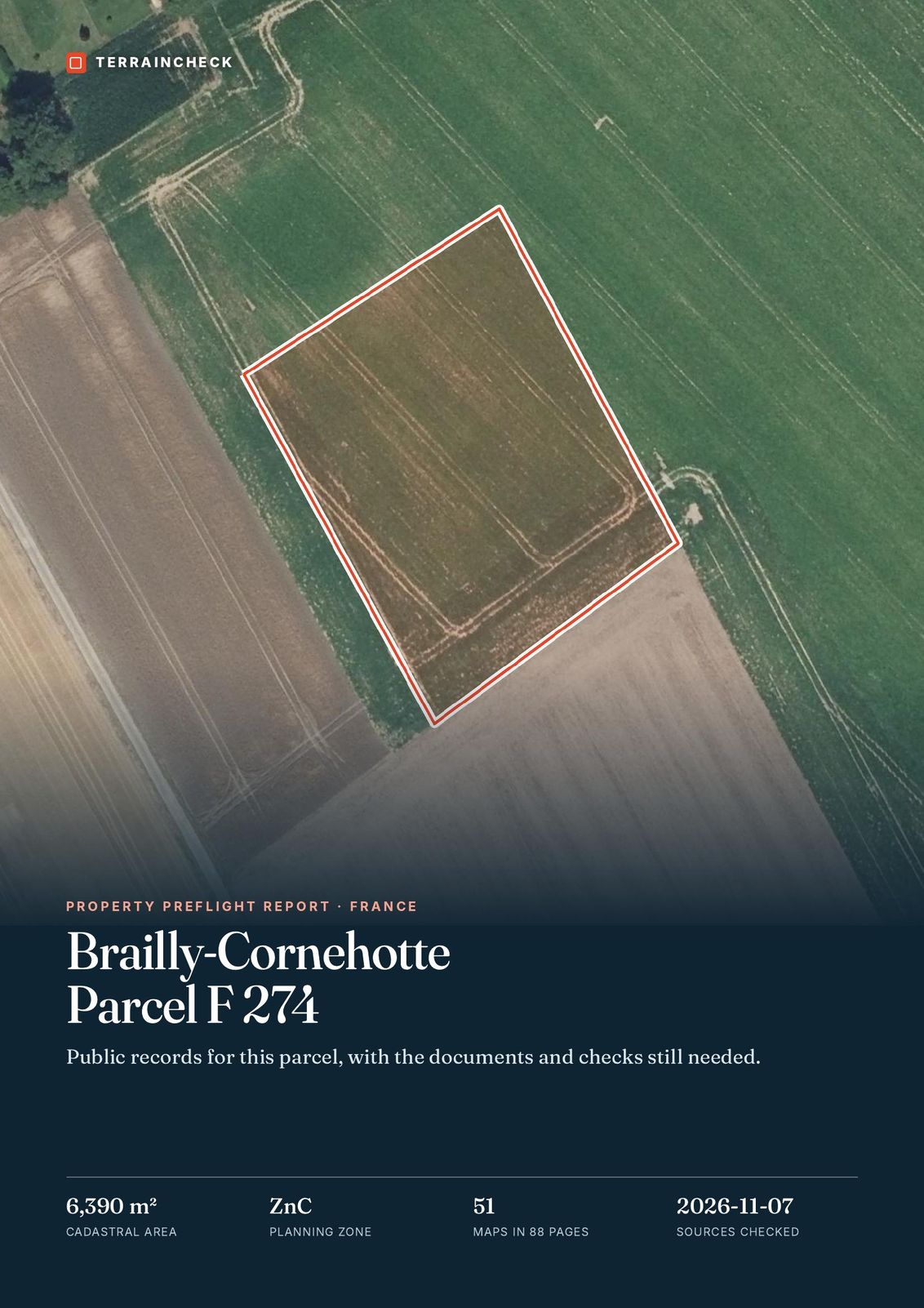
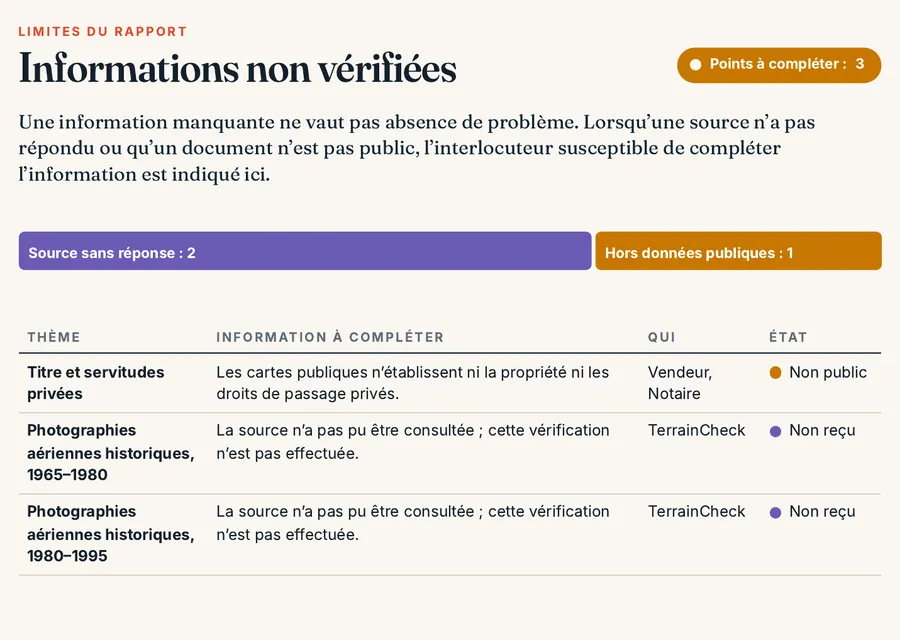
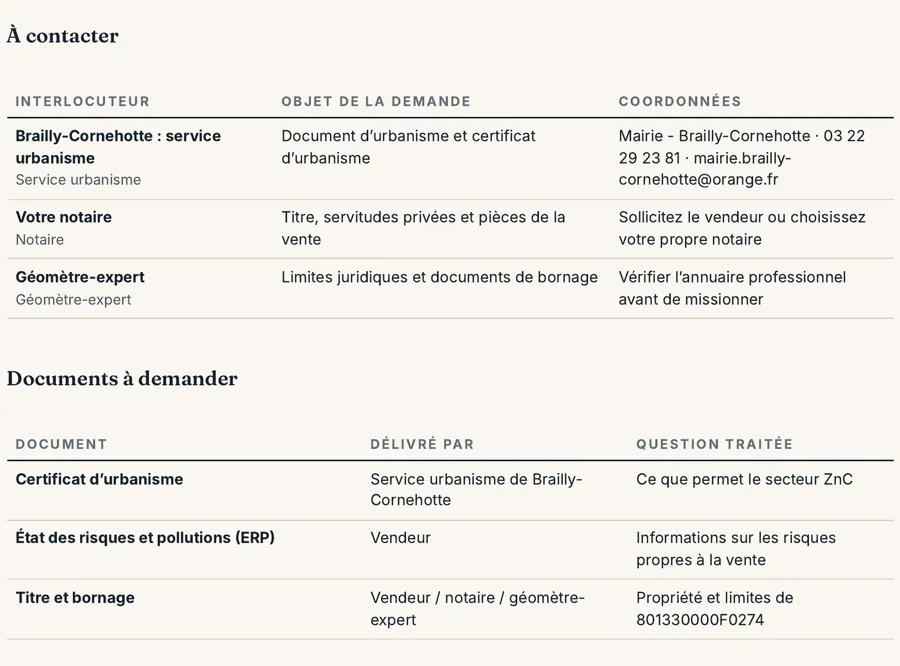
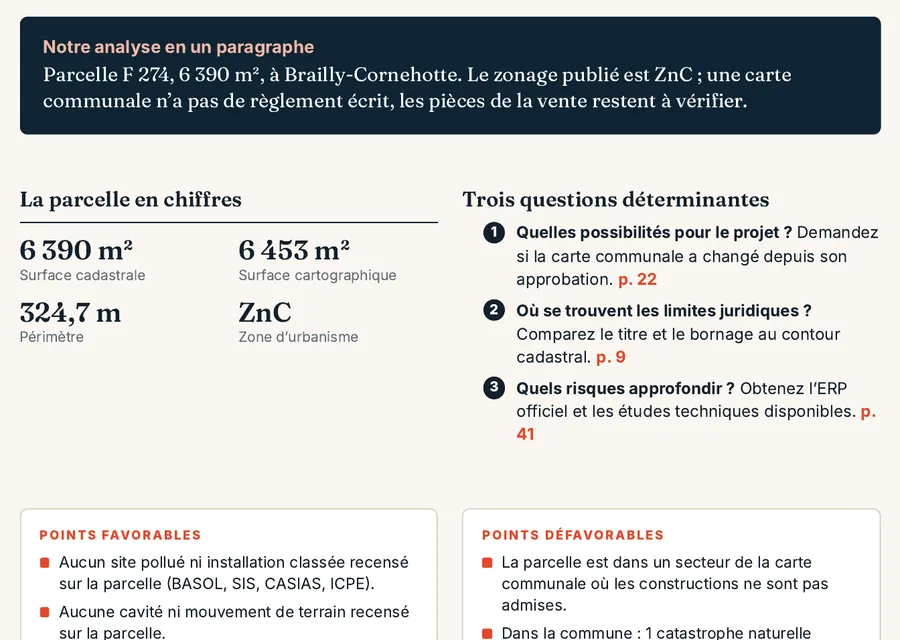
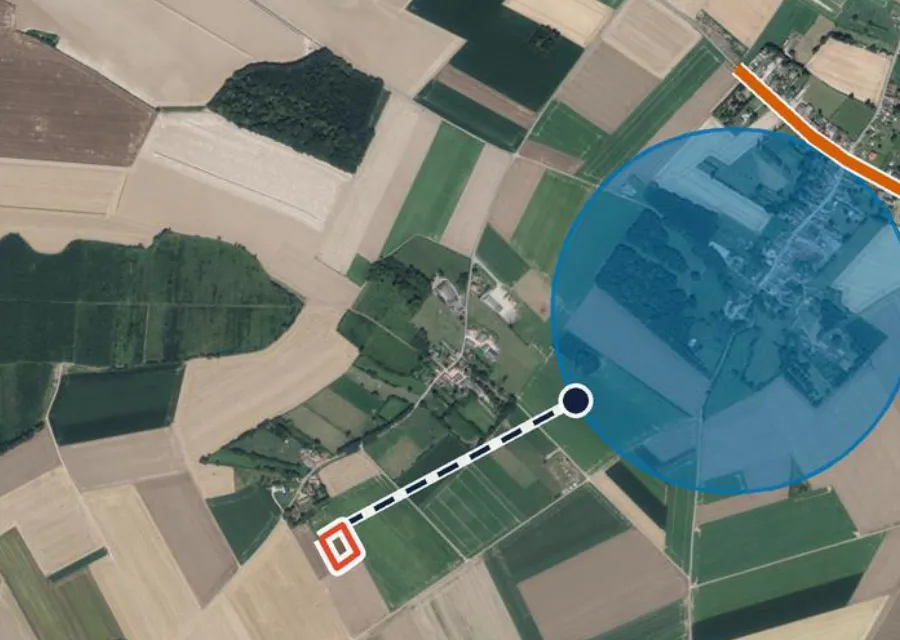
In the report: parcel F 274
What to ask the seller before the compromis
- A copy of their title with the registration details (date, volume, number).
- The same section, number and area in the title, the listing and the cadastre.
- The previous title if the origin of title points to a recent inheritance, gift or division.
- The bornage report and plan, if there is one.
- Easements mentioned in the deed, compared with what you saw on site.
- No registered title: the acte de notoriété and your notaire’s written opinion before you sign.
To find the owner of a plot that is not for sale, see finding the owner of a parcel. The clauses to negotiate next are in the preliminary sale agreement.
Common questions
Does a cadastral extract prove ownership?
No. The cadastre exists for tax purposes: the map does not fix boundaries and does not carry owners’ names. The document to ask for is the deed of acquisition registered at the land registry (SPF); in a dispute the judge weighs all the evidence, including any claim by prescription.
How much does a copy of a deed cost at the land registry?
For a deed registered since 1956: €15 on form 3236-SD, plus €2 if the reply comes by post. Without the registration references, add a 3233-SD request at €12 (plus €2 by post). These fees do not apply to the Livre foncier in Alsace-Moselle.
Can I ask the seller’s notaire for a copy?
Not directly: a notaire gives copies only to the signatories, their heirs and successors, or to a third party authorised by the president of the tribunal judiciaire. Ask the seller, or go to the land registry, which serves anyone.
Keep reading
Buying land at auction in France: court and notarial sales, steps, costs and risks
How to find who owns a plot of land in France, lawfully
Signing the final deed (acte authentique) for land in France: from the compromis to the title
Easements (servitudes) on French land: where to find them before you buy
Buying land with others in France: co-ownership or an SCI, and what happens if you disagree
Got the title? Check its description against the public records
Pick the parcel on the map. The report starts from its outline and cadastral area, then sets out the PLU zone, natural hazards, clay soils, Natura 2000 and recent sales nearby, each with its source and date and explained in English. It does not name the owner and is no substitute for the title. Free check, PDF report for €29 (€39 in French and English).