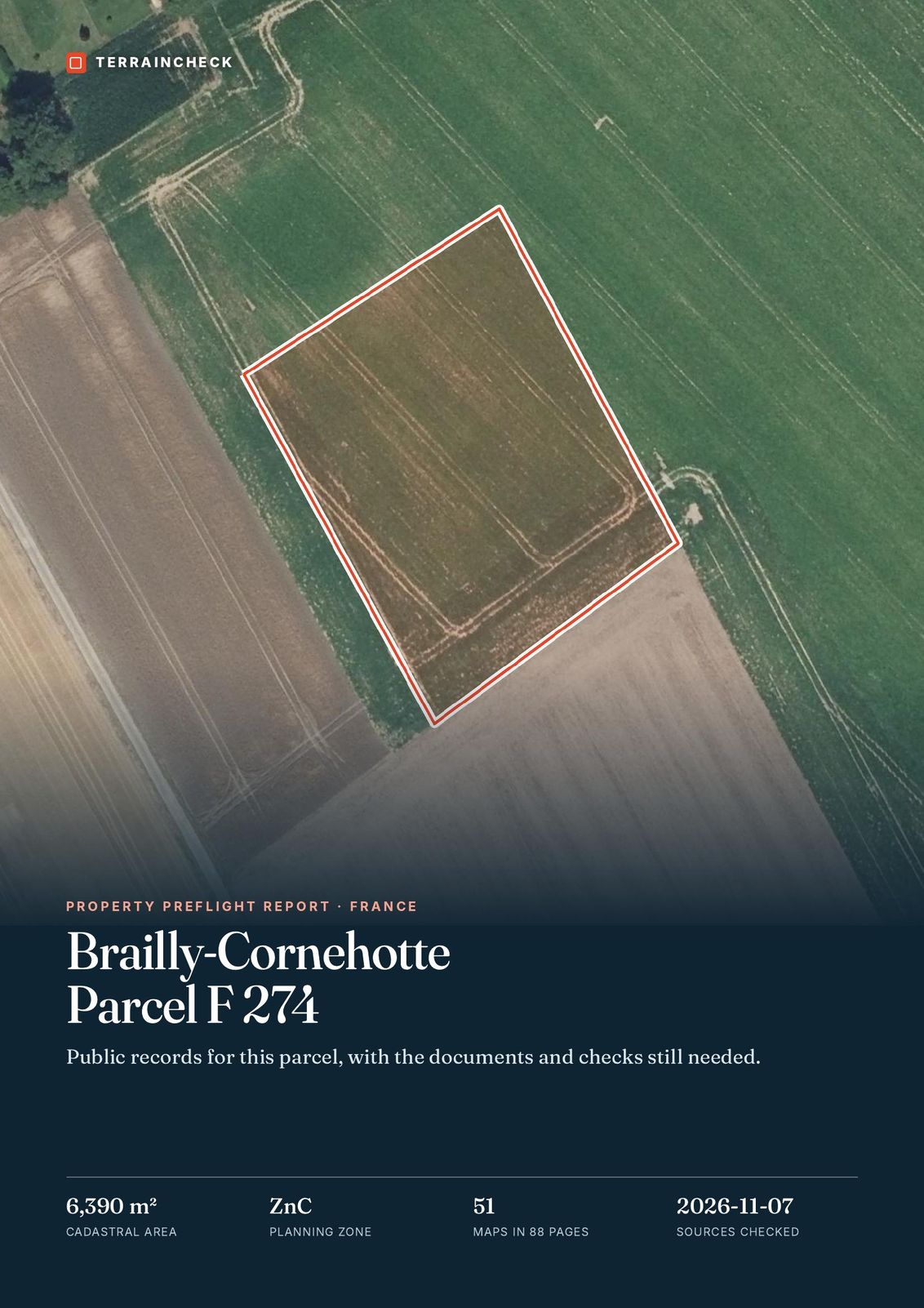
Pillar: Buying building land in France
Signing the final deed (acte authentique) for land in France: from the compromis to the title
In France, the final deed for a plot (acte authentique) is signed before a notaire, the public officer who handles the sale, usually three months after the preliminary contract according to Service-Public, the government’s information site. On that day you pay the price and fees and receive a certificate of ownership. First step: ask the notaire, as soon as the contract is signed, for the list of documents needed from you.
In brief
- Before the deed, the notaire (the public officer who draws up the deed) checks the parties’ identity, the seller’s title, any mortgages, the planning position and pre-emption rights. Where the commune (municipality) or another public body holds a pre-emption right, it has two months from receipt of the notice of intention to sell; silence means it waives the right (Planning Code, art. L213-2).
- On the day, the notaire reads the deed aloud, on paper or on screen. For a building plot outside a lotissement (planned subdivision), there is no cooling-off period before the deed, according to Service-Public, the government’s official information site.
- If you cannot attend, someone signs for you under a power of attorney, which must be notarial if it is also used to grant the mortgage for your loan (Civil Code, art. 2409). A notaire can take that power of attorney by video call (Decree 71-941, art. 20-1).
- Afterwards, registration must be requested within one month of the deed (General Tax Code, art. 647); the notaire pays the seller once the deed is registered, normally within a month, according to Service-Public.
On this page
Between the compromis and the deed: what the notaire collects
The compromis de vente (the binding preliminary contract) sets a deadline for signing the acte authentique, the final deed of sale. Service-Public says it usually falls three months after the contract, and both parties can extend it by a signed amendment before it expires. The clauses of the contract itself are covered in our guide to the compromis.
| Check | Where, from whom | Time limit |
|---|---|---|
| Identity and legal capacity of both parties; power of attorney of anyone absent | Passport or ID card and birth certificate, given to the notaire | None set by the texts cited |
| Seller’s chain of title, mortgage search | Seller’s title; land registry office (service de la publicité foncière), the Livre foncier in Moselle, Bas-Rhin and Haut-Rhin | None set by the texts cited |
| Planning rules | Certificat d’urbanisme (planning certificate) from the mairie, free | 1 month (information), 2 months (project) |
| Commune pre-emption | The owner’s notice of intention to sell (DIA), sent to the mairie | 2 months of silence = waiver; paused for documents or a visit |
| Safer pre-emption | Farmland: the notaire’s notice to the Safer | 2 months from its receipt; silence = waiver; paused for a visit, at least 1 month after restart |
| Appendices | Risk statement, soil study in clay areas, aircraft noise statement | Risk statement updated if any information has changed |
The checks Service-Public assigns to the notaire before a deed of sale of land, with the time limits set by the texts. Sources: Service-Public: deed of sale of a stand-alone building plot; Service-Public: planning certificate (certificat d’urbanisme); Planning Code, art. L213-2 (notice of intention to sell, two-month period); Rural Code, art. L143-8 (Safer pre-emption); Environment Code, art. R125-25 (updated risk statement). Accessed 12 November 2026.
The DIA (déclaration d’intention d’aliéner, notice of intention to sell) is only needed if the plot lies inside an area where a pre-emption right applies. Within the two months the holder of the right may make a single request for documents and ask to visit the plot, which pauses the clock; when it restarts, if less than a month is left, it gets one month to decide.
On farmland, the Safer (the regional agency that oversees farmland sales) may buy instead of you. It has two months from receipt of the notaire’s notice; a request to visit stops the clock from the day the notaire receives it until the visit or the owner’s refusal, and if less than a month is then left, the Safer gets one month. Silence means it waives its right, so set the signing date only after its answer or the end of the period. What this means for a private buyer is explained in buying agricultural land as a private buyer.
The timetable, from legal periods to the title deed
A DIA sent late, or a request for documents, can push the deed past the date in the compromis. Service-Public notes that the contract may provide for an automatic extension when some documents are slow to obtain: check that the clause is there, ask the notaire when the mairie received the DIA, and only book travel once the date is firm.
The signing appointment
The deed is signed by the buyer, the seller and the notaire. Each side may have its own notaire: the fees stay the same and are split between the two offices. Before anyone signs, the notaire reads the deed aloud; on an electronic deed the text is shown on a large screen and the parties sign on a tablet with a stylus. If you do not read French well, ask the office in advance how the deed will be explained to you.
The deed describes the plot and its area, the price and how it is paid, and states whether there is a boundary survey, any mortgage or any easement. The planning certificate, proof that the commune did not pre-empt and, where relevant, the release of the seller’s mortgage are attached. The notaire keeps the original, the minute, for 75 years before it goes to the public archives.
On the same day you receive an attestation de propriété, a certificate of ownership, while the title is processed.
If you cannot be there
Someone can sign on your behalf under a procuration (power of attorney), private or notarial according to Service-Public, which also mentions appearing before the notaire by video call.
Check two things about the form of the power of attorney. If the same representative also grants the mortgage for your loan, it must be notarial, because the power to mortgage takes the same form as the mortgage (Civil Code, art. 2409). And since Decree 2020-1422, a notaire can draw up an electronic power of attorney when a party is not in the room: consent given by video call, signature by qualified electronic signature (Decree 71-941, art. 20-1, version in force since 1 October 2025). Powers of attorney signed abroad have their own rules: see buying land in France as a foreigner.
Paying: bank transfer, the notaire’s account, paying the seller
On the day of the deed the buyer pays the full price and the fees. Payments made or received by a notaire for an authentic deed that is subject to land registration must go by bank transfer (Monetary and Financial Code, art. L112-6-1), from a threshold of €3,000 (art. R112-5). To budget for the fees, see notary fees when buying land.
Example: a plot at €50,000, with €5,000 paid to the notaire when the compromis was signed. That sum comes off the price on the day of the deed, leaving €45,000 to transfer, plus the fee deposit the notaire asks for. Both the €5,000 and the €45,000 are above the €3,000 threshold, so both go by transfer. From abroad, allow for the time your bank needs for an international transfer, and for any currency conversion.
With limited exceptions, money a notaire holds for clients is deposited in accounts at the Caisse des dépôts et consignations, the state-owned financial institution (Decree 45-0117, art. 15). The notaire gives the buyer a receipt and pays the seller once the deed has been registered with the land registry office, normally within a month. If the fee deposit exceeds the actual costs, the balance is refunded with a detailed statement; if it falls short, the notaire asks for the difference before sending the title.
After signing: registration and the title deed
To be registered, the sale must result from a deed drawn up in authentic form by a notaire practising in France (Civil Code, art. 710-1). Registration and land-registry entry form a single “combined formality” for deeds entered in the land register (fichier immobilier), and it must be requested within one month of the date of the deed (General Tax Code, art. 647).
You own the land from the moment you sign. Registration makes the sale enforceable against third parties: it is done at the land registry office for the area, or in the Livre foncier in Moselle, Bas-Rhin and Haut-Rhin, a separate register with its own procedure. The notaire then sends you a copy of the deed stamped by the tax administration: that copy is your title deed, received about six months after signing according to Service-Public.
How many building-land deeds are signed, and when
The DVF files that the French tax administration (DGFiP) publishes on data.gouv.fr date each sale by the day the deed was signed. We counted sales covering building land only, with no house, flat, outbuilding or other premises: 65,209 in 2022, 43,823 in 2023, 32,182 in 2024 and 36,336 in 2025, in France excluding Bas-Rhin, Haut-Rhin, Moselle and Mayotte.
From 2022 to 2025, August was every year the month with the fewest building-land deeds signed, and December was one of the two busiest. The files do not say why. If the date matters to you, agree it with the notaire when the compromis is signed. The id_mutation identifier is rebuilt by data.gouv.fr and changes between deliveries, so a count on another delivery may give slightly different figures.
In the report: the questions to settle before the deed
The week before signing
- The notaire has confirmed that pre-emption rights are cleared (commune and, for farmland, the Safer).
- The planning certificate and risk statement attached are current; the risk statement has been updated if anything changed.
- Release of the seller’s mortgage is arranged, if there is one.
- Statement received, the notaire’s bank details confirmed through a channel you trust, transfer sent.
- Power of attorney ready if you will not attend, notarial if it also covers the loan mortgage.
- Draft deed read: description, area, boundary survey, easements, price.
Common questions
How long between the compromis and the final deed for land in France?
Service-Public says the deed usually follows three months after the preliminary contract; the deadline is written in the compromis and can be extended by amendment. Where a pre-emption right applies, the commune has two months from receipt of the DIA, paused if it asks for documents or a visit (Planning Code, art. L213-2).
Can I sign the deed without travelling to France?
Yes, through a representative holding a power of attorney. It must be notarial if it is also used to grant the mortgage for a loan (Civil Code, art. 2409). A French notaire can draw it up electronically, with your consent given by video call (Decree 71-941, art. 20-1).
When does the seller get paid?
The notaire transfers the price after the deed has been registered with the land registry office; according to Service-Public, this normally takes no more than a month.
When do I receive the title deed?
You get an attestation de propriété (certificate of ownership) on the day you sign. The copy of the deed stamped by the tax administration, which is the title deed, arrives about six months later, according to Service-Public.
Keep reading
The French notaire: what they do, what they don’t check, and the language of the deed for foreign buyers
Notary fees when buying land in France: 2026 rates by département, the fee scale and worked examples
Buying land in France as a foreigner or non-resident: the rules and the steps
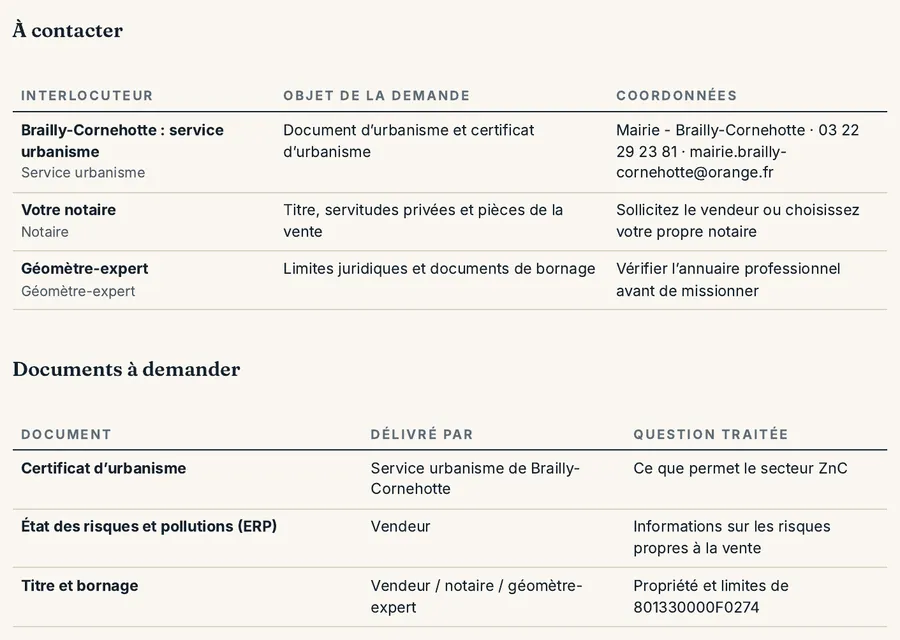
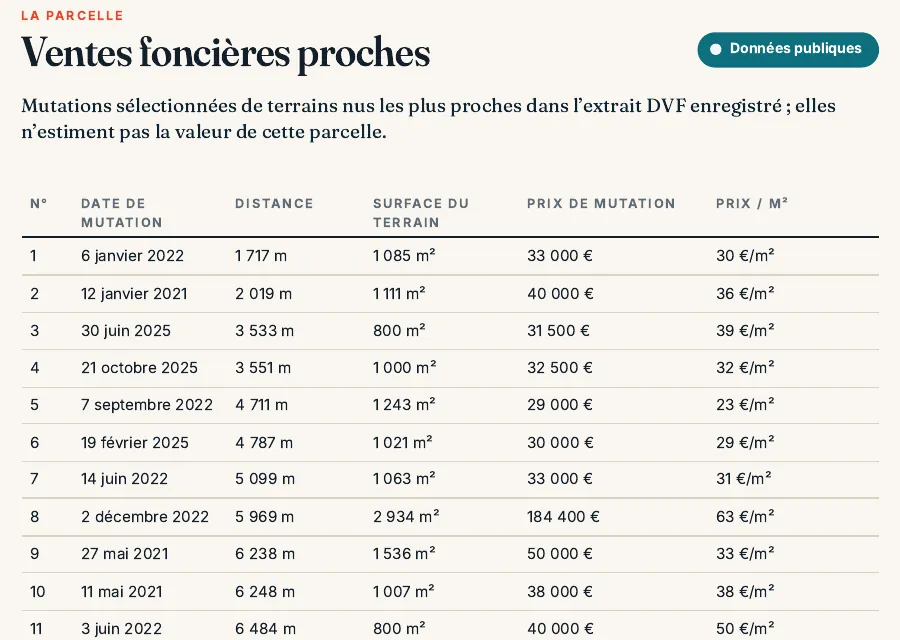
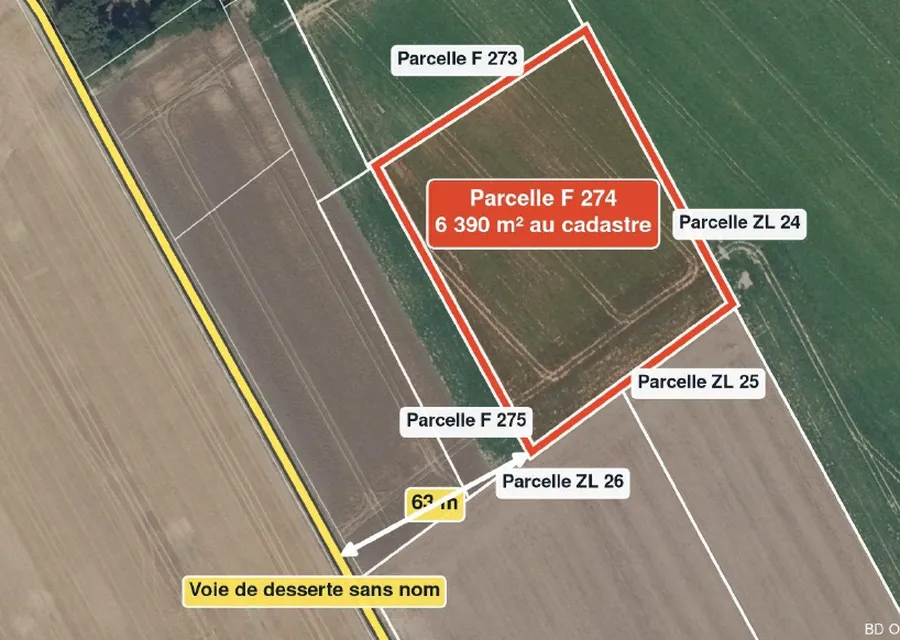
Before you sign, read what the public records say about the plot
Pick the parcel on the map: the report brings together its cadastral area, planning zone, hazards and three questions to settle before buying, each with its source and date, explained in English. It does not replace the notaire’s checks and does not confirm ownership. Free preview, PDF report for €29 (€39 in French and English).