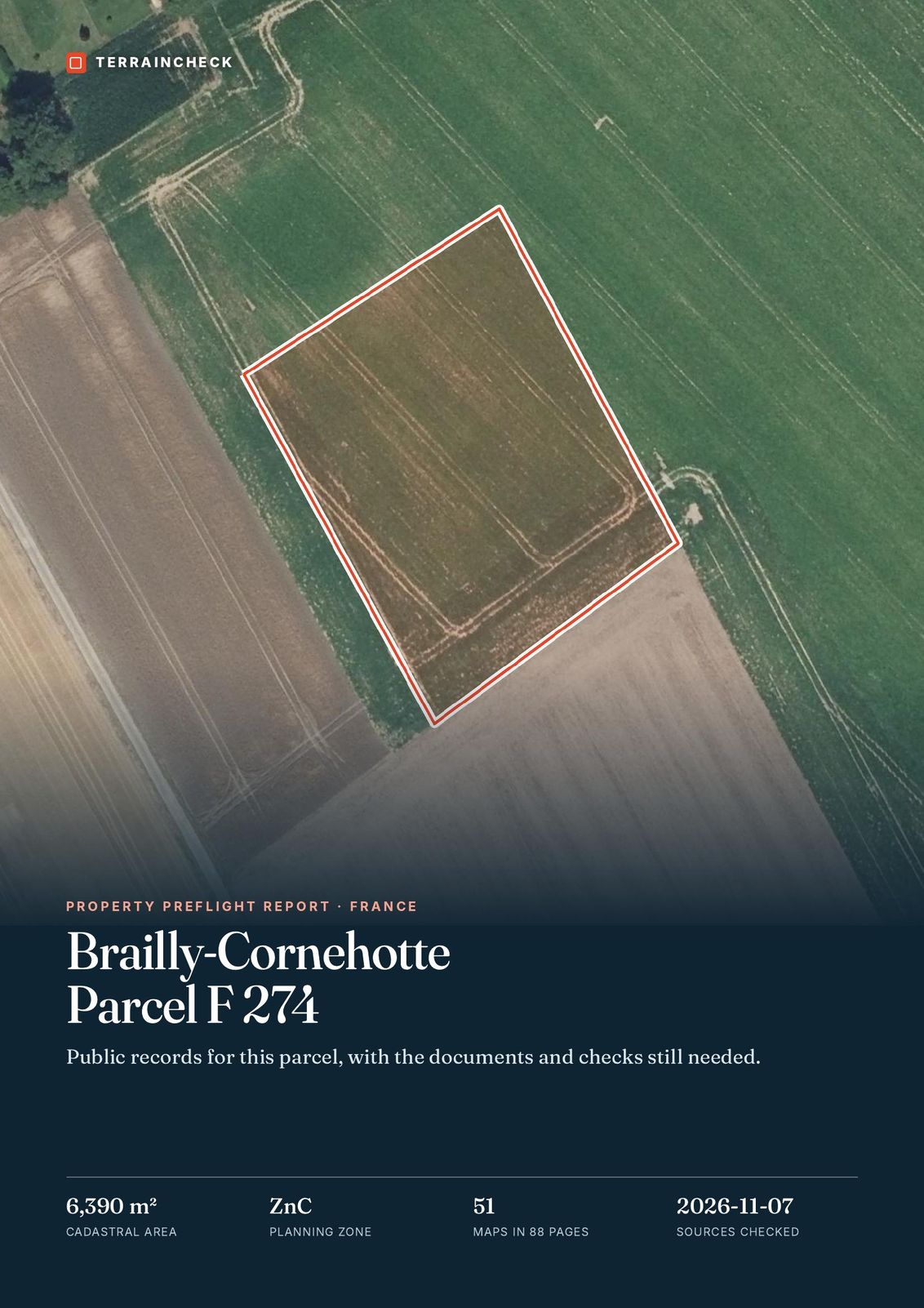
Pillar: Buying building land in France
The French notaire: what they do, what they don’t check, and the language of the deed for foreign buyers
In France a land sale is signed before a notaire, an impartial public officer whom either party may choose: they check the seller’s title, mortgages, pre-emption rights and the planning rules for the land, pay the duties and file the sale for registration within a month of the deed (outside Alsace-Moselle, which has its own register, the Livre foncier). First step: ask who the seller’s notaire is before the compromis (the binding sale agreement signed before the deed), and decide whether to appoint your own at no extra fee.
In brief
- The notaire (a public officer who executes property deeds) is not your lawyer: the code of ethics calls them “the impartial drafter” of both parties’ intentions and adviser to each.
- You may appoint your own notaire. The regulated fee for the deed does not go up: the two offices share it (Commercial Code, art. R444-63).
- The deed is written in French; a translation may accompany it. If the notaire sees that your French is weak, they have to invite you to bring an interpreter.
- The notaire checks the seller’s title, mortgages, pre-emption rights and the planning rules that apply to the land (through a planning certificate). Whether your particular house is feasible under the PLU (local zoning plan), a soil study and the cost of utility connections are for you to check.
On this page
A public officer, not one side’s lawyer
In France a land sale has to be executed as an acte authentique, a deed drawn up by a notaire, because any deed entered in the land registry must take that form (decree of 4 January 1955, art. 4). The 1945 ordonnance defines notaires as “public officers” who give deeds the authenticity attached to acts of public authority.
In practice the notaire fixes the date of the deed and keeps the original, the minute, at the office. Service-Public says it is kept there for 75 years before going to the public archives. If you are used to a solicitor or conveyancer who acts for you alone, this is the main shift: the notaire must act with “loyalty, neutrality, impartiality”, advises both parties and has to explain “the extent of the obligations” they take on.
| Task | Legal basis | What it gives you |
|---|---|---|
| Execute the deed of sale | Ordonnance 45-2590, art. 1; decree 55-22, art. 4 | A fixed date, the original kept on file |
| Check the seller’s title and recorded mortgages | Service-Public, deed of sale of a stand-alone building plot | The seller is free to sell |
| Clear pre-emption rights | Same page (commune, Safer, co-owners) | Commune or Safer did not buy in your place |
| Check the planning rules (planning certificate), attach the reports | Same page (risk statement; soil study in exposed clay areas) | Rules and hazards written into the deed |
| Pay the registration duties | General Tax Code, art. 1705 | The sale’s tax is settled by the office |
| Register the sale | Decree 55-22, art. 32; Tax Code, art. 647 (filing within a month) | The sale entered in the public register |
What French law asks of the notaire on a land sale; registration differs in Bas-Rhin, Haut-Rhin and Moselle. Sources: Ordonnance 45-2590 of 2 November 1945, article 1 (status of notaries); Decree 55-22 of 4 January 1955, article 4 (notarial form); Service-Public: deed of sale of a stand-alone building plot; General Tax Code, article 1705 (who pays the duties); Decree 55-22 of 4 January 1955, article 32 (duty to register); General Tax Code, article 647 (combined formality, one-month period). Accessed 13 November 2026.
What the notaire checks, and what is left to you
For a building plot outside a lotissement (planned subdivision), Service-Public lists the notaire’s checks: identity and legal capacity of both parties, any power of attorney, the seller’s chain of title, recorded mortgages, the planning rules (through a certificat d’urbanisme, a planning certificate), the cadastral position, and the pre-emption rights of the Safer (rural land agency), local authorities and co-owners. The supporting papers are attached to the deed.
The list does not cover the cost of connecting water or electricity, or whether your house, with its size and position, will get a permit. It lists a soil study as an annex only in areas exposed to clay shrink-swell. The certificate states which rules apply; for a specific project, see the detailed planning certificate and reading the PLU.
After signing, the notaire must register the sale “regardless of the parties’ wishes” (1955 decree, art. 32). For an ordinary sale, tax registration and entry in the land registry are a single step, the formalité fusionnée (combined formality), which the notaire must request within one month of the date of the deed; the period is two months for a sale by auction (Tax Code, art. 647 III).
Where duties are payable, late filing triggers interest and a 10% surcharge, raised to 40% if a formal notice goes unanswered for 30 days (BOFiP, BOI-ENR-DG-40-20-40).
The civil time limits in article 33 of the 1955 decree remain in force alongside this tax deadline and are the only ones for deeds outside the combined formality (version in force on 13 November 2026; a 2024 ordonnance is due to replace these rules by 31 December 2028 at the latest).
The month covers filing with the land registry office; the texts cited do not say when you will receive the registered deed. In Bas-Rhin, Haut-Rhin and Moselle, a separate register, the Livre foncier, applies with its own procedure: see the Alsace-Moselle land register.
One notaire or two: who chooses, who pays
“Everyone is free to choose their notaire”: article 21 of the code of ethics says so, and bars notaires from any move that undermines that choice. Seller and buyer can share one notaire or each have their own. The Autorité de la concurrence, the competition regulator, counted 12,361 self-employed notaires in 7,175 offices on 31 October 2025, excluding Moselle, Bas-Rhin and Haut-Rhin.
With two notaires, one executes the deed and keeps the original (the notaire instrumentaire); the other joins in. The Commercial Code settles the price: involving several notaires in one deed “does not increase the fee”, unless the work is billed by the hour. Service-Public confirms it for a building plot: the amount stays the same and the two offices split it.
The fee on a sale follows a national scale. In mainland France, for a plot sold for €50,000: 6,500 × 3.870% = €251.55; 10,500 × 1.596% = €167.58; 33,000 × 1.064% = €351.12, a total of €770.25 before VAT, €924.30 with VAT at 20%. A second notaire does not change it. Taxes for the State and outlays come on top: see notary fees on bare land. The buyer pays the costs of the deed unless the parties agree otherwise.
These fees tracked the volume of sales: up with the boom of 2021–2022, down with the slump after it. Before the compromis, agree with the office who will take you through the draft deed, and in which language.
Sources: Decree 2023-1297 of 28 December 2023: code of ethics of notaries; Commercial Code, article R444-63 (several notaries on one deed); Professional rules of notaries (order of 29 January 2024): joint deeds; Service-Public: deed of sale of a stand-alone building plot; Service-Public: what notary fees are made of. Accessed 13 November 2026.
Language: the deed, the interpreter, the translation
The Ministry of Justice set this out in 1989, in answer to a parliamentary question: deeds executed by notaires are public acts and must be written in French, but may come with a translation set beside the French original, prepared under the notaire’s sole responsibility. The answer expressly leaves the separate rules for Alsace-Moselle unaffected.
If you cannot travel, there are two routes: a power of attorney, which the notaire checks, or, for an electronic deed, signing remotely before another notaire who takes your consent (1971 decree, art. 20). How the signing works is covered in signing the final deed for land.
Sources: National Assembly, written question 12617, answer of the Justice Minister (1989); Cour de cassation, 1st civil chamber, 13 May 2014, no. 13-13.509; Decree 71-941 of 26 November 1971, article 20 (party not present); Service-Public: deed of sale of a stand-alone building plot. Accessed 13 November 2026.
Working with the notaire, step by step
- Decide before the compromis. Ask the seller or agent who their notaire is, then decide whether to appoint your own. Cost: no extra fee. Time: about an hour of calls and emails (TerrainCheck estimate).
- Put your questions and your language in writing. One email to the office: your building plans, your level of French, whether you need an interpreter or a translation. Cost: the interpreter’s or translator’s quote. Time: no deadline in the texts cited; arrange it before the signing date.
- Ask for the draft deed and its annexes. Chain of title, mortgage search, cleared pre-emption rights, planning certificate, risk statement. Cost: part of preparing the deed. Time: depends on the office; ask for a date.
- Check what the deed does not say about your project. What the PLU zone allows for your house, hazards, ground, utilities, boundaries. Cost: varies (planning certificate applied for at the mairie, the town hall; quotes for a soil study and a boundary survey). Time: depends on the services involved.
- After signing, follow the registration. For an ordinary sale, the notaire files the combined formality within a month of the deed (two months for an auction; the Livre foncier in Alsace-Moselle). Cost: included in the fees. Time: 1 month for the filing; the texts cited set no period for the registered deed to come back, so ask the office for a date.
Sources: Decree 2023-1297 of 28 December 2023: code of ethics of notaries; Service-Public: deed of sale of a stand-alone building plot; General Tax Code, article 647 (combined formality, one-month period); BOFiP, BOI-ENR-DG-40-20-40: period for the combined formality and penalties; Decree 55-22 of 4 January 1955, article 33 (time limits). Accessed 13 November 2026.
In the report: who to ask about what
Before you sign: six points with the notaire
- Notaire chosen: the seller’s, your own, or both, before the compromis.
- Your level of French stated in writing; interpreter or translation arranged.
- Draft deed received in advance, with chain of title and mortgage search.
- Pre-emption rights cleared and planning certificate attached.
- Your house checked against the PLU, plus ground, utilities and boundaries, by you.
- If you cannot attend: power of attorney or remote signing arranged.
For the rest of a purchase from abroad: buying land in France as a foreigner, the preliminary sale agreement and the title deed.
Common questions
Can the seller’s notaire act for me too?
Yes. Seller and buyer may use the same notaire, who must stay impartial and advise both. If you want someone of your own, appoint a second notaire; the regulated fee does not rise.
Do two notaires cost more?
Not in regulated fees: under article R444-63 of the Commercial Code, several notaires on one deed do not increase the fee, unless the work is billed by the hour. The two offices share it.
Can the deed be in English?
No. The deed is written in French. A translation can accompany it, under the notaire’s responsibility, and you can bring an interpreter. Separate rules apply in Alsace-Moselle.
Will the notaire tell me whether I can build?
The notaire attaches the planning certificate and states the rules that apply, but whether your own project is feasible is checked through the PLU, a detailed planning certificate or a permit application.
Keep reading
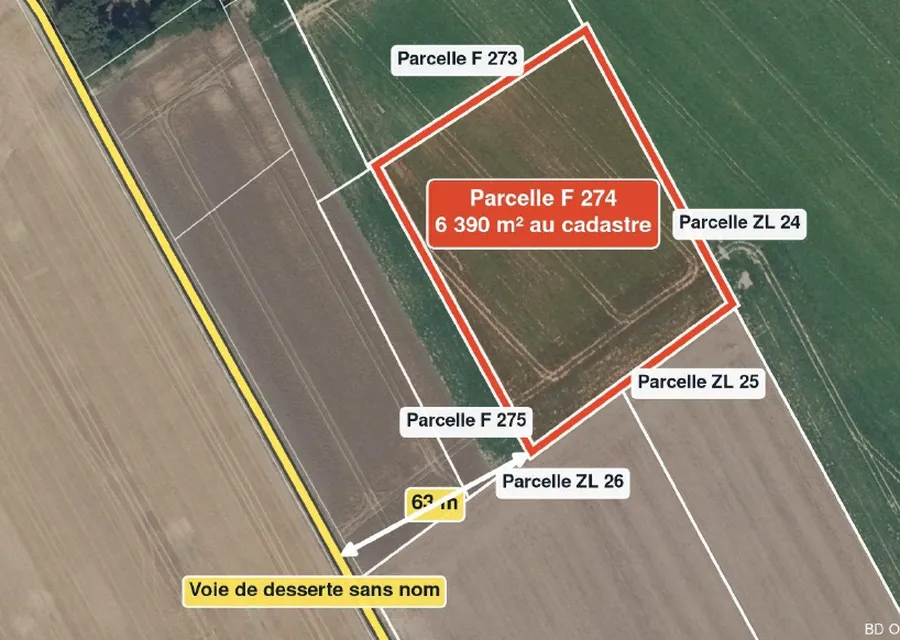
Buying land in France as a foreigner or non-resident: the rules and the steps
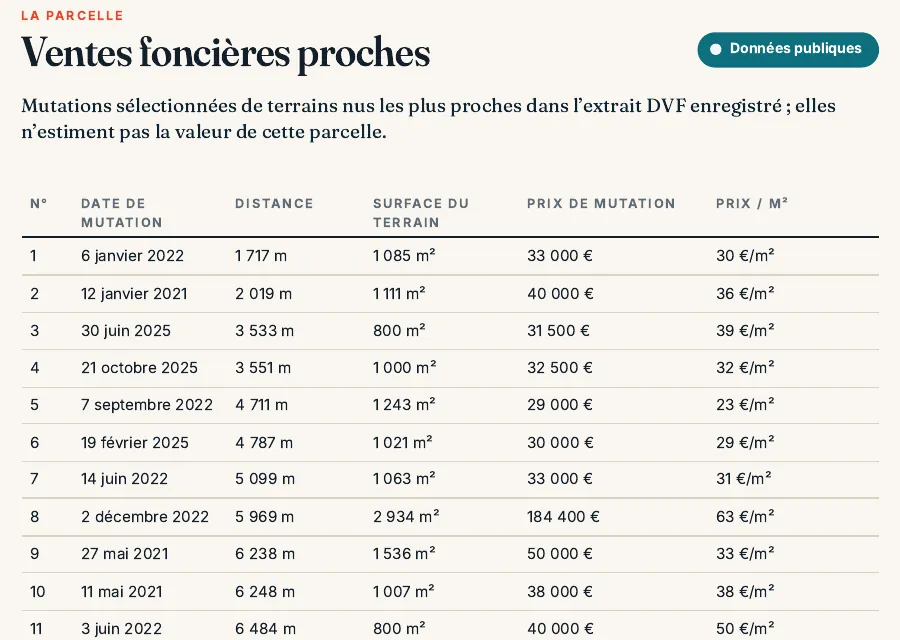
Notary fees when buying land in France: 2026 rates by département, the fee scale and worked examples
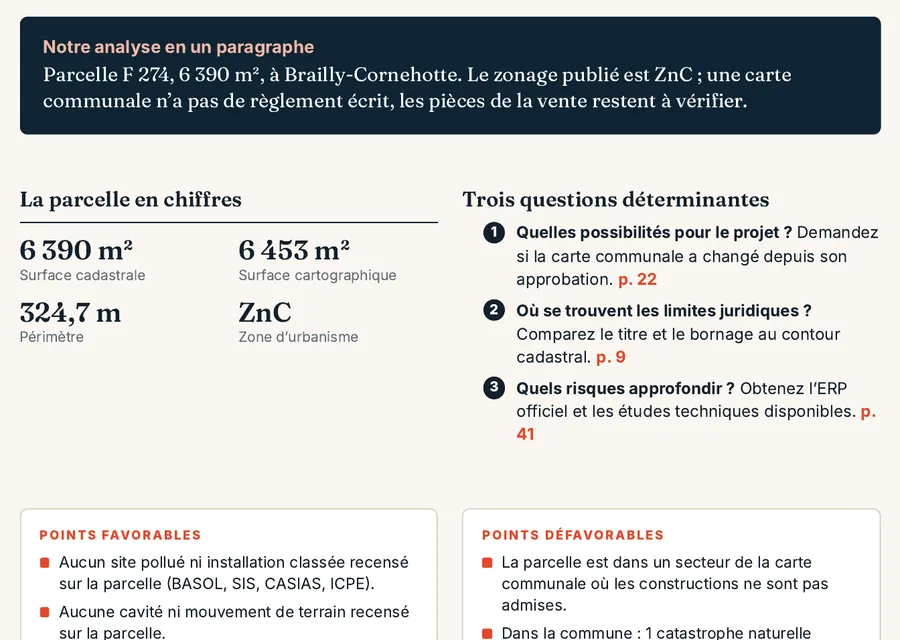
Signing the final deed (acte authentique) for land in France: from the compromis to the title
Signing a French land purchase from abroad: power of attorney, video link or local notary
The notaire checks the sale; check the land for your project
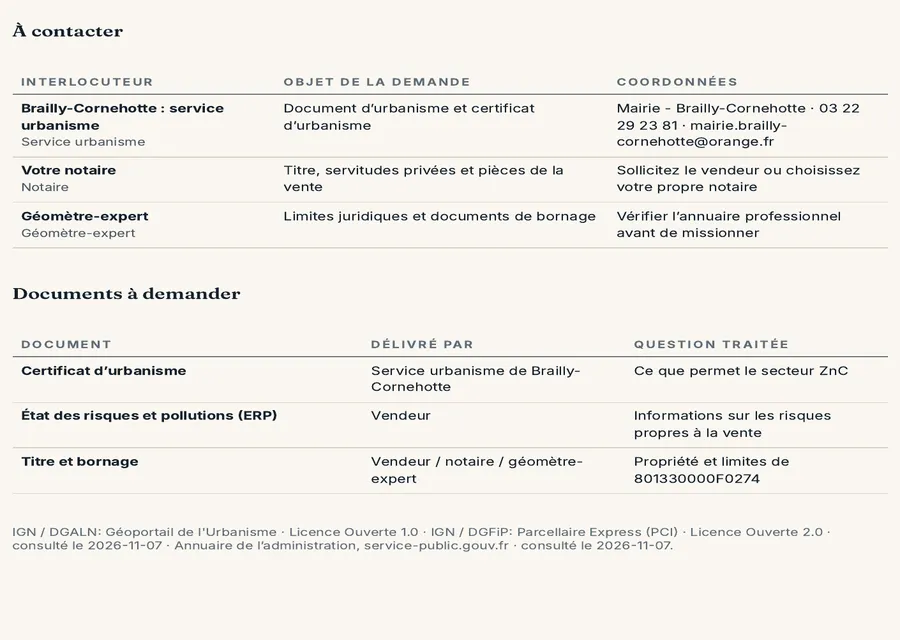
Pick the parcel on the map. The report brings together the PLU zone, natural hazards, clay soils, Natura 2000 and recent sales nearby, each with its source and date, explained in English, and says who to ask about anything still open. It does not replace the notaire and does not name the owner. Free check, PDF report for €29 (€39 in French and English).