Pillar: Buying building land in France
Buying land with others in France: co-ownership or an SCI, and what happens if you disagree
In France, several buyers take land either in indivision (co-ownership), each with a share stated in the deed, or through an SCI, a property company that buys while you hold its shares. In co-ownership, selling the land needs everyone’s consent unless a court authorises it or a special regime applies in Corsica or certain overseas territories (Civil Code, art. 815-3). First step, before signing the compromis de vente (the binding preliminary sale agreement): agree with the notaire (public notary) who buys and in what shares.
In brief
- Indivision (co-ownership): each buyer owns a share of the whole plot, stated in the purchase deed. For unmarried partners, or PACS partners under separate property, the default when the deed is silent is half each.
- Co-owners holding two thirds of the rights can manage the land; selling it needs everyone’s consent unless the tribunal judiciaire (civil court) authorises it (Civil Code, arts 815-3, 815-5, 815-5-1 and 815-6) or a special regime applies in Corsica or certain overseas territories.
- SCI (société civile immobilière, a property-holding company): the company buys the land and you hold shares. Formalities in 2026: €60.38 registration and €19.33 beneficial owners declaration, plus a legal notice at €191 excluding tax in mainland France (VAT on top), before professional fees.
- Nobody can be forced to stay in co-ownership: a split can be requested at any time, unless a co-ownership agreement (five years at most if fixed-term) or a court decision says otherwise.
On this page
Co-ownership or SCI: seven differences
If several people simply buy together, they buy in indivision (Civil Code, arts 815 ff.): each owns an undivided share of the whole plot, for example 60% and 40%, not a particular corner of it. An SCI (arts 1832 ff.) is a separate legal entity: the company owns the land, you own its shares, and its written statuts (articles of association) set the rules.
| Point | Co-ownership | SCI |
|---|---|---|
| Who owns the land | Each co-owner, for their share | The company, once registered |
| Day-to-day management | Two thirds of the rights | The manager |
| Selling the land | All, unless a court authorises it or allows an auction | As the articles provide |
| Selling your share | Sale to an outsider: others can pre-empt within 1 month | Partners’ approval unless the articles differ; none for a sale to your ancestors or descendants, unless the articles say otherwise |
| Leaving | A split at any time, unless an agreement or a court says otherwise | Withdrawal as the articles provide |
| Debts | Personal creditors cannot seize the share, but can force a split | Partners liable in proportion to their capital |
| Setting up | The purchase deed is enough | Articles and registration |
The default rules. A co-ownership agreement or the SCI’s articles can change several of them, within the law. Sources: Légifrance: Civil Code, arts 815 to 815-18 (statutory co-ownership); Légifrance: Civil Code, arts 1873-2 to 1873-15 (co-ownership agreements); Légifrance: Civil Code, arts 1832 to 1844-17 (companies); Légifrance: Civil Code, arts 1845 to 1870-1 (civil companies). Accessed 13 November 2026.
Co-ownership: who decides what
The Civil Code sets three levels. One co-owner may act alone to preserve the property, even when it is not urgent (art. 815-2). Those holding at least two thirds of the rights may carry out management acts, appoint a general manager and grant leases, except leases of property used for farming, commerce, industry or crafts. They must tell the others, or the decision cannot be enforced against them.
Anything outside the normal use of the property, and any act of disposal such as selling the land, needs everyone’s consent. Two thirds is counted in rights, not heads. In an example from Service-Public, the government information site, with four equal co-owners, three must agree; if one holds half the rights and the other three share the remaining half equally (16.66% each), the half-owner needs only one of them, since 1/2 + 1/6 = 2/3.
Each co-owner may use the land in line with its purpose, as far as this is compatible with the others’ rights (art. 815-9). One who has sole use of it owes the others compensation unless agreed otherwise.
The co-ownership agreement
A convention d’indivision sets the rules in advance: a manager, costs, what happens to a share on death. It must be in writing, failing which it is void, list the property and state each share; for land, it goes through the land registration formalities (art. 1873-2).
A fixed-term agreement cannot exceed five years, renewable by express decision, and a split before the term needs good cause. An open-ended agreement allows a split at any time, provided it is not in bad faith or at an untimely moment (art. 1873-3).
Beyond the manager’s powers, decisions need unanimity; a manager who is also a co-owner can still go to court (arts 815-4 to 815-6). With no minor or protected adult among you, the agreement can set another rule for some categories of decision, but not for selling the land: that needs everyone, unless a court allows it (arts 815-4 and 815-5; art. 1873-8).
The SCI: the articles set the rules, within the law
A company needs at least two people (art. 1832), and two spouses may form one whatever their marital property regime. The articles must be in writing (art. 1835) and the SCI becomes a legal person when it is registered (art. 1842). Its business must stay civil: buying to resell is commercial and not allowed.
One or more managers, partners or not, are appointed by the articles, a separate document or a partners’ decision (art. 1846). Changing the articles needs unanimity unless they provide otherwise (art. 1836).
Selling shares needs every partner’s approval, unless the articles set a majority, let the managers approve, or waive approval for transfers to partners or a partner’s spouse. The law itself exempts a transfer to the seller’s ancestors or descendants (parents, children, grandchildren) from approval, unless the articles say otherwise (art. 1861).
Towards third parties, partners are liable without limit for the company’s debts, in proportion to their share of the capital, once creditors have pursued the company without success (arts 1857 and 1858). A loan taken by the SCI can therefore reach your personal assets.
- Draft the articles. Yourselves, or with an avocat (lawyer) or a notaire, on a quote that depends on the clauses.
- Publish the legal notice of formation in an approved newspaper. Flat rate for 2026, excluding tax: €191 in mainland France, €223 in La Réunion and Mayotte; VAT is added depending on the territory.
- Register the company on the government’s business formalities portal (guichet des formalités des entreprises): €60.38, plus €19.33 for the beneficial owners declaration.
- Sign the purchase in the SCI’s name once it is registered. If the compromis de vente (the binding preliminary contract) is signed earlier, ask the notaire to provide for the company to take your place as buyer.
Time: no deadline set by the texts cited; it depends mostly on preparing the articles and on registration.
Buying as a couple: married, PACS or unmarried
Married under French law without a marriage contract, you are under the statutory community regime (art. 1400): land bought during the marriage, together or by either of you, is in principle community property (art. 1401), not co-owned in indivision. It stays personal if bought before the marriage or received by inheritance or gift (art. 1405). Couples married abroad or with a marriage contract should ask the notaire which regime applies and have each share stated in the deed.
PACS partners (France’s registered civil partnership) whose PACS was signed after 1 January 2007 and never amended hold property separately: each one’s share is what the deed says, and half each if it is silent. The PACS agreement can opt for co-ownership of what you buy (art. 515-5-1). Unmarried partners co-own half each unless the deed sets other shares.
Disagreement, leaving or death: the ways out
Anyone may ask for a split unless an agreement or a court has suspended it (art. 815). To sell a share to an outsider, the co-owner must serve the others, through a commissaire de justice (court officer), with the price, terms and buyer’s identity. Each then has one month to pre-empt, and two months from their reply to complete (art. 815-14).
If one co-owner blocks the sale of the whole plot, those holding at least two thirds of the rights state their intention before a notaire, who has it served on the others within a month.
If anyone objects, or stays silent for three months from service, the notaire records it in a formal report (procès-verbal). The court (tribunal judiciaire) may then authorise the sale if it does not excessively harm the others’ rights (art. 815-5-1).
That sale takes place by licitation, an auction, and the proceeds may be reinvested only to pay the co-ownership’s debts and charges. This route is closed where ownership is split between usufruct and bare ownership, or where a co-owner is presumed absent, unable to express their will or under a protection order.
Two other court routes lead to an ordinary sale. If one co-owner’s refusal puts the common interest at risk, a court can authorise another to sign alone (art. 815-5). Since 9 April 2026, article 815-6 also lets the president of the court, as an urgent measure required by the common interest, authorise one co-owner to sign a sale alone.
In an SCI, a partner withdraws as the articles provide, failing that with the others’ unanimous consent or by court order for good cause (art. 1869). When a partner dies, the company by default continues with the heirs or legatees, but the articles can provide otherwise: for example, approval of the heirs by the remaining partners, winding up, or carrying on with the surviving partners only (art. 1870).
If the estate passes to a legal entity, it becomes a partner only with the other partners’ approval, unless the articles say otherwise (art. 1870). Heirs who do not join are entitled to the value of the shares (art. 1870-1).
- Corsica: for a property with no existing title deed, where a notarial deed of notoriety records possession that meets the conditions for acquisitive prescription (ownership gained through long possession), co-ownership follows a separate, time-limited regime: ask the notaire whether it applies (Act no. 2017-285, arts 1 and 2).
- Overseas: in Guadeloupe, French Guiana, Martinique, La Réunion, Mayotte, Saint-Barthélemy, Saint-Martin and Saint-Pierre-et-Miquelon, for an estate opened more than ten years ago, holders of more than half of the rights in full ownership can sell or split real property before a notaire, for projects notified before 31 December 2038 (Act no. 2018-1244).
- Both Acts carry their own conditions and exclusions.
- Alsace-Moselle: in Moselle, Bas-Rhin and Haut-Rhin, land registration runs through the Livre foncier, a separate register.
- Tax: tax on co-ownership and on an SCI, in France and in your home country, is not covered here; take advice before choosing.
Buying land that is already co-owned
A plot sold by several heirs or former partners is often co-owned. Every co-owner must sign; failing that, ask the notaire which court authorisation the sale relies on (arts 815-5 or 815-6). A sale obtained through the two-thirds route (art. 815-5-1) goes through an auction, not a compromis negotiated with you. To identify who holds rights, see finding the owner of a parcel and tracking down the title deed.
In the report: what it does not check
Before the compromis: checklist
- The structure is chosen: co-ownership, with or without an agreement, or a registered SCI.
- The shares in the deed match what each of you actually pays.
- If one of you will use the land: compensation or free use agreed in writing.
- Co-ownership agreement: term, manager, what happens to a share on death.
- SCI: management, approval of share sales, withdrawal and death covered in the articles.
- Land sold by several owners: every co-owner signs the compromis.
Read next: the clauses of the compromis and what the French notaire does for a foreign buyer.
Common questions
Can we buy land together in unequal shares?
Yes. In co-ownership the purchase deed states each share, for example 70% and 30%. For unmarried or PACS partners under separate property, if the deed is silent, the law and Service-Public treat it as half each.
Can one co-owner stop the sale of the land?
They can refuse, because a sale needs everyone’s consent (art. 815-3). Court routes remain: an auction requested by two thirds, via a notaire and the civil court (815-5-1, unless ownership is split or a co-owner is protected), or permission to sell alone if the common interest is at risk (815-5) or in urgent cases (815-6).
What does it cost to set up an SCI?
In 2026 the formalities cost €60.38 for registration, €19.33 for the beneficial owners declaration and the legal notice, €191 excluding tax in mainland France (€223 in La Réunion and Mayotte), with any VAT on top. Fees for drafting the articles come on top, on a quote.
Keep reading
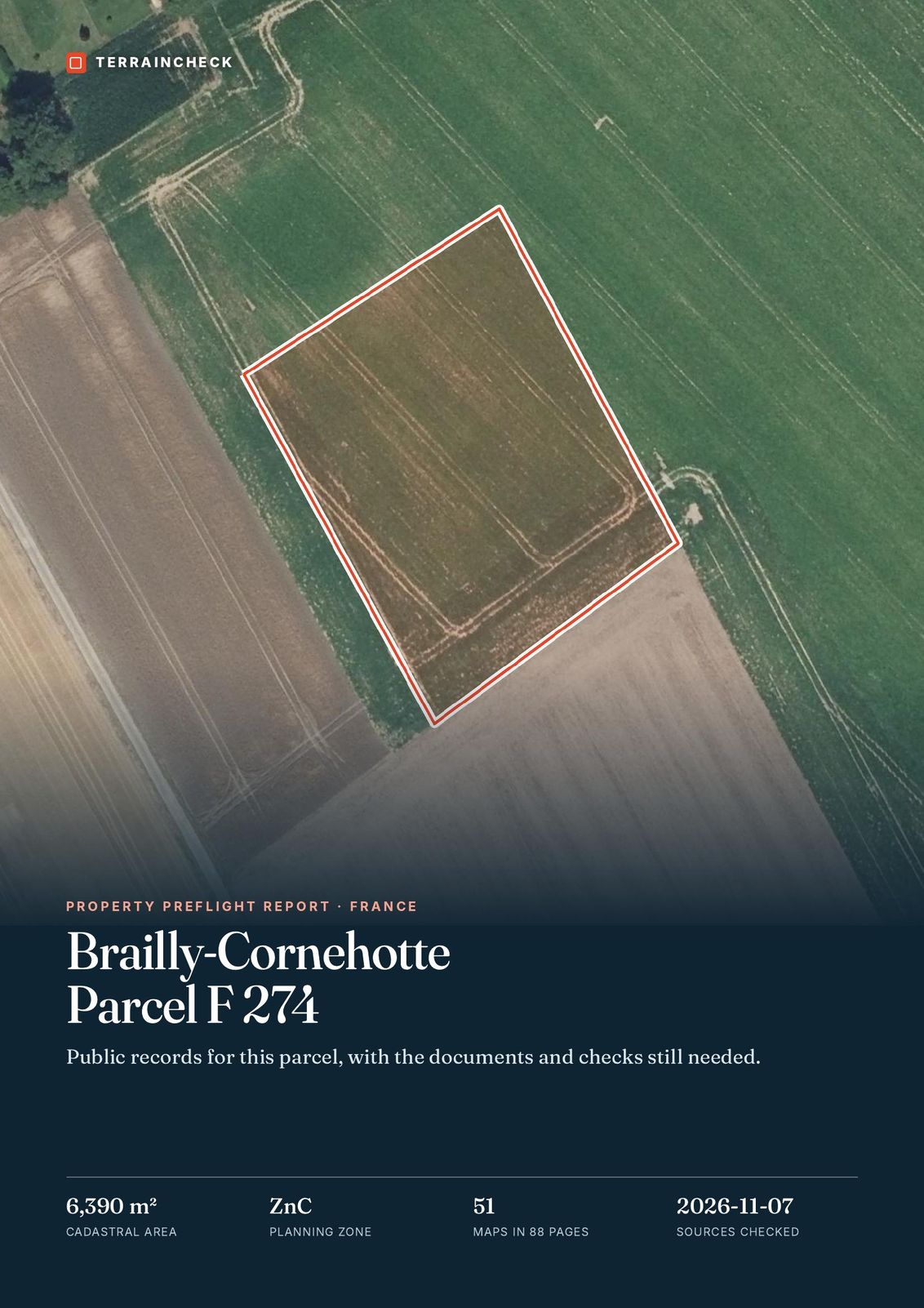
Buying with others? Check the plot together first
Pick the parcel on the map. The report sets out the PLU zone, natural hazards, clay soils and Natura 2000, each with its source and date and explained in English. It does not name the owner. Free check, PDF report for €29 (€39 in French and English).