Pillar: Buying building land in France
How to find who owns a plot of land in France, lawfully
The owner’s name is not shown on cadastre.gouv.fr. You get it in writing: a free ownership extract from the land tax office, or a land registry search (form 3233-SD, €12 per property, answered within 10 days). In Moselle, Bas-Rhin and Haut-Rhin that second route goes through a separate register, the Livre foncier, with its own procedure.
In brief
- The owner’s name is not shown on the French cadastral map, and cadastre.gouv.fr cannot be searched by name. You get it with a written request.
- Ownership extract (relevé de propriété): free, from the land tax office, quoting the commune (the French municipality) and the parcel reference (five parcels at most per request).
- Land registry (service de la publicité foncière): form 3233-SD, €12 per property, written answer within 10 days, including past owners and sale prices. None of this applies in Moselle, Bas-Rhin and Haut-Rhin, where a separate register, the Livre foncier, has its own procedure.
- What you may do with the name is limited: on the tax office’s form, the applicant undertakes not to use the data for canvassing or mass mailing and to get the person’s consent before any reuse.
On this page
Why the name is not online
French cadastral records come in two parts. The plan shows parcel boundaries and numbers, with no names. The matrice cadastrale lists who owns which parcels in each commune, and ownership extracts are drawn from it.
Online, only the plan can be viewed. At cadastre.gouv.fr, as at the mairie (town hall), you search by address or cadastral reference, never by name. The open data at cadastre.data.gouv.fr is the plan; the files of properties and owners are not included. If you do not have the reference yet, start with searching for a parcel on cadastre.gouv.fr.
The three lawful routes
| Route | What you get | Cost | Time | Limit |
|---|---|---|---|---|
| Ownership extract, land tax office (SDIF) | The rights holders recorded in the cadastre for the parcel | Free, on paper or by email | No deadline given in the official sources | One commune and five properties at most per request |
| Information request, land registry (SPF) | Successive owners, date and type of acquisition, mortgages, sale prices | €12 per property; €2 postage, free by email | Written answer within 10 days | Written request on the form, paid in advance. Moselle, Bas-Rhin and Haut-Rhin: a separate register (Livre foncier) with its own procedure |
| Files of legal entities (data.gouv.fr) | Name and legal form of the owning body | Free | Yearly file; 2026 position published in November 2026 | No private individuals, single-member companies or sole traders |
The extract shows who was recorded on 1 January of the year of the last land tax roll; the land registry shows the deeds through which the land changed hands. Sources: BOFiP: release of ownership records (BOI-CAD-DIFF-20-20-10-10); Service-Public: how to consult the cadastre; Service-Public: obtaining information on a property; Form 3233-SD (02-2026): request for information from 1 January 1956; data.gouv.fr: parcels owned by legal entities (DGFiP). Accessed 12 November 2026.
Requesting the ownership extract
- Note the commune, section and number. The request needs them; cadastre.gouv.fr shows them. Cost: nothing. Time: a few minutes if you have an address.
- Write the request. Form 6815-EM-SD (Cerfa 11565) is on impots.gouv.fr, but it is not compulsory: a letter or an email will do, as long as it gives your name, the commune and the parcels.
- Send it to the land tax office (centre des impôts fonciers) covering the commune, by ordinary or recorded post, or hand in a written request at the front desk. Its address is in the directory on service-public.gouv.fr and, on impots.gouv.fr, under “Contacts et rendez-vous” in the personal Finances publiques account.
- Receive the extract on paper, or by email if you asked for it. It is free. The official sources we read give no deadline for the answer.
When the request names a specific parcel, you receive an extract limited to that property: only that parcel’s entries, without the owners’ dates and places of birth or personal tax reliefs. The full version goes to the rights holders, their heirs and their representatives, and to notaires (the public officers who handle property sales), chartered surveyors and lawyers.
The extract shows the position on 1 January of the year of the last land tax roll. A sale completed since then may not appear yet. That is one reason to use the land registry when the information has to be current.
Sources: BOFiP: release of ownership records (BOI-CAD-DIFF-20-20-10-10); Form 6815-EM-SD: request for a matrice extract; Service-Public: how to consult the cadastre. Accessed 12 November 2026.
The land registry: the parcel’s history
The documents held by the service de la publicité foncière (SPF, the French land registry) are public. Anyone may ask for the successive owners, the date and type of acquisition (sale, gift, inheritance), any mortgages and the sale prices. For entries published since 1 January 1956, use form 3233-SD.
The form goes to the SPF office for the area where the parcel lies: one copy if you want the answer by email, two for an answer by post. The charge is €12 per property listed, paid in advance; postage adds €2, an email answer is free. The office gives no information by phone or at the counter and answers in writing within 10 days; if it does not, you can refer the matter to the Cada, the commission on access to public documents.
Moselle, Bas-Rhin and Haut-Rhin are not covered by this procedure. Land registration there goes through a separate register, the Livre foncier: the system specific to the local law of Alsace-Moselle, run by eleven land register offices (bureaux fonciers) attached to the courts of appeal of Colmar and Metz. Service-Public refers you to those offices. Form 3233-SD, the €12 fee and the 10-day deadline described here belong to the SPF; for a parcel in those three départements, ask the competent office for its own procedure and fee before sending anything. For deeds before 1956, Service-Public points to other forms.
Sources: Service-Public: obtaining information on a property; Form 3233-SD (02-2026): request for information from 1 January 1956; Livre foncier of Alsace-Moselle (EPELFI, Ministry of Justice). Accessed 12 November 2026.
Example: F 274 and its neighbours
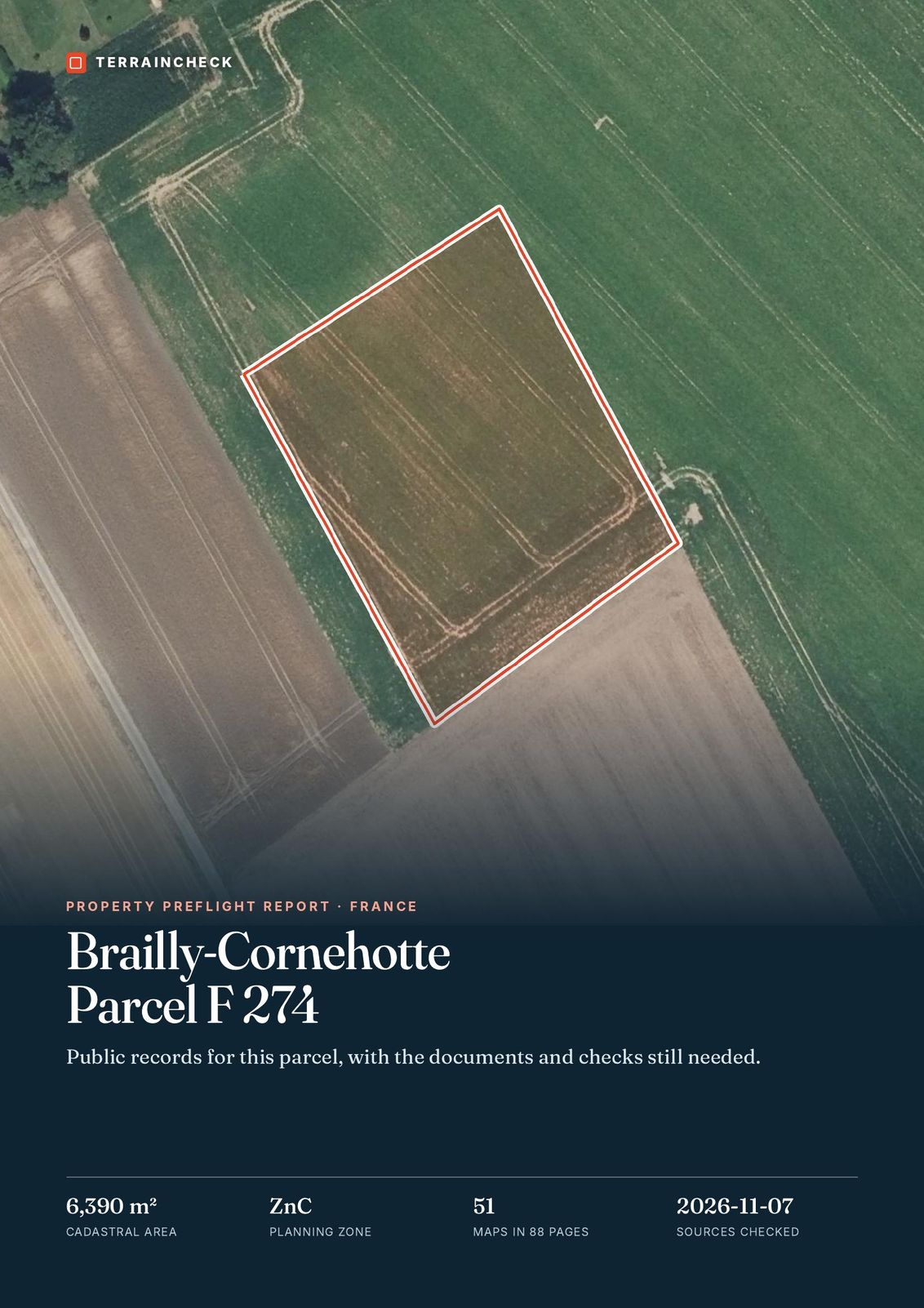
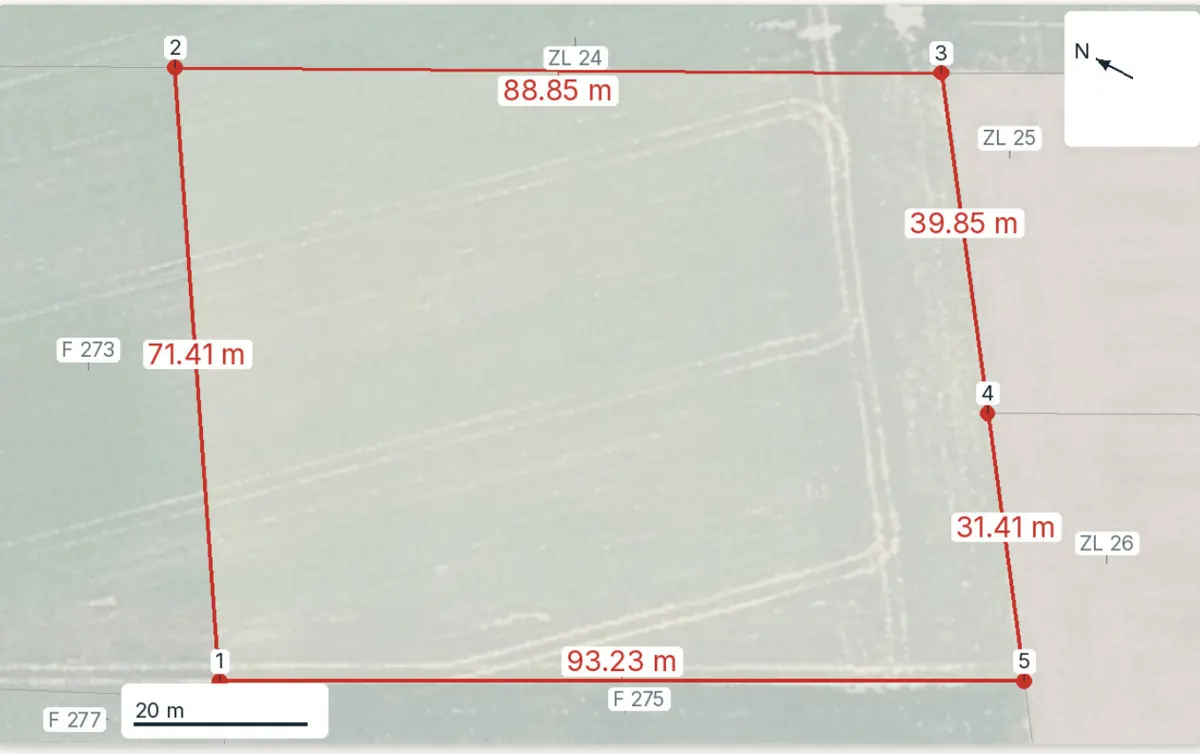
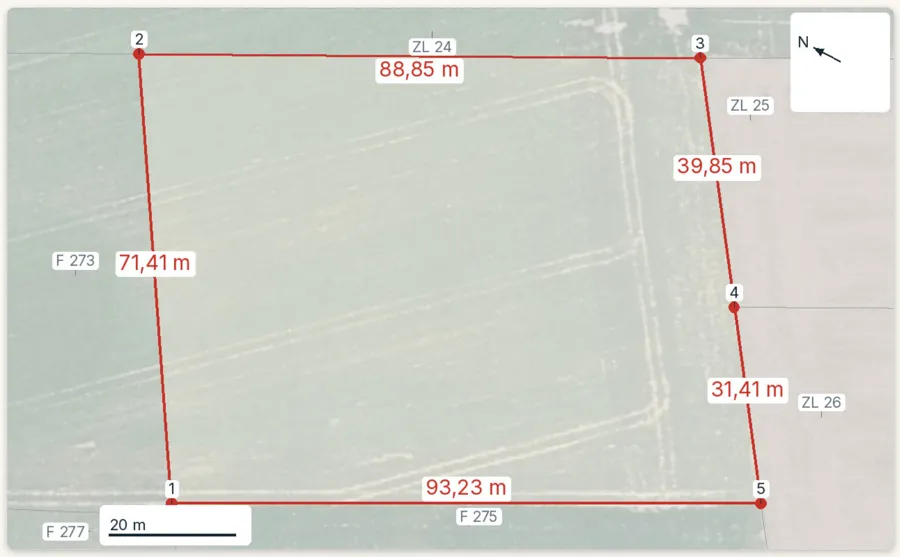
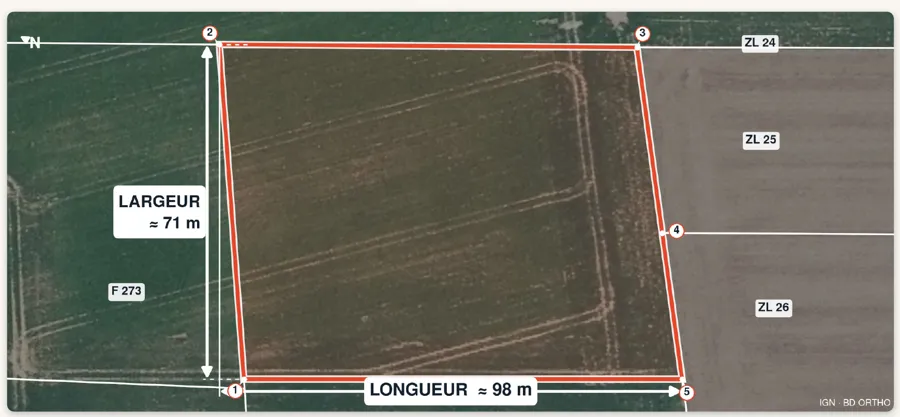
Say you are interested in parcel F 274 at Brailly-Cornehotte, in the Somme, and also want to know who owns the adjoining land, perhaps to negotiate a right of way. The cadastral plan shows five adjoining parcels, in two different sections.
Six parcels count as six properties. An ownership-extract request takes five at most, so you need two free requests to the same land tax office. At the land registry the same search costs 6 × €12 = €72, with no postage if the answer comes by email.
Unknown owners, co-ownership, estates
An extract may list several names: a request about one person also returns the properties they hold with other rights holders, for example heirs who own the land jointly (indivision). The notaire then checks who has to sign the sale.
Where the last recorded owner has died, a land registry search shows whether a transfer on death has been published. If none has, talk to a notaire before making an offer: the person entitled to sell may not be the one on the cadastre.
Ownerless land
Some parcels no longer have a known owner. The French public property code sets out two categories. The first is land from an estate opened more than thirty years ago where no heir has come forward. The period drops to ten years when the land lies within a major urban development scheme (grande opération d’urbanisme) or a territorial revitalisation scheme (ORT), in a France ruralités revitalisation zone (the rural zoning referred to in II and III of article 44 quindecies A of the tax code) or in a priority urban district: that is the wording of article L1123-1 in force since 1 July 2024. According to the ministry’s guidance for local authorities, the ten-year period has applied since 23 February 2022 to estates opened on or after 1 January 2007 and not yet divided. In every case the article leaves the civil-law rules on prescription untouched. Such land passes automatically to the commune or its group of communes, failing that to the State or a conservation body.
The second is property with no known owner whose land taxes have gone unpaid, or been paid by someone else, for more than three years. Here the commune or its group of communes has to follow a procedure: an opinion from the local direct-tax committee, an order by the mayor or president, public notice, then, if nobody comes forward within six months, a council decision to take the land. An owner or heir who turns up later can claim it back within the thirty-year limitation period; if the land has since been sold or put to a use that prevents its return, they may only get compensation.
Sources: BOFiP: release of ownership records (BOI-CAD-DIFF-20-20-10-10); Service-Public: obtaining information on a property; Public Property Code (CG3P), art. L1123-1 (in force since 1 July 2024); collectivites-locales.gouv.fr: ownerless property. Accessed 12 November 2026.
What you may do with the name
The name does not prove that the person can sell alone, or that the land is free of mortgages or easements. Those points are checked by the notaire against the title deed. For the order of checks, see what to verify before the compromis.
Sources: Form 6815-EM-SD: request for a matrice extract. Accessed 12 November 2026.
In the report: who to write to about the parcel
Before you write to the owner
- Commune, section and number noted from cadastre.gouv.fr (plus the prefix if communes have merged).
- Ownership-extract request sent to the land tax office: one commune, five parcels at most.
- If you need current data or the history: form 3233-SD to the land registry, €12 per property; in Moselle, Bas-Rhin and Haut-Rhin, the Livre foncier office instead, under its own procedure.
- Several names on the extract: have the notaire check who must sign.
- No canvassing or mass mailing from the extract, and no reuse of the data without the person’s consent.
Read next: reading a cadastral reference and why the cadastral area is not the land’s real area.
Keep reading
Get the parcel right before you write
Pick the parcel on the map: the report gives its full reference, outline and neighbours, the planning document that applies, the hazards and the offices to contact, each with its source and date, in English. Free preview, PDF report for €29 (€39 in French and English).