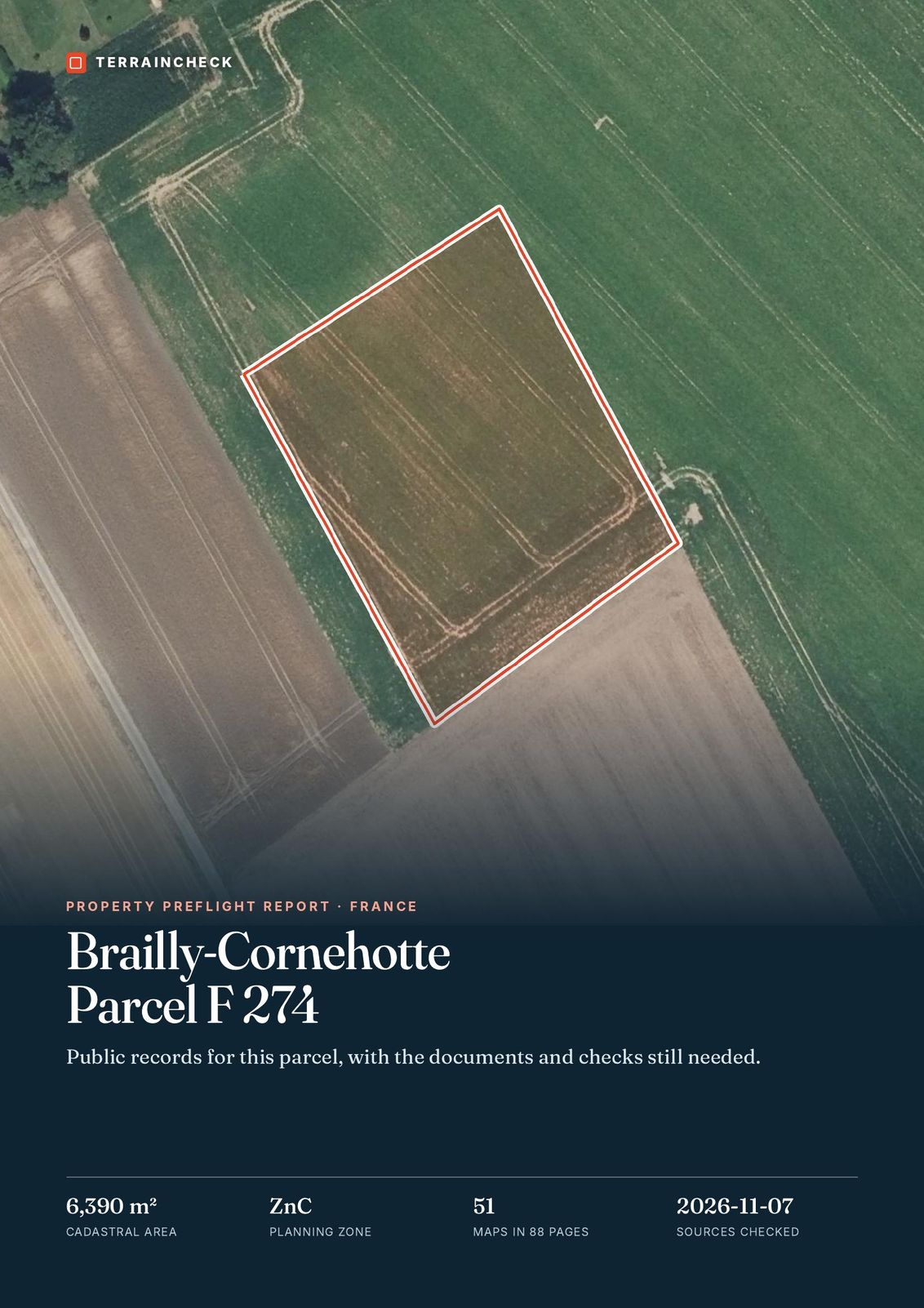
Pillar: Buying building land in France
Selling part of your plot in France: permission, surveyor, access and tax
In France, detaching a building lot to sell it normally creates a lotissement (a legal subdivision; exceptions in art. R442-1): you file a prior declaration at the mairie (town hall), processed in one month from a complete file unless extended, or a development permit (three months) if shared roads or facilities come with it. First step: check the local plan (PLU) and get a free operational planning certificate to confirm the lot can be built on and served.
In brief
- No lotissement, so no declaration or permit, if the strip you sell goes to enlarge an adjoining property, or if the part detached carries a building that stays (art. R442-1 of the Planning Code, code de l’urbanisme). Exception: in a protected zone mapped by the municipal council (art. L115-3), a division needs a prior declaration, except in the cases listed in art. R421-23 b (a division within an approved development scheme, within a rural land consolidation before it closes, or resulting from a farm lease granted to a farmer).
- What stops a sale: a lot the PLU (local plan) does not allow building on, public networks that need extending with no date or body named (the mairie, the town hall, must then object), or a lot with no access to the road.
- Who pays: the planning certificate is free, the géomètre-expert (chartered surveyor) quotes a fee, and the Civil Code puts the costs of the deed on the buyer (art. 1593).
- Capital gains: a lot sold as building land is not covered by the main-home exemption, even if it was part of your garden, except a garage, yard or access to the house; other exemptions may still apply, including a sale price of €15,000 or less.
On this page
Will the lot be buildable?
If the plan local d’urbanisme (PLU, the local zoning plan) does not allow building on that part of your land, or sets setbacks and footprint limits the lot cannot meet, you have nothing to sell as a building plot. Read the zone and its rules at the mairie or on the Géoportail de l’urbanisme (reading the PLU, checking whether land is buildable).
Then apply for an operational planning certificate (certificat d’urbanisme opérationnel), describing the project: number of lots, rough position and use of the buildings. It says whether the land can be used for it and what public services exist or are planned. It is free; the mairie has two months from receipt and consults the network operators. A prior declaration filed within 18 months of the certificate is assessed under the rules in force on its date, except rules protecting public safety or health (the planning certificate in detail).
Sources: Planning Code, art. L410-1; Planning Code, art. R*410-10; Service-Public: planning certificate. Accessed 12 November 2026.
Prior declaration or development permit
Dividing land to create one or more lots meant for building is legally a lotissement (a subdivision), even for a single lot. The normal route is a déclaration préalable (prior declaration) at the mairie. A permis d’aménager (development permit) is needed when the scheme creates roads, spaces or facilities shared by several lots, specific to the subdivision and paid for by the person dividing.
For applications filed since 28 September 2026, being in a protected heritage area (site patrimonial remarquable), near a listed monument or in a listed site no longer requires a development permit on its own (decree 2026-674 of 27 July 2026); the previous wording did. Finally, in zones the municipal council has mapped to protect landscapes, sites and natural habitats (art. L115-3), a voluntary division needs a prior declaration even with no building lot, except in the cases listed in art. R421-23 b (a division within an approved development scheme, within a rural land consolidation before it closes, or resulting from a farm lease granted to a farmer).
Processing takes one month for a declaration and three months for a development permit, from a complete file. The mairie has one month to ask for missing documents, and one month is added in heritage areas or near a listed monument, among other cases. The decision lapses if the division has not taken place within three years of its notification or of the tacit decision (4 or 5 years for permissions granted between 1 January 2021 and 28 May 2024). What goes in the file is in our guide to the prior declaration for a land division.
Sources: Planning Code, art. L442-1; Planning Code, art. L442-3; Planning Code, art. R*421-19, version of 29 July 2026; Planning Code, art. R*421-23; Planning Code, art. L115-3; Planning Code, art. R*442-1; Planning Code, art. R*423-38; Planning Code, art. L442-4; Planning Code, art. R*424-18; Service-Public: prior declaration. Accessed 12 November 2026.
The géomètre-expert: boundaries and survey
A géomètre-expert sets out the new boundary on the ground and prepares the document d’arpentage, the survey plan that gives the new parcels their numbers in the cadastre (the land tax map). Fees are by quote: state the number of lots and the boundaries to be marked.
For a lot in a lotissement, the sale contract must state that the description of the land comes from a bornage (boundary survey). The cost of an agreed boundary survey with the neighbours (bornage amiable) is usually shared, though you can agree otherwise (bornage: cost and who pays). The texts cited here do not say whether seller or buyer pays the surveyor for the division: put it in the contract.
Sources: Planning Code, art. L115-4; Service-Public: boundary surveys. Accessed 12 November 2026.
Access and networks for the new lot
A lot taken from the back of a house plot often has no road frontage. There are two ways round it: an access strip sold with the lot (a “flag” lot), or a right of way over the land you keep, written into the deed. If the sale itself landlocks the lot, the Civil Code makes the access come from the land that was divided, unless an adequate route cannot be set up there (landlocked plots).
On networks: if work on the public water, sewer or electricity networks is needed to serve the project and the authority cannot say when and by whom it will be done, it must object to the prior declaration. Connections and works specific to the lot can be charged to whoever holds the permission. For costs, see serviced or unserviced plots and electricity connection.
Sources: Planning Code, art. L332-15. Accessed 12 November 2026.
The steps in order, who pays, how long
| Step | Where | Cost | Time |
|---|---|---|---|
| PLU zone, operational certificate | Mairie | Free | 2 months from receipt |
| Division plan, boundary survey | Géomètre-expert | By quote | No time limit in the texts cited |
| Prior declaration (or development permit) | Mairie | Plans often drawn by the surveyor | 1 month (3 months) from a complete file, extensions possible |
| Contract, then deed | Notaire | Deed costs fall on the buyer (Civil Code 1593) | If pre-emption applies: 2 months of silence after the notice is received |
| Capital gains tax | Notaire | 19% + 17.2% after allowances, unless exempt | Worked out and paid by the notaire |
The five steps of selling part of your land, seen from the seller’s side. Sources: Planning Code, art. R*410-10; Service-Public: planning certificate; Service-Public: boundary surveys; Planning Code, art. R*423-23; Civil Code, art. 1593; Planning Code, art. L213-2; Service-Public: capital gains on property. Accessed 12 November 2026.
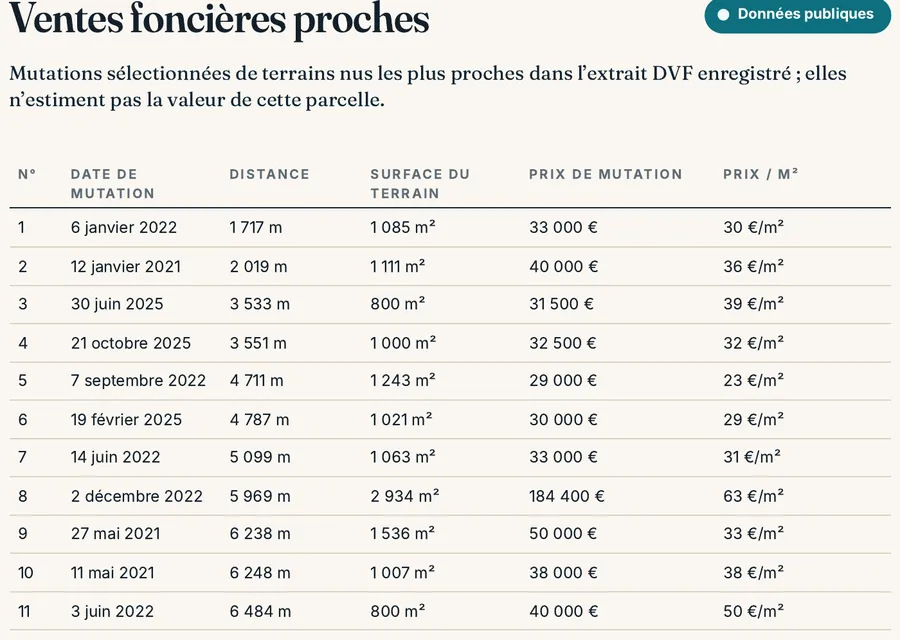
For the price, look at nearby sales in the public DVF records (pricing land with DVF). If the commune holds an urban pre-emption right over the area, the notaire (the public official who draws up the deed) sends a notice of intended sale to the mairie; two months of silence count as a waiver, and a request for documents or a visit pauses the clock (urban pre-emption right).
Sources: Planning Code, art. L213-2. Accessed 12 November 2026.
Capital gains: what the main-home exemption covers
Individuals selling property in France, built or not, pay tax on the gain. Your main home on the day of sale is exempt, together with its immediate and necessary outbuildings sold at the same time. Outside building land, the tax authority accepts that this covers all the land around the house, whatever its size, if sold with it or shortly after.
For a lot sold as building land, meaning land the planning documents allow building on, the official tax guidance rules the exemption out, even if the lot used to be part of your garden. Only the garage, parking, shed, caretaker’s house, yard and land used as access to the home can still be exempt with the house.
Other exemptions in article 150 U of the General Tax Code may apply, notably a sale price of €15,000 or less, assessed share by share for jointly owned land. Otherwise the gain is reduced by a holding-period allowance: no income tax after 22 years, no social charges after 30. Service-Public’s example: a €20,000 taxable gain means €3,800 of income tax (19%) and €3,440 of social charges (17.2%), €7,240 in all. The surcharge on gains above €50,000 does not apply to building land. The notaire calculates, files and pays the tax; if you live abroad, check the tax treaty with your country, which may set different rules.
Sources: General Tax Code, art. 150 U, version of 21 February 2026; BOFiP: main-home exemption and outbuildings (BOI-RFPI-PVI-10-40-10, version of 27/06/2023, § 330–350); Service-Public: capital gains on property. Accessed 12 November 2026.
In the report: access and boundaries of F 274
Before you sign a sale contract
- PLU zone and rules read for the part to be sold; operational planning certificate applied for.
- Answers from the network operators (water, sewer, electricity) in hand.
- Access settled: strip sold with the lot or right of way drafted.
- Surveyor’s quote signed; who pays it written into the contract.
- Prior declaration filed, or development permit granted before any contract.
- Capital gain estimated with the notaire, knowing the lot is outside the main-home exemption.
- Dividing a plot in France: prior declaration, development permit or nothing, depending on the case
- Document d’arpentage in France: what it is, who draws it up and how new parcels get their numbers
- Right of way (servitude de passage) in France: who maintains the track, who pays and what each owner may do
Common questions
Do I need a prior declaration to sell a strip of garden to my neighbour?
No, if the strip is detached to be joined to the neighbour’s adjoining property: that is not a lotissement (art. R442-1 f). Exception: a protected zone mapped by the commune under art. L115-3, where a division must be declared, save for the cases in art. R421-23 b (approved development scheme, rural land consolidation, farm lease). You still need a surveyor for the new boundary and a deed signed before a notaire.
How long does the mairie have to answer?
One month for a prior declaration and three months for a development permit, from a complete file. These can be extended, for example by one month in a protected heritage area or near a listed monument.
Is selling a lot from the garden of my main home tax-free?
Not under the main-home exemption if the lot is sold as building land (BOFiP, BOI-RFPI-PVI-10-40-10, § 340). Other exemptions in article 150 U may apply, for example a sale price of €15,000 or less.
Who pays the surveyor and the notary fees?
The Civil Code puts the costs of the deed on the buyer (art. 1593). For the surveyor, the texts cited do not decide: seller and buyer agree it in the contract.
Keep reading
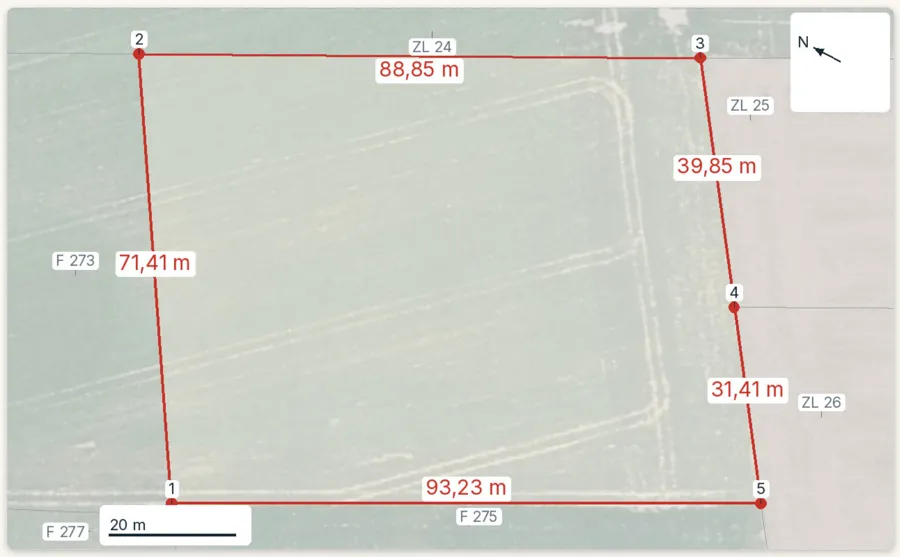
Dividing a plot in France: prior declaration, development permit or nothing, depending on the case
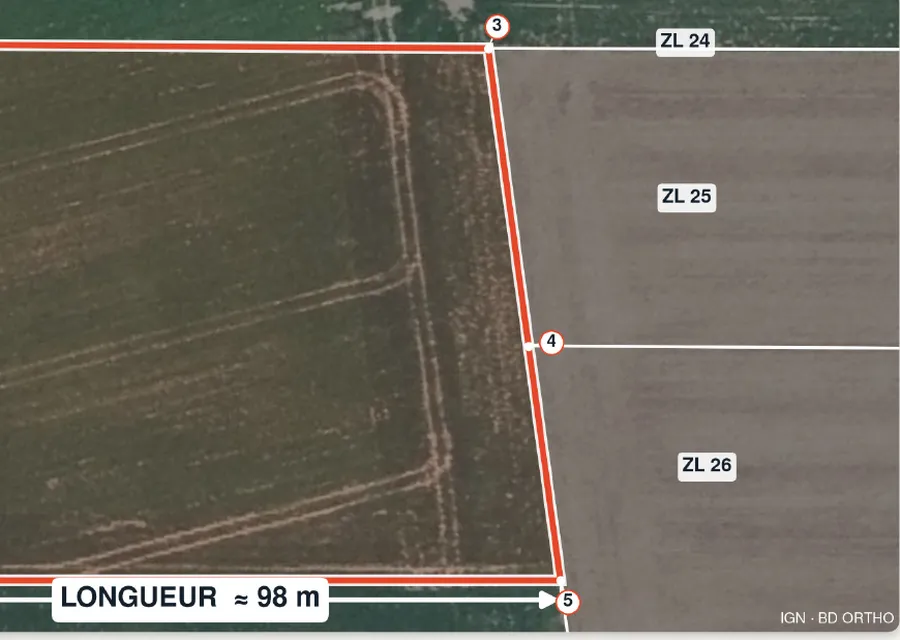
Document d’arpentage in France: what it is, who draws it up and how new parcels get their numbers
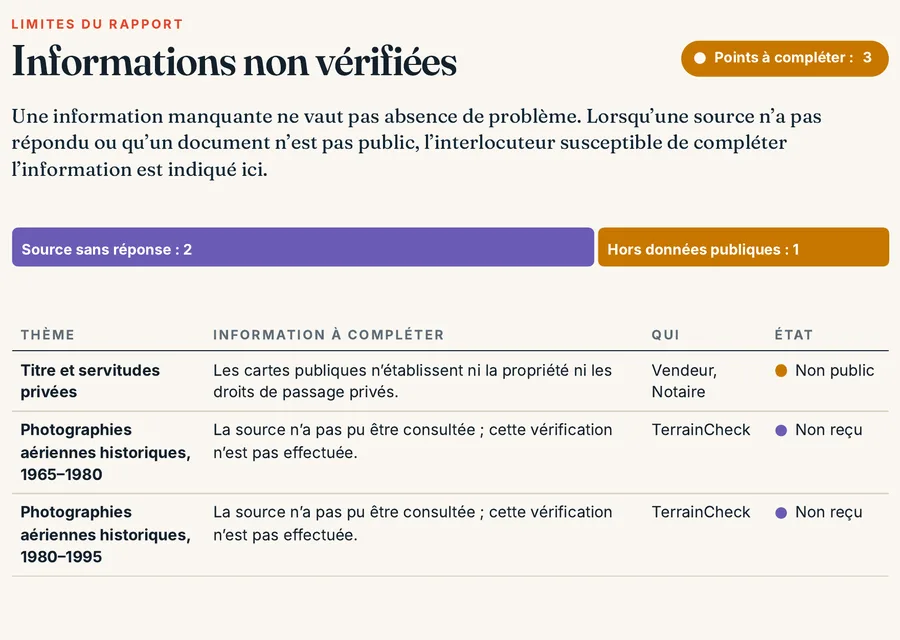
Right of way (servitude de passage) in France: who maintains the track, who pays and what each owner may do
Capital gains tax on selling building land in France: calculation, allowances and exemptions
Before you divide, see what the public records say about the parcel
Pick the parcel on the map. The report sets out its outline, PLU zone, mapped roads and networks nearby, natural hazards and recent sales around it, each with its source and date and explained in English. It does not replace a surveyor or a notaire. Free check, PDF report for €29 (€39 in French and English).