Pillar: Buying building land in France
Dividing a plot in France: prior declaration, development permit or nothing, depending on the case
Detaching one or more plots intended for building creates a lotissement (subdivision). Apart from the cases in article R442-1 of the Planning Code, the owner files a prior declaration with the mairie (town hall), or a development permit if the scheme provides roads, spaces or facilities shared by the plots. First step: ask the mairie’s planning office what the zone allows, before paying a surveyor for the plan.
In brief
- Detaching a building plot with no shared roads, spaces or facilities built by the seller (outside the cases in article R442-1): prior declaration (déclaration préalable, DP) with the mairie (town hall), form cerfa 16703*03, processed in one month from the complete file, two months in a protected heritage area or near a listed monument, and other extensions are possible. If the mairie does not answer in time, approval is in principle given by default.
- Development permit (permis d’aménager, PA): form cerfa 16297*05, three months, required only if the subdivision provides roads, spaces or facilities shared by several plots, specific to the scheme and paid for by the developer. For applications filed since 28 September 2026, a protected heritage area, the surroundings of a listed monument or a site classé no longer require it on their own.
- No plot intended for building: no planning authorisation is needed to divide, except in a zone the commune (the French municipality) has delimited under article L115-3, where a prior declaration is required.
- For the buyer of a plot: after a prior declaration, a building permit cannot be refused or made subject to special conditions on the basis of new planning rules for five years from the decision not to object (art. L442-14), unless the subdivision documents are amended.
On this page
Dividing to build means creating a lotissement
French planning law calls a lotissement (subdivision) “the division, in ownership or in use, of one landholding or of several adjoining landholdings, intended to create one or more plots for building” (art. L442-1). One plot is enough. If a seller detaches the bottom of their garden and sells it as a building plot, that is a lotissement, even if the listing never uses the word.
A lotissement that does not need a development permit goes through a prior declaration (art. L442-3, R421-23 a). The permit is required only for schemes that provide for “the creation or improvement of roads, spaces or facilities shared by several plots intended for building and specific to the lotissement”, counting only the facilities the developer has to build (R421-19 a).
In practice: two building plots served by a shared lane that the seller builds need a development permit. A single building plot with its own frontage on the street needs a prior declaration.
Divisions that are not a lotissement
Article R442-1 lists divisions that “do not constitute lotissements” and need “neither a prior declaration nor a development permit”. Among them:
- e) detaching land that carries buildings not intended for demolition: selling the house with part of the land and keeping the rest;
- f) detaching a strip of land to join it to an adjoining property, for example one sold to the neighbour;
- a to d, g to i) divisions governed by another procedure (a permit that includes the division, a ZAC development zone, land reallocation, compulsory purchase…), each with its own conditions: read the full list in the article before relying on one.
That exemption applies under the lotissement rules; inside a zone delimited under article L115-3 (below), have the mairie confirm the regime.
A division that creates no plot for building is not a lotissement either: Service-Public says no planning formality is needed. The exception: to protect landscapes and natural areas, the municipal council may delimit zones where voluntary divisions that need no development permit go through a prior declaration (art. L115-3). Article R421-23 b leaves out divisions within an authorised development scheme, within a rural land consolidation before it closes, and those that result from a farm lease granted to a farmer.
A sale made in breach can be annulled by a court at the request of the authority, within five years of the deed being registered (art. L115-3). Ask the planning office whether the land lies in such a zone before you sign anything.
Which procedure applies
| Situation | Procedure | Form | Standard period | Rule |
|---|---|---|---|---|
| Division with no plot intended for building, outside an L115-3 zone | No planning authorisation | None | None | L442-1; Service-Public |
| The same division inside an L115-3 zone | Prior declaration, except within an authorised development scheme, a rural land consolidation before it closes, or a farm lease to a farmer | cerfa 16703*03 | 1 month | L115-3, R421-23 b |
| A case on the R442-1 list (built plot keeping its building, land added to an adjoining property, ZAC…) | Neither declaration nor development permit under the lotissement rules; inside an L115-3 zone, have the mairie confirm the regime | None | None | R442-1; L115-3, R421-23 b |
| Lotissement without shared roads, spaces or facilities paid for by the developer, including in a protected area for applications filed since 28/09/2026 | Prior declaration | cerfa 16703*03 | 1 month; 2 months in a protected heritage area or near a listed monument | R421-23 a, R423-23, R423-24 |
| Lotissement with roads, spaces or facilities shared by several plots, specific to the scheme, paid for by the developer | Development permit | cerfa 16297*05 | 3 months; 4 months in the same areas | R421-19 a, R423-23, R423-24 |
Planning Code in force on 12 November 2026. Further extensions: articles R423-24 to R423-33. Sources: Planning Code, art. R*421-19 (development permit), version of 29 July 2026; Planning Code, art. R*421-23 (prior declaration); Planning Code, art. R*442-1 (divisions that are not a lotissement); Planning Code, art. R423-24 (one-month extension); Service-Public: which planning authorisation is needed to divide land?. Accessed 12 November 2026.
How a prior declaration for a division works
- Zone rules. Ask the mairie’s planning office, or read the PLU (plan local d’urbanisme, the local zoning plan) on the Géoportail de l’urbanisme; Service-Public notes it may set buildability, number of plots and distances from boundaries. Cost: nothing. Written answer: a planning certificate.
- Division plan. According to Service-Public, before the application a géomètre-expert (chartered land surveyor) marks out the plots and draws up the document modificatif du parcellaire cadastral (DMPC) that updates the cadastral map. Cost: on quote. See boundary surveys and who pays.
- Filing. Form cerfa 16703*03, online where the commune offers it, by recorded delivery or by hand against a receipt. The file holds at least a location plan, an outline plan of the site showing existing buildings, and a sketch and dimensioned plan showing the intended divisions (art. R441-10). Within fifteen days the mayor publishes a notice of filing (art. R423-6).
- Processing. One month from the complete file (R423-19, R423-23). A missing document is requested within the first month; without it after three months, the mairie is deemed to object (R423-38 and R423-39). A longer period must be notified within the first month (R423-42). If the mairie has not objected by the end of the period, the declaration is tacitly accepted (a tacit non-opposition), unless the project requires an environmental assessment (R424-1, R424-2-1).
- Posting and appeals. The decision is displayed on the land, visible from the road, with the maximum number of plots for a lotissement (R424-15, Service-Public). The two-month period for third-party appeals runs from the first day of two months of continuous display on site (R600-2). The authority may withdraw an unlawful decision within three months (L424-5).
- Carrying it out. As a general rule, the decision lapses if the division has not taken place within three years (R424-18), which can be extended twice by one year if planning rules and administrative easements have not changed against the project (R424-21). A transitional regime under Decree no. 2025-461 covers only decisions still valid on 27 May 2025: those made from 1 January 2021 to 27 May 2022 are extended by one year; those made from 28 May 2022 to 28 May 2024 are valid for five years, with no extension under the first paragraph of R424-21. On a sale, the notaire (the public notary who handles every French property sale) registers the division with the land registry, the service de la publicité foncière; Moselle, Bas-Rhin and Haut-Rhin use a separate register, the Livre foncier.
Buying a detached plot: what to check
Ask the seller for the decision not to object (arrêté de non-opposition) with its date or, if the mairie never answered, a document confirming the tacit non-opposition and its date. Any advertising after the decision must give that date and say that the file can be consulted at the mairie (art. L442-6). The file shows the number of plots and the plan declared.
The posting on site starts the period for third-party appeals. The date of the decision starts the period of validity (see “Carrying it out”; have the mairie confirm the deadline) and the protection of article L442-14: for five years, your building permit cannot be refused or made subject to special conditions “on the basis of new planning provisions”. After a development permit, the five years run from the recorded completion of the works.
For a plot sold by a developer under a development permit, no promise of sale or deposit is allowed before the permit is issued (art. L442-4), and the buyer has ten days to withdraw after the option contract (art. L442-8): see the preliminary sale agreement for land.
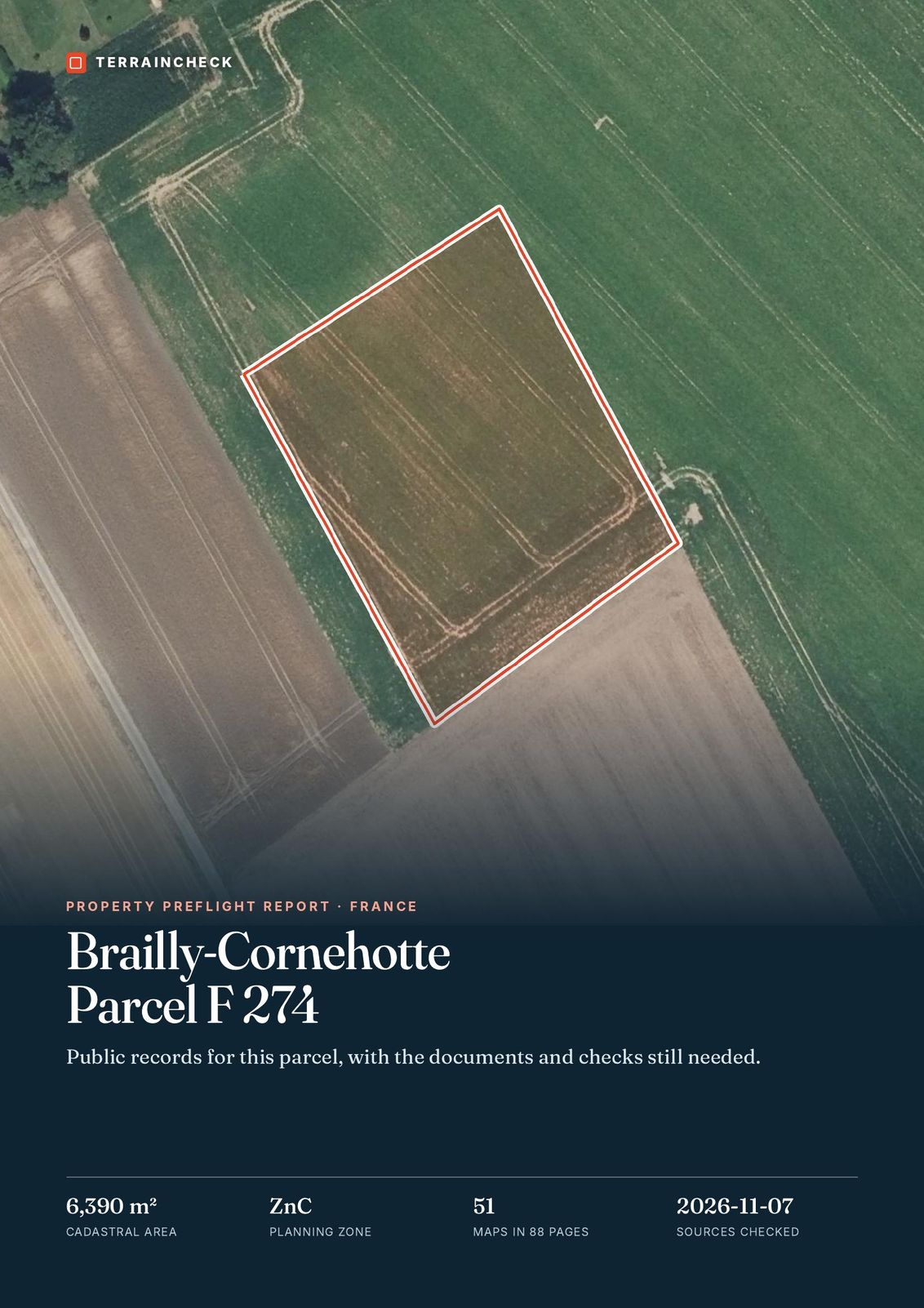
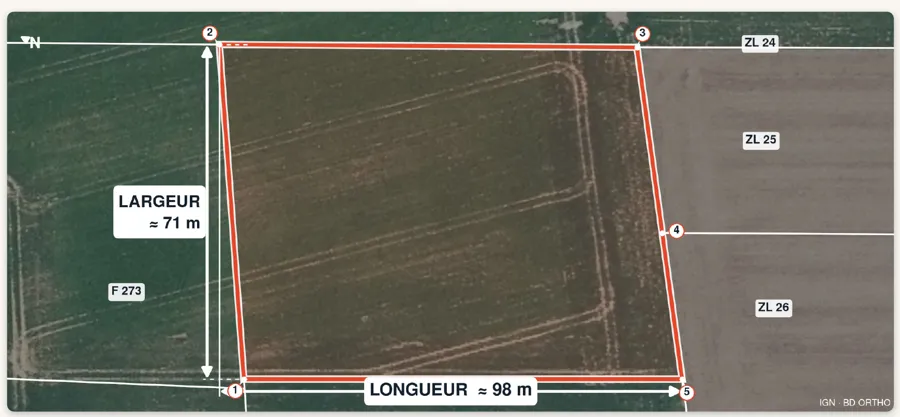
In the report: the plot plan
Before you sign for a detached plot
- Procedure identified (none, prior declaration, development permit) and the article that applies.
- Decision not to object, or a document confirming the tacit non-opposition, with its date; file consulted at the mairie.
- Displayed on the land for more than two months without appeal; division carried out while the decision is valid (see “Carrying it out”).
- PLU zone and any rules on divisions read, or a planning certificate obtained.
- The géomètre-expert’s plan, the plot area and the survey statement in the contract.
- Access and utilities: street, shared lane (development permit) or a right of way still to be granted.
Next: read the PLU for the zone and go through the checks before the compromis.
Common questions
Do I need permission to divide land without building on it?
In principle no: Service-Public says that a division with no building project needs no planning formality. Inside a zone delimited by the municipal council under article L115-3, a prior declaration is required, except in the cases listed in article R421-23 b.
Which form is used for a prior declaration of division?
Form cerfa 16703*03; a development permit uses cerfa 16297*05.
How long does the mairie take to process a prior declaration of division?
One month from the complete file, two months in a protected heritage area or near a listed monument; other extensions exist and must be notified within the first month. If the mairie has not objected in time, the declaration is in principle tacitly accepted.
Is selling a house with part of its land a lotissement?
Not if the detached land carries buildings that are not meant to be demolished (art. R442-1 e): neither a prior declaration nor a development permit is needed on that ground. Inside a zone delimited under article L115-3, have the mairie confirm the regime. If another part of the land is later detached for building, that division falls under the lotissement rules.
Keep reading
Land boundary survey (bornage) in France: when it is required, how the price is set and who pays
Landlocked plot in France: access to a public road, rights of way and your options before buying
Compromis de vente for land in France: the clauses to check before you sign
Cadastral area vs real area of a plot in France: why the figures differ and what the law says
Looking at a detached plot? Start with the parcel it comes from
Pick the parcel on the map. The report gives its plan with the length of each side, the zone in the local plan, easements and known hazards, each with its source and date and explained in English. It does not replace the mairie’s decision or the surveyor’s plan. Free check, PDF report for €29 (€39 in French and English).