Pillar: Buying building land in France
Landlocked plot in France: access to a public road, rights of way and your options before buying
In France, the owner of a landlocked plot can claim a passage over a neighbour’s land against compensation (Civil Code, art. 682), even if no deed provides for it: the route and the way it is used are set by agreement, by thirty years of continuous use (art. 685) or by the tribunal judiciaire (the civil court). First step: before the compromis (preliminary contract), ask the seller for the deeds and any evidence of how the passage has been used, and ask the notaire (the public notary who handles the sale) to check the existing right.
In brief
- Landlocked (enclavé) means no way out onto a public road, or access that is inadequate for the intended use of the land (farming, industry or business, building or dividing it into building plots). The owner can then claim a passage over a neighbouring plot, against compensation (Civil Code, art. 682). Land that is merely awkward to reach does not qualify.
- The passage normally runs where the route to the public road is shortest, but at the place that does least damage to the neighbour (Civil Code, art. 683). If the plot became landlocked when a property was divided (sale, exchange, sharing out), the passage is claimed first over the plots that came from that division (art. 684).
- No official scale for compensation: it matches the damage and is set by agreement or, failing that, by the tribunal judiciaire (the civil court) where the land lies. Before going to court, an attempt at settlement is required in the cases listed in article 750-1 of the Code of Civil Procedure; the court conciliator (conciliateur de justice) is free.
- A chemin rural belongs to the commune (the municipality) and is open to the public; a chemin d’exploitation (farm track) is presumed to belong to the adjoining owners, is shared by those who need it and may be closed to the public (Rural Code, art. L161-1 and L162-1).
- A right of way does not guarantee planning permission: the local plan (PLU) may set access conditions and, where there is no PLU, a project can be refused if the roads serving the land do not suit its size, for instance for fire engines (Planning Code, art. R111-5). A new entrance onto a route départementale: road works permission from the conseil départemental, answer within 2 months, silence meaning refusal.
On this page
What the Civil Code says
Whether the way out is missing or insufficient is judged against farming or running a business on the land, or building or dividing it into building plots; the passage must be enough to serve the whole property (art. 682). Land that is merely awkward to reach does not qualify: Service-Public, the government’s information site, says you then need the neighbour’s written agreement, a contractual easement.
| Article | Rule | What it means for a buyer |
|---|---|---|
| 682 | A passage sufficient to serve the land fully, against compensation proportionate to the damage. | Access too narrow to build on may still open the right. |
| 683 | Shortest route to the public road, at the place least damaging to the neighbour. | The route is settled with the neighbour. |
| 684 | Landlocked after a division: passage only over the plots from that division, unless a sufficient one cannot be made there. | A plot cut out of a property is opened up first through the rest of it. |
| 685 | Thirty years of continuous use fix the route and the manner of the passage. The claim for compensation can lapse; the passage can continue. | An old track may have become the fixed route. |
| 685-1 | If the plot stops being landlocked, the owner of the land crossed can claim at any time that the easement has ended; without agreement, a court records it. | A new road can end the right of way. |
Civil Code, version in force on 12 November 2026. Sources: Civil Code, art. 682 to 685-1 (right of way); Service-Public: right of way over another owner’s land (checked 25 July 2025). Accessed 12 November 2026.
Compensation, agreement, court: who decides what
No text puts a figure on the compensation. According to Service-Public it makes good the damage (a wall knocked down, loss of use…) and is paid as a lump sum or periodically. The agreement is signed privately or before a notaire, the public official who draws up property deeds.
If you disagree about the use of the passage or the amount, Service-Public says you must first try a conciliateur de justice (free), a mediator (paid) or a collaborative procedure with lawyers. Article 750-1 of the Code of Civil Procedure makes that attempt compulsory, or the claim is inadmissible, for claims of €5,000 or less, abnormal nuisance between neighbours or certain actions listed in the Judicial Organisation Code, with exemptions (obvious urgency, no conciliator available within three months…). A lawyer can tell you whether your case is covered.
Without agreement, the tribunal judiciaire for the place where the land lies decides the route, how it may be used (on foot, by car) and the compensation. The owner who benefits maintains the passage, sharing the cost if both neighbours use it. The easement goes with the land and passes to the buyer.
Chemin rural and chemin d’exploitation: two different regimes
In the countryside many plots front a track rather than a road. Its status decides who owns it, who maintains it and whether it can disappear.
| Chemin rural | Chemin d’exploitation (farm track) | |
|---|---|---|
| Definition | Owned by the commune, used by the public, not classified as a commune road (L161-1). | Used only to link plots or to work them (L162-1). |
| Owner | The commune (private property); presumed communal unless proven otherwise (L161-3). | Without a title, the adjoining owners, each for their stretch (L162-1). |
| Who may use it | The public; public use is presumed, for instance from use as a through route (L161-2). | Everyone concerned; it may be closed to the public (L162-1). |
| Upkeep and policing | The maire (mayor) is responsible for policing and preserving it (L161-5). | Owners served pay, according to their interest (L162-2), unless they give up their rights (L162-4). |
| Can it disappear? | If no longer used by the public: sale possible after an inquiry, adjoining owners given notice to buy the part next to them (L161-10). | Only with the consent of all entitled to use it (L162-3); disputes: civil courts (L162-5). |
Rural and Maritime Fishing Code, version in force on 12 November 2026. Sources: Rural and Maritime Fishing Code, art. L161-1; Rural and Maritime Fishing Code, art. L161-2; Rural and Maritime Fishing Code, art. L161-3; Rural and Maritime Fishing Code, art. L161-5; Rural and Maritime Fishing Code, art. L161-10; Rural and Maritime Fishing Code, art. L162-1 to L162-5 (farm tracks). Accessed 12 November 2026.
Farm track: ask who pays for upkeep. Chemin rural: ask the mairie (town hall) whether a sale is planned. Any other private road: have the notaire establish on what basis you may use it (ownership or a share of the road, an existing easement, the legal right of way for a landlocked plot) and for what use.
Building: access is checked with the permit
In a commune with no local plan (plan local d’urbanisme, PLU), a project can be refused if the public or private roads serving the land do not suit its size or use, in particular if they hamper fire engines. It can also be refused, or allowed with conditions, if the entrance is a danger to road users (art. R111-5).
That article applies in communes under the national planning rules or with a carte communale (a simple zoning map), not where a PLU or an equivalent document is in force (art. R111-1): the PLU rules may then set the access conditions (art. R151-47). See reading the PLU before buying.
If the project creates or alters an entrance onto a road run by another authority, the authority granting the permit consults the road manager, unless the PLU already regulates access to that road (art. R*423-53). The certificat d’urbanisme opérationnel, a free planning certificate processed within 2 months, states the roads and networks that exist or are planned.
A new entrance onto a département road
Works that alter the surface or subsoil of the public road, such as a dropped kerb into a property, need a permission de voirie (form cerfa 14023*01): from the roads department of the conseil départemental (the county council) for a route départementale, the mairie (or intercommunal body) inside a built-up area, or the direction interdépartementale des routes for a national road. It takes at most 2 months, silence meaning refusal. The permission is temporary and revocable; any fee follows the road manager’s rates.
Plot without access: what to check, which way out
- On site and on the map. See where you actually get in and what lies between the plot and the road (the parcel on cadastre.gouv.fr). Cost: nothing. Time: the visit.
- From the seller. The title deed, any easement deed and, failing that, whatever shows how the passage is used and since when. Cost: nothing. Time: the seller’s reply, before the compromis.
- At the mairie. Status of the track, any plan to sell it, PLU rules, certificat d’urbanisme opérationnel. Cost: free. Time: 2 months for the certificate.
- From the road manager. A permission de voirie if a new entrance is needed. Cost: possible fee. Time: up to 2 months.
- With the notaire and the neighbour. The notaire checks any existing right, even with no deed (landlocked plot, route settled by thirty years of use, a share in a track). To buy safely, have the route, use and compensation written into a signed agreement before you commit. Cost: the agreed compensation plus deed fees, on quote. Time: no period is set by the texts cited. If you disagree: the conciliateur de justice, free.
In the preliminary contract (compromis de vente), have the access described and the plan of the passage attached; if you plan to build, add a condition precedent on the permit: the key clauses of the compromis. Utilities along the same passage: serviced or unserviced plot.
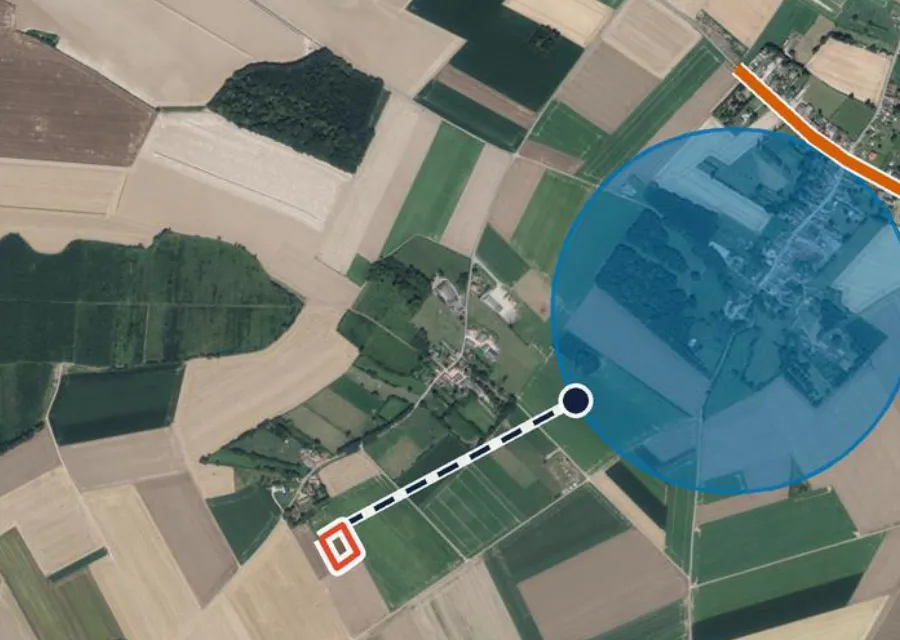
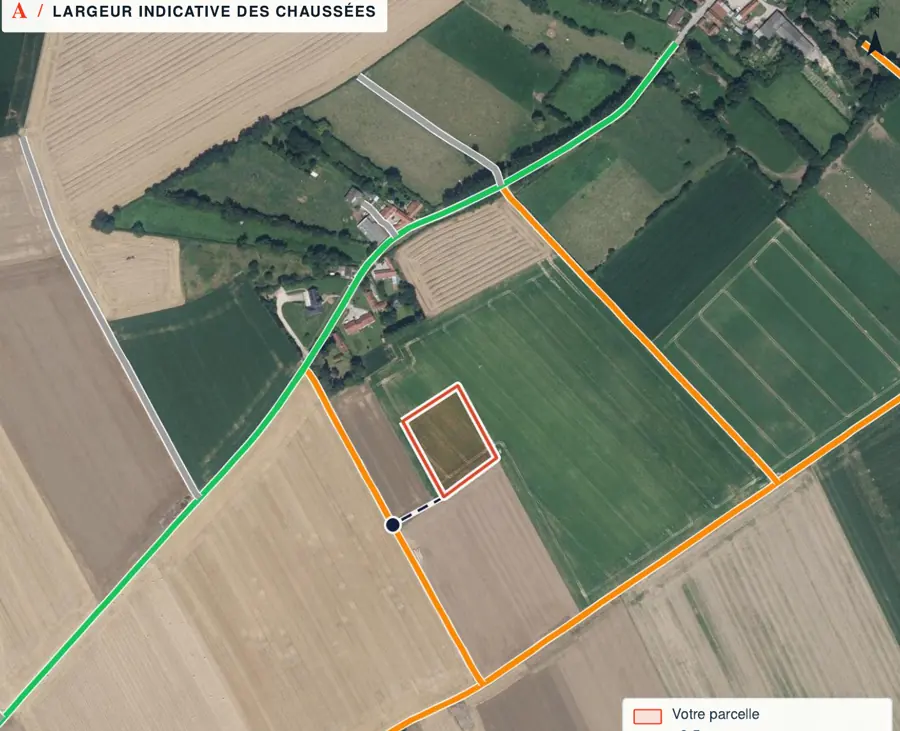
In the report: the roads around F 274
Before the compromis: access in six checks
- The plot touches a public road or a chemin rural, or the notaire has checked its right of access (deed, landlocked passage, share in a track).
- Route, width, use (on foot, by car), upkeep and compensation of the passage known; with no deed, put in writing before you sign.
- Status of the track checked at the mairie; no plan to sell a chemin rural that serves the plot.
- PLU rules on access read; with no PLU, a road suited to the size of the project and to fire engines.
- New entrance onto the road: permission de voirie requested from the road manager.
- Contract: access described, plan of the passage attached, condition precedent on the permit if you plan to build.
Common questions
Is a plot that is hard to reach “landlocked”?
No. Article 682 covers land with no way out onto a public road, or one that is insufficient for working or building on it. Land that is merely awkward to reach gives no right of way: you need the neighbour’s written agreement.
How much does a right of way cost?
There is no official scale. Compensation matches the damage to the land crossed; it is agreed between the owners or, failing that, set by the tribunal judiciaire, and can be paid at once or periodically. Deed fees come on top, on the notaire’s quote.
Does the right of way end if a new road is built?
If the plot is no longer landlocked and is served as article 682 requires, the owner of the land crossed can claim that the easement has ended; without agreement, a court records it (art. 685-1).
Keep reading
Easements (servitudes) on French land: where to find them before you buy
Dividing a plot in France: prior declaration, development permit or nothing, depending on the case
Serviced or unserviced plot in France: what “viabilisé” promises and how to check it
Compromis de vente for land in France: the clauses to check before you sign
See the roads and tracks around the parcel before you visit
Pick the parcel on the map. The report maps the roads and tracks published by IGN around it and the distance to the nearest, then the planning zone, public-interest easements and natural hazards, each with its source and date, explained in English. It does not say who holds a right of way. Free preview, PDF report for €29 (€39 in French and English).