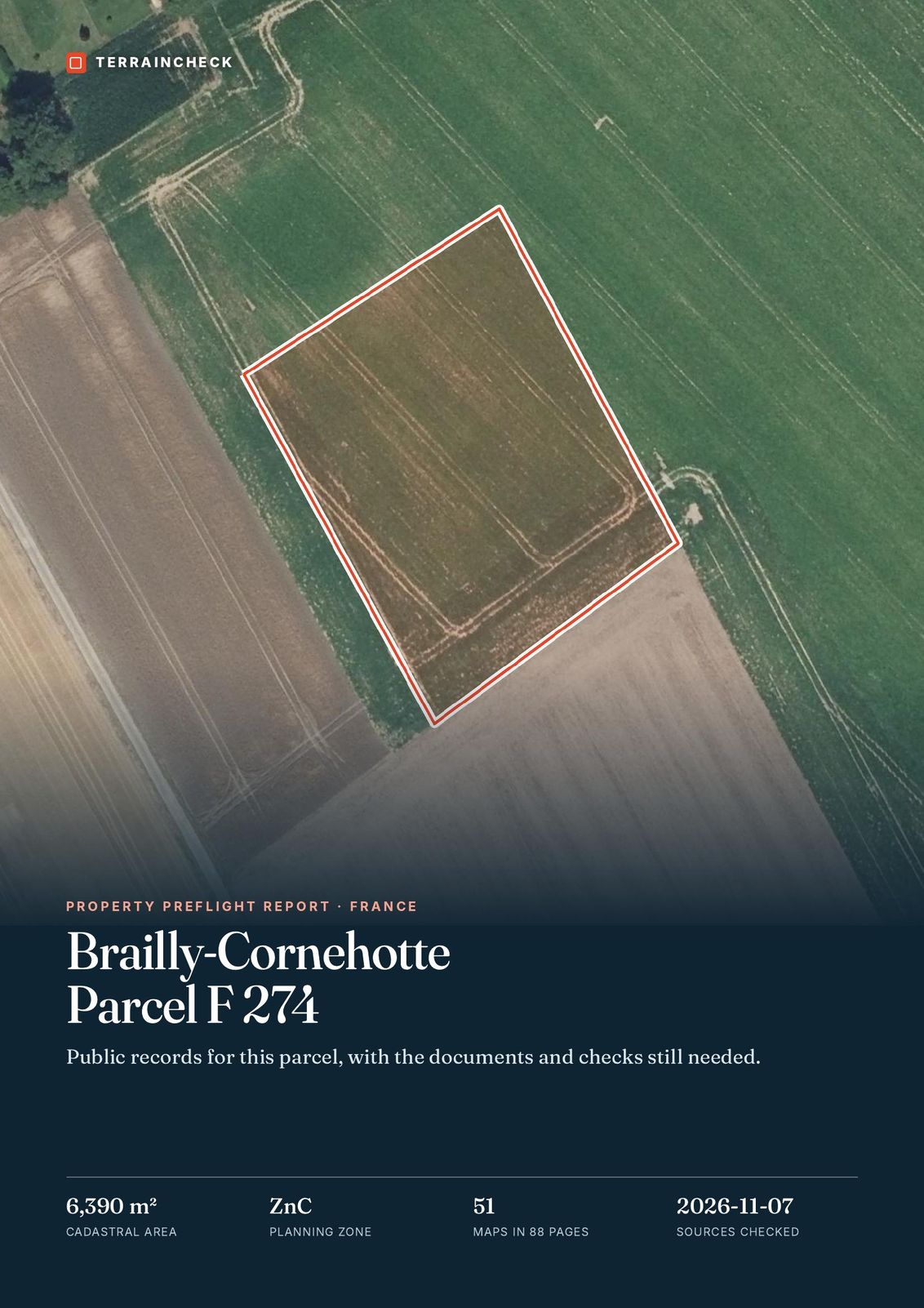
Pillar: Buying building land in France
Land near a high-voltage line or transformer in France: easements, distances, fields
In France, a power line declared to be in the public interest may pass over private land, place a support on it if it is unbuilt and unfenced, and have trees cut, without taking away the owner’s right to fence and build. First step: open the parcel on the Géoportail de l’urbanisme (the national planning portal) and look for an I4 easement.
In brief
- Compensation is due if creating the easements of article L323-4 causes direct, material and certain loss; failing agreement, a civil court sets the amount (art. L323-7).
- Around a line of 130 kV or more, the préfet (the State’s representative in the département) may, after a public inquiry, create a zone that restricts or bans homes and buildings open to the public (art. L323-10). It only exists where it has been created.
- Distances: a bare conductor must stay at least 3 m + 0.0075 × U (voltage in kV) from any building, which is 4.7 m for 225 kV (order of 17 May 2001).
- Fields: the order of 17 May 2001 caps them at 5 kV/m and 100 µT in places normally accessible to the public. The 1 µT figure from a 2013 instruction is a recommendation aimed at new sensitive buildings (nurseries, schools, hospitals).
On this page
What the easement allows the network operator
RTE runs France’s transmission network; local distribution lines are operated by the company serving the commune (municipality): Enedis or a local firm. Once the works on a line are declared to be in the public interest, this concessionnaire holds rights over private land, listed in the annexes to the PLU (the local land-use plan) among public-interest easements, under “electricity”. On planning maps (CNIG coding) it is easement type I4.
Before the declaration the public is consulted: a public inquiry where the Environment Code requires one, otherwise at least fifteen days in the town halls. The easements apply from the declaration.
| Right | What the law says | What it means for a buyer |
|---|---|---|
| Overhead passage | Running conductors above private property (L323-4, 2°). | The line can stay above the plot. |
| Support or underground route | Overhead supports or underground cables on land that is unbuilt and not enclosed by walls or equivalent fences (3°). | A pylon or buried cable may stand on the parcel. |
| Tree cutting | Cutting trees and branches that hinder the line or could cause short circuits or damage (4°). | Planting under the line is not unrestricted. |
| Rights kept | No loss of ownership; right to demolish, repair, raise, fence or build (L323-6). | Distribution network: notify the operator by registered letter at least one month before such works (D323-16). RTE line: read the agreement or order. |
Three of the rights in article L323-4 (the fourth, anchoring, concerns walls and roofs) and what they leave to the owner. Sources: French Energy Code, art. L323-3 to L323-9; French Energy Code, art. D323-16; CNIG: data sheet for easement type I4 (updated 31/03/2011). Accessed 13 November 2026.
The practical question for a buyer: which document does the line rest on? Ask the seller and the notaire (the notary who handles the sale) for the easement agreement or the order, with the plan of supports. For private easements unrelated to electricity, see checking easements before buying.
Lines of 130 kV and above: possible restricted zones
Article L323-10 covers overhead lines of 130 kilovolts or more. After a public-interest declaration preceded by a public inquiry, the authorities may create easements on land use and on works that need a building permit. Where needed, they restrict or ban new residential buildings and buildings open to the public.
They cannot block the adaptation, repair or extension of an existing building lawfully erected before they were created, as long as the works do not significantly increase the number of people living there. Any compensation is paid by the operator. Such a zone exists only where an order has created one, and it then appears among the easements annexed to the PLU.
Sources: French Energy Code, art. L323-10; French Planning Code, annex to Book I (list of easements). Accessed 13 November 2026.
The distances in the technical order
The order of 17 May 2001 sets the construction rules for electricity networks. For a bare conductor, the minimum distance D is the sum of a base distance and a voltage distance worked out from the nominal voltage U in kV: t1 = 0.0025 U, t2 = 0.005 U, t3 = 0.0075 U, rounded to the nearest decimetre.
Next to a building, the base is 3 metres for bare conductors, with t3 for the conductor at maximum temperature and in still air (t2 for positions in wind up to 240 pascals with conductors at 15 °C). Any structure over 3 metres high that people can normally reach counts as a building. Above ordinary land the base is 6 metres with t1, rising to t2 on farmland used by machinery around 4 metres high or more.
| Voltage U | Building: 3 m + t3 | Ordinary land: 6 m + t1 | Farmland (machinery): 6 m + t2 |
|---|---|---|---|
| 63 kV | 3.5 m | 6.2 m | 6.3 m |
| 225 kV | 4.7 m | 6.6 m | 7.1 m |
| 400 kV | 6.0 m | 7.0 m | 8.0 m |
TerrainCheck calculation, articles 12, 24 and 25 of the order (bare conductors, no wind, rounded to the decimetre). Public roads, silos, snow areas and spans over 400 m: separate rules. Sources: Order of 17 May 2001 (technical conditions for electricity networks). Accessed 13 November 2026.
These figures bind the operator who builds and maintains the line. They are not planning setbacks and say nothing about what the PLU allows. Only the operator knows how far its cables actually sag.
Electromagnetic fields: what the law requires, what the State recommends
What the law requires. Article 12 bis of the order of 17 May 2001 requires that, on AC networks, installations are placed so that in places normally accessible to the public the electric field does not exceed 5 kV/m and the magnetic field 100 µT, under continuous operating conditions. The rule governs where network installations are placed, not your house.
What the State recommends. The instruction of 15 April 2013 asks the préfets to advise local authorities and permit-issuing bodies to avoid, “as far as possible”, new sensitive buildings (hospitals, maternity units, nurseries, nursery and primary schools) in areas exposed to more than 1 µT near overhead lines, underground cables and transformer substations. It creates no ban, and its list does not include the single-family house.
What the health authorities say. In 2002 the IARC (the WHO’s International Agency for Research on Cancer) classed extremely low frequency magnetic fields, the kind you are exposed to near power lines, as group 2B, “possibly carcinogenic to humans”. Electric fields of the same frequency are in group 3, not classifiable. According to the ministry, ANSES (the national health safety agency) does not conclude, on current knowledge, that there are health effects as long as the regulatory limits are met.
Getting a measurement. Local authorities and some associations can ask for additional measurements, paid for by the transmission operator; a private individual goes through the town hall. Published measurements are on cem-mesures.fr.
Sources: Ministry for the Ecological Transition: low-frequency fields; Instruction of 15 April 2013 (planning near transmission lines). Accessed 13 November 2026. Source: IARC Monographs, vol. 80: static and extremely low frequency electric and magnetic fields (2002). Accessed 14 November 2026.
Where to check, in order
- Géoportail de l’urbanisme. Find the parcel on geoportail-urbanisme.gouv.fr (in French) and open the easements layer (I4). Free, about ten minutes (TerrainCheck estimate). Nothing there? Carry on: an easement can be annexed to the PLU without being published on the portal (art. L152-7).
- PLU annexes at the town hall. They include the public-interest easements (art. R151-51 of the Planning Code) with a plan. Free; no time limit is set by the texts cited. See reading the PLU before buying.
- Line maps. On data.gouv.fr: RTE overhead lines (mainland France, as at 30 June 2023) and Agence ORE’s overhead medium-voltage (HTA) lines, published for information only. Free, a few minutes (TerrainCheck estimate).
- The seller and the notaire. The agreement or order, its plan and any compensation paid. No charge; before the compromis (the binding preliminary contract).
- The operator. Distribution line (Enedis or a local company): the owner of land subject to the easement must notify the operator by registered letter at least one month before demolishing, repairing, raising, fencing or building (art. D323-16 of the Energy Code). That article does not cover the transmission network: for an RTE line, read the conditions in the agreement or order and write to RTE with your site plan before applying for a permit (no deadline is set by the texts cited).
- Before work starts, two declarations. On the free réseaux-et-canalisations service run by Ineris, the person behind the project files a project declaration (DT): operators reply within nine days of receiving a properly completed DT, fifteen for a paper one, public holidays excluded, plus a further fifteen days, public holidays also excluded, if they must take measurements to locate their network (art. R554-22). The firm doing the works then files a notice of intent to start works (DICT): operators reply within seven days of receiving a properly completed DICT, nine for a paper one, public holidays excluded in both cases, counted from receipt of any missing information if it was incomplete; a joint DT-DICT follows its own rules (art. R554-25 and R554-26). No work may start without the receipts for sensitive networks.
Sources: Géoportail de l’urbanisme (national planning portal); French Planning Code, art. R151-51; French Planning Code, art. L152-7; data.gouv.fr: RTE overhead lines (as at 30 June 2023); data.gouv.fr: overhead HTA lines (Agence ORE); French Energy Code, art. D323-16; Ineris, réseaux-et-canalisations: private individuals; French Environment Code, art. R554-20 to R554-22; French Environment Code, art. R554-26. Accessed 13 November 2026.
What you cannot tell from a distance
In the report: lines around parcel F 274
Before the compromis: a line or substation near the plot
- I4 easements read on the Géoportail de l’urbanisme and in the PLU annexes.
- Line of 130 kV or more: whether an L323-10 zone exists.
- Easement agreement or order obtained, with the plan of supports.
- Planned house position compared with the line; distribution operator notified by registered letter one month before works, RTE consulted in writing.
- Trees and hedges planned outside the tree-cutting area.
- Planning a building for children: magnetic field requested through the town hall.
Next: check whether the land is buildable and go through the checks before the compromis.
Common questions
Can I build a house under a high-voltage line in France?
The L323-4 easement does not remove the right to build (art. L323-6). Limits can come from an L323-10 zone around a line of 130 kV or more where one has been created, from the PLU, and from the distance the order of 17 May 2001 requires between conductors and buildings. On the distribution network, notify the operator by registered letter at least one month before the works (art. D323-16); for an RTE line, consult RTE before applying for a permit.
How far must a line be from a house?
For a bare conductor, at least 3 m plus 0.0075 times the voltage in kV, rounded to the decimetre: 4.7 m for 225 kV, 6 m for 400 kV. This rule governs where the line sits, in still air at maximum temperature; it is not a planning setback.
Is the 1 µT threshold mandatory?
No. It comes from the instruction of 15 April 2013, which recommends avoiding new sensitive buildings above 1 µT. The legal limit is 100 µT in places normally accessible to the public (order of 17 May 2001, art. 12 bis).
Am I entitled to compensation when buying land crossed by a line?
Article L323-7 gives a right to compensation when creating the easements causes direct, material and certain loss, to owners and holders of property rights. For an existing line, ask the seller for the agreement and what was paid, and negotiate the price knowing the easement is there.
Keep reading
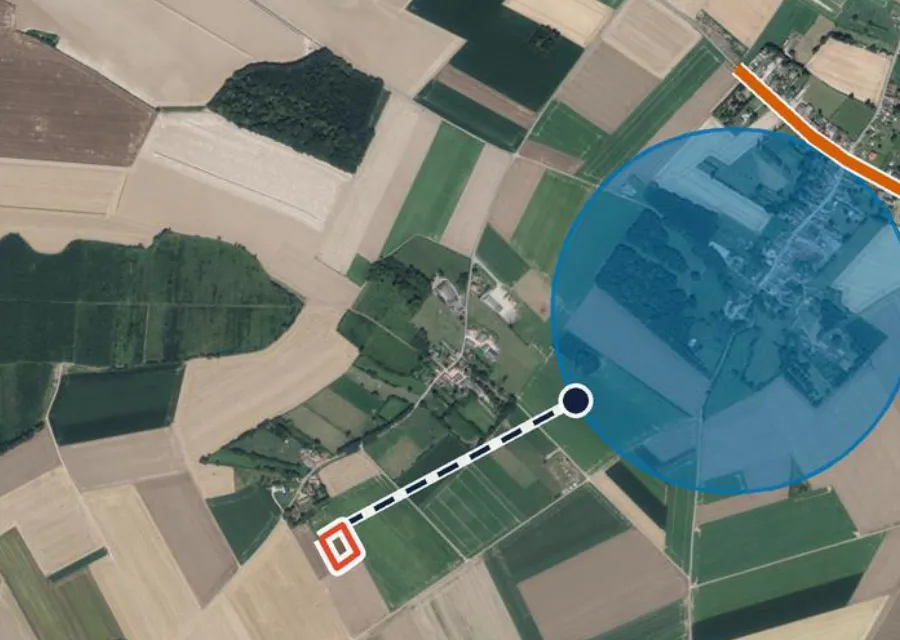
Easements (servitudes) on French land: where to find them before you buy
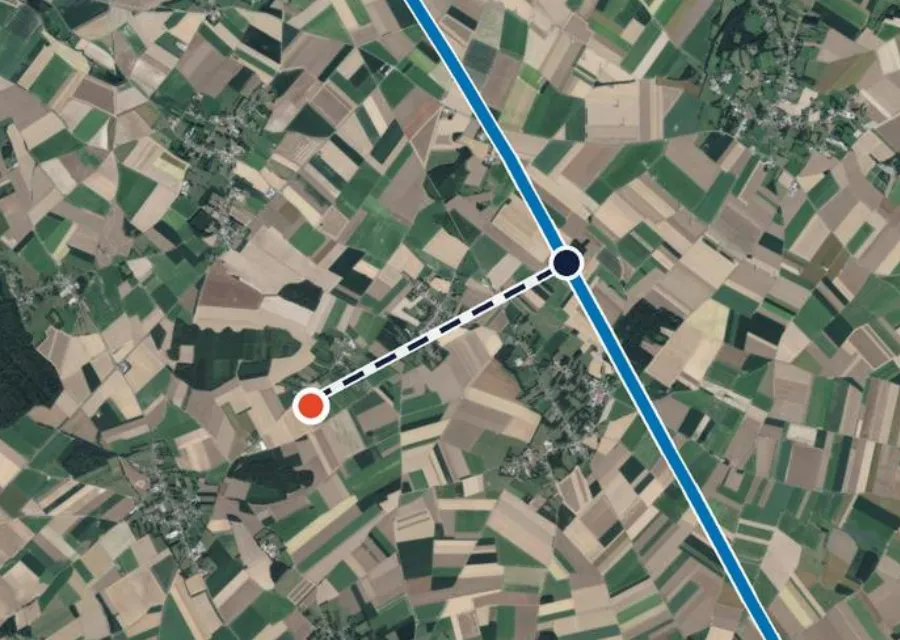
Electricity connection for a bare plot in France: Enedis steps, timings and cost
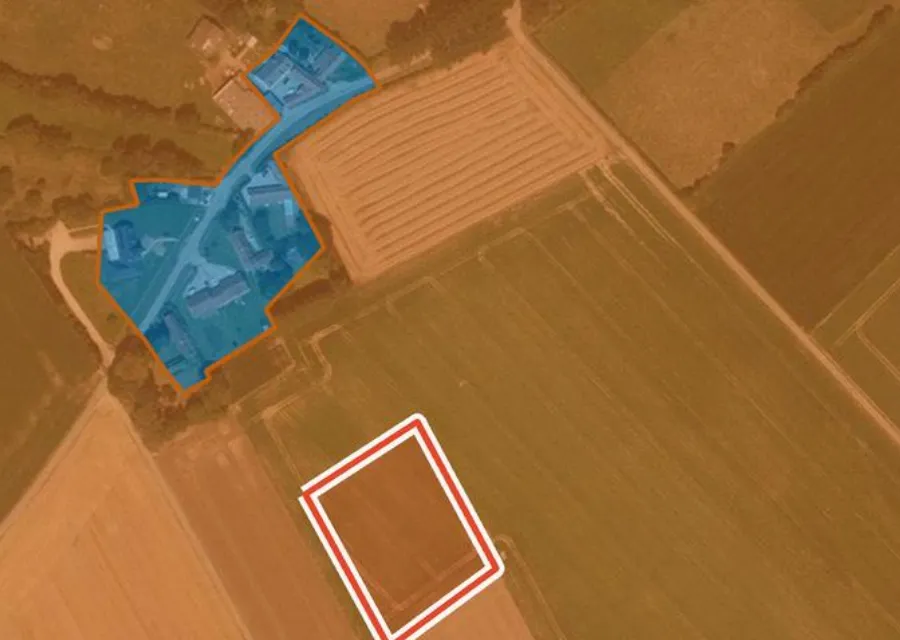
Is a plot buildable in France? How to check the zone, utilities, easements and the official answer
Airport noise exposure plan (PEB) in France: zones A to D, what you can build and what the seller must disclose
A line near the plot? Start with the map
Pick the parcel on the map. The report places the published overhead power lines around it, with the distance to the nearest, then sets out the PLU zone, hazards and recent sales nearby, each with its source and date and explained in English. It does not replace reading the easements. Free check, PDF report for €29 (€39 in French and English).