Pillar: Buying building land in France
Buying land from a French municipality: council vote, State valuation and time limits
In France a commune sells land only after a vote of its municipal council; above 2,000 inhabitants the decision must give reasons and follow a State valuation, deemed given one month after referral. First step: ask the town hall in writing whether the parcel is in the private domain, which can be sold, or the public domain, which must first be declassified. In Moselle, Bas-Rhin and Haut-Rhin, local law changes part of the procedure.
In brief
- Property in a commune’s public domain (set aside for direct public use, such as a square, or for a public service with special fittings) cannot be sold as it stands. Its public use must end first, followed by a formal act of declassification (déclassement).
- In a commune of more than 2,000 inhabitants, the municipal council votes a reasoned decision (délibération) after the valuation opinion of the State’s departmental director of public finances, deemed given one month after referral. Smaller communes still vote, but Article L2241-1 does not require that opinion.
- The commune cannot set any price it chooses: selling for nothing or below the property’s value is prohibited in principle. It remains possible through the business-aid discounts of Articles R1511-4 et seq. of the CGCT (the local government code) or, under Conseil d’État case law, where the sale serves the public interest and brings sufficient benefits in return.
- The council decision can be challenged for two months from publication, and the prefect has two months from transmission. Ask for both dates before you sign.
On this page
Public or private domain: the first question
A French commune (municipality) owns two kinds of property. The public domain covers property set aside for direct use by the public, or for a public service when specially fitted out for it, plus anything that is an inseparable accessory of such property. Everything else is the private domain, starting with land banks (réserves foncières), the example the law itself gives.
Public-domain property is inalienable and cannot be acquired by prescription: it cannot be sold as it stands, and using it for decades never makes it yours. The private domain is governed by private law and can be sold, following the formalities that apply to communes. To find out who owns a parcel, see finding the owner of a parcel; for its status, ask the mairie (town hall) in writing.
| Public domain | Private domain | |
|---|---|---|
| Examples | Square, street open to the public | Land bank |
| Can it be sold? | Not as is: declassify first | Yes, after a council decision |
| Prescription | Impossible | Possible (private law) |
| Before the sale | End of public use, act of declassification | State valuation opinion if over 2,000 people |
| Legal basis | CGPPP L2111-1, L3111-1, L2141-1 | CGPPP L2211-1, CGCT L2241-1 |
A commune’s two domains and what each means for a buyer. CGPPP: the public property code. Sources: CGPPP, Art. L2111-1, L2111-2 and L3111-1 (public domain, inalienability); CGPPP, Art. L2211-1 (private domain); CGPPP, Art. L2141-1 (declassification); collectivites-locales.gouv.fr: sales of municipal property. Accessed 13 November 2026.
When the land is in the public domain
Property no longer used by a public service or by the public leaves the public domain on the date of the administrative act recording its declassification.
For a municipal road (voie communale), the council decides the declassification. A prior public inquiry is needed only if the change affects the road’s function of giving access or carrying traffic.
Before the use ends, the commune may sign a promise of sale once it has decided to end that use; if a public-service reason later requires keeping the property, the buyer is compensated only for expenses incurred that benefit the commune. For a building or site in the man-made public domain, advance declassification sets a deadline of at most three years for the use to end (six years at most where the end of use depends on building, restoration or refurbishment work), with a reasoned council decision based on an impact study; if the use has not ended in time, the sale is cancelled automatically.
Sources: CGPPP, Art. L2141-1 (declassification); Highways Code, Art. L141-3 (municipal roads); CGPPP, Art. L3112-4 (promise of sale on public-domain property); CGPPP, Art. L2141-2 (advance declassification). Accessed 13 November 2026.
How a sale by a commune works
- Write to the mayor. Give the cadastral reference, your project and your price, in French if you can. Cost: nothing. Reply time: none set in the texts cited.
- Get the land’s status confirmed. Private domain: go on to the next step. Public domain: the public use must end, then comes the act of declassification, and possibly a public inquiry for a road. Cost to you: a letter; the commune runs the procedure. Time: none set in the texts cited, apart from any inquiry.
- State valuation opinion (communes of more than 2,000 inhabitants). The town hall, not you, refers the sale to the departmental director of public finances; one of the 59 State valuation units (pôles d’évaluation domaniale, still called “les Domaines”) values the land. Cost: none set by these texts. With no answer after one month, the opinion is deemed given.
- Council decision. It sets the price, the buyer and the conditions. The council meets at least once a quarter: depending on the meeting calendar, allow up to three months (TerrainCheck estimate).
- Publication and transmission to the prefect. The decision takes effect once published and sent to the prefect, the State’s representative in the département. Challenge periods run from these dates.
- Signing. Before a notaire (the public lawyer who draws up and records property deeds), the mayor signs the deed the council authorised. The commune may instead execute the deed in administrative form: the mayor authenticates it and a deputy mayor signs for the commune. Costs: ask the notaire for a quote, or the town hall for the breakdown (see notary fees on land); the signing itself is covered in signing the final deed.
In Moselle, Bas-Rhin and Haut-Rhin, points 1 to 8 of Article L2122-21 do not apply, the council decides on sales under Article L2541-12, and deeds go to a separate register, the Livre foncier: ask the notaire to check the procedure.
The price: State valuation opinion and a reasoned decision
Above 2,000 inhabitants, the council decision must give its reasons and cover the conditions and main features of the sale. The council votes having seen the State’s opinion, which everyone still calls the avis des Domaines. Article L2241-1 sets no period of validity for it; if the sale drags on, ask the town hall whether a new opinion is needed.
In principle a commune may not give land away or sell below its value. Two separate frameworks allow a lower price. The discounts of Articles R1511-4 et seq. of the CGCT belong to local authority aid for businesses, with their own conditions. Outside that framework, the Conseil d’État (the highest administrative court) accepts a sale below value if it is justified by public-interest reasons and brings real benefits in return that are sufficient to justify the price gap (14 October 2015, no. 375577; 8 April 2026, no. 496084).
Giving reasons is not enough if the benefits in return are missing: ask which ones the decision relies on and what the deed requires of you in exchange.
According to this table, about 84% of communes have fewer than 2,000 inhabitants. For them, as for a commune of exactly 2,000, Article L2241-1 requires neither the State opinion nor reasons. The council still votes; an independent valuation or recent sales nearby are your check on the price.
A section de commune (hamlet property managed separately) has its own procedure (CGCT, L2411-1 to L2411-19).
Sources: CGCT, Art. L2241-1 (sales by communes), version of 28 May 2026; collectivites-locales.gouv.fr: sales of municipal property; collectivites-locales.gouv.fr: State property valuation; Conseil d’État, 14 October 2015, no. 375577 (sale below value: conditions); Conseil d’État, 8 April 2026, no. 496084 (sale below value without counterparts). Accessed 13 November 2026.
Clauses to read: building deadline, cancellation clause
The conditions set by the council decision are carried into the deed. Where land is sold for a project, the commune may require you to build within a set time or keep a given use, backed by a cancellation clause (clause résolutoire): if you do not keep the commitment, the sale can be undone.
Under the Civil Code, a cancellation clause operates after a formal notice that refers to it has gone unanswered, unless the contract says the breach alone is enough. Read what the deed provides: notice or no notice, and what happens to the price paid and to work already done.
Sources: Civil Code, Art. 1304 and 1225 (resolutory condition and clause); CGCT, Art. L2241-1 (sales by communes), version of 28 May 2026. Accessed 13 November 2026.
Competition, publicity and challenges
The CGCT and CGPPP articles cited here lay down no competitive procedure for selling land in the private domain. Ask how the buyer was chosen and read the decision: anyone may obtain copies of council decisions and minutes.
Two time limits matter. A third party may take the decision to the administrative court within two months of its publication. The prefect may refer it to the court within two months of receiving it. The urban pre-emption right is a different situation, where a public body buys in place of a private buyer: see the urban pre-emption right.
Sources: Administrative Justice Code, Art. R421-1 (time limit to appeal); CGCT, Art. L2131-6 (referral by the prefect); CGCT, Art. L2121-26 (access to council decisions); CGCT, Art. L2131-1 (publication of decisions). Accessed 13 November 2026.
In the report: the zoning before you make an offer
Before you sign with the commune
- Status confirmed in writing: private domain, or a dated act of declassification (plus the inquiry for a road, where required).
- Commune over 2,000 inhabitants: State valuation opinion (or a referral more than a month old) cited in the decision.
- Council decision in hand: price, buyer, conditions, reasons.
- Publication and transmission dates known; both two-month periods over, or the risk dealt with in the deed.
- Clauses read: building deadline, cancellation clause, what happens to the price.
- Zone in the PLU (local plan) or carte communale checked against your project.
Next: checking whether land is buildable and what a carte communale allows.
Common questions
Does a commune under 2,000 inhabitants need the State’s valuation?
Article L2241-1 of the CGCT requires it only from communes of more than 2,000 inhabitants. Smaller communes still vote on the sale in council, but that article does not require the State opinion.
How long does it take to buy land from a commune?
There is no overall deadline. Allow for the State valuation opinion (deemed given after one month, above 2,000 inhabitants), the next council meeting (at least one per quarter), then two months for challenges after publication, plus declassification, sometimes with a public inquiry, for public-domain land.
Can the commune sell below the valuation?
In principle, selling for nothing or below value is prohibited. Exceptions: the business-aid discounts of Articles R1511-4 et seq. of the CGCT, or a sale justified by public-interest reasons with sufficient benefits in return, which a court reviews if it is challenged (Conseil d’État, nos 375577 and 496084).
Who signs the deed for the commune?
The mayor, authorised by the council decision. If the deed is executed in administrative form, the mayor receives and authenticates it and a deputy mayor signs for the commune.
Keep reading
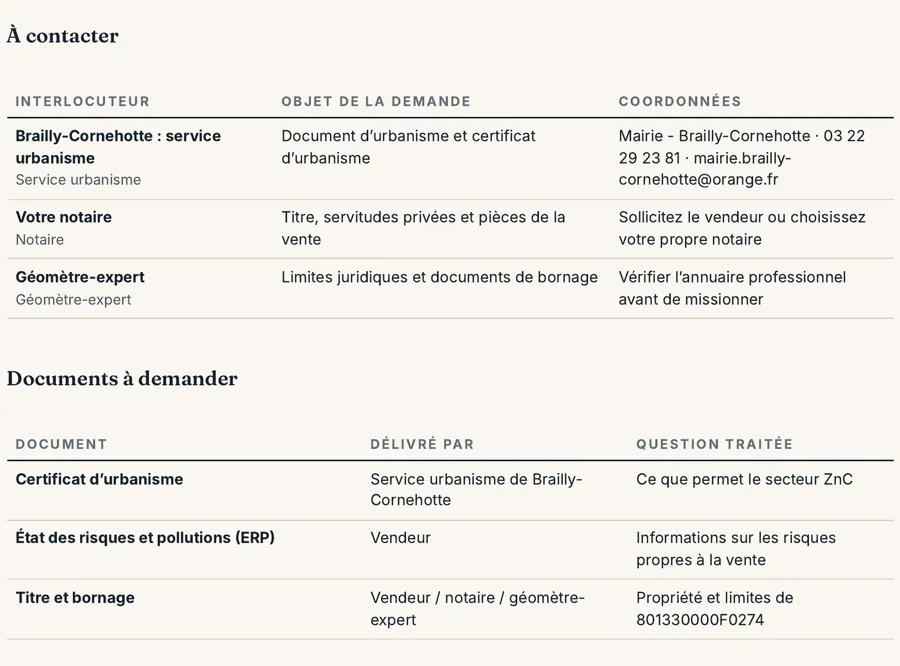
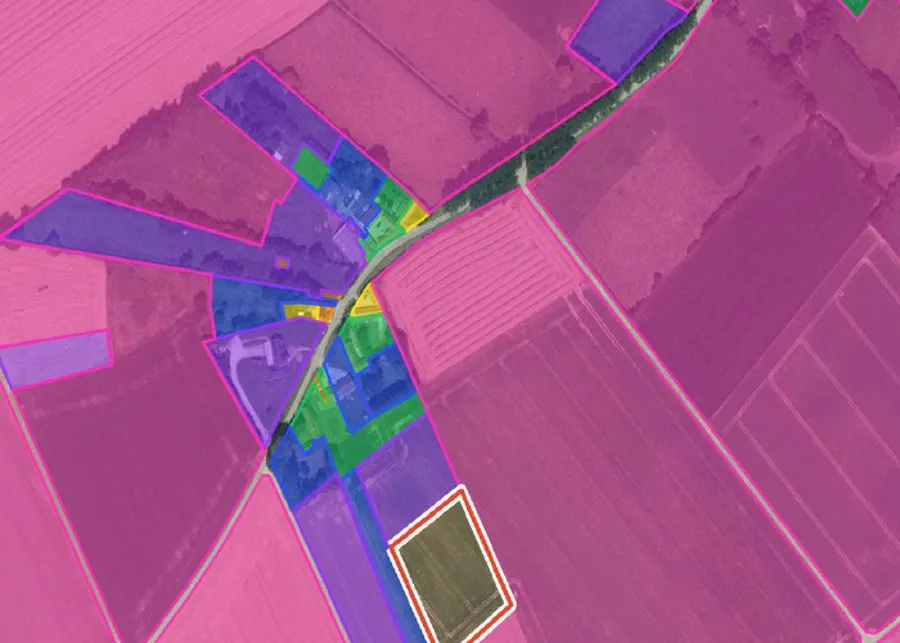
Before you write to the town hall, see what the parcel allows
Pick the parcel on the map. The report sets out its zone in the PLU or carte communale, natural hazards, clay soils and Natura 2000, each with its source and date and explained in English. It does not say who owns the land or whether it is in the public domain. Free check, PDF report for €29 (€39 in French and English).