Pillar: Buying building land in France
VAT on building land in France: total price, margin scheme or transfer duties
In mainland France, building land sold by a private owner carries no VAT: you pay transfer duties instead, 6.3185% of the price in the Somme at 1 June 2026 (less, under conditions, for a first-time buyer of a main home). If the seller is a business such as a developer, the price includes 20% VAT, either on the total price with duties cut to about 0.715%, or on the margin only with standard duties. Before you make an offer, ask in writing who is selling and under which scheme.
In brief
- The seller’s status decides. A private owner selling their land, even divided into lots, is presumed not to be in business, unless they actively market land like a trader.
- VAT on the total price (20%) when the taxable seller could deduct VAT on its own purchase, or the margin scheme cannot apply: transfer duty is then cut to 0.70%, plus a collection charge of 2.14% of that duty, with no local surcharge.
- VAT on the margin when the taxable seller bought the land without a right to deduct, as unbuilt land (conditions disputed, see below): standard transfer duties come on top, on the price net of VAT if the deed shows the VAT separately.
- Standard duties: a département (county-level authority) rate of 3.80% to 5.00% at 1 June 2026, plus 2.37% of that amount and a 1.20% surcharge. The increase above 4.50% does not apply, under conditions, to a first-time buyer purchasing their future main home (definition and exceptions below).
On this page
Private seller or taxable business: who charges VAT
French VAT (TVA) applies to a sale of building land only when the seller is a taxable person acting as such: someone carrying on an economic activity independently (French Tax Code, code général des impôts or CGI, art. 256 A).
A private owner who sells land received by inheritance or gift, or bought for private use, is presumed not to be in business. Dividing the land into lots before selling does not change that on its own, and neither do the number of plots or how long the sales take. See also selling part of a plot.
The presumption is rebutted when the owner actively markets land: buying outside ordinary management of personal assets, using the means of a professional (a sales office, guaranteed commission to an agent) or spending significant sums on site works. Selling through a notaire (the public official who draws up the deed) or an agent paid only by commission from the buyer does not count.
A commune (municipality) or other local authority charges VAT when the sale is part of an economic operation, for instance plots it bought and laid out for resale. It sells without VAT when it is simply managing its own property.
Sources: BOFiP: who is a taxable person for property supplies (BOI-TVA-IMM-10-10-10-10). Accessed 13 November 2026.
What counts as building land
For VAT, building land (terrain à bâtir) is land “on which construction may be authorised” under a local plan (plan local d’urbanisme, PLU), another planning document in its place, a carte communale (simplified local map) or article L. 111-3 of the Planning Code, which covers communes with no plan. To check a parcel: is my land buildable?
Other land, farmland or natural land for example, is supplied exempt from VAT (CGI art. 261(5)(1°)), even by a business, unless the seller opts to charge it. Without VAT, the sale bears standard transfer duties.
Sources: French Tax Code (CGI), art. 257 (building land), Legifrance; CGI, art. 261(5) (exempt supplies), Legifrance. Accessed 13 November 2026.
Total price, margin or duties: the three cases
| Seller | VAT | Transfer duties | Base for duties |
|---|---|---|---|
| Private owner managing own assets | None | Standard | Price paid |
| Business, other cases (e.g. purchase with right to deduct) | 20% of the net price | 0.70% + 2.14% charge | Net price if VAT shown separately |
| Business, purchase without right to deduct, as unbuilt land | 20% of the margin | Standard | Net price if VAT shown separately |
| Business, land that is not building land | Exempt unless the seller opts in | Standard without the option | Price paid |
Standard duties: see the worked example. If the deed does not show VAT separately, duties are charged on the price including VAT. Sources: CGI, art. 1594 F quinquies (0.70% rate), Legifrance; CGI, art. 1594 D (département rate), Legifrance; BOFiP: base of the duties, price net of VAT (BOI-ENR-DMTOI-10-10-20-20). Accessed 13 November 2026.
How VAT on the margin is worked out
The margin is the price paid by the buyer minus what the seller paid to acquire the land, including the transfer duties it paid. The margin is treated as VAT-inclusive: divide by 1.20 to get the taxable base, then apply 20%. For one lot, the purchase price is as a general rule apportioned by area; a different price for parts of the land is allowed where their features justify it, provided the total does not exceed what the land actually cost (BOFiP, § 300). A nil or negative margin gives a base of zero.
The margin scheme covers land resold in the same category: it does not apply to land bought with a building on it that the seller then demolished. If the seller cannot prove where the land came from, VAT is charged on the total price.
Sources: CJEU, 30 September 2021, Icade Promotion, C-299/20 (EUR-Lex); Assemblée nationale: written question no. 42486, answer published on 1 February 2022. Accessed 13 November 2026.
Worked example: €100,000 paid to the seller in the Somme
Suppose you pay €100,000 to the seller for a plot in the Somme, where the rate voted by the département is 5.00% at 1 June 2026, with the VAT shown separately in the deed. The figures are indicative, before rounding, and leave out the notaire’s own fees (see notary fees on land).
- Private seller. No VAT. Duties: 5.00% × 100,000 = €5,000; collection charge 2.37% × 5,000 = €118.50; surcharge 1.20% × 100,000 = €1,200. Total €6,318.50, which is 6.3185% of the price.
- Developer (lotisseur), VAT on the total price. Net price 100,000 / 1.20 = €83,333.33; VAT €16,666.67. Duty 0.70% × 83,333.33 = €583.33, plus the 2.14% charge (€12.48): €595.82. No surcharge.
- Developer, VAT on the margin. It paid €40,000 for the area of the lot, duties included. Margin €60,000; base 60,000 / 1.20 = €50,000; VAT €10,000. Net price €90,000. Standard duties on €90,000: 4,500 + 106.65 + 1,080 = €5,686.65.
In case C, if the deed does not show VAT separately, duties are charged on €100,000: €6,318.50 instead of €5,686.65, so €631.85 more. Where the département stayed at 4.50%, the overall standard rate is 5.80665%; in the Indre (3.80%) it is 5.09006%.
The rate above 4.50% does not apply if the property is your first home within the meaning of the tax guidance and will be your main residence; there is no income test (BOFiP, § 106 to 109).
- Who counts as a first-time buyer. Someone who, in the two years before the purchase, neither owned their main home nor acquired its property rights under a bail réel solidaire (a social shared-ownership lease). Only full ownership counts: a buyer who held only the usufruct or the bare ownership of their main home is still a first-time buyer when buying full ownership.
- Exceptions. The buyer or one of the people living in the home as their main residence holds a disability card, receives certain disability pensions or benefits, or was the victim of a disaster that made their main home permanently uninhabitable.
- Joint buyers, non-residents. For joint buyers the test depends on co-ownership or the marriage regime. For a buyer living abroad, only ownership in France counts.
Ask the notaire whether a plot bought to build that home qualifies. The 0.70% rate is not affected by the increase.
Sources: BOFiP: transfer duties, standard regime (BOI-ENR-DMTOI-10-20). Accessed 13 November 2026.
What the contract and the deed should say
- Before you make an offer, ask the seller. Ask the seller or agent in writing whether they are selling as a private owner or as a business, and whether the advertised price includes VAT. Cost: nothing. Time: no deadline in the texts cited; a reply within a few days (TerrainCheck estimate).
- In the compromis (binding preliminary contract), read the price clause. A price stated without further detail is treated as VAT-inclusive. VAT added on top of the price must be expressly agreed. Have the scheme (total price or margin) and the VAT amount written in. Other clauses: the preliminary sale agreement.
- Before completion, ask the notaire for the cost statement. Check the duty rate applied (0.70% or standard) and that the draft deed shows VAT separately. Cost: the duties themselves, worked out above. Time: no deadline in the texts cited.
- At completion, keep evidence of the VAT. The 0.70% rate depends on the VAT being paid or its payment being evidenced (CGI, annex II, art. 251): keep the deed and the cost statement. Time: on the day of signing.
Sources: BOFiP: transfer duties on sales subject to VAT (BOI-ENR-DMTOI-10-40); BOFiP: VAT rates in Corsica (BOI-TVA-GEO-10-10); CGI, art. 294 (French Guiana and Mayotte), Legifrance; BOFiP: ruling on moving VAT into the CIBS on 1 January 2027 (BOI-RES-TVA-000253). Accessed 13 November 2026.
In the report: land sales around parcel F 274
Before you sign: six VAT checks
- You know who the seller is: private owner, company, developer, commune.
- The listing price and the contract price say whether VAT is included.
- The VAT scheme is written down: total price, margin, or no VAT.
- Margin scheme: the base and the VAT amount appear in the deed.
- The notaire’s cost statement uses the right duty rate (0.70% or standard).
- Deed signed from 1 January 2027: scheme confirmed under the new code.
Read next: notary fees on land, signing the final deed and the checks before the compromis.
Common questions
Is the price of a plot on a new estate VAT-inclusive?
Yes, if the deed or contract states the price without further detail: it is then treated as including tax. The parties can agree that VAT comes on top, but the contract has to say so.
Does a private owner selling several plots have to charge VAT?
Not just because the land is divided or because there are several lots. VAT applies if the owner actively markets land: buying outside ordinary management of personal assets, using a professional’s means, or spending significant sums on site works.
Why pay transfer duties when VAT is already in the price?
Under the margin scheme, article 1594 F quinquies rules out the 0.70% rate, so standard duties apply. With VAT on the total price, duty falls to 0.70% plus a 2.14% collection charge.
What changes on 1 January 2027?
VAT rules move from the CGI to the code des impositions sur les biens et services, and earlier official guidance remains binding on the tax authority. For a deed signed from that date, have the notaire confirm the scheme.
Keep reading
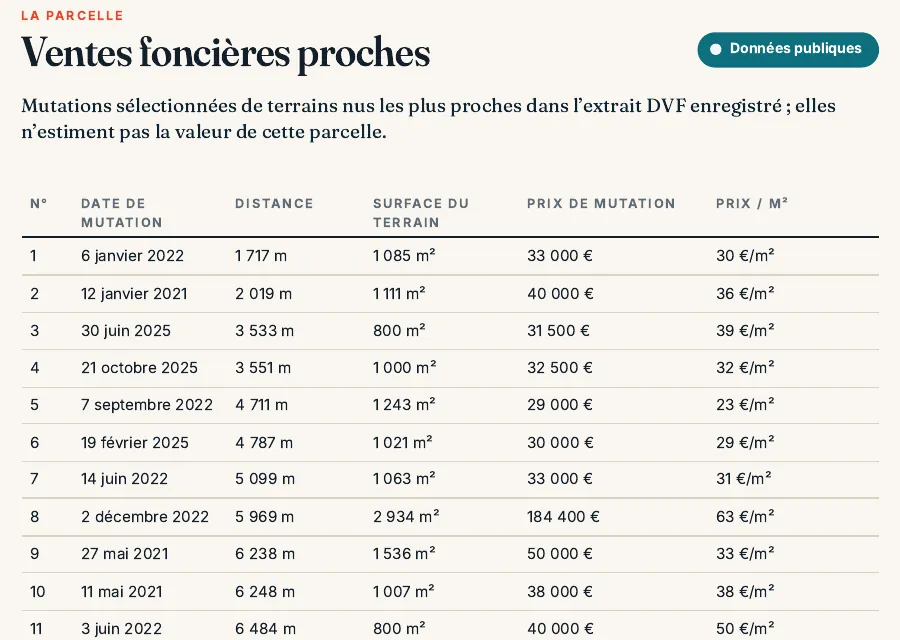
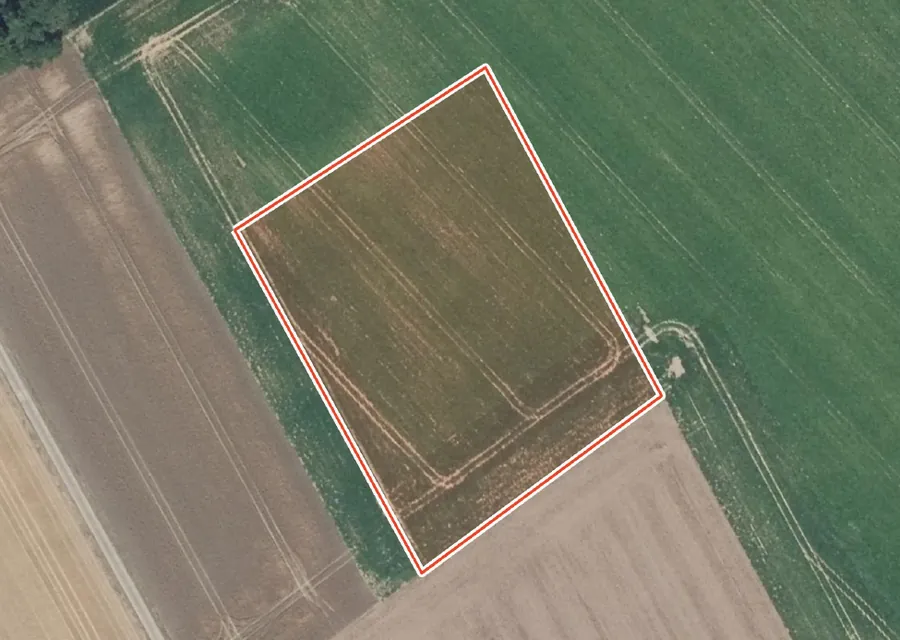
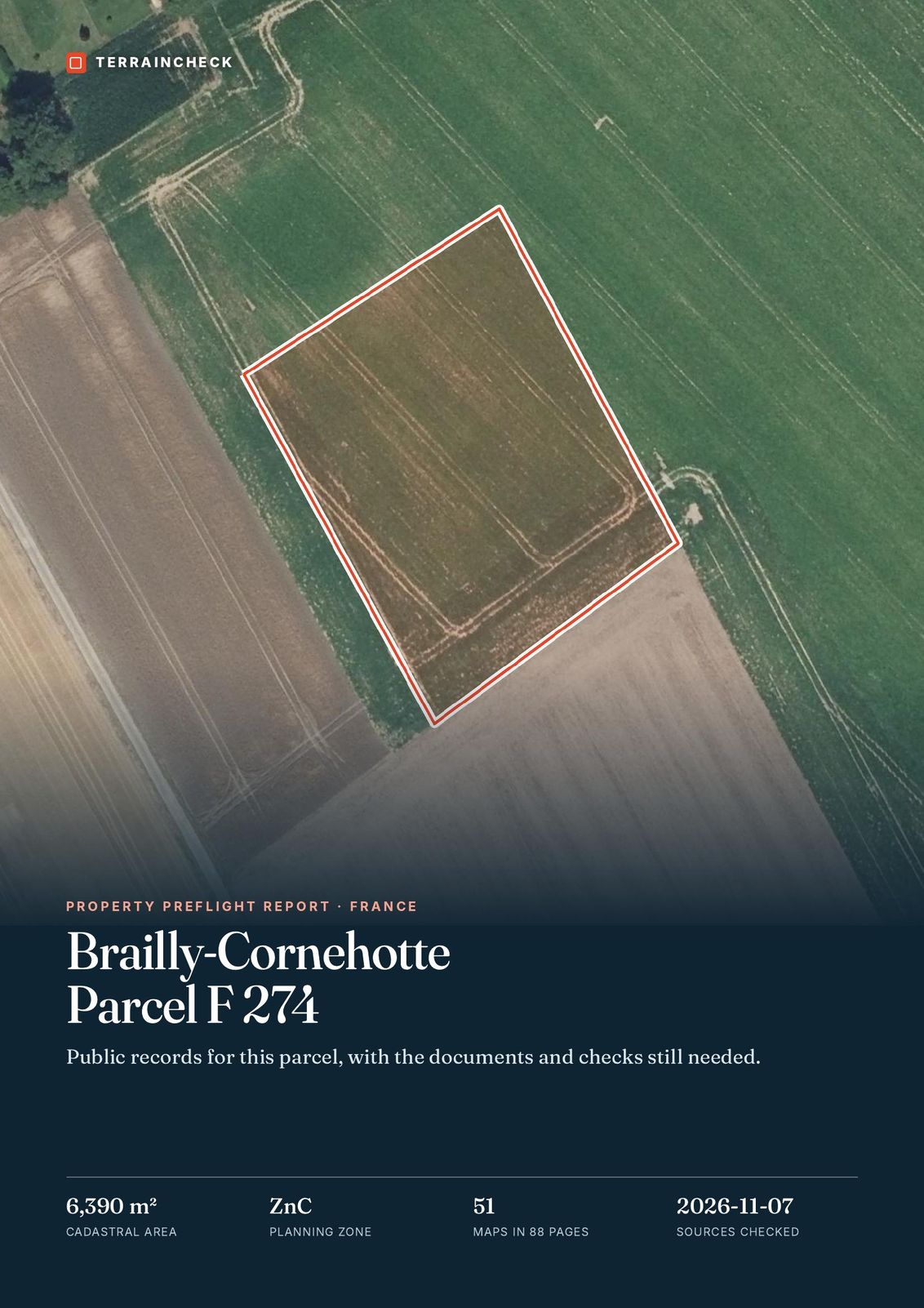
Compare the asking price with land sales nearby
Pick the parcel on the map. The report lists the nearby sales of building land recorded by the French tax authority, then the PLU zone, natural hazards, clay soils and Natura 2000, each with its source and date and explained in English. It does not tell you which VAT scheme the sale will use. Free check, PDF report for €29 (€39 in French and English).