Pillar: Buying building land in France
CCMI building contract and land purchase in France: what to sign first and how you are protected
In France you can sign a CCMI (the regulated contract for building a single-family house to the builder’s plan) before buying the plot, provided you already hold a promise to sell for that land: the land purchase then becomes a condition of the contract, along with the permit and the loans. First step: a promise to sell the land subject to a loan and a permit, then the CCMI, with the final deed for the land signed last.
In brief
- A CCMI (contrat de construction de maison individuelle, the regulated house-building contract) with plan covers a house with no more than two dwellings, built to a plan the builder proposes. It must be in writing and signed before work starts.
- The purchase of the land can only be a condition precedent of the CCMI if you hold a promise to sell (promesse de vente) for that land. The other possible conditions: building permit, loans, building damage insurance, completion guarantee.
- Once the CCMI is signed you have 10 days to withdraw, counted from the day after the registered letter notifying you of the contract is first presented at your address, even if you do not collect it then.
- Before work starts the builder may ask for at most 3% of the price as a security deposit, or 5% at signature and 5% when the permit is granted if a refund guarantee is attached.
On this page
What a CCMI with plan regulates
French law imposes this contract whenever a company builds one or two dwellings for you to a plan it has proposed or had someone propose, whether from a catalogue or through an architect it introduces. The Construction and Housing Code (code de la construction et de l’habitation, CCH) lists what the contract must state and what goes in the annexes. That list is your checklist before you sign.
Three clauses matter most when the land is not yet yours. The contract identifies the plot and states your title or the rights that let you build on it. It describes all the groundworks, including any the geotechnical study calls for, with a copy of that study attached. And it records the building permit, with a copy attached.
| Document | Purpose | What to check |
|---|---|---|
| Description of the land | Places the house on the plot | Address, area, cadastral references; your title deed |
| Agreed price | Fixed and final, completion guarantee included | Any revision clause (BT 01 index) and its limits |
| Work you arrange yourself | What you will do yourself | Described and priced by the builder; your handwritten, initialled clause |
| Notice descriptive | Says what is and is not in the price | Utility connections, earthworks, groundworks |
| Plans and soil study | Fix the house and its foundations | Copy of the geotechnical study attached where required |
| Guarantees | Completion and refund, provided by the builder | Certificates issued by the guarantor, attached |
| Building damage insurance | Pays for repairs before liability is settled | Reference of the policy you take out |
| Timetable | Start date, build time, penalties | Deadline for the conditions to be met |
The documents of a CCMI with plan and what each does (CCH articles L231-2 and L231-4, Service-Public). Sources: Légifrance: Construction and Housing Code, articles L231-1 to L231-13 (CCMI with plan); Service-Public: building your house, which contract to sign. Accessed 13 November 2026.
If you arrange some work yourself (decorating, floor finishes, fencing), the builder must describe and price it. For four months after signing you can still ask the builder to do that work at the prices and terms in the contract.
The order to sign in
The risk is simple: land bought without conditions stays yours even if the permit or the loan for the house is refused. The sequence below keeps each signature dependent on the next. It does not apply as it stands when the builder sells you the plot as well; that case is covered in land tied to a builder.
- Sign a conditional promise to sell the land. Through the notaire (the public notary who handles every French property sale) or the estate agent. Article L231-4 speaks of a promesse de vente without saying whether a privately signed compromis also qualifies, so ask the notaire to confirm that your agreement meets the test. If the agreement states that any of the price will be paid with a mortgage, it is made subject to obtaining that loan for at least one month from signature. Add a planning-permit condition too: see conditions precedent. Time: whatever the agreement sets.
- Sign the CCMI subject to conditions. It lists the conditions chosen and sets the latest date for meeting them, from which the start date on site follows. That deadline must leave time to sign the deed for the land, so it should end after the completion date in your land agreement. Cost now: a security deposit or first payment, both capped (next section). Time: 10 days to withdraw, by recorded-delivery letter to the builder.
- Apply for the building permit. You do not own the land yet, but the application can come from someone who certifies that the owner has authorised the work. The CCMI requires you to state the latest date for filing. Where: the mairie (town hall), in person or by recorded post. Standard processing time: two months for a single-family house, from receipt of a complete file, unless extended (permit processing times).
- Secure the loans, the building damage insurance and the completion guarantee. The builder provides the guarantee, you take out the insurance. Price and turnaround: set by the insurer or guarantor, on quotation.
- Sign the final deed for the land, then let work start. How the signing works: the final deed.
What the builder can ask for, and when
No payment or deposit may be demanded or accepted before the CCMI is signed. After that, the contract uses one of two systems. Either a security deposit of no more than 3%, paid into a special account in your name and frozen until the conditions are met. Or, without that deposit, up to 5% at signature and up to 5% when the permit is granted, provided a refund-guarantee certificate is attached.
Example for an agreed price of €200,000: a deposit of €6,000 at most (200,000 × 3%), or €10,000 at signature and €10,000 at permit (200,000 × 5%). When the foundations are finished, the total called cannot exceed €50,000 (25%).
The last 5%, €10,000, is due at handover, or within eight days of receiving the keys if no professional assists you; if you record snags, it is held by a third party until they are put right. Where the builder makes, fits and assembles prefabricated elements on site, article R231-7-1 sets a different schedule with other stages and caps.
Late-delivery penalties cannot be set below 1/3,000 of the agreed price per day. On €200,000 that is at least €66.67 a day (200,000 ÷ 3,000), or €2,000 for thirty days late.
Sources: Légifrance: Construction and Housing Code, articles L231-1 to L231-13 (CCMI with plan); Légifrance: Construction and Housing Code, articles R231-1 to R231-14 (payments, guarantees, penalties). Accessed 13 November 2026.
Guarantees and insurance: who provides what
The completion guarantee (garantie de livraison) is taken out by the builder, with its certificate attached to the CCMI. From the day work starts it covers you if the work is not carried out at the agreed price and on time: it pays any overrun needed to finish the house and the contractual penalties once the delay exceeds thirty days.
For overruns it may carry an excess of up to 5% of the agreed price, so up to €10,000 left for you to pay on €200,000: read the guarantor’s certificate.
The completion guarantee ends at handover recorded in writing and, where it applies, when the eight days after the keys are handed over have passed, the period an owner not assisted by a professional has to report visible defects by recorded letter (article L231-8). If you listed snags, it runs until they are cleared.
The refund guarantee protects money paid before work starts: it applies if the conditions are not met in time, if work does not start on the agreed date or if you withdraw, and it ends when work starts. The building damage insurance (assurance dommages-ouvrage) is yours to take out, before work starts, and its reference goes in the contract.
Some clauses are treated as never written. For instance, requiring you to let the builder arrange your loans (unless you give an express mandate that sets out the loan terms), or making the refund of your security deposit depend on proof that several loan applications were refused (article L231-3 b).
Sources: Légifrance: Construction and Housing Code, articles L231-1 to L231-13 (CCMI with plan); Légifrance: Construction and Housing Code, articles R231-1 to R231-14 (payments, guarantees, penalties); Légifrance: Insurance Code, article L242-1 (building damage insurance); Service-Public: completion guarantee for a single-family house; Service-Public: building your house, which contract to sign. Accessed 13 November 2026.
The land and the soil study before signing
In areas exposed to clay shrink-swell that are defined by ministerial order, you must pass the geotechnical study to the builder before the contract is made, and the CCMI records that the builder received it. The seller of building land supplies a preliminary study; what it covers and costs: geotechnical studies G1, G2. The CCMI must describe all the groundworks, including those the study makes necessary, so any extra foundation cost is settled before you sign.
Sources: Légifrance: Construction and Housing Code, articles L132-4 to L132-9 (clay soils); Légifrance: Construction and Housing Code, articles L231-1 to L231-13 (CCMI with plan). Accessed 13 November 2026.
In the report: what to look at on the plot
Before you sign the CCMI
- A promise to sell the land is signed, with loan and permit conditions.
- The CCMI deadline for conditions ends after the completion date set for the land.
- The CCMI identifies the plot: address, area, cadastral references.
- Fixed price, notice descriptive, work you arrange yourself priced, with your handwritten clause.
- Completion guarantee certificate read (any excess) and, if you pay before work starts, refund guarantee.
- Deposit of 3% at most into an account in your name, or 5% + 5% with a guarantee attached.
- Late-delivery penalties of at least 1/3,000 of the price per day.
- Geotechnical study passed to the builder if the plot is in a regulated clay zone.
Further reading: unilateral promise or compromis and the checks before buying building land.
Common questions
Can I sign the CCMI before buying the land?
Yes, subject to the purchase of the land, provided you hold a promise to sell for that land. The contract sets the deadline for meeting the conditions; if it passes, the CCMI is void and the money paid is returned.
Can the builder take a down payment before I sign?
No. No payment or deposit may be demanded or accepted before the CCMI is signed. After that, a security deposit is capped at 3% of the price, or payments at 5% on signing and 5% at permit with a refund guarantee.
Who takes out the building damage insurance?
You do, as the client (maître de l’ouvrage), before work starts. The completion guarantee is the builder’s to provide.
Keep reading
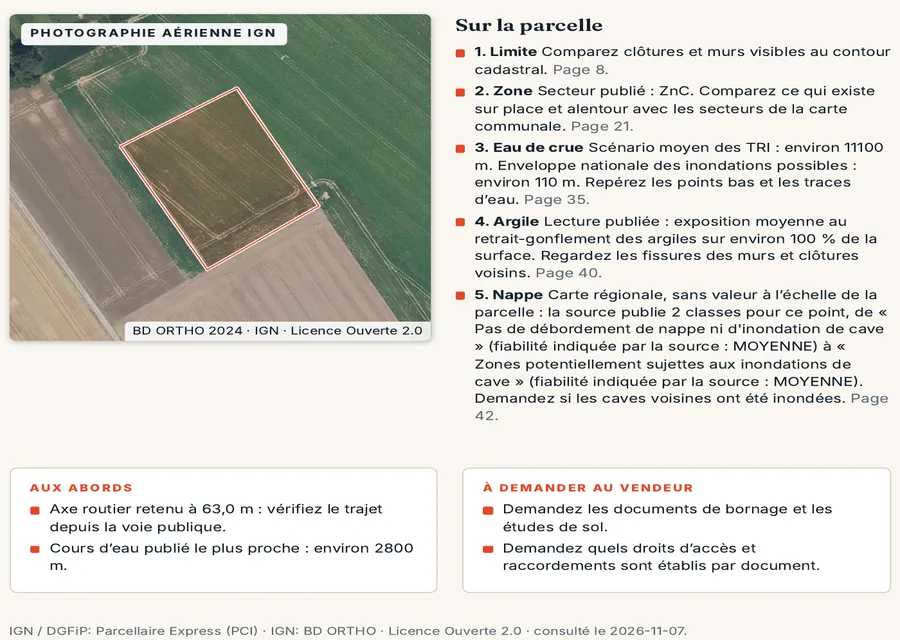
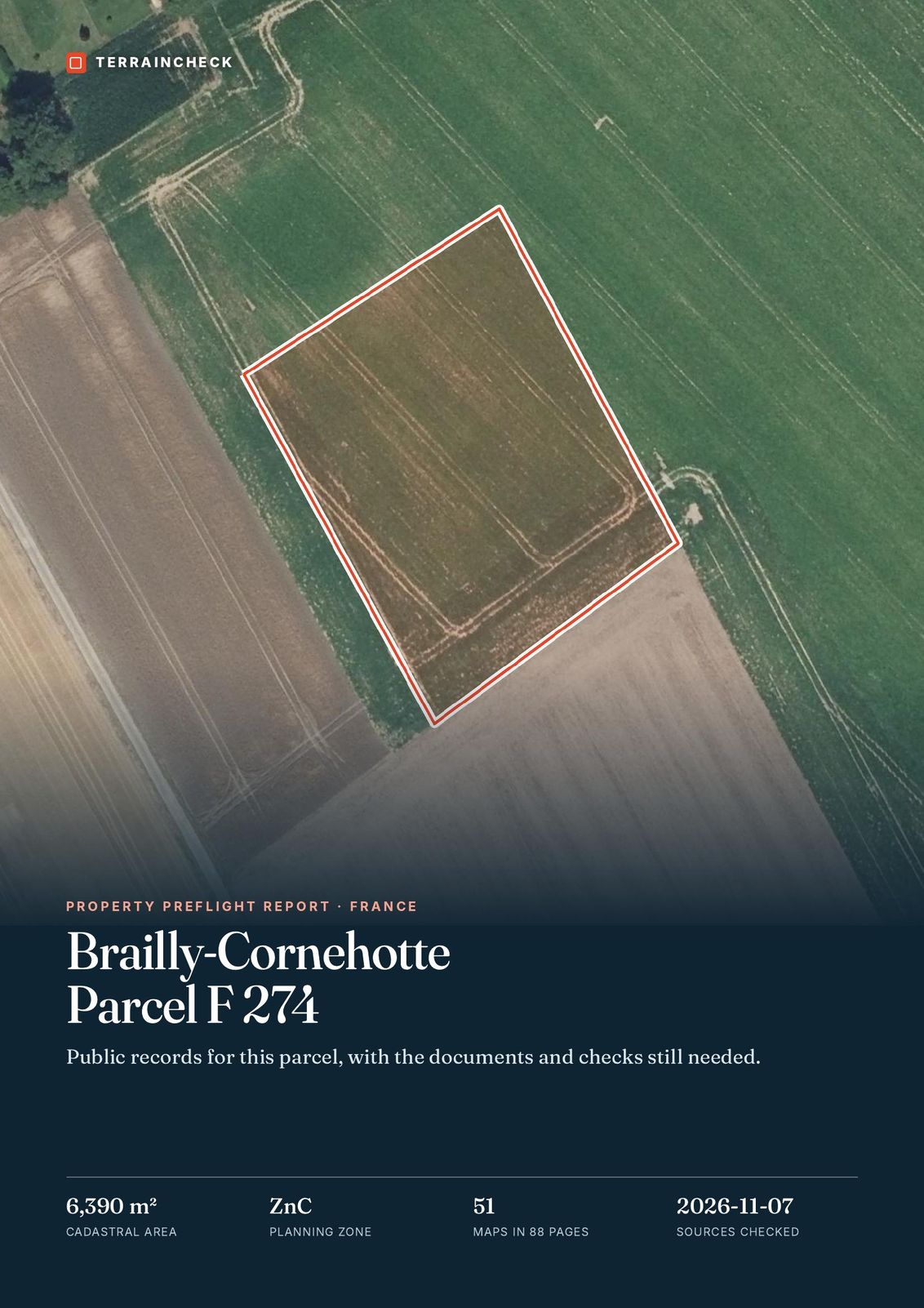
Before you sign a CCMI, see what the public records say about the plot
Pick the parcel on the map. The report brings together the planning zone, natural hazards, clay exposure and Natura 2000, each with its source and date and explained in English, then lists what to check on site. It does not replace the permit or a soil study. Free check, PDF report for €29 (€39 in French and English).