Pillar: Buying building land in France
Road and rail noise classification: what it means for a plot in France
In France the préfet, the State’s representative in each département, grades noisy roads and railways into five categories by order; on each side lies a sector up to 10 to 300 m wide, depending on category, where new homes need façade insulation of at least 30 dB; in the overseas départements this does not apply to categories 4 and 5. First step: open the PLU annex or the préfet’s order and measure the distance from the road or line to the future house.
In brief
- The classification is made by the préfet (the State’s representative in each département) by order. It covers roads carrying over 5,000 vehicles a day, intercity railways with over 50 trains a day, and urban railways and public transport lines on their own reserved track with over 100 trains or buses a day.
- Each classified road or line gets a category from 1 to 5. The noise-affected sector extends up to 10 m (category 5) and up to 300 m (category 1) on each side, measured from the nearest edge of the carriageway or the nearest rail.
- Homes built inside the sector must have façade sound insulation of at least 30 dB, more depending on category and distance. It is the person having the house built who must provide it: the rule targets buildings yet to be built.
- In the overseas départements, the required insulation does not apply to category 4 and 5 roads and lines.
On this page
What the préfet classifies, and on which thresholds
Article L571-10 of the Environment Code requires the préfet to list and classify land transport infrastructure in each département “according to its noise characteristics and traffic”. On that basis, after consulting the communes (municipalities), the préfet maps the sectors affected by noise and the noise levels builders must design for.
Quiet roads are left out. Article R571-33 covers roads whose average traffic exceeds 5,000 vehicles a day, current or forecast in the impact study, intercity railways with more than 50 trains a day, and urban railways and public transport lines on their own reserved track with more than 100 trains or buses a day. A country lane below those figures is not classified, however audible it is.
The category depends on two reference noise levels for that infrastructure alone, measured or calculated: the average from 6 am to 10 pm and the average from 10 pm to 6 am, in dB(A). If day and night point to different categories, the louder one applies. A stretch that is covered over or in a tunnel is not classified.
The classification can change. Any revision follows the same procedure as the original one, with the communes concerned consulted; if they do not reply within three months, their opinion counts as favourable. A commune may also propose its own draft classification to the préfet. A planned road or railway can be classified as soon as the decision opening its public inquiry is published, or once it is shown as a reserved site in the local plan, so a quiet plot today can already sit next to a classified project.
For a buyer from abroad, the practical point is that this is a building rule, not a ban. A plot inside a sector stays buildable if the local plan allows it; the house simply has to be designed with better façade insulation. Give the builder the category and the distance at the outset, so that the quote includes the insulation from the start.
| Category | Day (6 am-10 pm) | Night (10 pm-6 am) | Max. width |
|---|---|---|---|
| Category 1 | > 81 dB(A) | > 76 dB(A) | 300 m |
| Category 2 | 76 to 81 dB(A) | 71 to 76 dB(A) | 250 m |
| Category 3 | 70 to 76 dB(A) | 65 to 71 dB(A) | 100 m |
| Category 4 | 65 to 70 dB(A) | 60 to 65 dB(A) | 30 m |
| Category 5 | 60 to 65 dB(A) | 55 to 60 dB(A) | 10 m |
Roads and high-speed lines. For conventional railways the thresholds are 3 dB(A) higher; the widths are the same. Ranges: above the lower value, up to and including the upper one. Sources: Order of 30 May 1996 as amended, classification and sound insulation; Environment Code, articles R571-32 to R571-43 (classification and insulation). Accessed 13 November 2026.
Is your plot inside a noise-affected sector?
The width is counted on each side: from the nearest edge of the carriageway for a road, from the nearest rail for a railway. The widths in the table are maximums set by the national order; the préfet’s order draws the actual sectors in your commune.
A plot can be only partly inside a sector. What matters is where the house will stand: article R571-43 refers to “buildings to be constructed in the noise sector”. Siting the house further from the road can take it out of the sector, if the local plan and the shape of the plot allow it.
What the classification requires of a new building
In a house or block of flats built inside the sector, living rooms, bedrooms and kitchens must have a minimum level of insulation against outside noise. The level depends on the category of the road or line, the type and height of the building, its distance from the source and, where relevant, what lies between the two.
The order of 30 May 1996 provides a standard calculation (article 6). The client commissioning the building may instead rely, at their own risk, on a more precise assessment of noise at the façade (article 7). Either way, the figure used is never below 30 dB. These rules, as revised in 2013, apply to building permit applications filed since 1 January 2014.
The duty falls on whoever builds, not on the seller of the land. For a buyer it is mostly a budget question: windows, air vents, sometimes the layout of the house. There is no official price scale for the extra cost; ask the builder or architect for a quote that states the category and the distance used.
Strategic noise maps
A separate tool: strategic noise maps, drawn up every 5 years for roads with more than 3 million vehicles a year, railways with more than 30,000 train passages a year, and large urban areas. They describe exposure to noise and feed noise prevention plans. The insulation rule for new homes is tied to the sectors of the noise classification, not to these maps.
Checks before you sign
- Find the préfet’s classification order. It is published in the département’s official gazette (Recueil des actes administratifs) and posted for a month at the mairie (town hall) when adopted. Free. No time limit is set by the texts cited; allow half an hour to read it (TerrainCheck estimate).
- Open the annexes to the PLU (plan local d’urbanisme, the local zoning plan). Where relevant, they include the sector boundaries, the insulation requirements, the reference of the orders and where to consult them. The PLU sent to the State can be read on the Géoportail de l’urbanisme or at the town hall. Free. How to read it: reading the PLU before buying.
- Measure the distance from the nearest carriageway edge or rail to where the house would go, and compare it with the sector width. Free, a few minutes on a plan (TerrainCheck estimate).
- Go and listen. At rush hour and in the evening, on the road side and the garden side. Our land viewing checklist helps. One or two visits (TerrainCheck estimate).
- Get the insulation priced. Give the builder or architect the category, the distance and the order. Price on quotation; timing depends on the firm.
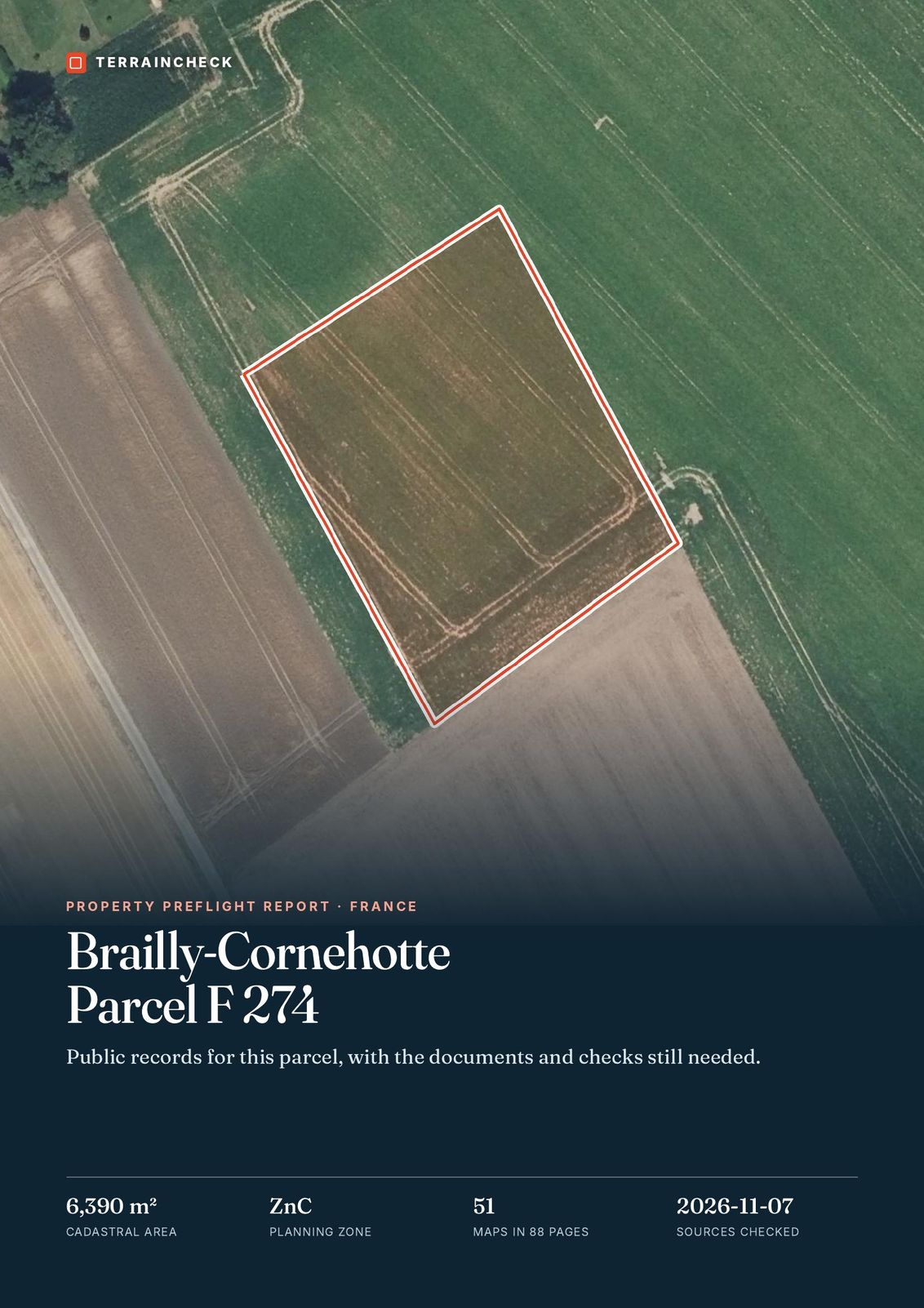
In the report: railways around parcel F 274
Before the compromis: road and rail noise in six checks
- Préfet’s classification order found, with its date.
- Category of every nearby road or railway noted.
- Distance from the road or line to where the house would stand measured.
- PLU annex checked (sectors and insulation requirements).
- Builder’s quote includes the façade insulation.
- Visit made at rush hour and in the evening.
Next: see what a planning certificate can tell you, and go through the checks before the compromis (the binding preliminary contract).
Common questions
Does the seller have to tell me the plot is in a noise-affected sector?
The noise classification rules cited here place no duty on the seller: they address the préfet, the commune for its local plan, and whoever builds. The information is in the préfet’s order and the PLU annexes, which you can check yourself.
Does an existing house near a classified road have to be insulated?
Not under the classification: article R571-43 and the order of 30 May 1996 apply to buildings yet to be built. For an extension or a rebuild, ask the planning department at the town hall.
My commune has no PLU. Does the classification still apply?
Yes. The sector and the insulation requirement come from the préfet’s order; the PLU is only where they are copied. Without a PLU, look the order up in the département’s official gazette or ask the town hall.
What insulation is required 50 m from a category 3 road?
It is calculated under article 6 of the order of 30 May 1996, with corrections for the direction the façade faces and any screening, and never falls below 30 dB. The builder or an acoustic engineer works it out for your project.
Keep reading
Reading the PLU before you buy: zone, rules, easements and pending changes
Viewing land in France before you buy: what to look at and photograph
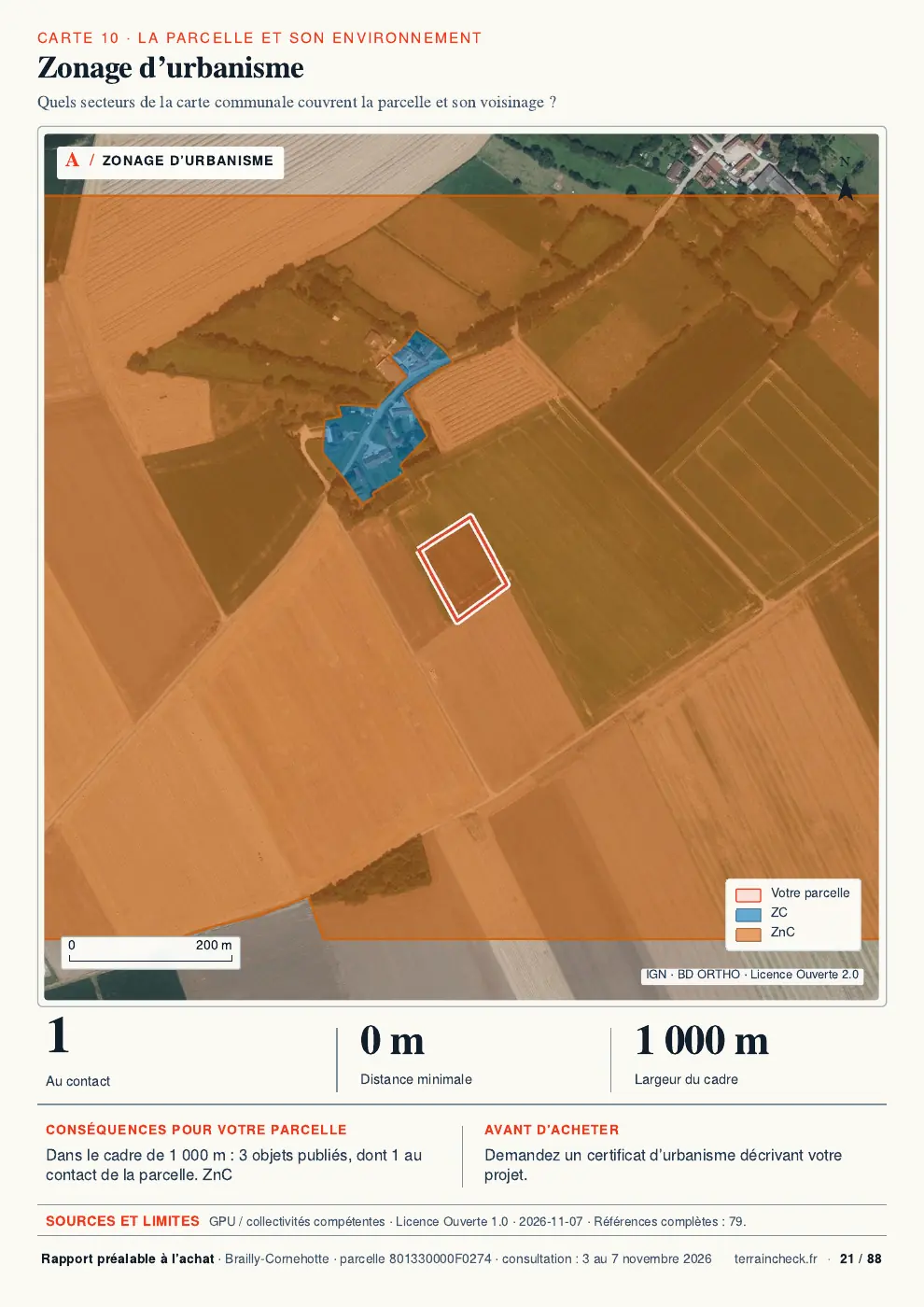
French planning certificates: information or operational CU before buying land
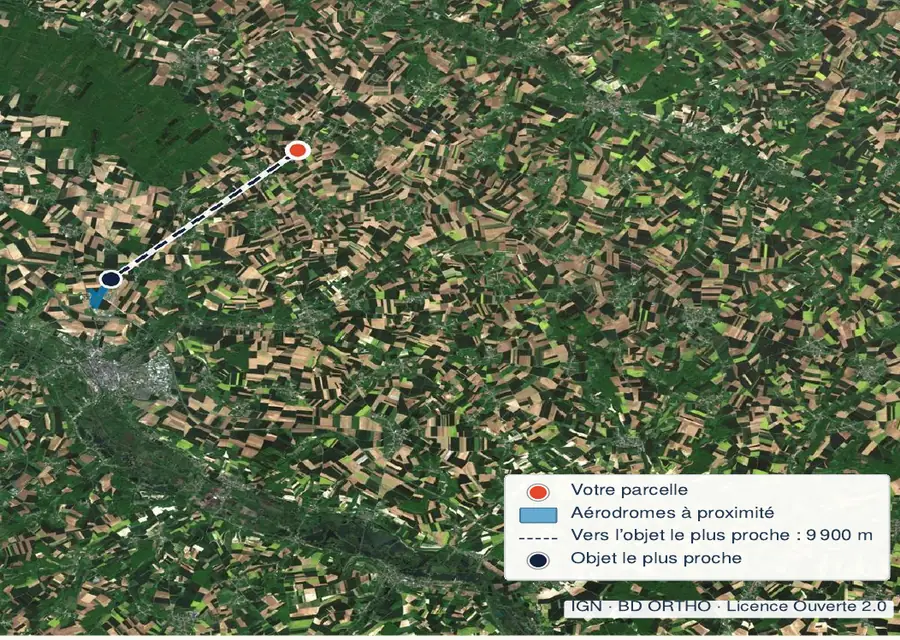
Airport noise exposure plan (PEB) in France: zones A to D, what you can build and what the seller must disclose
A road or railway near the plot? Start by locating it
Pick the parcel on the map. The report measures the distance to published railway lines, then covers the PLU zone, natural hazards, clay soils and recent sales nearby, each with its source and date and explained in English. It does not measure noise and does not replace the préfet’s order. Free check, PDF report for €29 (€39 in French and English).