Pillar: Buying building land in France
Classified sites (ICPE) near a plot in France, farms included: where to find them and what they mean
Classified installations (ICPE), a category that takes in livestock farms and workshops as well as factories, can be looked up free of charge in the Géorisques “Installations classées” database (sites under authorisation and registration; declared ones only if inspected), then at the mairie (town hall) for small farms and pending projects. For building land, check classified cattle, pig and poultry units first: as a rule a new house must stand 100 m from their buildings and annexes, with shorter distances and waivers in the cases the law provides.
In brief
- ICPE (installations classées) are not only factories: the label covers any industrial, farming or craft operation that may cause hazards or nuisance, livestock farms included. Look them up in the Géorisques database (updated 11/11/2026): it holds the sites under authorisation or registration overseen by the Ministry for Ecological Transition; a declared installation only appears if it was inspected before 2022 or has had an inspection with a report since 1 January 2022. The address report only names Seveso sites and those listed under the dangerous-substances headings.
- In 2025 France had 18,370 sites under authorisation, 22,530 under registration and about 450,000 installations under declaration. Seveso status, which is not a fourth regime, covers 1,299 classified establishments, 702 of them upper tier.
- Classified cattle, pig and poultry units: their buildings and annexes must as a rule stand 100 m from third-party homes (50, 25 or 15 m in the cases listed in the orders of 27 December 2013). Under the reciprocity rule, a new house needing a permit must as a rule keep the same distance, subject to the exceptions and the waiver in article L111-3 of the Rural Code, set out below.
- If an installation under authorisation or registration was operated on the plot itself, the seller must tell you in writing, along with any serious hazards or nuisances the seller knows of; a seller who ran the installation must also say whether the activity involved handling or storing chemical or radioactive substances (art. L514-20 of the Environment Code).
On this page
Declaration, registration, authorisation: three regimes, plus Seveso status
An installation classée pour la protection de l’environnement (ICPE) is any industrial, farming or craft operation that may disturb neighbours, harm health or pollute: a livestock unit, a warehouse, a wind turbine, a filling station, an incinerator. The law places it in one of three regimes, declaration, registration or authorisation, according to how serious its hazards or nuisances are. Seveso is not a fourth regime: it is a special status given to some classified establishments.
| Regime or status | Which activities | Procedure and neighbours | What you can find online |
|---|---|---|---|
| Declaration (D) | The least polluting and least hazardous | Online declaration, operation allowed 15 days later; some activities get periodic checks by an approved body | Only if the site was inspected (before 2022, or with a report since 2022) |
| Registration (E) | Standard installations: warehouses, filling stations, poultry units… | Simplified authorisation; public and councils consulted | A record in the Géorisques database, with published inspection reports |
| Authorisation (A) | The greatest hazards and impacts | Environmental authorisation with detailed studies and public consultation; the préfet (the state’s representative in the département) grants it on conditions or refuses it | A record in the Géorisques database, with published inspection reports |
| Seveso status (lower or upper tier), separate from the regime | Classified establishments with a major-accident hazard due to the quantities of dangerous substances | Upper tier: a technological risk prevention plan (PPRT) can restrict building around it | A record, and a mention in the address risk report |
Classification follows the official list of activities (nomenclature), heading by heading: in the Géorisques search, heading 1435 is filling stations, for example. Searching by heading number avoids translating activity names. Sources: Ministry for Ecological Transition: classified installations (ICPE); Environment Code, art. L511-2 (regimes); Ministry for Ecological Transition: Seveso directive and the 2003 Risks Act. Accessed 12 November 2026.
For a buyer, the declaration bar is the one to remember: that regime covers by far the most installations, and it is the category least visible online.
Finding the installations around a plot
- The Géorisques database. Page “Installations classées ou autres sites inspectés”: search by commune (municipality), activity, heading, regime (authorisation, registration, other) and Seveso status; results as a list or on a map. Free, a few minutes per commune.
- Each site’s record. It gives the regime, the Seveso status and, for inspected sites, the inspection reports, which the authorities publish. Read the latest ones.
- The address risk report is not enough. It only lists Seveso sites and those under headings 4xxx (dangerous substances). A livestock unit 300 m away may not appear. See how to read the Géorisques report.
- The mairie. Ask the town hall which farms and workshops it knows of near the plot and about pending projects. When a project goes to a public inquiry (enquête publique), the notice is published at least 15 days before it opens (art. R123-11 of the Environment Code). Free; ask at the counter or in writing, in French.
- The préfecture or the DREAL. For one specific site (file, conditions, complaints), Géorisques points to the département’s préfecture or the regional environment directorate (DREAL). Response times vary.
What a nearby installation means for the plot
Being authorised does not mean being harmless: an installation is classified precisely because running it may cause hazards or nuisance (art. L511-2 of the Environment Code). Noise, smells, dust and lorry traffic are judged on site, at different times of day.
Livestock units: the 100 m rule works both ways
Three ministerial orders dated 27 December 2013, one per regime, set siting distances for classified cattle, pig and poultry units. The general case: livestock buildings and their annexes stand at least 100 m from homes or premises usually occupied by third parties, from sports grounds and approved campsites, and from areas zoned for housing in the local planning document. Homes of farm staff and former farmers do not count. The distance therefore runs from the building or annex nearest the house, not from the middle of the farm. Annexes include straw and fodder stores, silos and equipment for storing effluent, but not outdoor runs.
- 50 m under all three regimes: mobile poultry houses moved at least 100 m for each flock; outdoor pig units; aviaries stocked at no more than 0.75 animal-equivalent per m².
- Units under declaration only: two separate reductions are possible. To 50 m for a cattle building on deep litter; to 25 m for an installation in a designated mountain area (art. R113-14 of the Rural Code), a case the order does not limit to cattle.
- 15 m possible under all three regimes for straw and fodder stores, with every precaution against fire.
- The distances can also be increased where no technical solution protects the neighbours and the water.
On an existing farm, the distances only apply to buildings, annexes and runs whose application was filed, or whose significant change was notified to the préfet, after 1 January 2014 (after 2 October 2015 or 7 December 2016 for poultry and some cattle units under registration), unless a building is replaced without enlarging its footprint by more than 10%. An older shed can therefore lawfully stand closer to houses. Farms too small to be classified fall outside these orders: ask the mairie which distance applies.
Article L111-3 of the Rural Code applies the same distance to any new non-farm building or change of use that needs a building permit, extensions of existing buildings excepted. The authority issuing the permit may allow a shorter distance after consulting the chamber of agriculture, except where the PLU (local plan) or a council decision has set specific rules for built-up areas. The waiver by easement, with the agreement of the parties concerned, only covers buildings changing use and the extension of an existing farm building, in the cases the article sets out.
Upper-tier Seveso sites: the PPRT
Around upper-tier Seveso sites, a technological risk prevention plan can ban future building or allow it only on conditions. If the plot lies in the exposure zone of an approved PPRT, the seller must give you a risk statement (état des risques). The ministry counted 386 PPRTs in force in June 2025; ask the mairie whether the commune has one.
What if the installation was on the plot itself?
Where an installation under authorisation or registration was operated on the land being sold, the seller must inform the buyer in writing, together with any serious hazards or nuisances resulting from the operation, so far as the seller knows of them. A seller who was also the operator of the installation must state in writing as well whether the activity involved handling or storing chemical or radioactive substances. The deed of sale records that this was done. If the seller did not, and pollution makes the land unfit for the use stated in the contract, the buyer can, within two years of discovering the pollution, ask for the sale to be cancelled or part of the price refunded. The buyer can also ask for the site to be cleaned up at the seller’s expense, where the cost does not seem out of proportion to the sale price.
Two inventories complete the search and should not be confused. Soil information sectors (SIS) are plots where the state knows of pollution, and a buyer of property in an SIS must be told. The CASIAS map, which absorbed the older BASIAS inventory in November 2021, lists former activities that may have polluted; being listed does not prove pollution. The planning certificate (certificat d’urbanisme) states whether the plot appears in CASIAS.
In our report: the nearest installation
Before the preliminary contract: the classified-sites checklist
- Géorisques database searched for the commune and its neighbours; sites within 1 km listed.
- Records and latest inspection reports read for the nearest sites.
- Mairie asked about declared farms and workshops and any public inquiry under way.
- Livestock building or annex within 100 m: distance measured from the nearest building or annex; applicable distance and any waiver checked with the mairie.
- Plot inside a PPRT perimeter or an SIS: risk statement and written information obtained.
- Former installation on the plot: the seller’s written information (art. L514-20) repeated in the preliminary contract, chemical or radioactive substances included if the seller ran it.
Read next: clay soils and the soil study and the order of checks before the compromis (the preliminary sale contract).
Keep reading
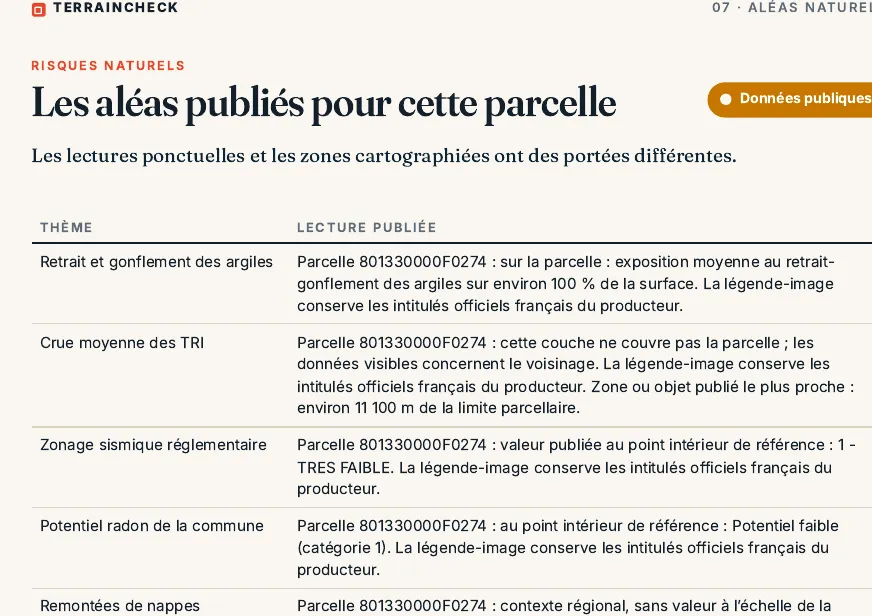
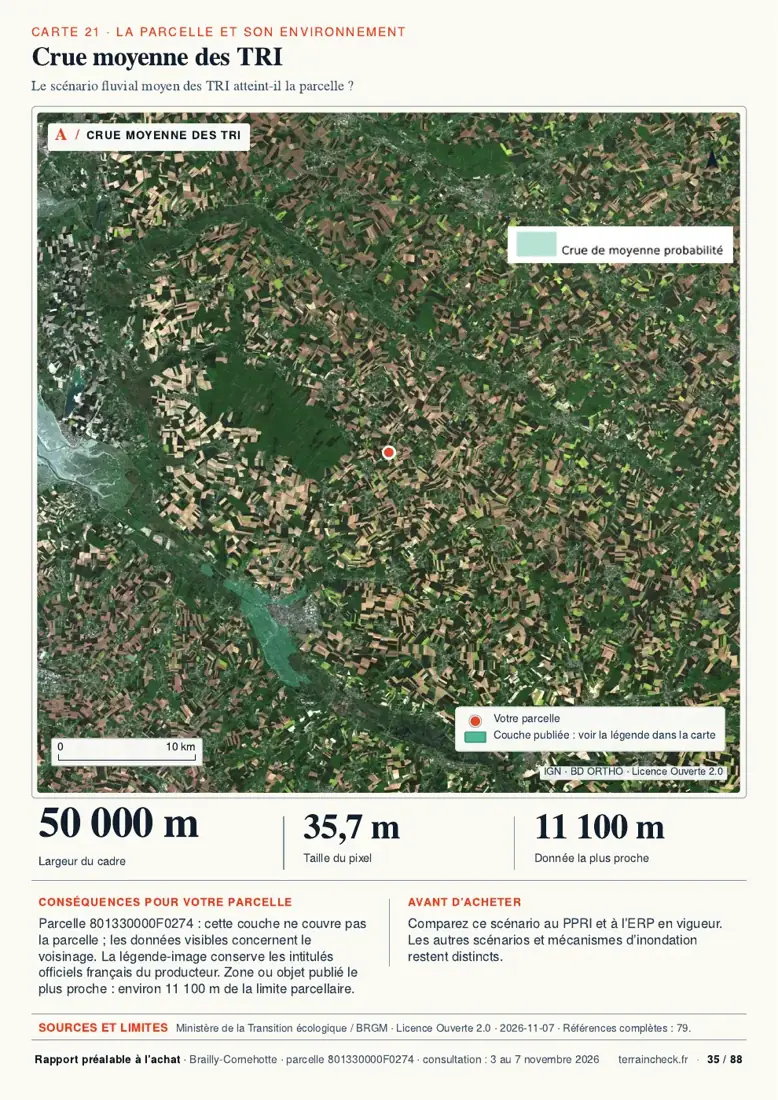
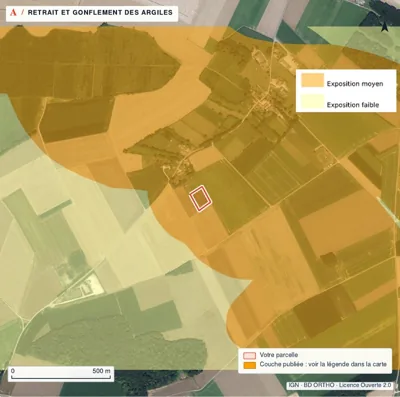
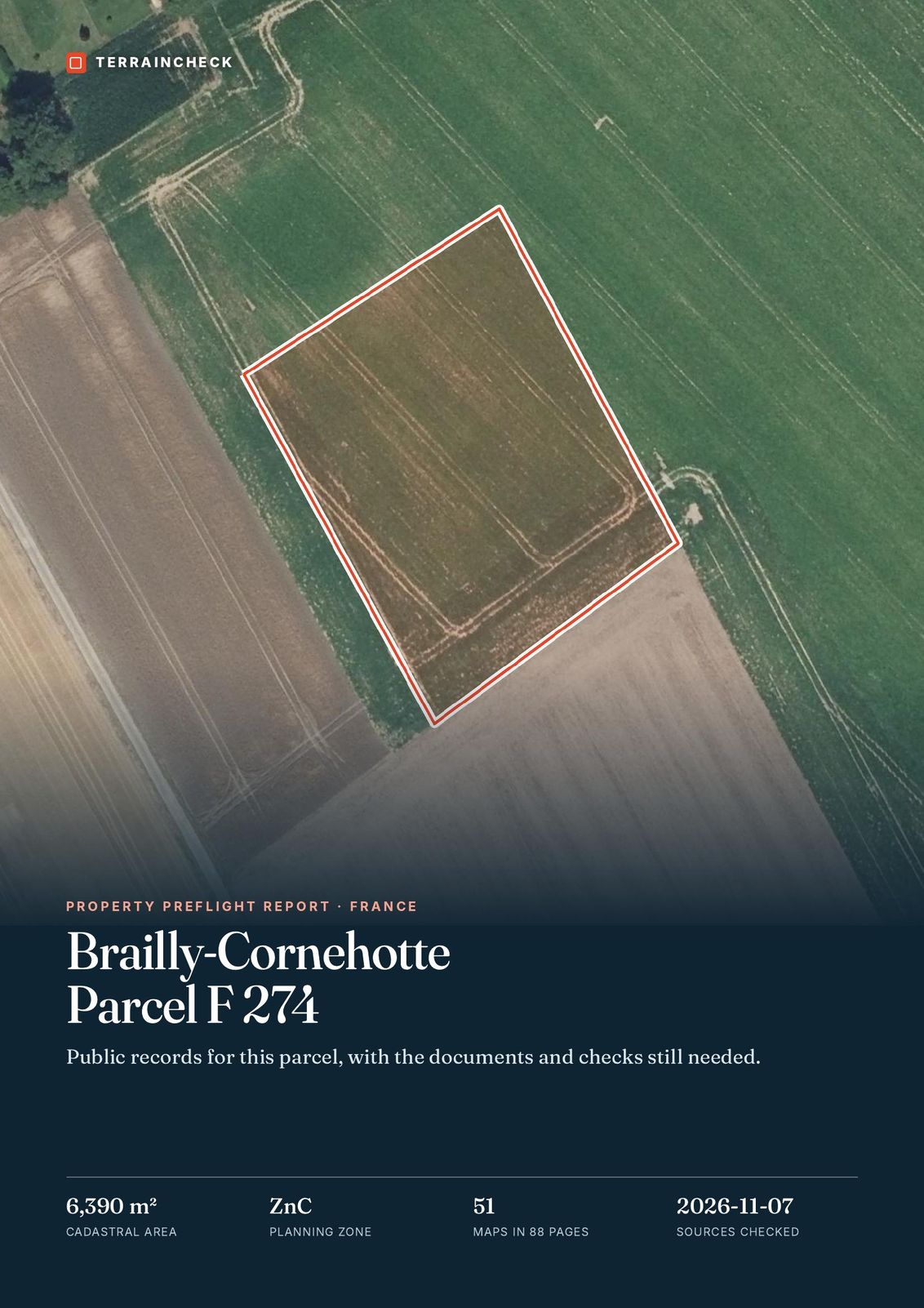
The nearest classified site, measured for your parcel
Select the parcel on the map. The report lists the classified installations, polluted and former industrial sites, natural hazards and planning document that concern it, each with its distance, source and date, explained in English. Free preview, PDF report for €29 (€39 in French and English).