Pillar: Buying building land in France
Radon in France: municipal potential levels and what to do before buying land
In France every commune (municipality) is classed in radon potential zone 1, 2 or 3 by an order of 27 June 2018; you can look the zone up free in a few minutes on the government site Géorisques, from the plot’s address. In zone 3 the seller adds a radon sheet to the risk statement, and for a house you plan to build, State services recommend designing in a ground-to-building seal and ventilation from the start.
In brief
- Zone 3 means significant radon potential: about 7,000 communes (French municipalities) lying at least partly on rocks richer in uranium, such as granite and some volcanic ground. There, the seller must add a radon information sheet to the risk statement.
- French public health law sets a reference level of 300 Bq/m³ as an annual average in buildings. It is not a hard limit: above it, action is recommended.
- A test on bare land does not give the radon level of the future house, and the commune’s class is only a probability. That level is measured inside the house once it is lived in, over at least 2 months of the heating season.
- To build, State services recommend planning from the drawings: a seal between ground and building, good ventilation, a ventilated base.
On this page
What radon is and why it matters
Radon is a natural radioactive gas with no colour or smell, given off by the uranium and radium in rocks. Outdoors it disperses quickly. Indoors it rises from the ground and can build up, especially in the lowest, poorly ventilated rooms.
The International Agency for Research on Cancer has classed it as a proven lung carcinogen since 1987. In France it is the second cause of lung cancer after smoking; the national radiation protection institute (IRSN) put the deaths attributable to it at about 3,000 a year. For the same exposure, a smoker’s risk is about 20 times higher.
The average level in French homes is below 100 Bq/m³ (becquerels per cubic metre of air, the unit used for radon). The differences come from the ground, how airtight the building is, its ventilation and how it is lived in.
Sources: Géorisques: radon; Géorisques: radon information sheet for buyers and tenants (May 2023); Géorisques: expert file on radon. Accessed 12 November 2026.
Zones 1, 2 and 3: what the commune’s class says
Article R1333-29 of the Public Health Code divides France into three zones, defined by how much radon escapes from the soil. An order of 27 June 2018 places every commune in one of them, département by département, in mainland France and overseas.
| Zone | Definition (R1333-29) | Mainland communes | What follows from it |
|---|---|---|---|
| 1 | Low radon potential | 26,744 (74.7%) | No radon sheet in the risk statement: it is only required in zone 3. |
| 2 | Low potential, but geological features (faults, old mine workings) can help radon reach buildings | 2,055 (5.7%) | Radon is included in the official information on major risks (département file, commune document at the town hall). |
| 3 | Significant radon potential | 6,999 (19.6%) | Radon sheet in the risk statement; the same public information; compulsory testing in some buildings open to the public. |
Radon potential zones: definition, share of communes and main legal effects. Sources: Légifrance: Public Health Code, art. R1333-29 (version in force); data.gouv.fr: ASNR, radon potential of communes (radon.csv, 6 May 2019); Légifrance: Environment Code, art. R125-23 (version in force); Légifrance: Environment Code, art. R125-24 (version in force); Géorisques: expert file on radon; Légifrance: Public Health Code, art. R1333-33 (version in force). Accessed 12 November 2026.
The compulsory testing in the last row covers specific establishments only: schools, childcare for under-sixes, health and social care with accommodation, spas and prisons. It applies in zone 3, and in zones 1 and 2 where existing measurements exceed 300 Bq/m³. It is repeated every ten years and after works that significantly change ventilation or airtightness; after two consecutive campaigns below 100 Bq/m³, the ten-year repeat is no longer due until such works (art. R1333-33). These rules cover those establishments, not homes.
The order lists communes as they stood on 1 January 2016. If the commune where the land lies has merged with others since, look for the name of the former commune in its département’s list.
Sources: Légifrance: Public Health Code, art. D1333-32 (version in force); Légifrance: order of 27 June 2018 (radon potential zones). Accessed 12 November 2026.
Finding the zone of a plot: four steps
- Géorisques, by address or by clicking on the map. On georisques.gouv.fr, the government risk site (in French), the risk report states “le potentiel radon est de 1/3” (or 2/3, 3/3) for the commune. Free; a few minutes (TerrainCheck estimate). How to read the whole report: reading a Géorisques report.
- The ASNR map. The page “Connaître le potentiel radon de ma commune” of the national nuclear safety and radiation protection authority (ASNR) gives the same class. For a large commune it points to a finer map drawn by geological formation. Free, instant.
- Merged commune: the order on Légifrance. Look for the former commune in its département. Free; a few minutes (TerrainCheck estimate).
- The seller’s risk statement. The état des risques is handed over at the first viewing and must be less than six months old; it is updated if its content is no longer accurate when the preliminary contract or the deed is signed. In zone 3 it includes the radon sheet. Cost to the buyer: none. More detail: the ERP risk statement.
Sources: Géorisques: risk report, point in Brailly-Cornehotte (12/11/2026); ASNR: radon potential of my commune; Légifrance: Environment Code, art. R125-25 (version in force); Service-Public: risk statement for a sale or let. Accessed 12 November 2026.
What the map tells you about a single plot
The class applies to the whole commune. A commune is in zone 3 if only part of its land sits on formations richer in uranium. For a large commune, the ASNR explains that the class rather expresses the likelihood of a high source somewhere in it, however localised.
The national survey of buildings in mainland France gives orders of magnitude. On category 1 formations, about 20% of buildings exceed 100 Bq/m³ and fewer than 2% exceed 300 Bq/m³. On category 3 formations, over 40% exceed 100 Bq/m³ and over 10% exceed 300 Bq/m³.
Sources: ASNR: radon potential of my commune; Géorisques: expert file on radon. Accessed 12 November 2026.
Building in zone 2 or 3: the recommended measures
For a new house, State services describe three families of protection. They have to be settled at the design stage, because the membrane goes down before the slab is poured. They are recommendations: neither the 2018 order nor articles R1333-28 and R1333-29 turn them into a building requirement.
- A seal between ground and building. A waterproof membrane laid before the slab is poured (DREAL Occitanie gives a ventilated crawl space, a vide sanitaire, as the alternative), sealed pipe and cable entries, and airtight hatches to the crawl space or basement.
- Room ventilation. Air inlets in living rooms and bedrooms, outlets in kitchen and bathrooms, a gap under internal doors, and a separate air supply for any fuel-burning heater.
- A treated base. A ventilated crawl space, or a sub-slab depressurisation system (SDS) that draws radon out from under the slab before it gets in.
Cost: on a quote from the builder or architect; there is no official price list. Ask for these items to be written into the building contract and the plans.
Sources: DREAL Occitanie: sheet 601 “Le radon” (September 2021); Légifrance: Public Health Code, art. R1333-28 (version in force); Légifrance: Public Health Code, art. R1333-29 (version in force). Accessed 12 November 2026.
Once the house is lived in: test, then act on the result
Testing uses passive detectors left for at least 2 months in the heating season, from mid-September to the end of April in mainland France (elsewhere, follow the period given by the laboratory supplying the detectors), in at least two main rooms on the lowest occupied floor, preferably the living room and a bedroom. A detector with its analysis costs a few tens of euros. The accredited laboratory sends its report no more than 2 months after receiving the detectors.
| Result | Official recommendation | Then |
|---|---|---|
| Below 300 Bq/m³ | No specific measures. Air each room for at least 10 minutes a day, maintain the ventilation. | Testing again is advised after energy-saving work. |
| 300 to 1,000 Bq/m³ | Simple steps, no major works: seal cellar doors, pipe entries and cracks, fix the ventilation, reopen crawl-space or cellar vents. | Test again to check the effect. |
| Over 1,000 Bq/m³, or over 300 despite those steps | A survey of the building by a professional, then works: sealing, more air change, treating the base. | Test again after the works. |
Health recommendations of the order of 20 February 2019 for buildings, as set out by Géorisques. Sources: Légifrance: order of 20 February 2019 (radon health advice), annex; Géorisques: expert file on radon; Géorisques: radon information sheet for buyers and tenants (May 2023). Accessed 12 November 2026.
Sources: Géorisques: expert file on radon; Légifrance: Public Health Code, art. R1333-30 (version in force); ASNR: radon potential of my commune. Accessed 12 November 2026.
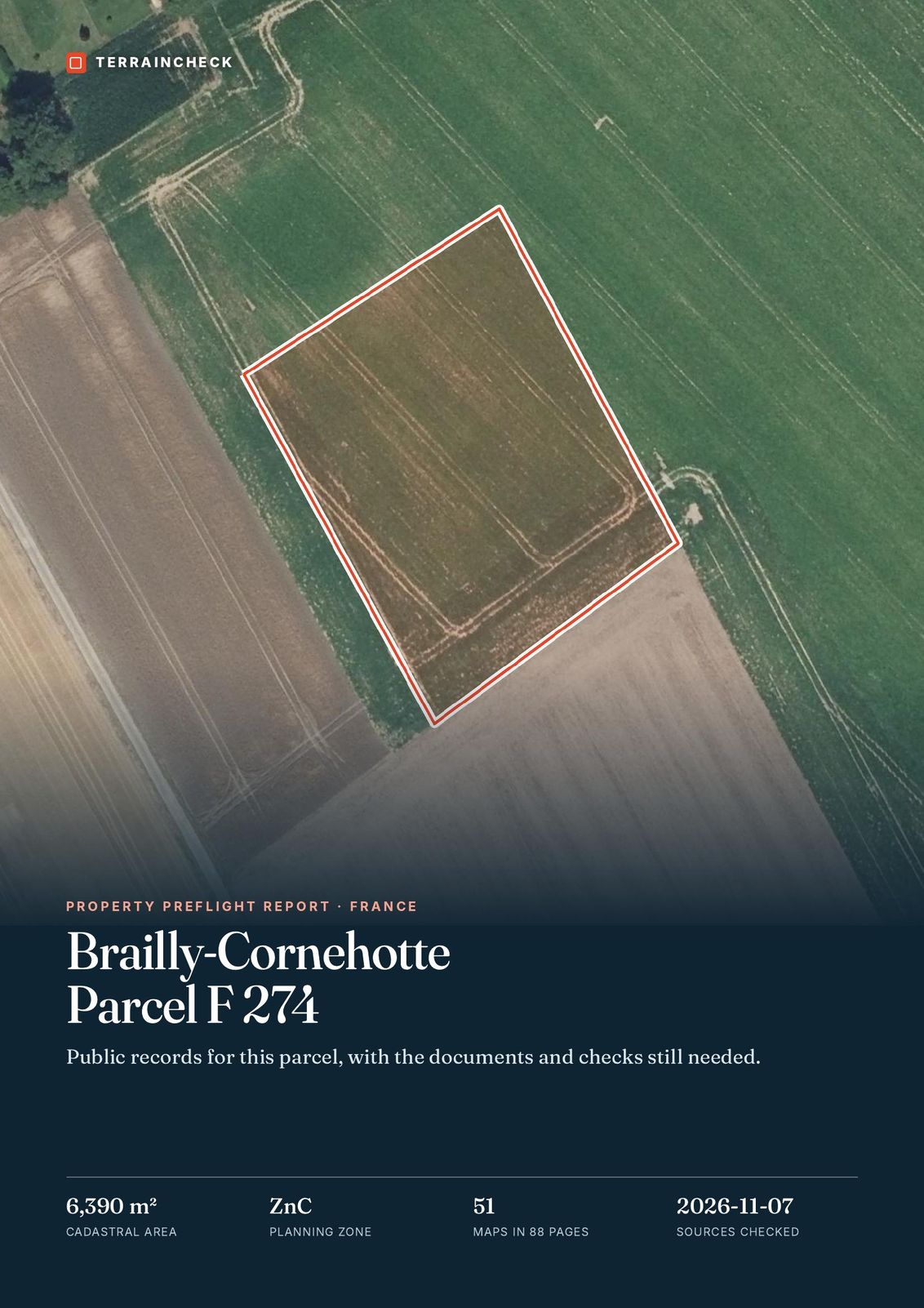
In the report: radon potential for the commune of F 274
Before the compromis: six radon checks
- Zone of the commune noted from Géorisques or the ASNR map (1, 2 or 3).
- Commune merged since 2016: former commune found in the order of 27 June 2018.
- Zone 3: radon sheet included in the risk statement, which is under six months old.
- Large commune: the geological map checked around the plot.
- Building in zone 2 or 3: membrane or ventilated crawl space, sealed service entries and ventilation priced in the quote.
- Existing house on the land: any test results requested from the seller.
Next: the clay hazard on the same plot and the order of checks before the compromis (the binding preliminary contract).
Common questions
Does a test on bare land give the radon level of the future house?
No. According to Géorisques, the level in a building also depends on how it is built and how its occupants live, and the only way to know it is to test inside the home over at least 2 months of the heating season. Before you build, you have the commune’s zone and, for a large commune, the ASNR map by geological formation.
Must the seller of land in zone 2 provide the radon sheet?
No: the radon sheet is only required when the commune is in zone 3 (art. R125-24, 3°). A risk statement may still be required for other reasons, such as a seismic zone from 2 to 5 or a risk prevention plan.
How long does it take to know the radon level of a new house?
At least 2 months of testing in the heating season (mid-September to the end of April in mainland France; elsewhere, the period given by the laboratory), then the analysis: the accredited laboratory must send its report within 2 months of receiving the detectors (art. R1333-30).
Keep reading
France’s risk statement (ERP) for land: what the seller must give you, the six-month rule and what it leaves out
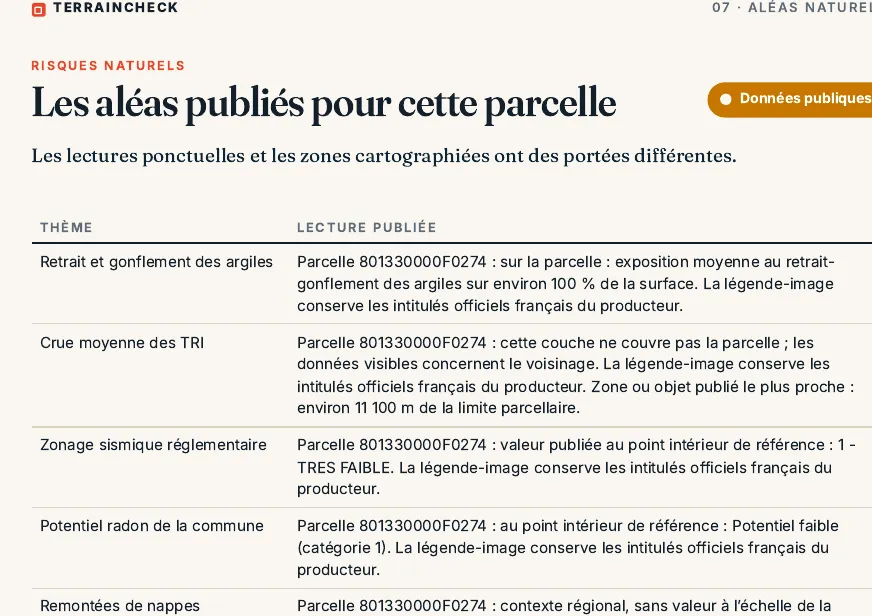
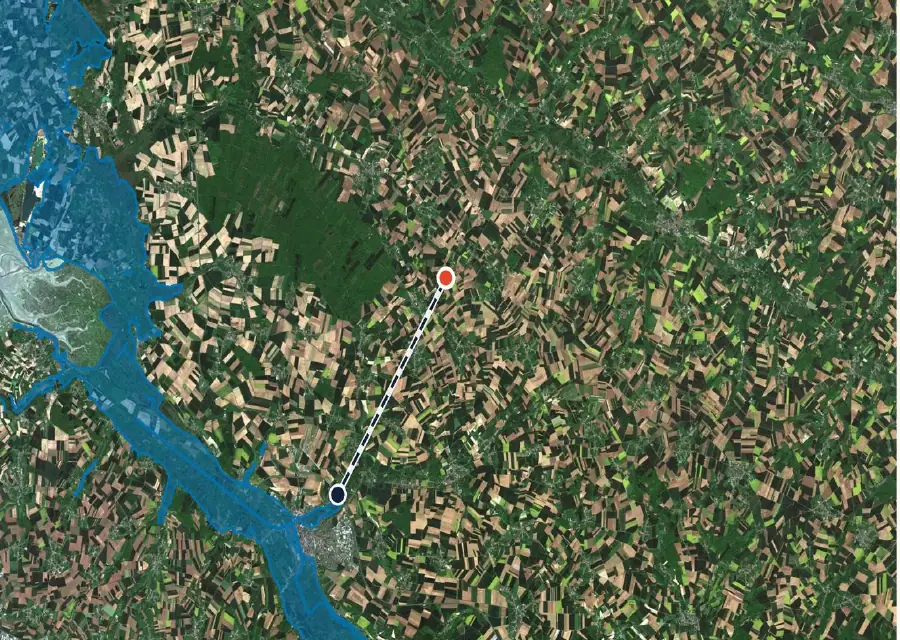
Géorisques: how to read the hazard report for a French plot and what it leaves out
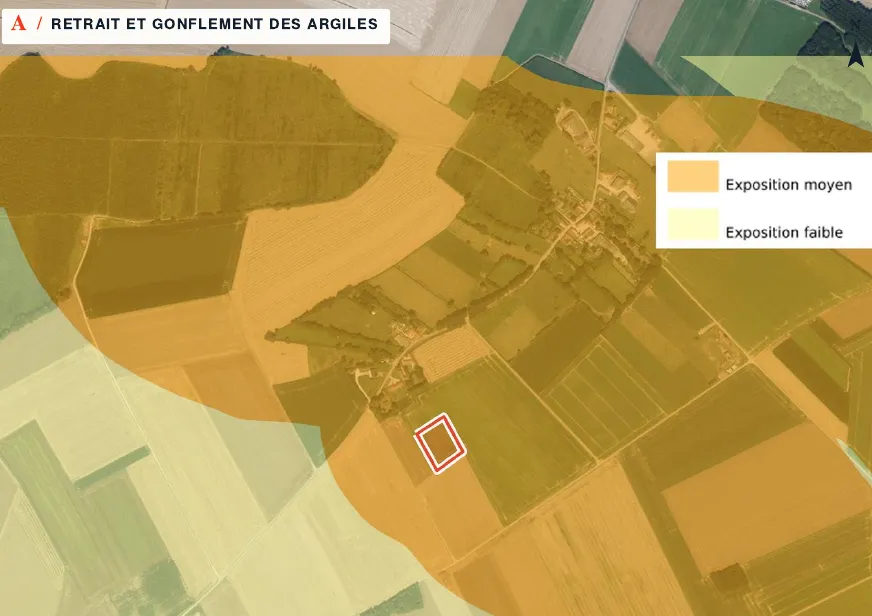
Clay shrink-swell hazard in France: reading the exposure map and what it means for building
See the radon potential alongside the plot’s other hazards
Pick the parcel on the map. The report gives the commune’s radon potential read at the parcel, together with the seismic zone, clay soils, flood areas and polluted sites, each with its source and date, explained in English. It does not measure radon in a building. Free check, PDF report for €29 (€39 in French and English).