Pillar: Buying building land in France
Buying woodland in France: price, pre-emption and management rules
In mainland France, woodland under 4 ha recorded as such in the cadastre can only be sold after the price has been notified to the owners of adjoining woodland and to the mayor, who have 2 months to step in as buyer, save for exceptions set by law. The Safer group puts the 2025 average for woodland without buildings at €4,950 per hectare. First step: get the cadastral class and total area from the seller.
In brief
- Price: the Safer group (the regional land agencies) puts the 2025 average for woodland without buildings at €4,950 per hectare across France, from €2,850 (Massif Central) to €7,880 (Nord-Bassin parisien). These are averages, not valuations.
- Under 4 ha recorded as woodland in the cadastre (the land tax register): owners of adjoining woodland and the commune (municipality) must be told the price and terms before the sale, then have 2 months to step in as buyer, except in the cases listed in article L331-21.
- Clearing (défrichement: ending the land’s use as forest for good, not routine felling) to build, farm or turn the land into pasture needs the prefect’s permission, except where article L342-1 exempts it. In woodland protected by the local plan (espace boisé classé) the application is refused automatically.
- From 20 ha held by one owner, an approved management plan (plan simple de gestion) is compulsory (article L312-1; a region may set a lower threshold between 10 and 20 ha).
On this page
Under 4 ha: neighbours and the commune can buy ahead of you
When the property for sale is recorded in the cadastre as woodland (nature de bois et forêts) and its total area is under 4 hectares, the owners of adjoining wooded parcels, as named in the cadastral records, have a right of preference. The same applies to the sale of undivided shares or rights of use in the property.
In practice your offer becomes the benchmark: the seller notifies it to the neighbours, who may buy at the same price and on the same terms. If several come forward, the seller chooses freely. A sale made without this notice is void; the claim lapses after five years and only the neighbours who should have been notified, or their successors, can bring it.
| Who | Condition | Time limit | Effect |
|---|---|---|---|
| Owners of adjoining woodland | Adjoining wooded parcel | 2 months from notice or posting | Preference; seller picks among several |
| Commune (preference) | Woodland within its boundaries | 2 months from notice to the mayor | Preference; lapses if the sale is not completed within 2 months of its declaration |
| Commune (pre-emption) | It owns adjoining woodland under a document d’aménagement (public forest plan) | 2 months from notice to the mayor | Pre-emption; the neighbours’ preference does not apply |
| The State | A state forest (forêt domaniale) adjoins the parcel | 3 months’ silence = waiver | Pre-emption; overrides the neighbours’ preference and the commune’s pre-emption |
Priority rights on the sale of woodland under 4 ha (Forestry Code, articles L331-19 to L331-24). Pre-emption by the Safer or under the Planning Code comes before the neighbours’ preference. Sources: Forestry Code, article L331-22 (pre-emption by the commune); Forestry Code, article L331-23 (pre-emption by the State); Forestry Code, article L331-24 (commune’s right of preference). Accessed 12 November 2026.
The preference does not apply in the ten cases listed in article L331-21, including a sale to an owner of adjoining woodland, to someone close to the seller (spouse, civil partner, cohabiting partner, relative or in-law up to the fourth degree), or of a property that also includes another asset, built or not. The Safer, whose pre-emption takes priority, has its own rules: see buying agricultural land as a private buyer.
Sources: Forestry Code, article L331-21 (exclusions). Accessed 12 November 2026.
Using the land for something else: clearance permission
French law calls it défrichement (clearance) when any deliberate act destroys the tree cover and ends the land’s use as forest, including indirectly and over time. Felling the trees to build or to farm ends that use.
Unless an exemption applies (below), clearance needs prior permission. The application goes to the prefect of the département, through the departmental directorate for the territories (DDT or DDTM), online or on form cerfa 13632; the forms are in French. Except in special cases, no answer within 2 months of receipt of the complete file means permission is granted. The clock stops if the prefect refers the project for a case-by-case environmental screening; it becomes 4 months if the prefect orders a site inspection, extendable by 3 months. Where clearance is subject to a public inquiry, no answer after 6 months means refusal.
It can be refused, among other reasons, to protect slopes, water, dunes or people against fire, and, save for the exceptions in article L341-6, it is granted subject to one or more conditions. For example: replanting an equivalent area elsewhere, where required multiplied by a factor of 1 to 5, or paying an equivalent sum set by the authorities. In woodland protected by the local plan (espace boisé classé), the application is refused automatically.
Some clearance needs no permission, notably in woodland smaller than a threshold set by the prefect at between 0.5 and 4 ha depending on the département, unless it is part of a larger wood that reaches the threshold, and in an enclosed park or garden of under 10 ha attached to a main home (lower threshold where a building project is involved). The full list is in article L342-1; no exemption applies where a natural hazard prevention plan requires the trees to stay.
Sources: Forestry Code, article L341-3 (clearance permission); Forestry Code, article R341-4 (decision period); Forestry Code, article L342-1 (exempt clearance). Accessed 12 November 2026.
Managing the wood: management plan and felling
Since 12 July 2023, article L312-1 requires an approved management plan (plan simple de gestion) for private woodland of at least 20 ha, in one block or in several parcels of the same owner within an area set by decree, with adjustments allowed for some low-value forests (article L122-5). The minister may set a lower threshold for a region, between 10 and 20 ha. The implementing article R312-6 still refers to 25 ha and leaves out isolated parcels under 4 ha: ask the regional forest owners’ centre (CRPF) whether your holding is caught.
If the wood you buy already has an approved plan, tell the CRPF about the change of owner. If it should have one and does not, no felling is allowed without official permission, except for your own household use (not timber) and emergency felling after damage, reported to the CRPF.
One point for the preliminary contract: in a forest area larger than a threshold set by the prefect, after clear-felling above another prefectoral threshold and without satisfactory natural regeneration, the stand must be renewed within 5 years of the start of the final felling. If the deed does not mention this work and the buyer’s undertaking to pay for it, the seller remains liable to the buyer for its cost.
Sources: Forestry Code, article L312-1 (compulsory management plan); Forestry Code, article L124-6 (restocking after clear-felling). Accessed 12 November 2026.
Prices: what the Safer averages say
Each year the Safer group publishes the average price of woodland without buildings (forêts non bâties): mainly wooded property not intended for development, sold with no building on it. In 2025 the national average was €4,950 per hectare (up 2.5% on a year).
As a rough guide, 3 ha in the Nord-Bassin parisien region come to 3 × 7,880 = €23,640 at the average price. A particular wood is worth what its species, stand, access and area make it. Only a valuation of the wood itself gives its worth, the Safer points out.
Buying woodland in five steps
- Identify the property: cadastral references, land-use class, total area. Where: seller or notaire (the public notary who handles the sale). Cost: nothing. Time: no time limit set in the texts cited.
- Clear the priority rights (woodland under 4 ha). The seller notifies the neighbours and the mayor; if a state forest adjoins, the notaire informs the prefect. Cost: recorded-delivery letters or, from 10 notices, a posting at the town hall and a legal notice. Time: 2 months, 3 for the State.
- Collect the management papers, recent felling and any restocking work still owed. Where: seller, CRPF. Cost: nothing. Time: no time limit set in the texts cited.
- Check any non-forest plan. Read the local plan (PLU) for protected woodland and get clearance before you commit, or make it a condition of the contract. Where: DDT(M). Cost: no filing fee mentioned in the sources cited; compensation possible. Time: 2 months, up to 7 with a site inspection.
- After signing. Woodland under a management plan: tell the CRPF about the new owner. Time: none set by article R312-11.
Overseas: in French Guiana a management plan is only compulsory from 100 ha; in Réunion and Mayotte clearance is banned unless an exemption is granted. In woodland classified as at risk of fire or deemed particularly exposed (articles L132-1 and L133-1 of the Forestry Code), brush-clearing duties come on top near the woods: ask at the mairie (town hall).
Sources: Forestry Code, articles L372-3, L374-1 and L375-4 (French Guiana, Réunion, Mayotte); Forestry Code, article L134-6 (brush-clearing duty). Accessed 12 November 2026.
In the report: the nearest public forest
Before the preliminary contract: six checks
- Cadastral class “woodland” and total area of the property known (4 ha threshold).
- Owners of adjoining woodland, mayor and, if a state forest adjoins, prefect notified and time limits passed, or an exclusion under article L331-21 identified.
- Management plan, code of good practice or standard management rules: copy in hand.
- Recent clear-felling: restocking work and who pays for it written into the deed.
- Building or farming plan: PLU read, no protected woodland, clearance granted or made a condition.
- Access for timber lorries by a track whose right of use is in writing.
Common questions
Can a neighbour buy the wood instead of me after my offer?
Yes, if the property is recorded as woodland in the cadastre, is under 4 ha in total and falls outside the exclusions in article L331-21. The neighbour has 2 months from the notice to declare they will buy at the price and on the terms notified; if several do, the seller chooses freely among them.
Can I build a cabin in the wood I buy?
You need two separate things: land where the local plan or planning rules allow building, and, if trees have to go, clearance permission unless article L342-1 exempts it. In protected woodland (espace boisé classé) a clearance application is refused automatically. See how to check if land is buildable.
Does the “Monichon” relief reduce the cost of buying woodland?
No. Buying costs follow the ordinary rules (see notary fees for bare land). This relief, in article 793 of the General Tax Code, exempts three quarters of inheritance and gift tax on woodland, provided the transfer comes with a certificate from the DDT(M) and the heir or recipient undertakes to apply a sustainable-management guarantee for 30 years (or, if the wood has none, to present one within 3 years).
Is a management plan compulsory for 5 ha?
No, unless those 5 ha add to other woodland of the same owner to reach the threshold in article L312-1 (20 ha, or a regional threshold between 10 and 20 ha). The CRPF can tell you whether your holding is caught.
Keep reading
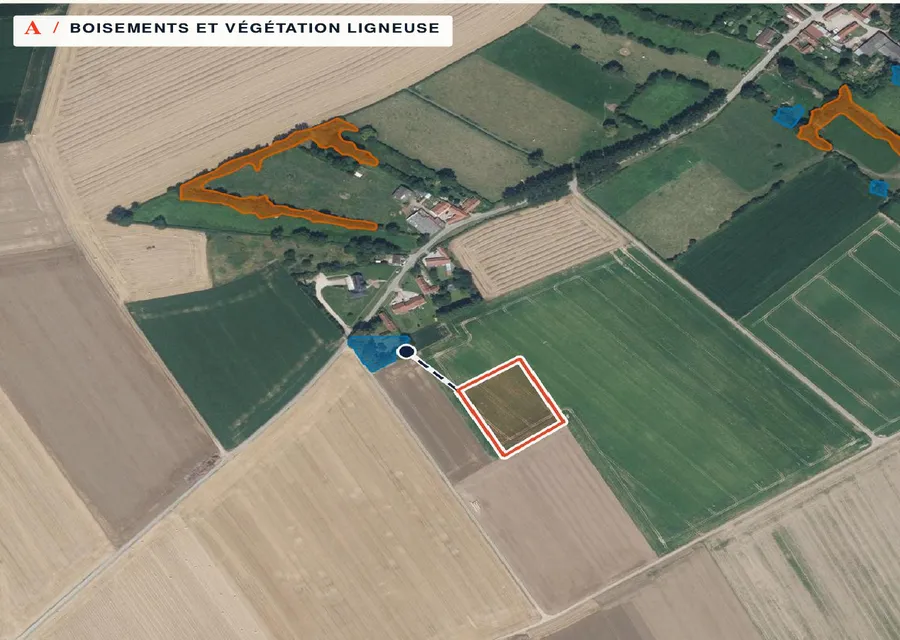
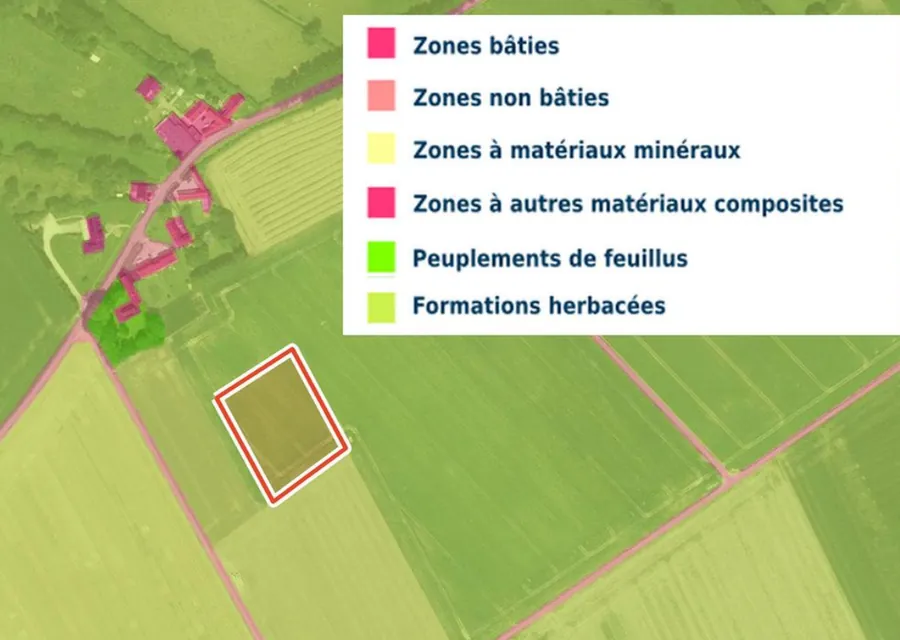
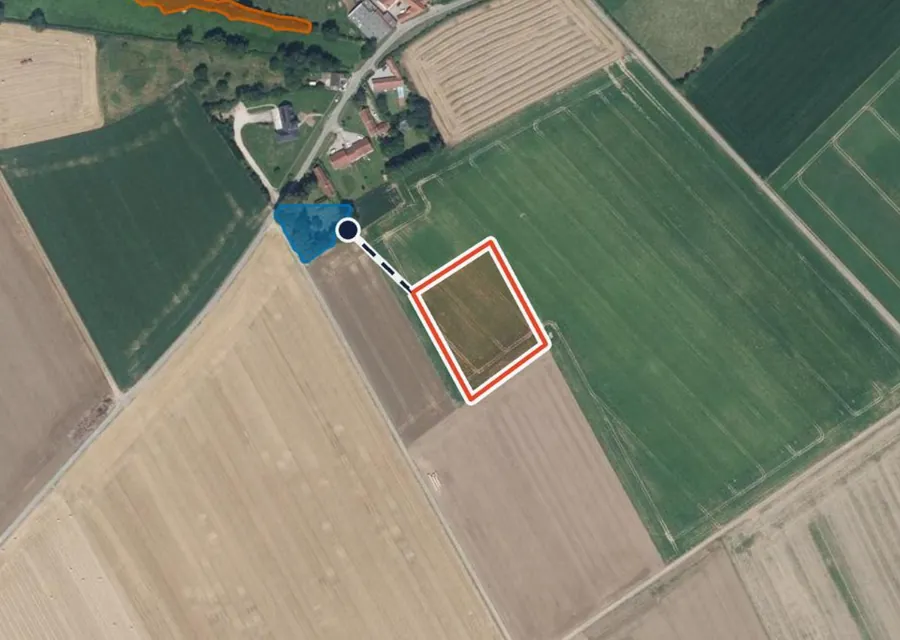
Found a wood you like? See what surrounds it
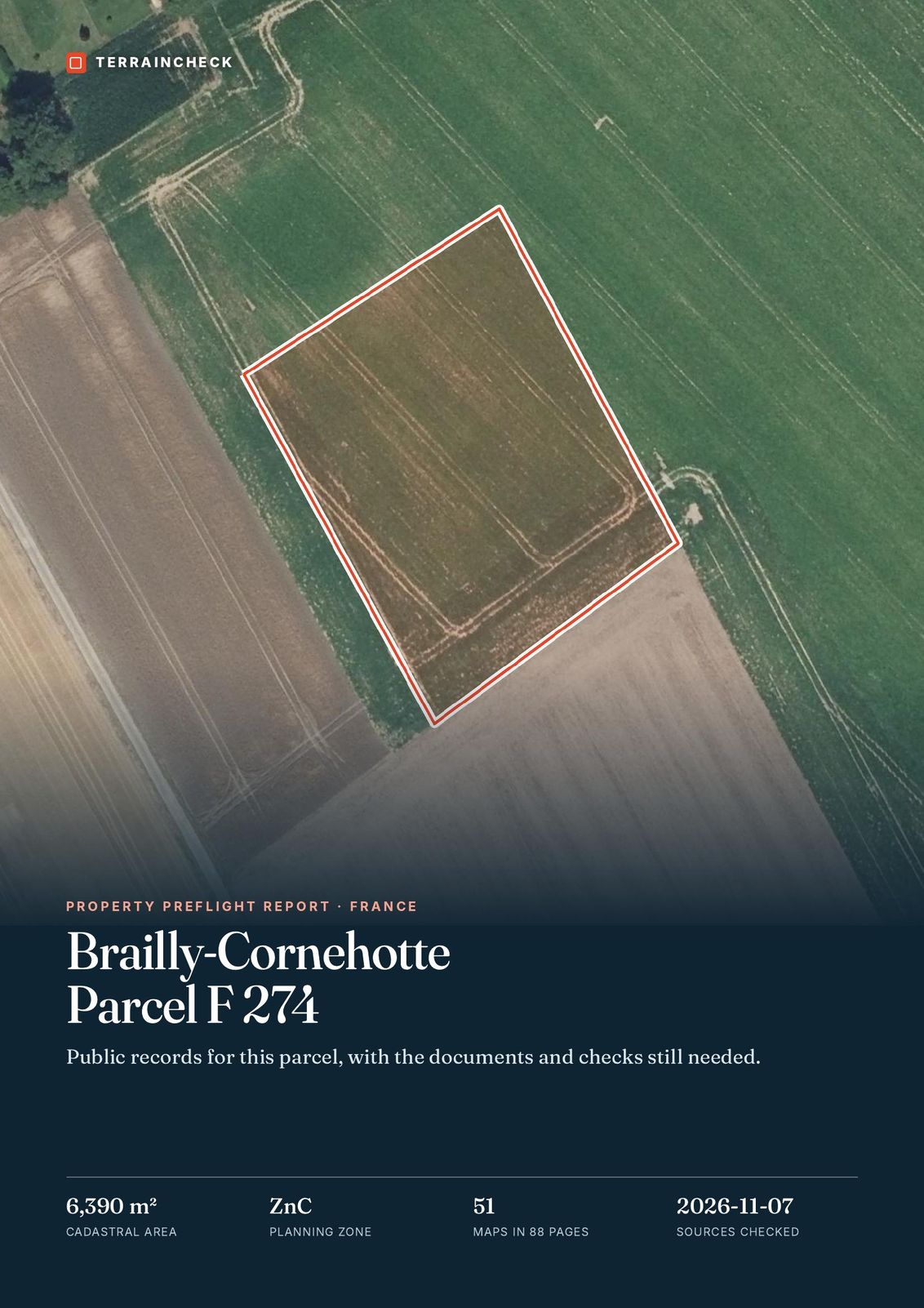
Pick the parcel on the map. The report shows the woodland, hedges and the nearest public forest, then the PLU zone, hazards and recent sales nearby, each with its source and date and explained in English. It does not name the owner or say whether the priority rights have been cleared. Free check, PDF report for €29 (€39 in French and English).