Pillar: Buying building land in France
Mandatory brush clearing for wildfire risk in France: where, how wide, who pays
In the 25 départements (French administrative counties) whose woodland is deemed particularly exposed to fire, and around woodland classed at fire risk elsewhere, the owner of a building less than 200 m from woods must clear brush for 50 m around it, or 100 m where the mayor has decided so. First step: look up the address on the brush-clearing map at cartes.gouv.fr, then ask the mairie (town hall) for the prefectoral order.
In brief
- The duty does not cover all of France: woodland deemed particularly exposed in 25 départements of the south-east, the south-west and Corsica, plus woodland classed at fire risk in listed parts of other départements. Patches under 0.5 ha are left out of the “deemed exposed” category, but woodland classed in annex 1 remains covered.
- Around a building less than 200 m from woods, heath, maquis or garrigue (Mediterranean scrub): clear 50 m, or 100 m if the mayor has decided so. The owner of the building pays, even where the band reaches a neighbour’s land.
- In an urban zone of a PLU (the local zoning plan), within the same 200 m, the whole plot must be cleared by its owner, even with no house on it.
- There is no official price list for the work: get a quote. Ignoring a formal notice can mean an administrative fine of up to €50 per m² subject to the duty and the commune (municipality) doing the work at your expense.
- Since 1 January 2025 the seller of affected property signs a sworn declaration that the duty has been met; it is attached to the preliminary contract and the deed.
On this page
Where the duty applies
In the Forestry Code, débroussaillement (brush clearing) means reducing the vegetation that would feed a fire: breaking up continuous cover, pruning the trees you keep and removing cuttings.
The legal duty, known as the OLD (obligations légales de débroussaillement), applies in two cases. First, woods and forests “deemed particularly exposed” to fire in 25 départements named in article 3 of the ministerial order of 6 February 2024. Second, woodland “classed at fire risk” in annex 1 of the same order, in other départements and often only in part of them.
For this order, woods and forests include plantations, replanted land, heath, maquis and garrigue. Article 4 leaves out of the woodland “deemed particularly exposed” any patch of less than 0.5 hectare in one piece and the lower-risk areas listed in annex 2. The exclusion does not cover woodland classed in annex 1: a small wood left out by article 4 may still be listed there, so read the prefectoral order. In every case, only land less than 200 metres from such woodland is affected.
To see whether a plot falls in an affected zone, open the “Débroussaillement” layer on cartes.gouv.fr and search for the address. The Ministry of Agriculture’s guide says the map is only informative: woodland under 4 hectares may be missing although the duty applies. The binding detail (depth, spacing between trees, pruning height) is in the prefectoral order (arrêté préfectoral) for the département, available at the mairie (town hall) or the préfecture (the State’s office in the département).
Buying the woodland itself? See buying a forest plot.
How wide, and who pays
For land less than 200 metres from woods and forests, article L134-6 of the Forestry Code sets the depth by situation; article L134-8 says who pays.
| Situation (art. L134-6) | What must be cleared | Who pays (art. L134-8) |
|---|---|---|
| Building, building site or installation (1°) | 50 m around it; the mayor can extend this to 100 m | Owner of the building |
| Private access road (2°) | Depth set by the prefect, at most 10 m on each side | Owner of the building |
| Urban zone of a PLU or equivalent plan (3°) | The whole plot | Owner of the plot |
| Urban zone of a commune without a PLU (4°) | 50 m around buildings; the prefect can go further, up to 200 m | Owner of the plot |
| Lotissement (plot subdivision), ZAC (planned development zone), AFU (urban landowners’ association) (5°) | The whole plot | Owner of the plot |
The situations a buyer meets most often. Land under article L444-1 of the Planning Code (6°), campsites and holiday home parks (7°, the site manager pays) and Seveso industrial sites (8°, 100 m from the property boundary) follow their own rules. Sources: French Forestry Code, art. L134-5 to L134-18 (brush clearing), current version. Accessed 13 November 2026.
The 50 metres are measured from the building, not from the plot boundary. A house 10 metres from the boundary can therefore put up to 40 metres of band on the neighbour’s side. Under point 1° alone the band goes beyond 50 metres only where the mayor has extended it to 100 m, the prefect up to 200 m (urban zone without a PLU), or another row of the table covers the whole plot.
The law also requires “keeping the land cleared”: the Ministry for Ecological Transition says to clear every year, and summer work may be banned by prefectoral order.
What the work costs
There is no official scale: you do the work yourself or ask a contractor for a quote (devis), which depends on the area, the growth, the slope and access, and should follow the rules of the prefectoral order.
Clearing on a neighbour’s land
Where the band crosses your boundary, the neighbour cannot object to the work (art. L131-12), though they may do it themselves. If they refuse access, the duty passes to them. The procedure in article R131-14:
- Notify the neighbouring owner and occupier of the duty affecting their land, in a way that proves the date (registered letter with proof of delivery). Cost: postage. Time: a day, TerrainCheck estimate.
- Ask for permission to enter their land to do the work, and remind them that without permission within one month the duty becomes theirs. The ministry publishes a model letter.
- No permission after a month: inform the mayor. Until consent is given, the neighbour is answerable for clearing their own land.
- Permission given: it is valid for three years; keep it in writing, dated.
Where several duties overlap on the same plot, article L131-13 shares them out. According to the ministry, the duty falls first on the owner of the overlapping area if that owner is subject to it too.
Inspections and penalties
The mayor checks compliance. Commissioned officers may enter private land, but not homes; if the owner refuses, a judge can authorise access.
| Measure | Amount or time limit | Article |
|---|---|---|
| Formal notice from the mayor or the prefect | Time limit set by the authority | L135-2 |
| Administrative fine after the formal notice | Up to €50 per m² subject to the duty | L135-2 |
| Daily penalty attached to the notice | Up to €100 a day, €5,000 in total | L134-9 |
| Work done by the commune at your expense | Possible one month after the formal notice | L134-9, R134-5 |
| Minor offence for work not done | 5th class: up to €1,500 | R163-3; Criminal Code 131-13 |
| Criminal offence after an ignored notice | Fine of €50 per m² subject to the duty | L163-5 |
Penalties under the Forestry Code in force on 13 November 2026. Sources: French Forestry Code, art. L135-1 and L135-2 (inspection, formal notice, fine); French Forestry Code, art. L134-5 to L134-18 (brush clearing), current version; French Forestry Code, art. R134-4, R134-5 and D134-7 (prefectoral order, works done by the commune, seller’s declaration); French Forestry Code, art. R163-3 (minor offence); French Criminal Code, art. 131-13 (fines for minor offences); French Forestry Code, art. L163-5 (criminal proceedings). Accessed 13 November 2026.
Worked example. If 800 m² are subject to the duty and the formal notice is ignored: 800 × €50 = €40,000 as the maximum administrative fine. The authority may also impose the daily penalty (€5,000 at most) and, if the commune does the work itself, send you the bill.
What it means when you buy
Since 1 January 2025, article L134-16 makes the sale of land or a building subject to the duty conditional on the duty being met on that land or around that building, “within the limit of the property” on which it stands. Clearing due on a neighbour’s land is not a condition of the sale, but that duty carries on after you buy. The seller signs a sworn declaration that the work has been done in line with the prefectoral order (art. D134-7). It is attached to the preliminary contract and to the final deed signed before the notaire (the public notary who handles the sale).
The seller must also tell you about the duty and any easements. In an affected zone published on Géorisques, the risk statement includes the brush-clearing information sheet. The statement is due at the first viewing.
Checks before the preliminary contract
- Map of affected zones on cartes.gouv.fr, at the plot’s address. Free, about 10 minutes (TerrainCheck estimate). Hatched area or any doubt: ask the mairie.
- Prefectoral order, and any mayor’s decision extending the band to 100 metres: from the mairie or the préfecture. Free. The texts cited set no deadline for the mairie to reply.
- Risk statement with the brush-clearing sheet, handed over at the first viewing, then the sworn declaration attached to the compromis de vente (binding preliminary contract).
- Quote for clearing in the first year if growth is dense. Usually free; timing depends on the contractor.
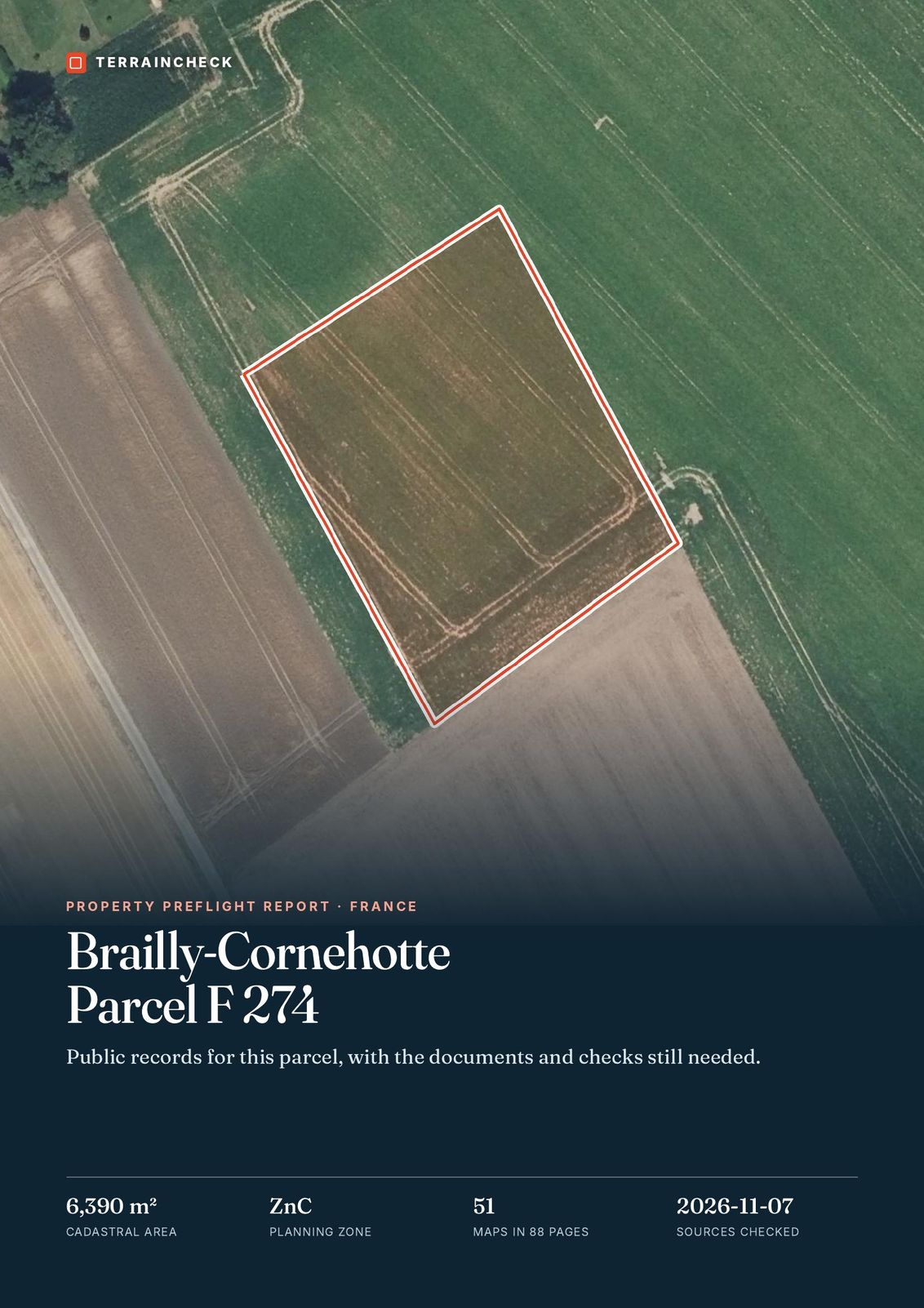
In the report: woodland around F 274
Before you sign: brush clearing
- The département is one of the 25 in the order, or nearby woodland is classed at fire risk.
- Distance from the plot to the nearest woods, heath or garrigue: under 200 m?
- PLU zoning: in an urban zone, the whole plot must be cleared.
- Prefectoral order read; mayor’s decision extending the band to 100 m, if any.
- 50 m band drawn on the plan: how much falls on the neighbour’s side, written consent or not.
- Brush-clearing sheet in the risk statement; seller’s declaration attached to the contract.
- Quote for the first clearance and yearly upkeep.
Next: read the PLU to see whether the plot is in an urban zone, check the Géorisques report for the address and go through the checks before the compromis.
Common questions
I am buying bare land near woodland: do I have to clear it?
It depends on the situation. In an urban zone of a PLU, a lotissement, a ZAC, an urban land association or on land under article L444-1, the whole plot within 200 m of woodland must be cleared, even when bare. Elsewhere, bare land has no 50-metre duty of its own: that duty arises with a building, building site or installation, including the site of your house. It can still lie within the band of a neighbouring house or road, or under a fire-risk prevention plan: ask the mairie.
My neighbour will not let me in: what now?
Write by registered letter. Without permission within one month, the duty on their land becomes theirs (art. R131-14 and L131-12); inform the mayor.
Does the 100-metre band apply everywhere?
No. The basic depth is 50 metres. The mayor can extend it to 100 metres; in urban zones of communes without a PLU, the prefect can go up to 200 metres after consulting the municipal council and the départemental safety commission. Read the orders that apply in the commune.
Can the sale go ahead if the land has not been cleared?
Article L134-16 makes the sale conditional on the duty being met on the land sold or around the building, within the limit of that property, and the seller has to declare it on oath. Clearing owed on a neighbour’s land remains due after the sale. If the growth is dense when you visit, ask for the work to be done before signing and have it written into the preliminary contract.
Keep reading
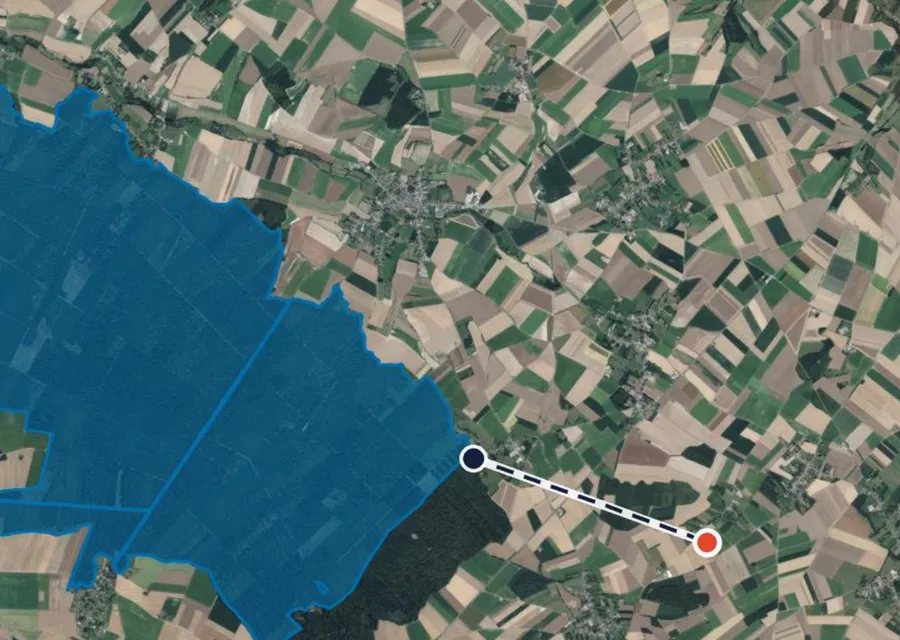
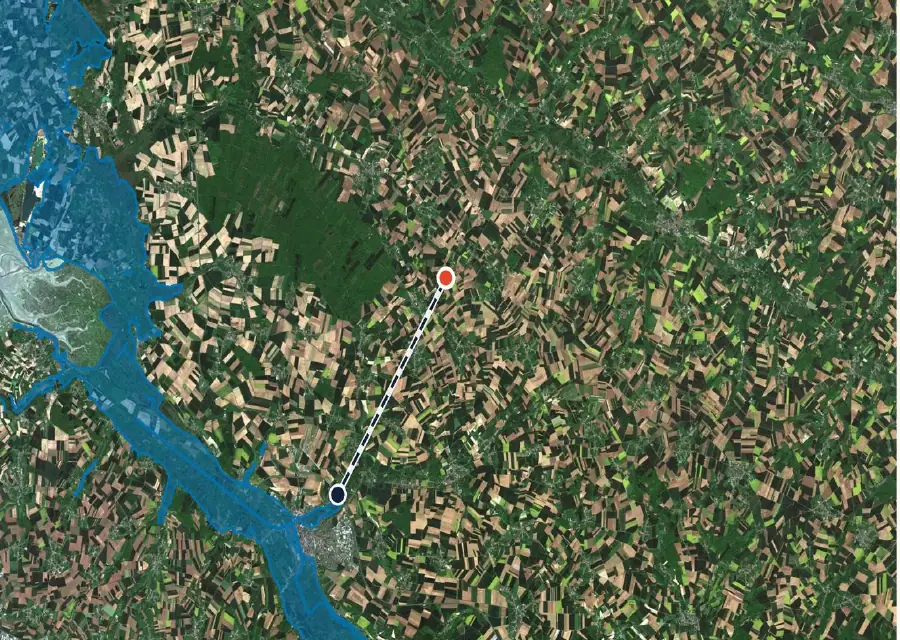
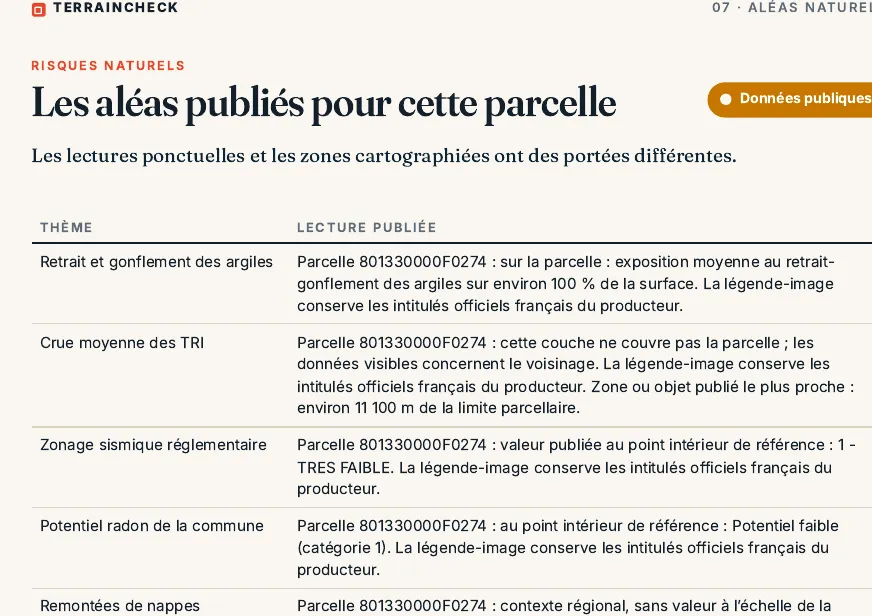
Woodland nearby? Measure the distance before you view
Pick the parcel on the map. The report maps the woods and hedgerows on record around it and measures the distance to the nearest one, then sets out the PLU zone, natural hazards and recent sales nearby, each with its source and date, explained in English. It does not replace the prefectoral order. Free check, PDF report for €29 (€39 in French and English).