Pillar: Buying building land in France
Certificat de numérotage: how a plot in France gets an official address, and how to check it
In France house numbering is up to the maire, the mayor, who sets it by order (General Local Authorities Code, art. L2213-28); the commune must then enter the number in its local address base, published on adresse.data.gouv.fr, within one month of the decision. First step: look the address up on that site; if the plot is not there, write to the mairie (town hall) quoting its cadastral reference.
In brief
- A certificat de numérotage (numbering certificate) is a letter from the mairie, the town hall. We found no national rule setting its form, fee or timescale, and the documentation of the national address base (Base adresse nationale, BAN) points out that the statutes specify no legal value or effect for such certificates: they are for information only.
- Since the “3DS” act of 21 February 2022, the municipal council names every road and lieu-dit (named locality), including private roads open to traffic, and each commune (municipality) makes its road names and house numbers available (General Local Authorities Code, art. L2121-30). The number itself is set by an order of the maire, the mayor (art. L2213-28).
- Utility networks want an address, each on its own terms: Enedis’s connection form for installations up to 36 kVA makes the street number and name and the cadastral reference compulsory; for the internet provider Free, an address given by the mairie is a prerequisite for a fibre connection.
- On 12 November 2026 the BAN held 26,122,489 addresses, 19,581,642 of them certified by the commune (about 75%); 29,030 of 35,011 communes feed it through their own local address base.
On this page
Who gives a plot its address
In France an address is decided at the town hall: the BAN FAQ calls address management a compétence communale, a power of the commune. The maire sets the number: in every commune where it is necessary, house numbering is carried out by order of the maire (General Local Authorities Code, art. L2213-28).
Naming the road has been the municipal council’s job since the 3DS act added it to article L2121-30 (table below). Both articles also apply in Moselle, Bas-Rhin and Haut-Rhin, where local law otherwise differs on some points: they are not among the exceptions listed in articles L2541-1 and L2542-1.
| Text | What it says | What it means for a buyer |
|---|---|---|
| Art. L2213-28 | House numbering by order of the maire, in communes where it is necessary; upkeep of the numbering falls on the owner. | The number comes from a decision of the maire; upkeep of the numbering is then yours. |
| Art. L2121-30 (3DS act) | The council names roads and lieux-dits, including private roads open to traffic; names and numbers are made available. | A private road open to traffic that serves building plots gets its name from the municipal council. |
| Art. R2121-13 (decree of 11 August 2023) | Road names and numbers are supplied to the BAN through a government system; any change is entered by the commune within one month of the decision. | The commune must enter a new number no later than a month after the maire’s order. |
| 3DS act, art. 169 | Replaces “for the first time at the commune’s expense” with “by order of the maire” in L2213-28. | The law no longer says the first numbering is paid for by the commune: ask who supplies the plate. |
Texts in force on 12 November 2026 (General Local Authorities Code unless stated). Sources: General Local Authorities Code, art. L2213-28 (house numbering); General Local Authorities Code, art. L2121-30 (street names, address data); General Local Authorities Code, art. R2121-13 (local address base, one-month deadline); Act no. 2022-217 of 21 February 2022 (the “3DS” act), article 169; General Local Authorities Code, art. L2541-1 and L2542-1 (Moselle, Bas-Rhin, Haut-Rhin). Accessed 12 November 2026.
The certificat de numérotage: what the paper is worth
A certificat de numérotage is a letter from the mairie stating the number and road of a plot or building. The official BAN documentation says so plainly: the statutes specify no legal value or effect for these administrative certificates, which are information documents only.
It is distinct from the certificat d’adressage (addressing certificate), which may be available in the BAN files and online explorer. Its model states that an address is certified in the base on a given date and gives the section and number of the parcel.
Fee and timescale are up to each commune. Ask the mairie (front desk or service urbanisme, the planning department) whether there is a form, whether there is a charge and how long it takes, and keep the answer in writing.
Who will ask you for an address
Each utility sets its own paperwork. For water, sewerage or a publicly run fibre network, ask the local operator for its list before you apply.
| Who | What is asked for | What kind of rule |
|---|---|---|
| Enedis, electricity connection for an individual installation up to 36 kVA | Address of the works: street number and name, postcode and commune, marked compulsory; cadastral reference (section, parcel) marked compulsory; GPS coordinates without an asterisk. | Form Enedis-MOP-RAC_003E of 3 July 2025: fields marked with an asterisk must be filled in for the request to be accepted. |
| Free, fibre connection | A standard postal address given by the mairie and declared in the BAN. | Free’s support page: a “prerequisite” for connection to the network operator’s fibre. |
| Communes (national good practice) | Give a new building its number when the building permit is applied for; a building plot and the entrance to a property should carry a number. | A recommendation of the BAN documentation to communes, not an obligation on you. |
Documents published by each body, read on 12 November 2026. Sources: Enedis: connection request form, individual installation up to 36 kVA (Enedis-MOP-RAC_003E); Free support: getting an address from the mairie; adresse.data.gouv.fr: good practice, what should be numbered. Accessed 12 November 2026.
Checking a plot’s address on adresse.data.gouv.fr
- Search for the address in the listing on adresse.data.gouv.fr. Cost: nothing, no account. Time: a few minutes. Addresses certified by the commune show in green in the explorer; those from a local base still awaiting certification show in grey.
- Look at the linked parcel, where the commune has entered it: the local address base format provides for a link between an address and its parcel. It should match the reference in the compromis, the preliminary sale contract (see reading a cadastral reference and finding the parcel on cadastre.gouv.fr).
- Address missing: the BAN FAQ sends you first to the mairie, which can create or update the address; you can also file a report on the “Mes signalements” platform. The base takes in the published local address bases every day.
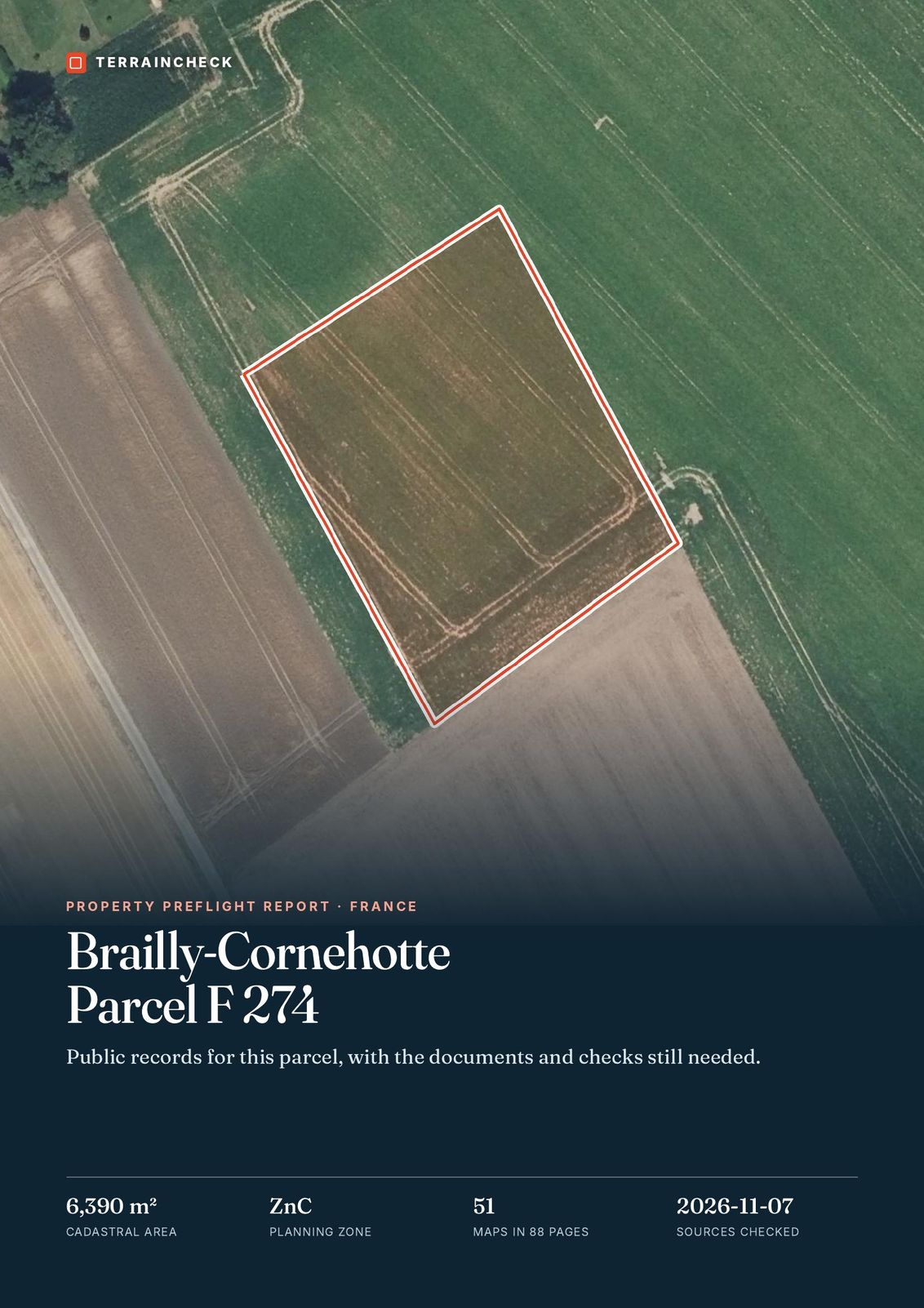
About one commune in six does not feed the base through its own local address base: its addresses come from other sources, and only 72,650 of the 2,854,998 addresses in that group are certified. There, check with the mairie. In Brailly-Cornehotte (Somme), the commune of our sample report, the local base holds 129 numbers on 12 roads, all certified, and none is linked to parcel F 274 (read on 12 November 2026).
Getting a number for a bare plot
- Write to the mairie of the commune where the land lies: cadastral reference, location plan, where the entrance onto the road will be, building permit number if there is one. Fee and timescale: set by the commune.
- The maire sets the number by order (art. L2213-28). If the plot is served by a road with no name, public or private but open to traffic, the council names it by resolution (art. L2121-30).
- The commune enters the number in its local address base within one month of the decision (art. R2121-13); the BAN takes in local bases every day. Then check it on adresse.data.gouv.fr.
- Give the address to the utilities: Enedis, the fibre operator, the water service, with the certificate if one of them asks for it. Upkeep of the numbering is the owner’s; ask the mairie who supplies the plate.
Divided plots, private roads, lieux-dits
A plot cut from a larger one. According to the national guidance, a building plot and the entrance to a property should carry a number, so each lot with its own entrance is concerned. Raise it with the mairie when the land is divided, before applying for connections.
Private road. If it is open to traffic, naming it is up to the council (art. L2121-30). The article does not cover a private road closed to the public: ask the mairie how the lots it serves will be addressed.
Lieu-dit. A number can be attached to a lieu-dit, the traditional name of a hamlet or area. The national good-practice guide on addresses (ANCT) notes that no text obliges a commune to number only along roads, or to drop lieux-dits.
Sources: adresse.data.gouv.fr: good practice, what should be numbered; General Local Authorities Code, art. L2121-30 (street names, address data); ANCT, “Bonnes pratiques de l’adresse” guide, version 4 of 30 December 2022. Accessed 12 November 2026.
In the report: locating a plot that has no address
Before the compromis: six checks on the address
- The address in the listing is on adresse.data.gouv.fr, in the right commune, and certified.
- The parcel linked to the address, if any, is the one in the contract.
- Plot with no number: written request lodged at the mairie with the cadastral reference and a plan.
- The maire’s numbering order obtained, or a date for publication in the local address base.
- What Enedis, the fibre operator and the water service need, known before applying.
- The mairie’s answer on the number plate: who supplies it, who fixes it.
For the other utilities, see serviced or unserviced plot; for the order of checks, buying building land in France.
Common questions
Do I need a certificat de numérotage to buy or sell land in France?
We found no text that makes it a required document for the sale, and the national address base documentation points out that the statutes specify no legal value for such certificates. A utility or other body may still ask for an address or a certificate: ask for its list of documents.
What does a certificat de numérotage cost and how long does it take?
We found no national fee or timescale: each commune decides. The one deadline in the regulations concerns something else: the commune must enter a new number in its local address base within one month of the decision (art. R2121-13).
My plot is not on adresse.data.gouv.fr. What should I do?
Write to the mairie, which is responsible for creating addresses, with the cadastral reference and a plan; you can also file a report on the “Mes signalements” platform. In a commune with no local address base, addresses come from other sources, which do not guarantee to reproduce the addresses validated by the commune as they stand.
Keep reading
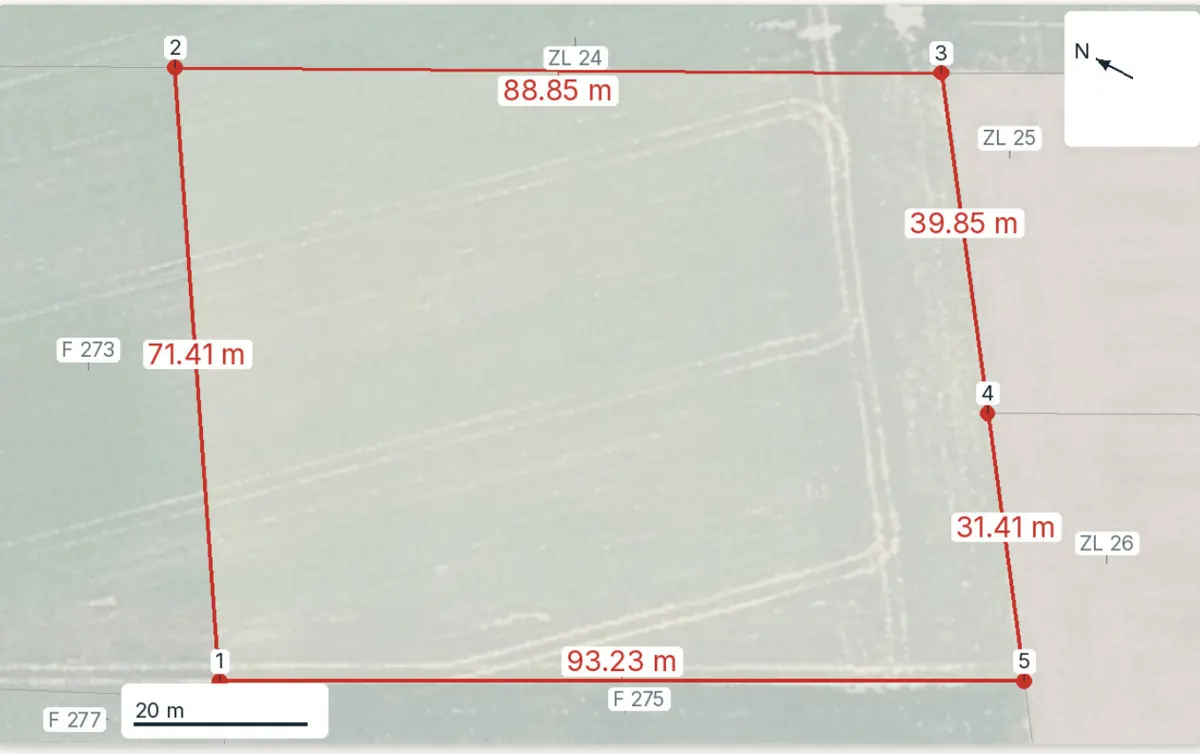
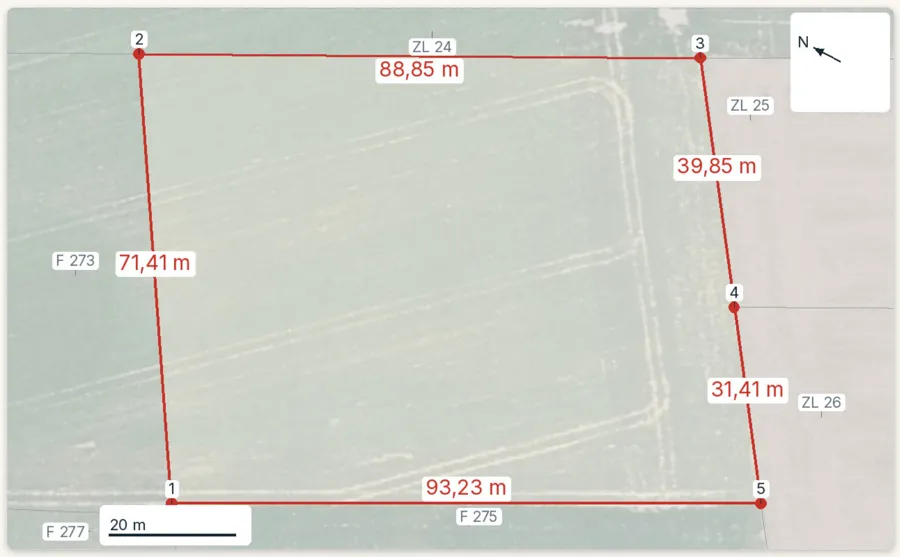
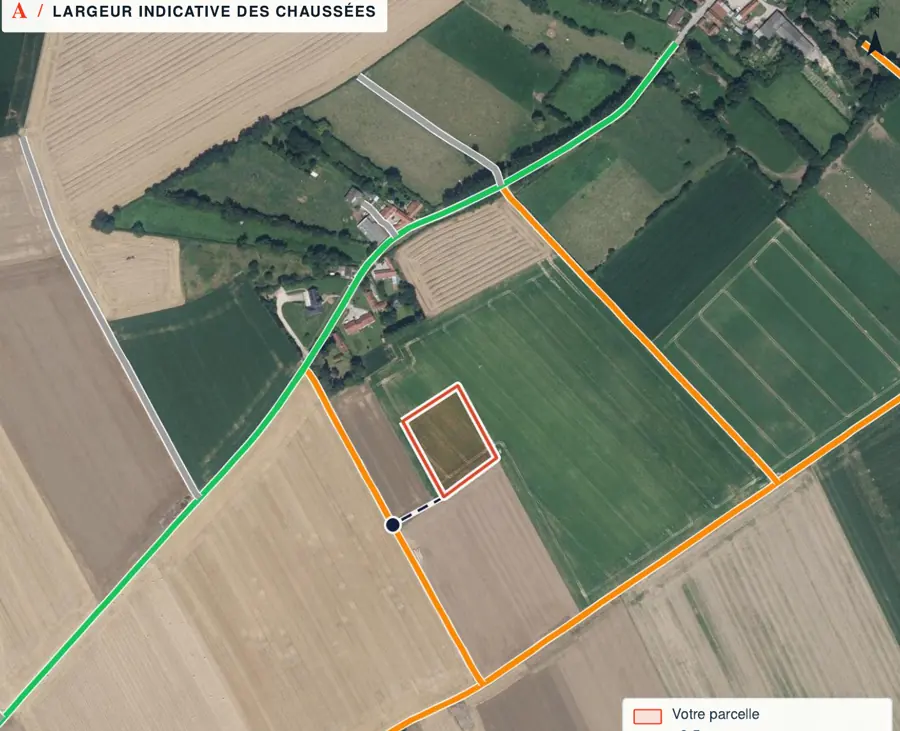
A plot with no address? Start from its cadastral reference
Pick the parcel on the map. The report locates it on the aerial photograph with its municipality code and coordinates, then sets out its cadastral area, the PLU planning zone, natural hazards and recent sales nearby, each with its source and date, explained in English. It does not give the plot an address or name the owner. Free preview, PDF report for €29 (€39 in French and English).