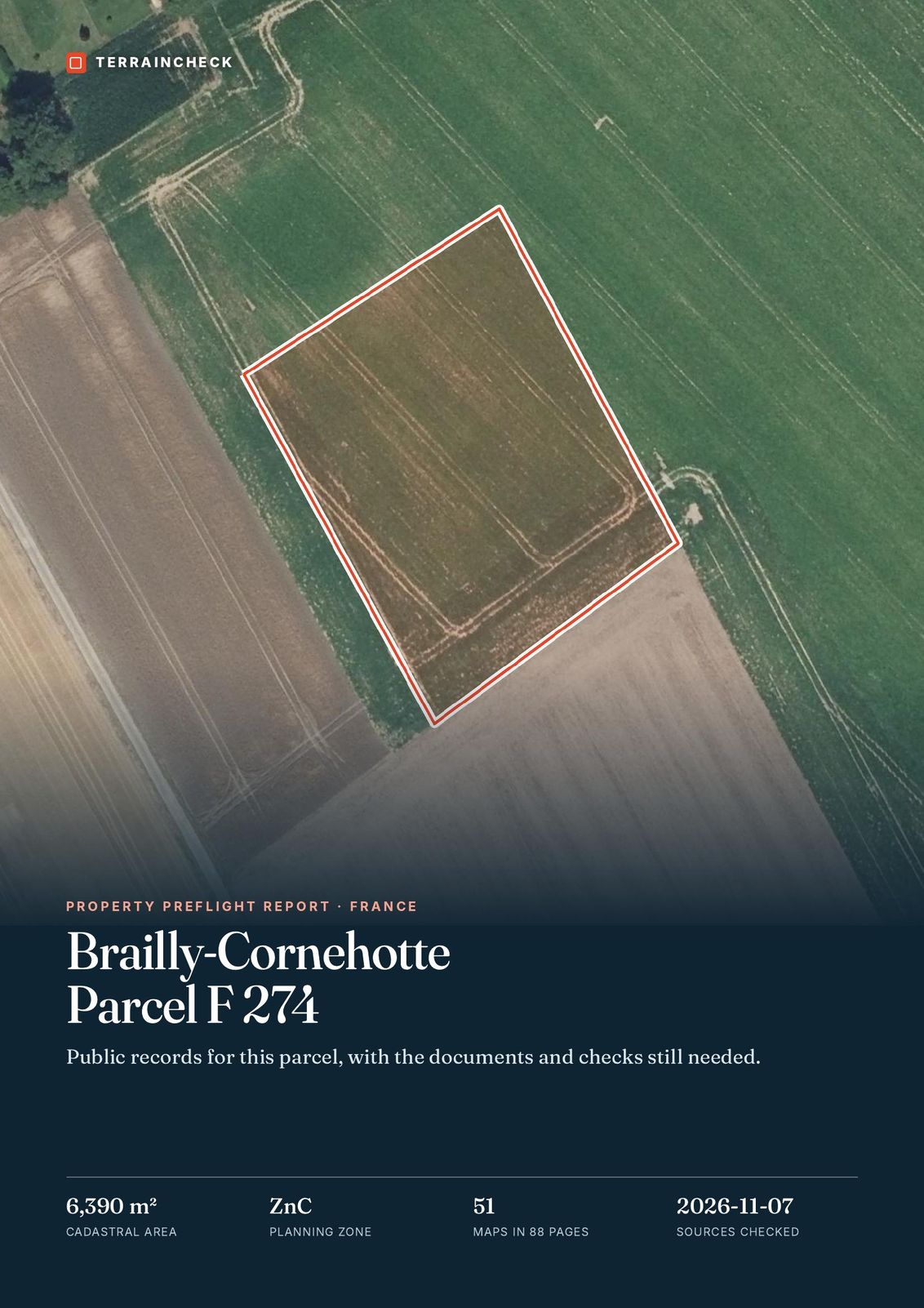
Pillar: Buying building land in France
Safer pre-emption on farmland in France: when it applies, the exemptions and the timing for buyers
In France, when farmland in a Safer pre-emption zone is sold, the notaire (the public officer who draws up and authenticates the sale deed) must notify the Safer, the regional rural land body, two months before the planned completion date; the Safer then has two months from receipt to pre-empt, and silence means it waives its right. Your first step as buyer: build those two months into the contract timetable and ask the notaire whether an exemption applies.
In brief
- What is covered: farm property and bare land “intended for agriculture”, meaning land in an agricultural (A) or natural and forest (N) zone of the local plan, in a protected agricultural zone or in a peri-urban farmland protection area. Where a commune (municipality) has no plan: areas not yet built up, except woods and forests.
- Where: a decree for each Safer sets the zones where it may pre-empt and, in some cases, a minimum area.
- How long: two months from receipt of the notice, paused if the Safer asks to visit. If a sitting tenant farmer has a prior right, the Safer’s period starts when it receives the tenant’s decision.
- Price: the Safer can pre-empt at the agreed price or offer its own. The seller accepts, withdraws the land or goes to court; six months’ silence after notice of the offer counts as acceptance, unless the seller dies within that time: the Safer must then repeat its offer to the heirs.
On this page
What the Safer can pre-empt
A Safer (société d’aménagement foncier et d’établissement rural) is a regional rural land body: it buys farm and rural property and sells it on to farmers, local authorities or other buyers whose projects fit its missions. When land is sold for a price, its pre-emption right lets it buy instead of the buyer the seller chose.
Article L143-1 of the Rural Code covers property in agricultural use and bare land intended for agriculture. The latter is defined by location: an A or N zone of the PLU (plan local d’urbanisme, the local zoning plan) or another planning document, a protected agricultural zone, or a peri-urban farmland protection area; with no planning document, areas not yet built up, excluding woods and forests. Land carrying only scrub, ruins or temporary structures still counts as bare.
The list of zones only applies to bare land; the article also covers property “in agricultural use” without tying it to a zone. If a plot zoned U or AU (urban or future development) is still farmed, ask the notaire how it is classified. Some buildings are also covered, under conditions, including farm dwellings.
The right only applies in the zones set by the decree for each regional Safer, sometimes above a minimum area. The list of these decrees is published on safer.fr.
Sources: Rural Code, L143-1; Rural Code, L143-7; Rural Code, R143-1; Safer: the pre-emption right (2023 figures). Accessed 13 November 2026.
Sales the Safer cannot pre-empt
| Situation | Condition | Article |
|---|---|---|
| Sale within the family | Relatives by blood or marriage up to the fourth degree, co-heirs and their surviving spouse, deeds between co-owners under articles 815-14, 815-15 and 883 of the Civil Code. | L143-4, 3° |
| Building land | An undertaking, attached to the prior notice, to use the land for building within three years at most, counted from the date the Safer receives the notice (not from the deed or the permit). Single-family house: the plot must be under 2,500 m² per house, or under the legal minimum plot size if that is larger. | L143-4, 5° a; R143-3 |
| Allotment gardens | Within a built-up area, 1,500 m² at most, or in a zone set aside for them. | L143-4, 5° b |
| Woods and forests | Parcels recorded as woodland in the cadastre, with exceptions, for example when sold with unwooded parcels of the same farm. | L143-4, 6° |
| Farm employee, family helper, farm partner | Adult, in that role for at least a year on the date of purchase, with the required farming experience and qualifications. The land must go to form a farm or forestry holding. The buyer undertakes, for themselves and their successors, to farm it and keep it in farm use for ten years, and attaches to the prior notice an undertaking to set up personally as a farmer within a year of the purchase. The resulting farm stays below the threshold in I, 1° of article L331-2. | L143-4, 4°; R143-3 |
| Sitting tenant farmer | A priority rather than an exemption: the Safer cannot pre-empt against a tenant who has farmed the land for more than three years and meets the other conditions of the article. | L143-6 |
Main exemptions and priorities for a private buyer. The full list and its conditions are in the articles cited. Sources: Rural Code, L143-4; Rural Code, R143-3; Rural Code, L143-6. Accessed 13 November 2026.
An exemption does not remove the duty to notify: the notaire informs the Safer of every transfer of rural property, land or farm or forest holdings, stating the obstacle to pre-emption. Pre-emption rights held by the State, local authorities and public bodies, such as the urban pre-emption right (DPU), rank ahead of the Safer’s.
Sources: Rural Code, L141-1-1; Rural Code, R141-2-1. Accessed 13 November 2026.
Notice, two months, decision: the sequence
- Notice. The notaire handling the sale informs the relevant Safer electronically, two months before the planned completion date: the property, its cadastral reference, its zoning, the price, the terms, and the identity and occupation of the parties. The texts cited set no notification fee.
- The Safer’s period. Two months from receipt; silence means it waives its right. A request to visit stops the clock until the visit or the owner’s refusal; if less than a month is then left, it gets one month. Where a tenant farmer has a prior right, the notaire passes on the tenant’s decision within eight days (auctions aside) and the Safer’s period runs from receipt.
- A reasoned decision. A pre-emption decision states the cadastral reference, the price and which objective of article L143-2 it serves, or it is void. The buyer who loses the purchase gets it by registered letter within fifteen days of the notaire’s receipt; a summary is posted at the mairie (town hall) for fifteen days.
- Completion. After a waiver or once the period has run out, the deed can be signed at the notified price and terms. If the Safer pre-empts, it has two months from sending its reply to sign the final deed; otherwise its pre-emption becomes void fifteen days after a formal notice that goes unanswered.
Sources: Rural Code, R143-7; Rural Code, L143-3. Accessed 13 November 2026.
Pre-emption at a revised price
If the Safer considers the price or terms excessive, in particular compared with prices in the region, it sends the seller’s notaire its own offer, after approval by the government commissioners who supervise it. The seller can accept, withdraw the land from sale, or ask the civil courts to review the price.
With no answer within six months of notice of the offer, the seller is deemed to accept. If the seller dies within the six months, that presumption does not bind the heirs, and the Safer must repeat its offer to them. If the court sets a price, either side may walk away; for three years, though, the seller can still require the Safer to buy at that price, possibly updated. The procedure does not apply to public auctions.
Pre-emption is rare: 3,750 cases out of 393,800 sale notices in 2023, 1%. Yet in 51% of them the seller refused the revised price and took the land off the market. The sale you agreed then does not happen; any later sale needs a fresh notice to the Safer.
Sources: Rural Code, L143-10; Rural Code, L143-12; Rural Code, L141-1-1. Accessed 13 November 2026.
What it means for you as buyer
Allow at least two months between the notice and the final deed. To complete sooner, the Safer may charge a fee for a fast-track answer; the Ministry of Agriculture stated in 2022 that this fee is optional and that no regulation governs it. What to put in the contract is covered in our guide to the preliminary sale agreement (compromis de vente).
If the price or terms change, the seller must notify them again. If the sale has not completed a year after the last notice was sent, the procedure has to be renewed, so a completion date pushed back too far reopens the Safer’s window.
If the Safer pre-empts, a court challenge must be brought within six months of the day the reasoned decision was made public. If it disputes whether the objectives of article L143-2 were met, the six months run from publication of the Safer’s decision to resell the land. See a French lawyer (avocat) as soon as the letter arrives.
Sources: National Assembly, question 45101, answer of 3 May 2022; Rural Code, L412-9; Rural Code, L141-1-1; Rural Code, L143-13; Rural Code, L143-14. Accessed 13 November 2026.
How to check whether a plot is caught
- Read the zoning on the Géoportail de l’urbanisme (national planning map, in French) or at the mairie; see reading the PLU before buying. Free; about fifteen minutes (TerrainCheck estimate).
- Open the decree for your regional Safer from the list on safer.fr: pre-emption zones and any minimum area. Free; about ten minutes (TerrainCheck estimate).
- Note the cadastral land type of each parcel and the buildings included in the sale. For woodland: buying a woodland plot.
- Ask the seller in writing whether there is a farm lease (bail rural): a tenant farming the land for more than three years may come before the Safer.
- Have the notaire confirm, before the compromis, any exemption and a completion date that fits the two months. The texts cited set no cost or deadline for this answer.
For the rest of the purchase, see buying agricultural land as a private buyer, agricultural land prices per hectare and, if you live abroad, buying land in France as a foreigner.
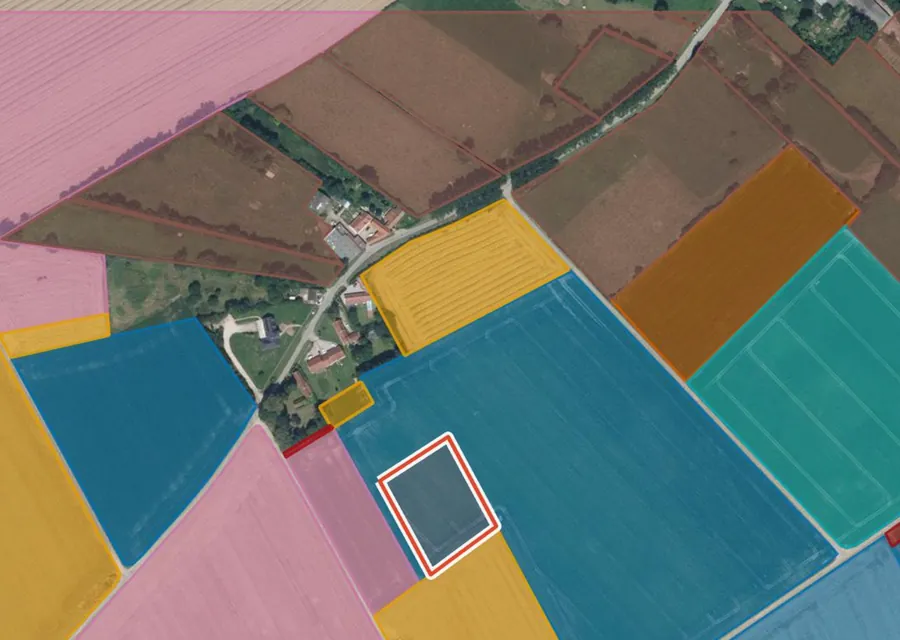
In the report: crops around parcel F 274
Before you sign: Safer pre-emption in six checks
- Zoning of the plot noted (A, N, U, AU, or no planning document).
- Regional Safer decree checked: pre-emption zone and minimum area.
- Any exemption identified with the notaire, with its evidence.
- Seller asked in writing whether there is a farm lease.
- Completion date at least two months after the notice, and within a year of it.
- The deed records the notice to the Safer and its reply or the end of its period.
Common questions
Can I buy farmland without going through the Safer?
Yes: the sale is between you and the seller, at the notaire’s. But if the land falls within the pre-emption right, the notaire must notify the Safer, which has two months to pre-empt unless an exemption in article L143-4 applies.
Can the Safer pre-empt building land?
Bare land in a U or AU zone is not in the list of zones in article L143-1, unless it also lies in a protected agricultural zone; property in agricultural use is still covered. A purchase of land for building is exempt if the buyer undertakes, in the notice, to build within three years at most, counted from the date the Safer receives the notice. For a single-family house the plot must be strictly under 2,500 m² per house (exactly 2,500 m² does not qualify), or under the legal minimum plot size if that is larger.
Do I have to pay for the Safer’s fast-track answer?
No. According to the Ministry of Agriculture’s answer published in the Official Journal on 3 May 2022, the fee is optional and no regulation governs it. Without it, the notaire waits until the two months have passed.
What if the Safer pre-empts the land I wanted?
Read the decision: it must name the objective it serves, or it is void. A court challenge must be filed within six months of the day the reasoned decision was made public, so speak to a French lawyer straight away.
Keep reading
Before you make an offer on farmland, see what surrounds it
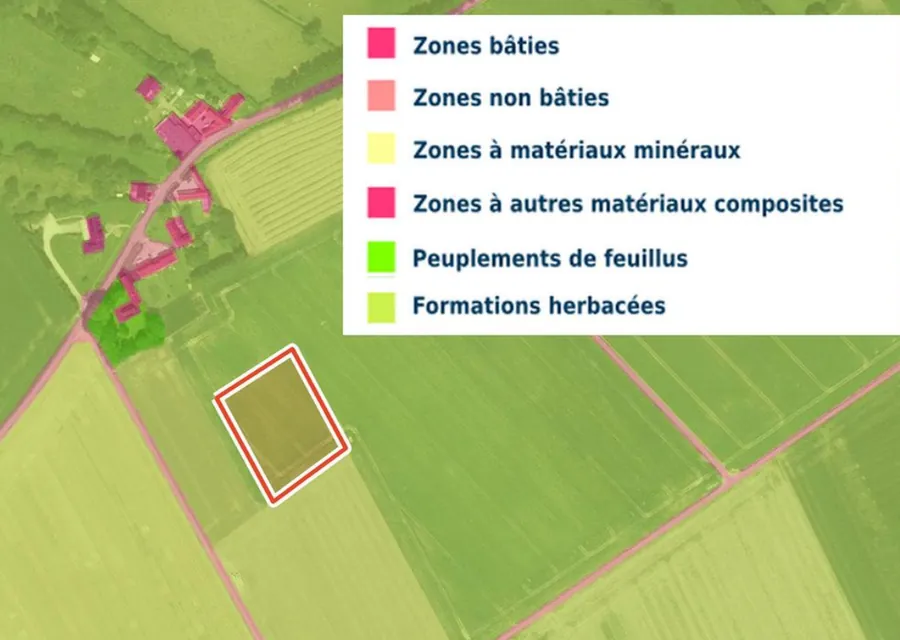
Pick the parcel on the map. The report sets out the PLU zone, the crops declared around it, natural hazards, Natura 2000 and recent sales nearby, each with its source and date and explained in English. It cannot tell you whether the Safer will pre-empt. Free check, PDF report for €29 (€39 in French and English).