Pillar: Buying building land in France
Seismic zones in France: building rules for your plot, zone by zone
Every commune (municipality) in mainland France and the overseas départements sits in one of five seismic zones set by the Environmental Code. For a new single-family house, seismic design rules apply only in zones 3, 4 and 5, with a certificate filed with the building permit; in zones 1 and 2 no seismic rules apply to the house. Start by looking up the address on Géorisques, the government hazard website.
In brief
- French law places every commune (municipality) in one of five seismic zones: 1 very low, 2 low, 3 moderate, 4 medium, 5 high (Environmental Code, art. R563-4 and D563-8-1). The list follows the communes as they stood on 1 January 2008.
- A maison individuelle (single-family house) is in importance category II. In zones 1 and 2 no seismic rules apply to it; in zones 3 and 4, Eurocode 8 or the CPMI-EC8 zones 3-4 guide (2021 edition); in zone 5, Eurocode 8 or the CPMI-EC8 zone 5 guide (2020 edition), the guides only where the house falls within their scope.
- In zones 3, 4 and 5 the building permit application for a house includes a seismic certificate, and a second one goes with the declaration that the works are complete.
- No official scale prices the extra cost of seismic design: you find it in the builder’s quote, item by item.
On this page
Five zones, set commune by commune
Article D563-8-1 of the Environmental Code gives the zone of each commune, département by département, often as “the whole département in zone X, except” a list of communes. In the Somme, for example, the whole département is in the very low zone except for a list of communes placed in the low zone.
The list was drawn up from the INSEE register of communes as at 1 January 2008. If the commune where the land lies has merged with others since, look up the name of the former commune. Géorisques, the government hazard website, puts the number of communes in zones 2 to 5, where seismic building rules apply to ordinary buildings, at about 21,000.
Each zone comes with a reference peak ground acceleration on rock, written agr, set by the order of 22 October 2010. It is the starting point for the ground motion used in the structural design (order, art. 4, II), and it is 7.5 times higher in zone 5 than in zone 1.
Where to check the zone of a plot
Géorisques’ information sheet for buyers points to the “Connaître les risques près de chez moi” (risks near me) section of georisques.gouv.fr. Our guide on reading a Géorisques report walks through the whole page.
Where the commune is in zone 2, 3, 4 or 5, the seller must tell the buyer in the risk and pollution statement (art. R125-23, 5°). Zone 1 does not trigger that duty on seismic grounds, though other hazards may.
What the zone requires, building by building
The rule also depends on the building’s importance category, from I to IV (art. R563-3). Category II includes, among others, single-family homes; categories III and IV cover buildings posing a high risk to people and those vital to civil security, defence or public order.
For new buildings, the order of 22 October 2010 applies the rules to categories III and IV from zone 2, and to categories II, III and IV in zones 3, 4 and 5 (art. 3). A building that mixes categories takes the strictest one.
| Zone | agr (rock) | New single-family house | Certificates |
|---|---|---|---|
| 1 · very low | 0.4 m/s² | No seismic rules | No |
| 2 · low | 0.7 m/s² | No rules (they cover categories III and IV) | Not for a house |
| 3 · moderate | 1.1 m/s² | Eurocode 8, or CPMI-EC8 zones 3-4 guide (2021) within its scope | At permit and completion |
| 4 · medium | 1.6 m/s² | Eurocode 8, or CPMI-EC8 zones 3-4 guide (2021) within its scope | At permit and completion |
| 5 · high | 3 m/s² | Eurocode 8, or CPMI-EC8 zone 5 guide (2020) within its scope | At permit and completion |
Requirements for a new single-family house (category II), zone by zone. Sources: Order of 22 October 2010 (seismic rules); Construction and Housing Code, art. R122-36 and R122-37; Planning Code, art. R431-16; Planning Code, art. R462-4. Accessed 13 November 2026.
Eurocode 8 or a simplified guide
The general rule is the NF EN 1998-1, 1998-3 and 1998-5 standards, known as Eurocode 8, with their French national annexes. For a house that meets the conditions in chapter 1 of the CPMI-EC8 guides, following the guide replaces the Eurocode 8 calculation (order, art. 4, III and IV). According to Géorisques, the guides cover houses and similar buildings of simple shape, mainly used as homes, with a footprint of up to 200 m²; beyond that, Eurocode 8 applies.
The rules also cover extensions built alongside, upwards or by adding floor area, and major structural alterations to an existing building (art. R563-5, III). The order sets separate thresholds for existing buildings in each zone.
The seismic certificate at permit and completion
In the version in force since 1 January 2024, the Construction and Housing Code (art. L122-8 and R122-36) requires, when the permit is filed, a document confirming that the design meets the seismic rules, for category II, III and IV buildings in zones 3, 4 and 5 and category III and IV buildings in zone 2. The Planning Code lists it among the documents in the permis de construire (building permit) file (art. R431-16, e).
- Note the commune’s zone on Géorisques and, for a merged commune, the former commune’s zone in article D563-8-1 on Legifrance, the official law database. Cost: nothing. Time: a few minutes (TerrainCheck estimate).
- Ask the builder or architect, ideally before the compromis de vente (binding preliminary contract), which method they will use (Eurocode 8 or the CPMI guide) and to price the seismic measures in the quote. Cost: part of the quote. Time: no deadline set in the texts cited.
- Have the design certificate drawn up before you file the permit. It is issued by a contrôleur technique (an approved building inspector); for a single-family house, any builder within the meaning of article 1792-1 of the Civil Code may issue it instead (art. L122-8). It states, among other things, the seismic zone and the building category. Cost: on quotation; the texts cited set no fee.
- File the completion certificate with the declaration that the works are finished and comply with the permit (Planning Code art. R462-4, Construction Code R122-37). For a single-family house any builder may issue it; otherwise an approved building inspector or engineering firm (art. L122-12).
How long the permit itself takes is covered in our guide to building permit processing times. Where a seismic risk prevention plan applies to the building, the certificate also confirms the preliminary study that plan requires (art. R122-36, III).
Sources: Construction and Housing Code, art. L122-8; Construction and Housing Code, art. R122-36 and R122-37; Planning Code, art. R431-16; Planning Code, art. R462-4; Construction and Housing Code, art. L122-12. Accessed 13 November 2026.
The extra cost: no official figure, so read the quote
None of the official sources consulted puts a figure on the extra cost for a house. It depends on the zone, the ground class, the plan, the materials and the method (CPMI guide or Eurocode 8 calculation).
Ask for the quote to list the items for seismic design and engineering separately and compare two quotes for the same plans. A soil study can also change the figures: see our guide to G1, G2 and G5 soil studies.
Soft ground and site effects
Géorisques explains that the type of subsoil or the relief can trap seismic waves and increase ground motion: these are site effects. The commune’s zone cannot show them, because it is the same for every plot in the commune.
The order allows for them through a soil factor, S, which depends on the ground class under the building as defined in NF EN 1998-1. In zones 1 to 4, S is 1 on class A ground and 1.8 on class E ground; in zone 5 it ranges from 1 to 1.4. In zones 1 and 2 no liquefaction analysis is required.
For other ground constraints, see clay shrink-swell and building on a sloping plot.
Overseas départements: their own zones and microzoning
Article D563-8-1 places the whole of Guadeloupe and Martinique in zone 5 (high), Mayotte in zone 3 (moderate), La Réunion in zone 2 (low) and French Guiana in zone 1 (very low). A new house in Guadeloupe or Martinique therefore follows Eurocode 8 or the CPMI-EC8 zone 5 guide.
For some communes in Martinique and Guadeloupe and for Saint-Martin, the order allows seismic microzoning studies published on Géorisques to replace the national design spectrum (art. 4 bis). The Construction Code also provides for a certificate on cyclone-resistant design, in the zones and for the buildings set by decree (art. L122-8, 2°).
Sources: Environmental Code, art. D563-8-1; Order of 22 October 2010 (seismic rules); Géorisques: earthquakes thematic file; Construction and Housing Code, art. L122-8. Accessed 13 November 2026.
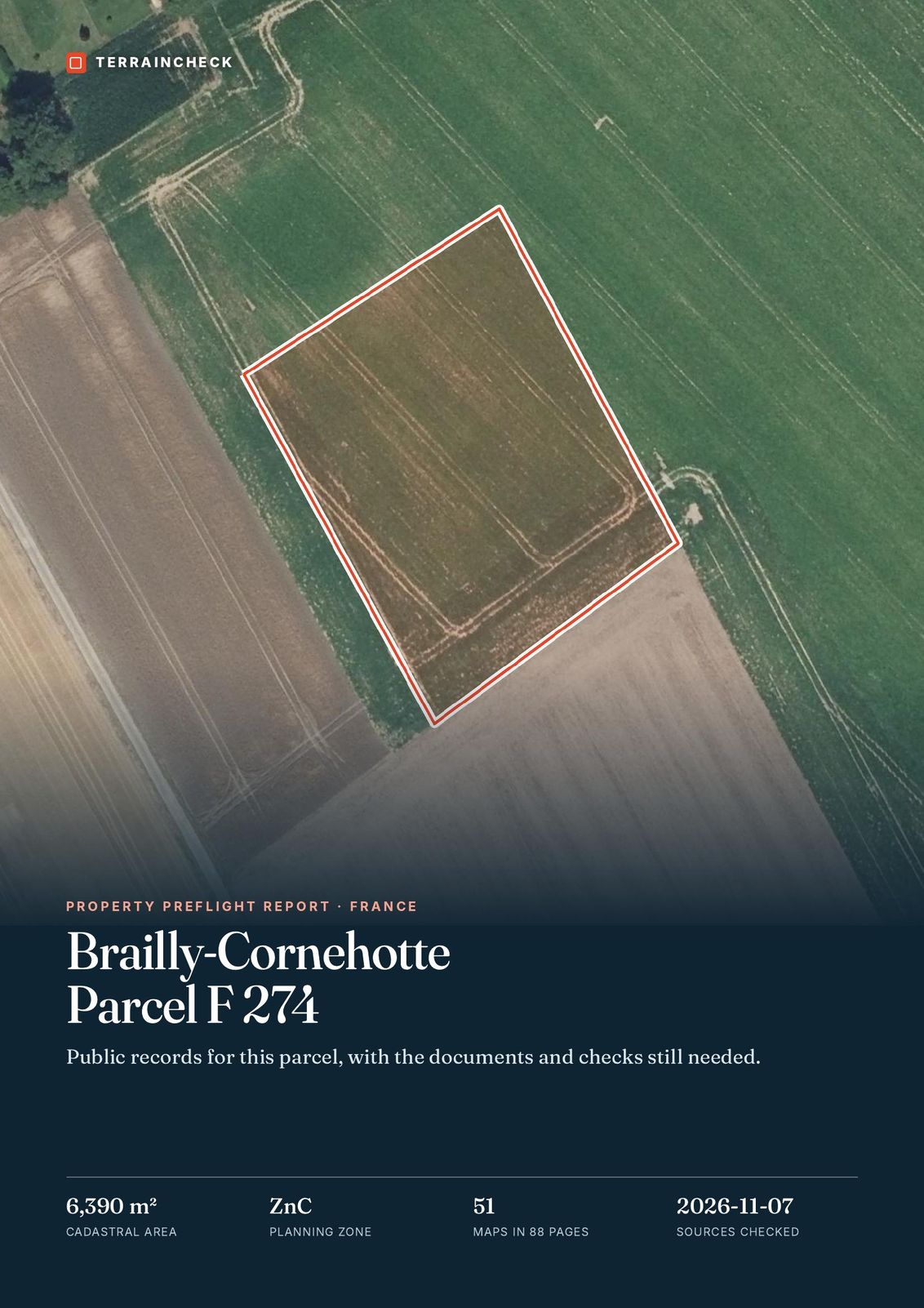
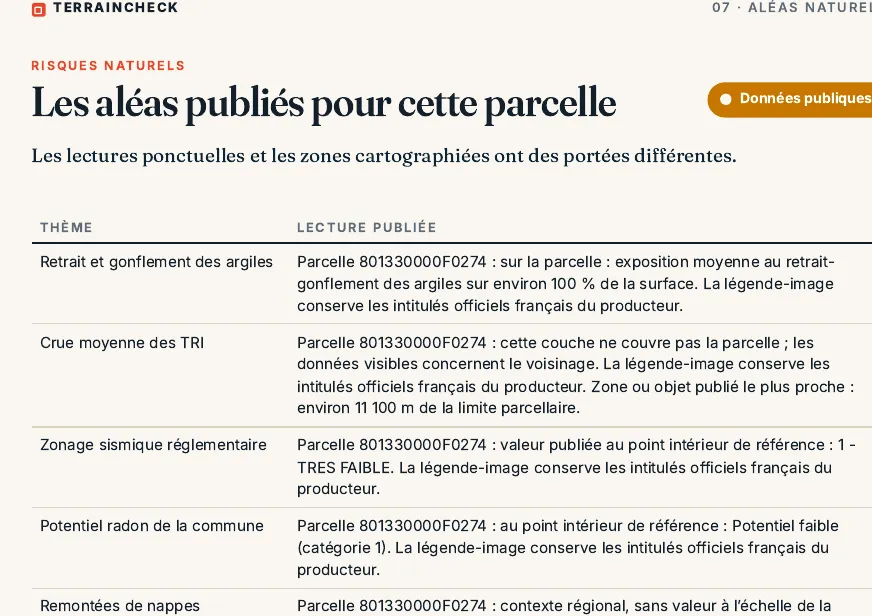
In the report: the seismic zone of F 274
Before the compromis: six seismic checks
- Zone of the commune noted (1 to 5), and for a merged commune the former commune’s zone.
- Risk statement received, showing the seismic zone if the commune is in zone 2 to 5.
- Zones 3 to 5: method stated by the builder (CPMI guide or Eurocode 8).
- Seismic items priced separately in the quote.
- Name of whoever will issue the certificate at permit stage, then at completion.
- Any doubt about the ground: the engineer’s view on the ground class.
Next: the risk and pollution statement, the radon potential of the commune and the order of checks before the compromis.
Common questions
My commune is in zone 2: do seismic rules apply to my new house?
Not to a new single-family house: in zone 2 the order of 22 October 2010 applies the rules only to new buildings in importance categories III and IV. The seller still has to provide the risk statement, because the commune is in zone 2.
Who can issue the seismic certificate for a house?
At permit stage, a contrôleur technique or, for a single-family house, any builder within the meaning of article 1792-1 of the Civil Code (Construction Code, art. L122-8). At completion, any builder for a single-family house, otherwise an approved inspector or engineering firm (art. L122-12).
My commune has merged with others: which zone applies?
The list in article D563-8-1 follows the communes as at 1 January 2008. Look for the former commune where the land lies in its département’s list, and compare with Géorisques.
Does the zone tell me whether the house already on the land is sound?
No. The zone sets the reference hazard of the commune for future building work. Whether an existing building would resist needs an assessment by a professional.
Keep reading
Géorisques: how to read the hazard report for a French plot and what it leaves out
France’s risk statement (ERP) for land: what the seller must give you, the six-month rule and what it leaves out
Soil studies in France (G1, G2, G5): when they are required, who pays and what they contain
Know the plot’s seismic zone before you sign
Pick the parcel on the map. The report reads the regulatory seismic zone at a point inside the parcel, then sets out the PLU zone, clay soils, flooding, radon and recent sales nearby, each with its source and date and explained in English. It does not replace a structural engineer or the seismic certificate. Free check, PDF report for €29 (€39 in French and English).