Pillar: Buying building land in France
Sheds, cabins and mobile homes on agricultural or natural land in France: what is allowed
In mainland France, a shed or cabin may only stand in the agricultural (A) or natural (N) zone of a PLU (local land-use plan) if the zone rules allow it, usually for a farm business or as an annex to an existing house. If it is allowed, the formality depends on size: none up to 5 m² outside protected areas, a prior declaration up to 20 m², a building permit above that. First step: read the zone rules at the mairie (town hall), or apply for an operational planning certificate (free, answer within 2 months).
In brief
- The zone rule comes before the size. A shed of 5 m² or less needs no application, but it must still comply with the zone rules (article L421-8): if the zone forbids it, skipping the paperwork does not make it legal.
- In zone A of a PLU, the rules may allow buildings needed for a farm business (zone N: farming and forestry), annexes to existing houses and buildings in a STECAL, on the terms of articles L151-11 to L151-13. A carte communale or a commune with no plan follows other articles.
- If the shed is allowed: a prior declaration (déclaration préalable) above 5 m² and up to 20 m², a building permit above that. In the protected areas of article R421-11 (near a listed monument, a classified site…), a declaration from the first square metre.
- Mobile home on its wheels: only on a campsite, a leisure home park or a classified holiday village. Caravan kept more than 3 months a year elsewhere: prior declaration.
- Existing cabin: being on the cadastre (the land tax map) does not prove it was authorised. Built without permission, it exposes the owner to a criminal fine and, for 10 years after completion, to a court action by the commune to demolish it or bring it into line.
On this page
The zone rule first, the size second
Two questions, in this order: does the local rule allow this kind of structure, and which formality applies to its size. Even a shed exempt from formalities must comply with the land-use rules (L421-8 and L421-6).
Where the commune has a local plan (PLU), non-building land lies in zone A (agricultural) or zone N (natural and forest). Zone A rules may allow buildings needed for a farm business or for the equipment of approved farm machinery cooperatives (CUMA); zone N rules the same, extended to forestry (R151-23 and R151-25).
Added to these are extensions and annexes to existing houses, if they do not harm farming or the landscape, within the height, footprint and density limits set by the rules (L151-12), and buildings in a STECAL (L151-13).
The code sets the outer limit; the local rules can allow less. A leisure shed on a plot with no house only fits if it is needed for a farm business or stands in a STECAL that allows it, and the planning office decides.
Carte communale or no local plan
Under a carte communale, non-building sectors only admit the exceptions of article L161-4, among them extending or repairing existing buildings and buildings needed for farming or forestry, provided they remain compatible with farming on the land and do not harm the landscape. With neither plan, article L111-4 sets a similar list outside built-up areas (see the national planning rules).
If the shed is allowed: which formality for its size
Two measurements count: the footprint (emprise au sol), the vertical projection of the structure’s volume including overhangs (R420-1), and the floor area (surface de plancher). The thresholds apply to a structure no taller than 12 m.
| Project | Threshold | Formality | Rule |
|---|---|---|---|
| Shed, cabin, animal shelter | 5 m² or less | None outside protected areas | R421-2 |
| Same shed | Over 5 m², up to 20 m² | Prior declaration | R421-9 a |
| Same shed | Over 20 m² | Building permit | R421-1 |
| Shed in a protected area | Up to 20 m² | Declaration from the first m² | R421-11 |
| Greenhouse | 1.80 m high or less | None, except in a classified or proposed site, heritage area or listed monument’s surroundings: declaration below 4 m, up to 2,000 m² | R421-2 e; R421-11 II e |
| Greenhouse | Over 1.80 m and no more than 4 m high, 2,000 m² of ground at most on the same landholding | Prior declaration, outside the three settings in the row above | R421-9 g |
| Caravan off a campsite | Over 3 months a year | Prior declaration | R421-23 d |
| Mobile home on wheels | Any length of time | Campsite, park or holiday village only | R111-42 |
| Mobile home without wheels | Treated as a building | Declaration up to 20 m², permit above | Service-Public |
Formalities once the zone rule is met (temporary structures: see below). Protected area: the areas in I of article R421-11: heritage area (site patrimonial remarquable), surroundings of a listed monument, classified or proposed site, nature reserve, core of a national park. Sources: French planning code, art. R*420-1 to R*421-12 (new constructions); French planning code, art. R111-31 to R111-50 (camping, mobile homes, caravans); Service-Public: caravan or mobile home in your garden. Accessed 13 November 2026.
The steps, from the zone to the application
- Find the zone at the mairie, or on the Géoportail de l’urbanisme (in French) if the commune has published its plan there. Cost: nothing. Time: a few minutes (TerrainCheck estimate).
- Read the zone rules: what is banned and allowed, siting, height. Cost: nothing. Time: about an hour (TerrainCheck estimate).
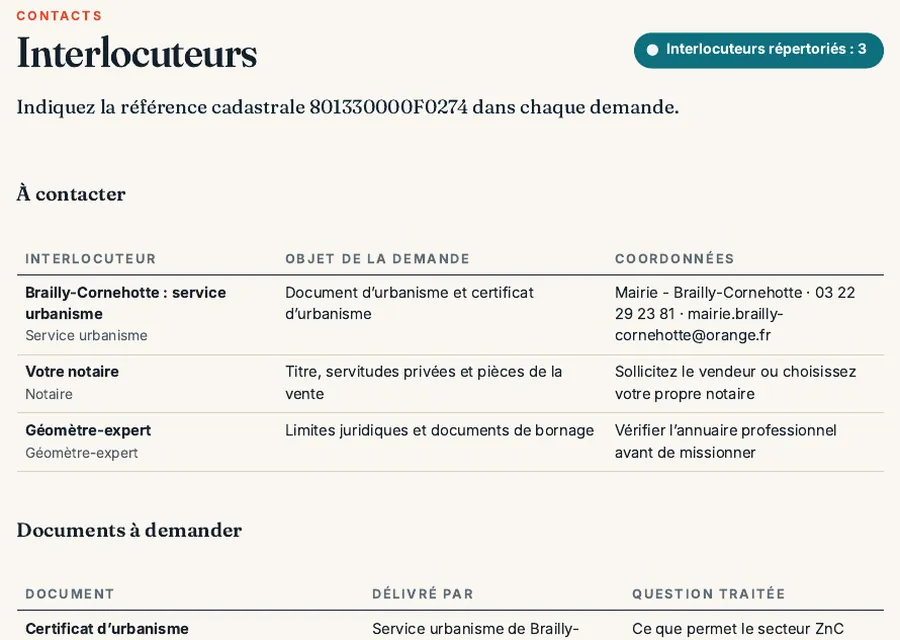
- Apply for an operational planning certificate (certificat d’urbanisme opérationnel) describing the shed. Free; the mairie has 2 months from receipt; valid for 18 months. See the planning certificate.
- File the prior declaration (form “Déclaration préalable constructions et travaux non soumis à permis de construire”) at the mairie, or online where the commune offers it. Processing: 1 month from filing; within that month the mairie may set a different time limit or ask for missing documents. As a rule, no answer means no objection. Above 20 m²: building permit processing times.
Development tax: a worked example
An enclosed, roofed shed over 5 m² is liable to development tax (taxe d’aménagement). For 2026 outside Île-de-France, Service-Public gives €892 per m² of enclosed space with more than 1.80 m of headroom, with example rates of 3% (commune) and 2.5% (département). A 10 m² shed: 10 × €892 = €8,920; €8,920 × 3% = €267.60; €8,920 × 2.5% = €223; total €490.60.
The commune rate runs from 1% to 5% (up to 20% in some sectors), the département rate is 2.5% at most. In Île-de-France the value is €1,011 and a regional share is added. Each authority may exempt, from its share, non-professional garden sheds of 20 m² or less. More: calculating the development tax.
Caravans, mobile homes and containers
Outside a campsite, a leisure home park, a classified holiday village or the grounds of an approved family holiday home, a caravan kept more than 3 months a year, periods added up, needs a prior declaration (R421-23 d). Below that, Service-Public says no permission is needed, provided nobody lives in it. Whatever the length of stay, it is banned where camping on your own is banned (R111-33), in protected woodland (espaces boisés classés), subject to articles L113-1 to L113-5, and in protection forests (R111-48).
A mobile home, which the highway code bans from the road, may only stand in a leisure home park, a holiday village classified for light accommodation or a properly created campsite, with the limits of article R111-42; storage and post-disaster rehousing are separate cases (R111-45, R111-46). With wheels and towbar removed, Service-Public treats it as a building.
A shipping container or a shed on blocks is measured by footprint too.
Temporary structures: a separate regime
A structure put up for three months at most is exempt from formalities, provided the site is then restored to its original state (R421-5). Other periods apply to some uses, such as building sites, events and emergency rehousing. The three months drop to fifteen days in classified or proposed sites, heritage areas, the surroundings of listed monuments and areas set by a reasoned council decision (R421-7); unlike the table, this list leaves out nature reserves and national park cores.
Article L421-8’s duty to comply with planning rules excludes these temporary structures (b of article L421-5). The time limit and the duty to restore remain: once the period is over, the exemption no longer covers the shed.
A cabin already built or on the cadastre
A “cabin on the cadastre” only means it appears on a map kept for tax purposes. Where permission was required, lawfulness is proved by the permit or the non-objection to a prior declaration. A shed exempt from formalities has no decision: ask for evidence of its date, size and compliance with the zone rules. Gather this with the seller before you sign the compromis de vente (the binding preliminary contract).
Ten years after completion, a refused permit or declaration can no longer rest on the original breach (L421-9), except in seven cases, including: built without the building permit that was required, in a classified site or national park, on public land, in certain zones of a natural-hazard prevention plan, or once demolition proceedings have started.
Penalties and putting things right
Building without the required permission, or against the rules, carries a fine of at least €1,200, capped at €6,000 per m² of floor area or €300,000 in other cases (L480-4): up to €90,000 for 15 m². The planning authority may order the owner to put things right, with a daily penalty of up to €1,000 and €100,000 in total (L481-1, version of 28 November 2025).
The commune or the inter-municipal body in charge may ask the civil court to order demolition or compliance for 10 years after completion, including for an exempt structure that breaks the zone rules (L480-14). Putting things right means filing the missing application after the event; a permit is only granted if the works meet the land-use rules (L421-6).
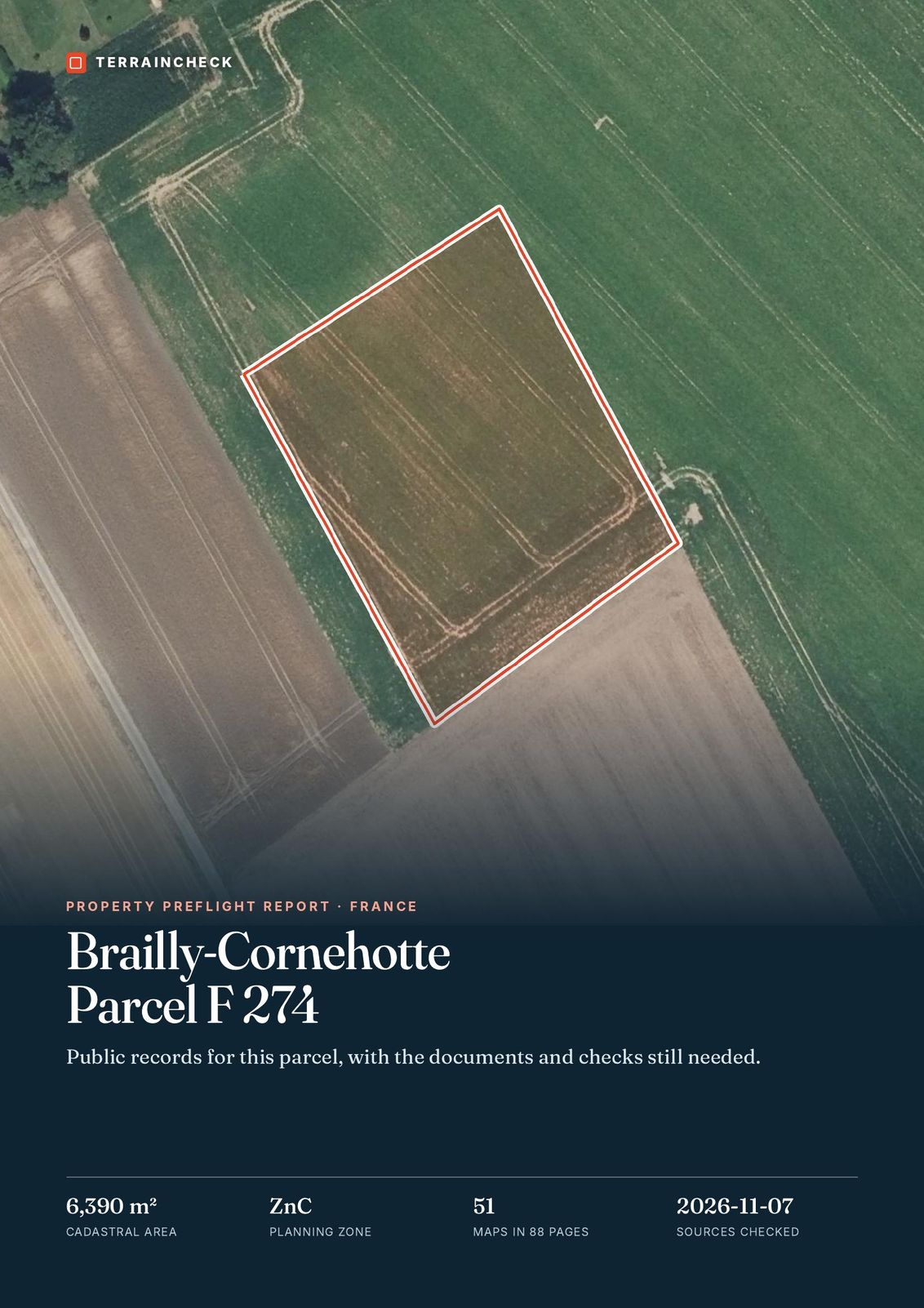
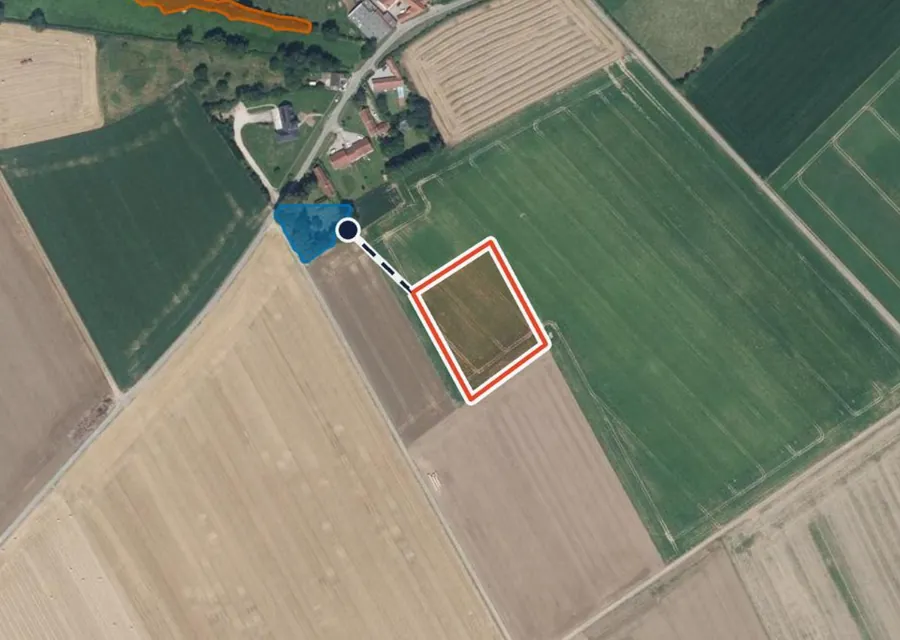
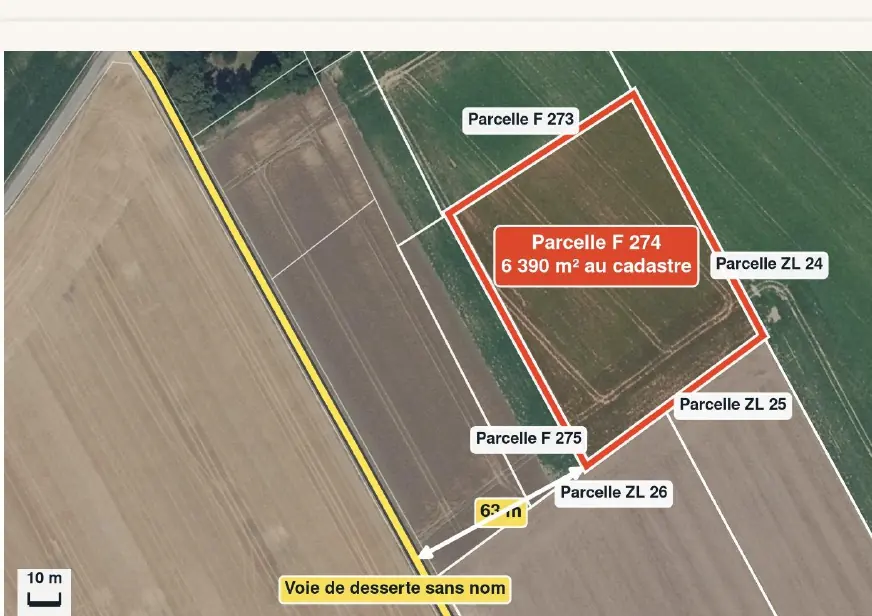
In the report: parcel F 274 in sector ZnC
Before buying land to put a shed on
- Zone noted: A or N of the PLU, non-building sector of a carte communale, or a commune with no plan.
- Zone rules read: shed, annex or farm building allowed or not, and on what terms.
- Protected area checked: listed monument, classified site, heritage area.
- Footprint and floor area measured, height noted.
- Existing shed: permit or non-objection if required, or proof of date and size.
- Development tax estimated above 5 m² of enclosed space.
See also: leisure land, buying farmland as a private buyer and, for a dwelling, a house on agricultural land.
Common questions
Is a cabin shown on the cadastre automatically legal?
No. The cadastral map exists for tax purposes. Ask the seller for the permit or non-objection if one was required, with the completion date; for a shed exempt from formalities, evidence of its date, size and compliance with the zone rules. A missing decision does not by itself make it unlawful.
Can I put up a shed of 5 m² or less on farmland without asking anyone?
It is exempt from formalities outside protected areas and if it is no taller than 12 m, but it must comply with the zone rules (L421-8). If the rules do not allow it, it is unlawful even without an application, and the commune can act for 10 years after completion.
Can I put a mobile home on my agricultural land?
On its wheels, only on a campsite, leisure home park or classified holiday village, apart from storage and post-disaster rehousing (R111-42 to R111-46). Without wheels it is a building: zone rule first, then declaration or permit by size.
Does a horse shelter count as a farm building?
Article R151-23 allows buildings needed for a farm business in zone A without listing them. The planning office judges each case: ask through an operational planning certificate before you buy.
Keep reading
Buying leisure land in France: what the Planning Code lets you put on it
Can you build a house on agricultural land in France? A zones, carte communale, national rules and farmers’ homes
France’s development tax (taxe d’aménagement): how it is calculated, when it is due and who is exempt
Buying land to put a shed on? Check its zone first
Pick the parcel on the map. The report shows the PLU zone or carte communale sector that covers it, then natural hazards, clay soils, Natura 2000 and recent sales nearby, each with its source and date and explained in English. It cannot tell you whether an existing shed was authorised. Free check, PDF report for €29 (€39 in French and English).