Pillar: Buying building land in France
Non-buildable land in France: price, permitted uses and pitfalls
In metropolitan France excluding Corsica, the closest public price is for farmland and meadows sold free of tenancy: €6,460 a hectare on average in 2025 (Safer/SSP), about €0.65 per m²; a small leisure plot has no official price. What you may do on the land depends on the zone rules, to be confirmed by a free planning certificate from the town hall.
In brief
- Public price benchmark: €6,460 a hectare in 2025 for undeveloped farmland and meadows sold free of tenancy (metropolitan France excluding Corsica, Safer/SSP), about €0.65 per m². That figure does not value a small leisure plot: the study leaves out parcels under 70 ares.
- Land is called non-buildable (terrain non constructible) when its classification does not, as a rule, allow a new house: most often an A or N zone of the PLU (the local plan), a non-buildable sector of a carte communale (a simpler plan used by small communes), or a plot outside the built-up parts of a commune (the French municipality) that has no PLU, no document in its place and no carte communale. An AU zone depends on whether it has been opened for development and has the utilities it needs.
- Common uses: farming, upkeep, fencing under local rules. A shed, a caravan or a mobile home each come with precise thresholds and conditions; a house or a lived-in tiny house is not yours by right. The exceptions to the no-building rule are set out in can you build on non-buildable land.
- On top of the price: land tax on undeveloped land, payable by whoever owns the land on 1 January, and the notaire’s fees (the notary handling the sale). The commune (in a pre-emption zone) or the Safer can buy in your place. The commune has 2 months from receipt of the seller’s notice of intent to sell; this is suspended if it asks for documents or a visit, then resumes with at least 1 month left to decide. The Safer has 2 months from notification of the sale.
On this page
What makes land non-buildable?
Neither the size of the plot nor missing utilities settles it alone. The starting point is the commune’s planning document, then the zone rules, utilities, hazards and easements. There are three cases, and listings rarely say which one applies.
U and AU zones do not settle everything either. In a U zone, the zone rules decide what can be built. An AU zone (a zone to be urbanised) opens to building only under the conditions of article R151-20 of the planning code. If the public roads and the water, electricity and, where relevant, sewer networks at its edge cannot serve the whole zone, opening it needs an amendment or revision of the PLU.
If they can, and the zone’s development guidelines (OAP, orientations d’aménagement et de programmation) set the conditions, building is allowed either as part of a single development scheme or as the internal roads and networks planned in those guidelines are built. Before paying a building-plot price for AU land, ask the town hall (mairie) which case applies and how far the internal works have got.
Farming zones protect land “because of the agronomic, biological or economic potential” of the soil. Natural and forest zones protect sites, landscapes, woodland and natural areas, or reflect a hazard.
Non-buildable does not mean nothing can ever be built: each regime has its own exceptions, under conditions, for instance for a house that already stands there or for farming. They are explained regime by regime in can you build on non-buildable land; this guide sticks to price and uses.
What does non-buildable land cost?
The only nearby public benchmark is the price of farmland. For undeveloped farmland and meadows sold free of tenancy (“libres”), in metropolitan France excluding Corsica in 2025, the Safer (the regional land agencies) and the agriculture ministry’s statistics service (SSP) give an average of €6,460 a hectare (+0.9%), €8,150 in arable areas. A hectare is 10,000 m², about 2.5 acres: roughly €0.65 per m². That figure is not a valuation of a small leisure plot.
These averages come from sales of farm parcels meant for farming: the study leaves out projects for non-farming use and, for land sold free of tenancy, parcels under 70 ares (0.7 ha). A small plot near a village sold as a leisure plot trades at a different price. Prices by département and the official scale published in the Journal officiel are covered in farmland prices per hectare.
For the commune you are looking at, the only direct reference is recorded sales (DVF, the public register of property sale prices) and the nearby sales the notaire can pull. Estimating a land price with DVF shows how to search it. Compare plots with the same zoning: a building-plot price does not carry over to land in an A or N zone.
| Item | What to know |
|---|---|
| Land tax on undeveloped land | Paid by whoever owns the land on 1 January, even if it earns nothing. How it is worked out: property tax on undeveloped land. |
| Brush clearance | Not automatic for a bare plot. The duty mainly covers the surroundings of buildings and installations, over 50 m that the mayor can extend to 100 m, near woods and heath classed as a fire risk (200 m), and the whole parcel in an urban zone of a PLU. It falls on the owner of the protected building, or of the land in an urban zone. Check the map of affected areas and the prefect’s order (arrêté préfectoral) for the département, and ask the mairie whether the mayor has done so. |
| Pre-emption | The commune (in a pre-emption zone) has 2 months from receipt of the seller’s notice of intent to sell (déclaration d’intention d’aliéner), suspended if it asks for documents or a visit, then at least 1 month once it resumes (Art. L213-2); the Safer has 2 months from notification of the sale. See Safer pre-emption. |
| Notaire’s fees | On top of the price, as with any property purchase. |
What comes on top of the purchase price. Sources: Service-Public: land tax on undeveloped land; Service-Public: compulsory brush clearance; Forestry Code, art. L134-6 and L134-8 (brush clearance); Service-Public: the commune’s pre-emption right; Planning Code, art. L213-2 (the commune’s time limit and its suspension); Safer: the pre-emption right. Accessed 14 November 2026.
What you can do, and what is forbidden
The table gives the general rule and points to the guides that go into each case. Whatever the case, being exempt from a planning formality does not make lawful a use the zone rules exclude.
| Plan | As a rule | Check |
|---|---|---|
| Farming, a vegetable garden, upkeep | Allowed | No planning formality |
| Stand-alone garden shed | Outside a protected area, no formality if the shed is at most 12 m high with at most 5 m² of footprint and of floor area. Beyond that, a prior declaration or a permit depending on area, height and location: thresholds in the guide linked | That the zone rules allow it. Details: a shed or cabin on farmland |
| Fence | Set by local rules | PLU rules and town hall |
| Caravan, mobile home | Length of stay, place and use are regulated; a mobile home without its wheels and tow bar counts as a building | Service-Public, sheet F620, and leisure land: the rules |
| House, lived-in tiny house | No automatic right on a bare plot in an A or N zone | Exceptions specific to the PLU, the carte communale or the national rules: can you build |
The formalities depend on area, height and location; whether a use is allowed depends on the zone rules. Protected area: remarkable heritage site, surroundings of a listed monument, classified site or one being classified, nature reserve, core of a national park. Sources: Service-Public: garden sheds; Planning Code, art. R*421-2 (works exempt from any formality); Service-Public: caravans and mobile homes on land. Accessed 14 November 2026.
If the town hall refuses because the zone rules do not allow a shed, a smaller shed will not change the answer. If you are buying for a specific use, put the question to the town hall in writing, quoting the cadastral reference, before you sign.
Can it become buildable?
Only the commune or the competent intercommunality (a grouping of communes) can change the zoning, through the change procedure the Planning Code sets for that document. It takes months, often years, with no guaranteed result. The steps are in can farmland become buildable, and the effect of the “zero net land take” target in ZAN and your plot.
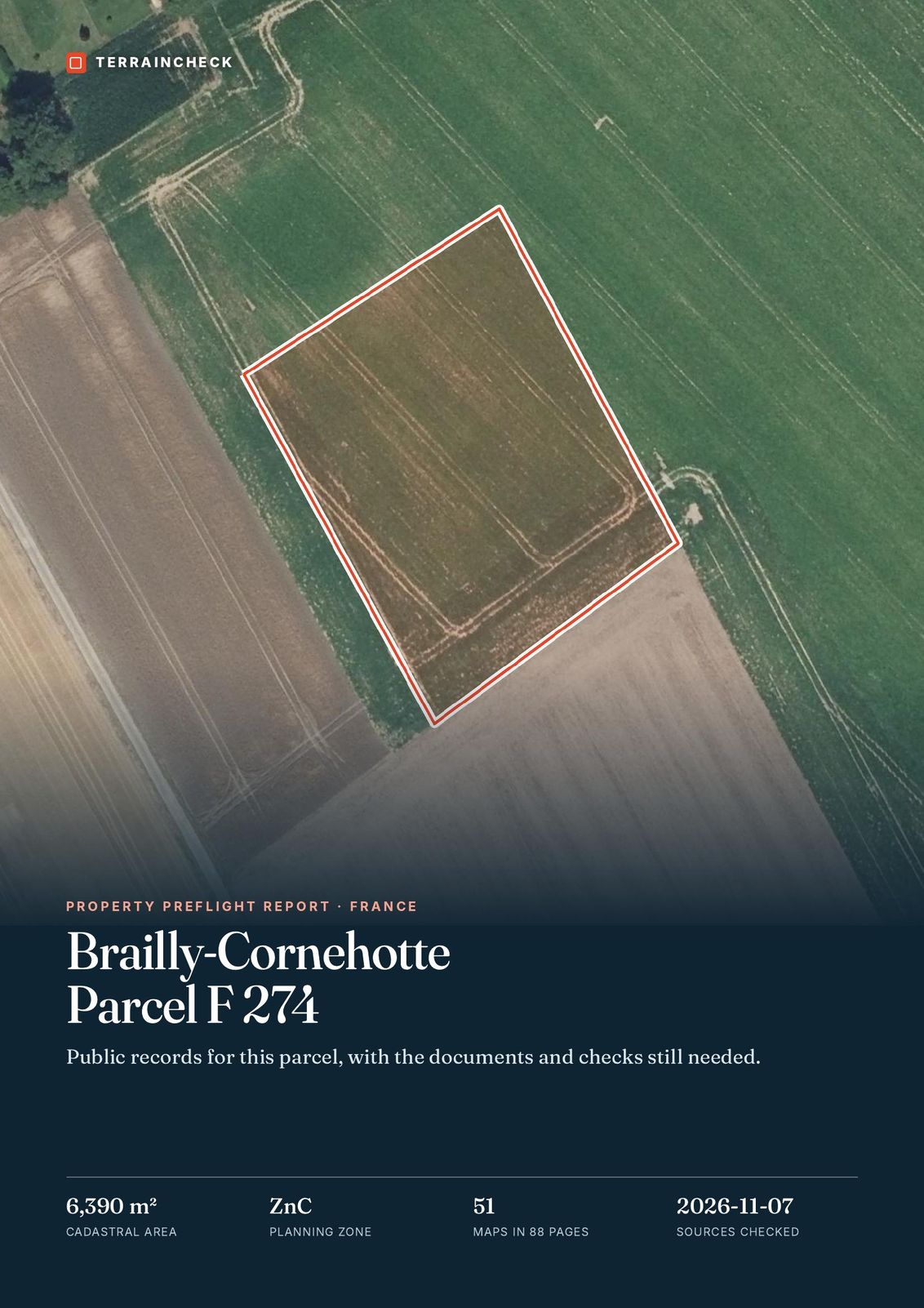
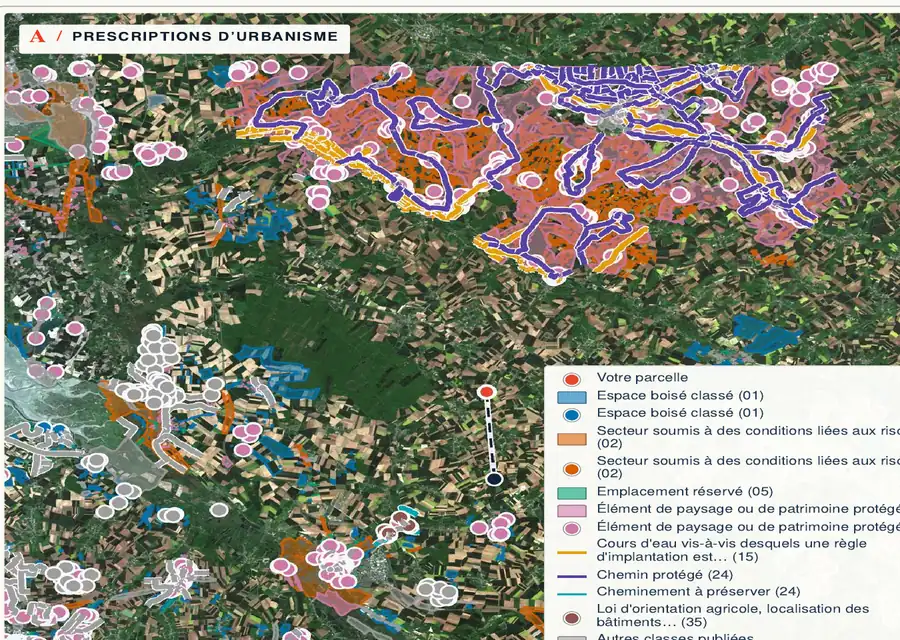
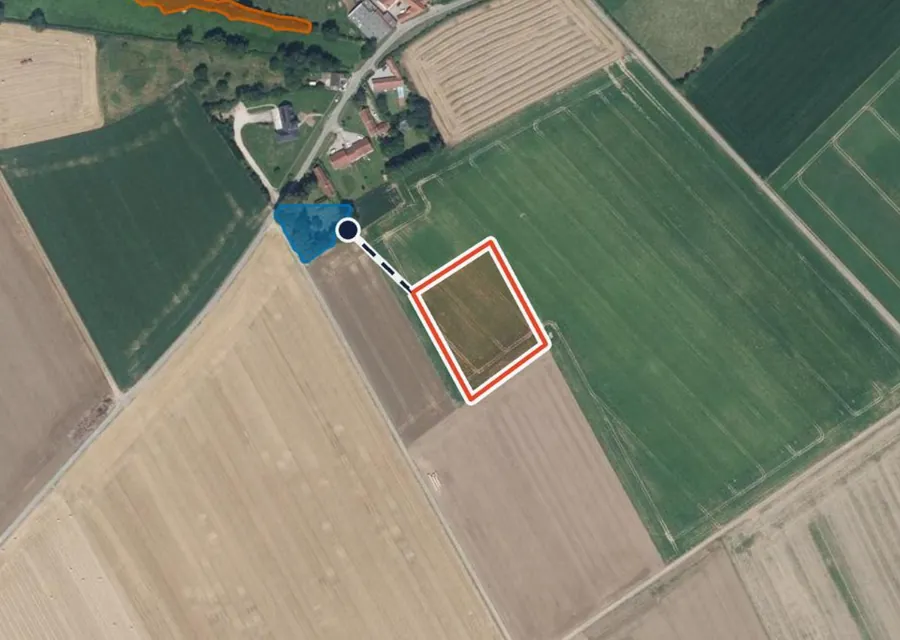
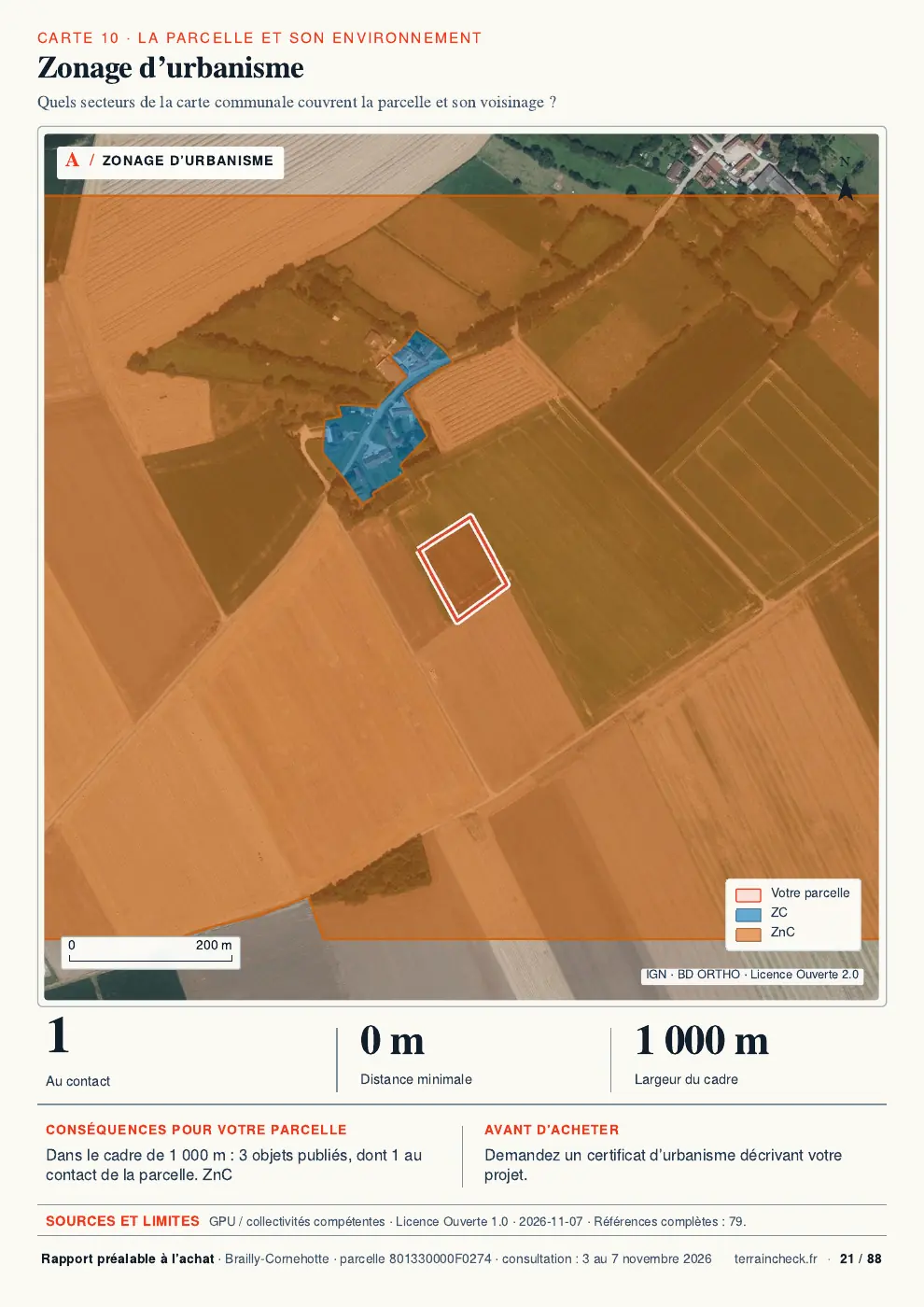
In the report: the zone and what it allows
Before buying non-buildable land
- Document and zone. Find the document in force (PLU, carte communale or, failing both, the national rules) and the zone or sector of the parcel on the Géoportail de l’urbanisme or at the town hall. Free; about ten minutes online (TerrainCheck estimate).
- Rules for your use. Read in the zone rules what is allowed for the intended structure: shed, fence, caravan, extension. Reading the PLU before buying explains the method. Allow an hour (TerrainCheck estimate).
- Price. Compare the asking price with regional farmland prices and with DVF sales of plots in the same zone. One to two hours (TerrainCheck estimate).
- Written answer. Ask the town hall for a planning certificate (certificat d’urbanisme), which is free: 1 month for an information certificate, 2 months for an operational one, counted from receipt of the application; valid for 18 months. See the planning certificate.
- Conditions in the pre-contract. Ask your notaire whether the compromis or promise should include a condition precedent tied to the town hall’s answer or to the consent you need. No time limit is set by the texts cited.
- Exact zone read in the planning document (PLU, carte communale or national rules), not in the listing.
- AU zone: open to development or not, and how far its internal works have got, with the town hall’s answer on file.
- Zone rules: shed, fence and access allowed or not.
- Planning certificate applied for (free; 1 month for an information certificate, 2 for an operational one).
- Price compared with regional farmland and nearby sales of plots in the same zone.
- Hazards: flooding, fire (brush clearance), easements.
- If the plan involves staying on the land, even part of the year: a written answer from the town hall.
Keep reading
Read the zone of your parcel before making an offer
Pick the parcel on the map. The report gives the zone or sector that covers it (PLU, carte communale or national rules), says what the document provides for that land, and names the source and date of each record. Free check, PDF report for €29 (€39 in French and English).